Acanthicus hystrix
L155 · Lyre Tail Pleco · Schwarze Elfenwels
Last revised 2026Edit this page
On this page12 sections
Quick factsEdit
Difficulty5 of 8 measures
Rated difficult because it needs a tank at least 2 m long.
- Space
- very large tank
- Water
- flexible
- Temp
- flexible
- Diet
- unknown
- Temperament
- territorial
- Social
- fine alone
- Compatibility
- unknown
Other demands
Each of these can raise the rating on its own, whatever the measures above say.
- Hardiness
- unknown
- Needs a tank at least 2 m long
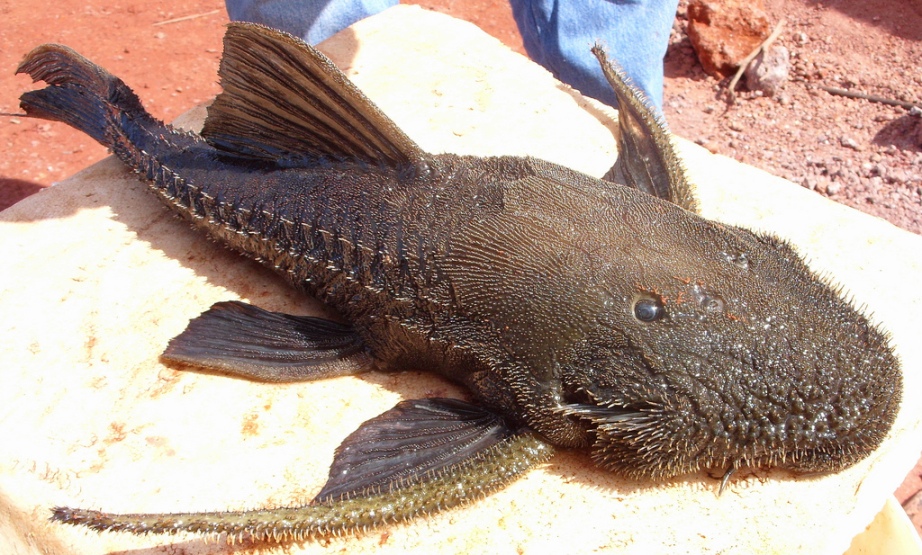
The lyre tail pleco, Acanthicus hystrix, is a very large loricariid catfish from the Amazon region of Brazil and Peru. A handful of records come from the Orinoco in Venezuela. Juveniles are traded in quite large numbers, but it can reach at least 1000 mm in nature and 500 to 600 mm in captivity, and becomes increasingly belligerent with age. Young fish are easily told from A. adonis by lacking its white to yellowish body spots.
Etymology
EditAcanthicus: from the Greek akánthinos (Gr. ἀκάνθινος), meaning 'thorny', in reference to the dorsal surface of the head being covered with erectile spines (odontodes) in type species A. hystrix.
hystrix: from the Greek hýstrix (Gr. ὕστριξ), meaning 'porcupine', in reference to the dorsal surface of the head being covered with erectile spines (odontodes).
Distribution
EditHabitat
Write a noteEditMostly inhabits slower-moving sections of rivers and tributaries and apparently often associated with human settlements.
Aquarium size
Write a noteEditFor an adult specimen aquarium base dimensions in excess of 600 ∗ 200 cm236 ∗ 79 in are required, meaning this species is largely unsuitable for private aquaria.
Maintenance
Write a noteEditPrefers dim lighting and access to refuges in the form of driftwood, large rocks or lengths of plastic piping. Juveniles can be kept in planted aquaria but adults are likely to consume or uproot any vegetation. An enormous filtration system and dedicated regime of water changes will also be required and maintenance of high dissolved oxygen levels is mandatory given the species' natural habitat and the fact that unlike some relatives it cannot respire atmospheric oxygen.
Water conditions
EditDiet
Write a noteEditThis species is a generalised detrivore, so offer a varied diet comprising dried, frozen and live foods including sinking tablets, wafers, slices of fruit and vegetables plus meatier fare such as bloodworm, earthworms, prawns, cockles and lancefish. In nature it is reputed to occur close to settlements and feed on human refuse/organic waste at some localities.
Growth may be inhibited if meal size and feeding frequency are insufficient. When purchasing loricariid catfishes, check that the belly and/or eyes do not appear sunken since these are typical signs of malnourishment.
These recommendations come from this profile’s own figures. They contain affiliate links, so we may earn a commission.
Behaviour and compatibility
Write a noteEditJuveniles tend to be quite peaceful but become more territorial and aggressive as they mature, meaning adults should be maintained singly and unless the aquarium is of public aquaria magnitude, in the absence of other substrate-dwellers. The most suitable tankmates are large, robust, pelagic fishes from genera such as Cichla, Osteoglossum, Brycon, Acestrorhynchus, etc.
Sexual dimorphism
Write a noteEditMales may develop more extensive odontal growth on the pectoral rays, cheeks and body and exhibit more territorial behaviour once sexually mature. The most reliable method is examination of the genital papilla, which in males is comparatively blunter in shape.
Reproduction
Write a noteEditAppears not to have been achieved in captivity thus far. Apparently a cave spawner with the male responsible for guarding and tending the eggs.
Notes
EditDespite its patent unsuitability as an aquarium subject attractively-coloured juvenile specimens of this species are traded in quite large numbers, although the scarcity of privately-maintained adults would suggest that most fail to reach their potential. Since it becomes increasingly belligerent with age it can only be recommended to owners of the largest private aquaria or tropical ponds. There exists an albino form which is available from time-to-time.
The genus Acanthicus currently comprises just two species but there exist a handful of undescribed ones, some of which have been exported for the aquarium hobby. Members are most easily characterised by lacking an adipose fin plus possessing extensive keels along the flanks as well as a greatly-extended pterotic-supracleithrum, a bony formation comprising fused pterotic, posttemporal, and supracleithrum bones and located just above the pectoral girdle. All are extremely spiny meaning extreme care should be taken when netting or otherwise handling them as they can easily become entangled in the mesh of aquarium nets or cause physical injury.
The two described taxa, A. adonis and A. hystrix, are easily distinguished when young since the latter lacks white to yellowish spots on the body. As adults they appear more similar although A. adonis tends to retain some degree of spotted patterning, most often on the fins or fin filaments.
The family Loricariidae is the largest among catfishes with over 700 species described to date and many awaiting description. The latter are typically assigned a specific 'L' number by hobbyists and scientists alike in order to provide a basic means of identification, although in some cases several species have been referred to the same number, or multiple numbers have been used for different populations of a single taxon. All loricariids are also commonly referred to as 'pleco', 'plecostomus' or 'suckermouth armoured catfishes'.
The closer relationships of member genera have long been of interest to icthyologists but in numerous cases remain unresolved. Isbrücker (1980) was the first to propose an arrangement of six subfamilies, namely Lithogeneinae, Neoplecostominae, Hypostominae, Ancistrinae, Hypoptopomatinae and Loricariinae, and this model was generally followed until publication of Armbruster's morphological analysis in 2004. His phylogeny also contained six subfamiles, with Isbrücker’s (1980) Ancistrinae being included as one of five tribes comprising Hypostominae. This was later modified slightly by Reis et al. (2006) and an adapted version of their key is reproduced here:
1a. No lateral and dorsal plates anterior to the dorsal fin: Lithogeneinae
1b. Possession of lateral plates anterior to the dorsal fin (except in Pareioraphis nudulus): 2
2a. Ventral surface of the pectoral girdle exposed (i.e. supporting odontodes) towards the centre of the coracoid strut: Hypoptopomatinae
2b. Ventral surface of the pectoral girdle covered in skin or plates towards the centre of the coracoid strut (odontodes supported by the plates rather than the girdle): 3
3a. Caudal peduncle flattened dorsoventrally; no adipose fin: Loricariinae
3b. Caudal peduncle oval, round, or triangular in cross-section; adipose fin usually present: 4
4a. Postdorsal ridge formed from several preadipose plates arranged singly. Teeth almost symmetrically bifid (divided into two equal parts): Delturinae
4b. Usually no postdorsal ridge. Teeth asymmetrical or unicuspid: 5
5a. Dorsal-fin spinelet V-shaped, dorsal-fin spine can be locked: Hypostominae
5b. Dorsal-fin spinelet rectangular or absent, dorsal-fin spine cannot be locked: Neoplecostominae
Subsequent papers attempting to resolve relationships within the Hypoptopomatinae and Neoplecostominae by Cramer et al. (2008, 2010) have revealed both subfamiles to be polyphyletic arrangements alongside several genera e.g. Pareiorhaphis, Pareiorhina, Hisonotus and Parotocinclus, so there is evidently a great deal of work still to be done. At any rate Acanthicus is currently considered a member of the tribe Ancistrini within Hypostominae and most closely-related to Leporacanthicus, Megalancistrus and Pseudacanthicus.
The sucking disc formed by the mouthparts is common to all representatives but both oral and dental morphology are highly variable depending on a given species' ecological adaptation(s). and some species even practice xylophagy (wood eating). Many species are also facultative air-breathers i.e. they possess the ability to respire atmospheric air if necessary.
Species images · 12


These photographs are used with each photographer's permission.
Send a photographDistribution
Profile completeness21 of 24
88% complete
Also missing: water condition notes.
Community
Questions about Acanthicus hystrix?
Ask on Discord