Sahyadria denisonii
Red-line Torpedo Barb
Formerly Labeo denisonii Day, 1865 · Barbus denisonii Day, 1865 · Crossocheilus denisonii Day, 1865 · Puntius denisonii Day, 1865
Last revised 2015Edit this page
On this page13 sections
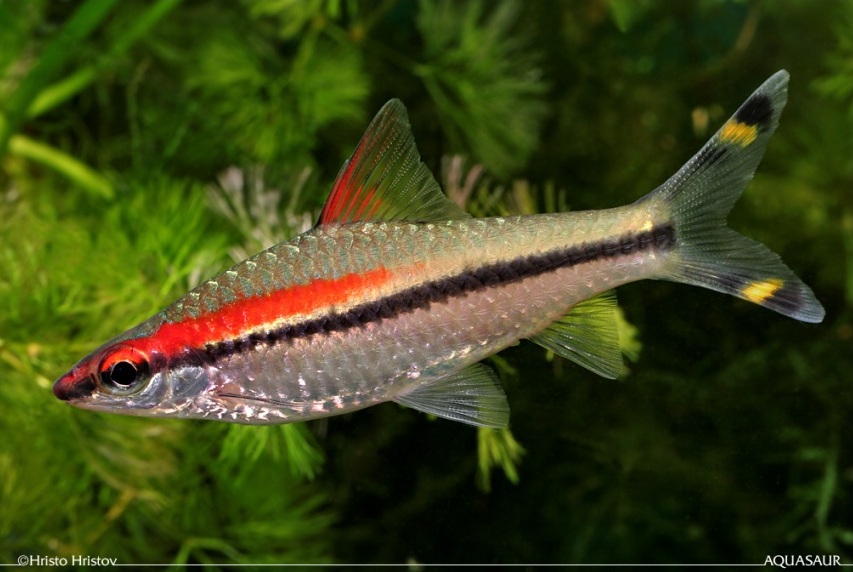
Quick factsEdit
Difficulty7 of 8 measures
Rated moderate because it needs a well-established tank and stable water.
- Space
- large tank
- Water
- flexible
- Temp
- flexible
- Diet
- unknown
- Temperament
- peaceful
- Social
- needs to be in a group
- Compatibility
- fine with others
Other demands
Each of these can raise the rating on its own, whatever the measures above say.
- Hardiness
- needs a well-established tank
The red-line torpedo barb, Sahyadria denisonii, is a cyprinid endemic to Kerala and Karnataka in southern India. Extremely popular since it appeared in the trade in the late 1990s, it is listed as Endangered by the IUCN, and collection for the aquarium trade has been held largely responsible for its decline. Large numbers are produced in Southeast Asia and Eastern Europe. The similar S. chalakkudiensis is occasionally traded as this species and is more belligerent.
Etymology
EditSahyadria: named after Sahyadri, noun, a vernacular name for the Western Ghats mountain ranges.
denisonii: named for Sir William Thomas Denison (1804-1871), governor of Madras, India, from 1861-1866.
Distribution
EditEndemic to the states of Kerala and Karnataka in southern India.
Its modern distribution is highly fragmented with small populations remaining in the Valapatanam, Chaliyar, Kallar, Karyangod, Kuttiyadi, Chandragiri, Sullya, Kuppam, Iritti, Anjarakandipuzha, Bhavani, and Bharatapuzha river systems.
Historical records from the Chalakudy, Periyar, Pamba, and Achankovil river systems are now considered to represent S. chalakkudiensis.
Type locality is 'Mundakayam, Travancore, India', which appears to correspond to the Manimala River near the town of Mundakayam in Kottayam District, Kerala state, southern India.
Habitat
Write a noteEditA stream and river-dwelling species most often found in pristine, highly-oxygenated headwaters and upper parts of river basins where it typically congregates in rocky pools with dense riparian vegetation. It is supposedly more active at dusk and dawn than during daylight hours.
Aquarium size
Write a noteEditBase dimensions of at least 120 ∗ 45 cm48 ∗ 18 in or equivalent are required.
Maintenance
Write a noteEditNot difficult to keep in a well-maintained set-up, and does not tend to harm aquatic plants.
Since it naturally occurs in pristine habitats it is intolerant to accumulation of organic pollutants and requires more-or-less spotless water in order to thrive. It also does best if there is a high proportion of dissolved oxygen and moderate water movement, and weekly water changes of 30-50% tank volume should be considered routine.
Water conditions
EditThese recommendations come from this profile’s own figures. They contain affiliate links, so we may earn a commission.
Diet
Write a noteEditWild fish on a variety of worms, insects, crustaceans, plant material, and other organic debris.
In the aquarium it is easily-fed but a balanced diet comprising regular meals of small live and frozen foods such as chironomid larvae (bloodworm), Daphnia, and Artemia alongside good quality dried products will being about optimal condition and colours. Sinking foods are best.
It is said that the red pigmentation can be intensified by feeding a diet rich in carotenoids such as astaxanthin.
Behaviour and compatibility
Write a noteEditGenerally peaceful making it an ideal resident of the well-researched community aquarium.
It is a schooling species by nature, and at least 6-10 specimens should be purchased.
The similar-looking S. chalakkudiensis is occasionally traded as S. denisonii (see 'Notes') and is known to be more belligerent.
Sexual dimorphism
Write a noteEditAdult females tend to grow a little larger, are heavier-bodied, and a little less colourful than males.
Reproduction
Write a noteEditLarge numbers are produced for the aquarium hobby in Southeast Asia and Eastern Europe, presumably via stimulation with hormones.
A 2011 study of its reproductive biology revealed that the sex ratio in wild fish appears skewed in favour of males and that absolute fecundity, i.e., the total number of eggs per female at a given point in time, is relatively low compared with some relatives such as Systomus sarana or Rasbora daniconius. Such factors, combined with habitat degradation via pollution or alteration, are likely to have an adverse effect on natural recruitment while affecting population dynamics and potentially leading to a reduced number of individuals in a given population.
In terms of private success at least one report of 'accidental' reproduction exists, in which a couple of fry were discovered hiding among plants during aquarium maintenance.
A more detailed report was published in the German magazine Aqualog in 2005. In this case a group of 15 adults spawned in soft, acidic water (gH 2-3/pH 5.7), depositing their eggs in a clump of Java moss (Taxiphylum barbieri). Apparently several of the adults exhibited a colour change with the dorsal surface becoming bluish, and the event appeared to be triggered by a gradual lowering of the pH via addition of driftwood.
Chester Zoo Aquarium in England have also reported successful breeding, and their theory is that a large group is needed as spawning is hypothesised to occur en masse.
Notes
EditThis species has become an extremely popular aquarium fish since it first appeared in the ornamental trade during the late 1990s, and it has been sold under various names including 'Denison's barb', 'denisoni barb', 'Denison's flying fox', 'rose line shark', 'bleeding-eye barb', 'red flash barb', and 'Indian flasher barb'. In India it is known locally as 'Miss Kerala' and 'Chorai Kanni' ( literally 'bleeding eyes').
It has been artificially hybridised with a member of the genus Dawkinsia (R. Collins, pers. comm.) and a selectively-bred 'gold' colour form has also been produced.
During the 2000s it was the Indian state of Kerala's most important export but collection of wild fish is now prohibited to an extent. Both S. denisonii and S. chalakkudiensis are listed as ‘Endangered’ in the IUCN Red List of Threatened Species, and wild stocks may have dwindled by as much as 50% in the last 15 years or so. Collection for the aquarium trade has been held largely responsible, although habitats are also being degraded by pollution from agricultural and domestic sources, plus destructive fishing methods involving explosives or organic toxins.
In 2011 the 'closed season' for collection was June, July, and October, based on the assumption that spawning takes place during these months, but Solomon et al. (2011) demonstrated that breeding occurs from October to March and collection should instead be prohibited between these months in order to adequately protect populations.
S. denisonii was described as a member of the genus Labeo and has also been placed in Barbus, Crossocheilus and most recently Puntius. The latter was formerly a polyphyletic catch-all which contained over 100 species, although this situation has been largely resolved since the turn of the century.
Sahyadria was raised by Raghavan et al. (2013) in order to accommodate S. denisonii and its only congener S. chalakkudiensis. The genus is diagnosed by the following combination of characters: adult size 85 – 190 mm3.3 – 7 in SL; a single pair of maxillary barbels; dorsal fin with 3-4 unbranched and eight branched rays, posterior branched ray sometimes bifurcate at the base giving the appearance of a 9th branched ray, posterior unbranched ray weak, segmented apically, unserrated; anal fin with 2-3 unbranched and five branched rays; lateral line complete, with 26–28 pored scales; free uroneural absent; gill rakers simple, acuminate, arranged in two rows with 12 and 18 rakers respectively; antrorse predorsal ray absent; post-epiphysial fontanelle absent: 5 supraneurals; infraorbital IO3 slender, not overlapping preoperculum; 5+3+2 pharyngeal teeth; 16 abdominal and 11 caudal vertebrae; colour pattern comprising an upper scarlet stripe extending from snout to midbody, a wide blackish lateral stripe extending along the lateral line from snout to caudal-fin base, a yellow stripe extending from the operculum to the hypural region between the black and scarlet stripes, caudal fin lobes with oblique black bands covering the posterior quarter and subterminal oblique yellow bands, dorsal fin with or without a black blotch: juveniles with scarlet pigmentation on the anterior dorsal-fin rays.
S. denisonii can be told apart from S. chalakkudiensis by possession of a subterminal mouth (vs. inferior), absence of a black marking in the dorsal-fin (vs. presence), and the scarlet body stripe being brighter and terminating beneath the centre of the dorsal-fin (vs. duller and terminates beneath or anterior to dorsal-fin origin).
References
- Pethiyagoda, R. (2013). Haludaria, a replacement generic name for Dravidia (Teleostei: Cyprinidae). Zootaxa 3646(2), 199
- Day, F. (1865). On the fishes of Cochin, on the Malabar Coast of India. Part II. Anacanthini. Proceedings of the Zoological Society of London 1865 (pt 1), 286-318
- Menon, A. G. K., K. Rema Devi, and M. P. Thobias (1999). Puntius chalakkudiensis, a new colourful species of Puntius (Family: Cyprinidae) fish from Kerala, south India. Records of the Zoological Survey of India 97(4), 61-63
- Baby, F., J. Tharian, S. Philip, A. Ali, and R. Raghavan (2011). Checklist of the fishes of the Achankovil forests, Kerala, India with notes on the range extension of an endemic cyprinid Puntius chalakkudiensis. Journal of Threatened Taxa 3(7), 1936-1941
- Raghavan, R., G. Prasad, B. Pereira, P. H. Anvar Ali, and L. Sujarittanonta (2009). ‘Damsel in distress’ - The tale of Miss Kerala, Puntius denisonii (Day), an endemic and endangered cyprinid of the Western Ghats biodiversity hotspot (South India). Aquatic Conservation: Marine and Freshwater Ecosystems 19, 67-74
- Pethiyagoda, R., M. Meegaskumbura, and K. Maduwage (2012). A synopsis of the South Asian fishes referred to Puntius (Pisces: Cyprinidae). Ichthyological Exploration of Freshwaters 23(1), 69-95
- Raghavan, R., S. Philip, A. Ali and N. Dahanukar (2013). Sahyadria, a new genus of barbs (Teleostei: Cyprinidae) from Western Ghats of India. Journal of Threatened Taxa 5(15), 4932-4938
Species images · 11


These photographs are used with each photographer’s permission.
Send a photograph