Results for “aquarium”
Type a name: scientific, common, or one a species used to go by. Or narrow the catalogue with the filters.
Filters
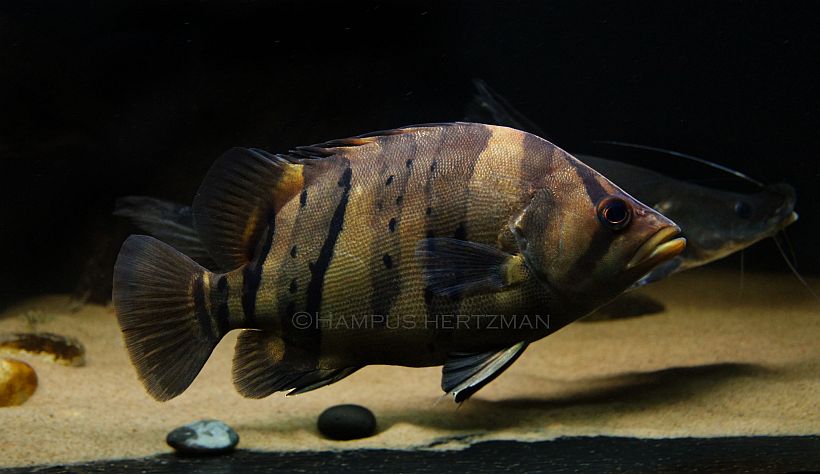
Datnioides microlepisIndonesian Tiger Perch
Bleeker, 1854
Max length500mm SL20in SLTanknot recordedTemp20–28°C68–82°FpH5.5–7.5In aquarium literature this species is also referred to as 'fine scaled tiger fish', 'Indonesian tiger fish', 'Sumatran tiger fish', 'Indo datnoid', and 'Indo dat'. The common name of 'tiger fish' is also used in reference to the African alestid genus Hydrocynus, and the more appropriate 'tiger perch' was suggested by Roberts and Kottelat (1994).
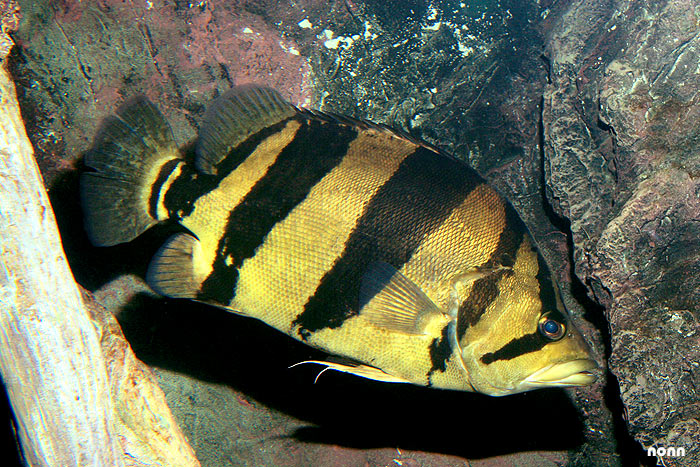
Datnioides pulcherSiamese Tiger Perch
Kottelat, 1998
Max length400mm SL16in SLTanknot recordedTemp20–28°C68–82°FpH5.5–7.5The massive decline in wild populations, hypothesised to be in excess of 90% since the mid-1980s, is thought to have been caused by a variety of factors, including habitat alteration due to construction of dams and other infrastructure, removal of riparian vegetation, and urban pollution, plus over fishing for both human consumption and the aquarium trade.
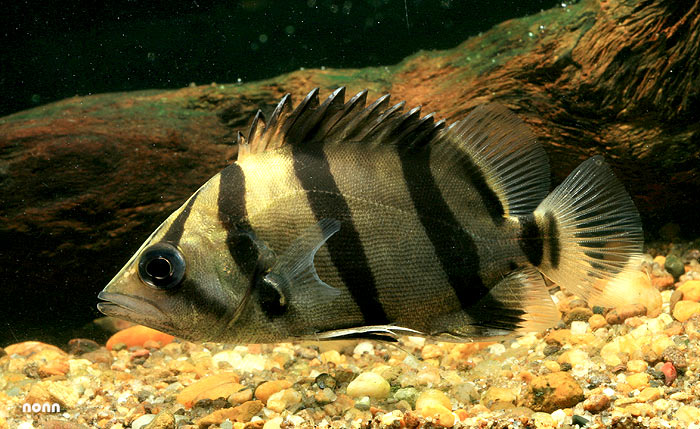
Datnioides undecimradiatusMekong Tiger Perch
Roberts & Kottelat, 1994
Max length300mm SL12in SLTank180 × 60cm72 × 24inTemp20–28°C68–82°FpH5.5–7.5An efficient, largely piscivorous, predator with highly protrusible mouthparts. In the aquarium, juveniles can be offered chironomid larvae (bloodworm), small earthworms, chopped prawn, and suchlike, while adults will accept strips of fish flesh, whole prawns, mussels, live river shrimp, larger earthworms, etc. Older individuals do not require feeding on a daily basis, with 2-3 times per week sufficient.
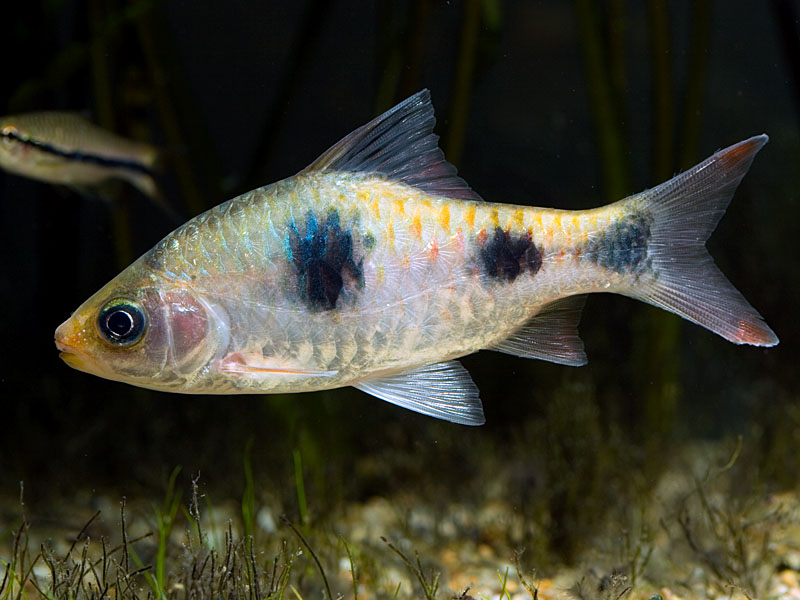
Dawkinsia rubrotinctus
Jerdon, 1849
Max length90mm SL3.5in SLTank120 × 45cm48 × 18inTemp18–25°C64–77°FpH6.0–7.5This species may have appeared in the aquarium trade under the misapplied names Puntius arulius or P. tambraparniei in the past, both of which are also now classified within Dawkinsia. See the relevant profiles for D. arulius and D. tambraparniei for additional information regarding that confusion, since here we concentrate on D. rubrotinctus. It was initially described by Jerdon in 1849 but placed in synonymy with P. arulius by Day (1878), where it remained for ov...
Desmopuntius endecanalis
Roberts, 1989
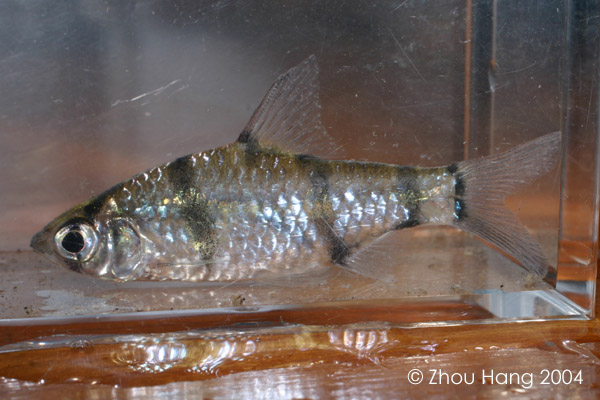
Max length50mm SL2.0in SLTank75 × 30cm30 × 12inTemp19–26°C66–79°FpH4.0–7.0Probably a micropredator feeding on small insects, worms, crustaceans and other zooplankton in nature. In the aquarium it will accept dried foods of a suitable size but should not be fed these exclusively. Daily meals of small live and frozen fare such as Daphnia, Artemia, and suchlike will result in the best colouration and encourage the fish to come into breeding condition. It's a schooling species by natur...
Desmopuntius pentazonaFive-banded Barb
Boulenger, 1894
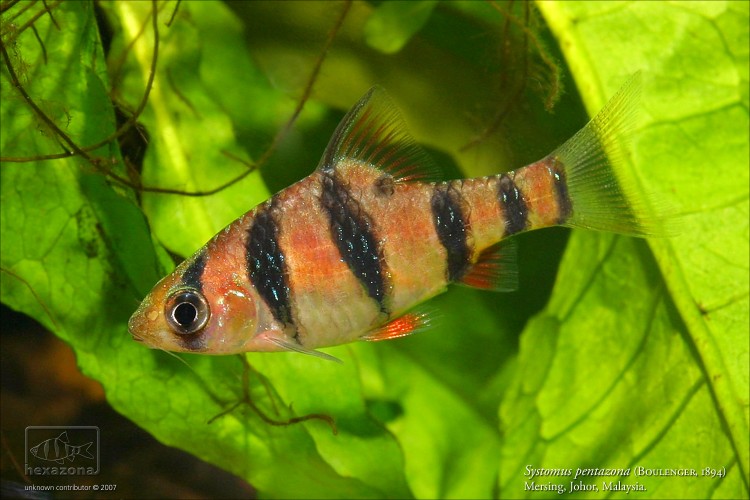
Max length55mm SL2.2in SLTank80 × 30cm31 × 12inTemp21–26°C70–79°FpH4.0–7.0This species is rare in the aquarium trade with the majority of fish available under the name or the vernacular 'pentazona barb' being the closely-related D. hexazona. The two are almost identical in terms of both appearance and meristics but can be separated by the fact that D. pentazona possesses a small dark marking at the posterior base of the dorsal-fin which is absent in D. hexazona.
Devario devarioBengal Danio
Hamilton, 1822
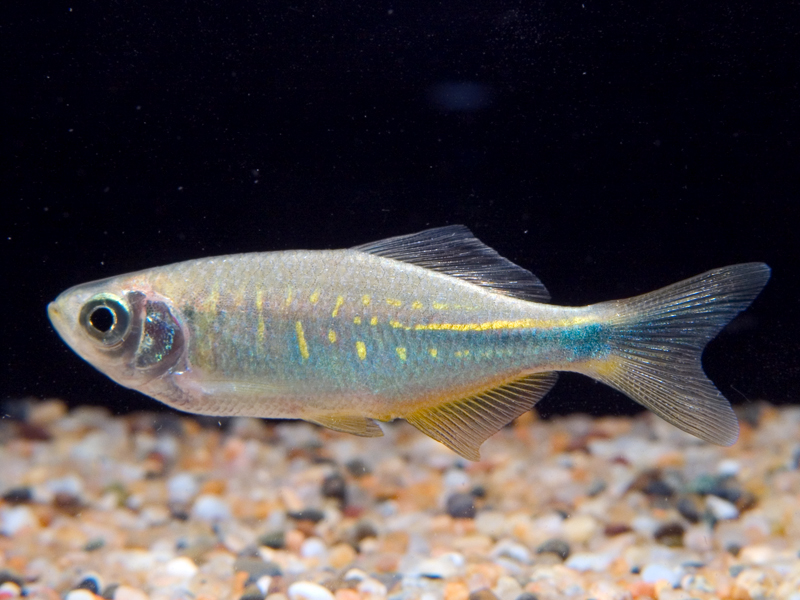
Max length80mm SL3.1in SLTank120 × 45cm48 × 18inTemp15–26°C59–79°FpH6.0–8.0Ecological studies have revealed this species to be more of a generalist than its chiefly insectivorous congeners. Aquatic and terrestrial insects form a significant proportion of the diet, but substantial amounts of filamentous algae and diatoms are consumed with water mites, fish scales, isopods, nematodes and detritus also taken occasionally. In the aquarium it's largely unfu...
Devario sp. 'purple cypris'
authority not recorded
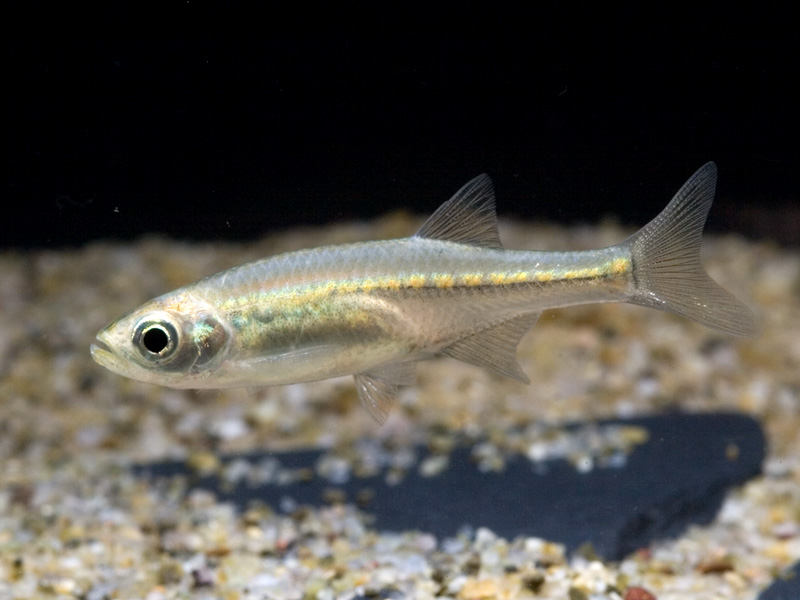
Max length45mm SL1.8in SLTank75 × 30cm30 × 12inTempnot recordedpHnot recordedThis unidentified species has only appeared in the aquarium trade on a handful of occasions and it has been widely misidentified as Devario jayarami (Barman, 1984). It differs from D. jayarami by possessing 9-10 lateral bars which progressively increase in size posteriorly (vs. 12-13 bars which decrease in size posteriorly), 12 anal-fin rays (vs. 15-16) and a blunter head profile with a lack of convexity behind the head (vs. head profile conical with noticeable convexity behind the head).
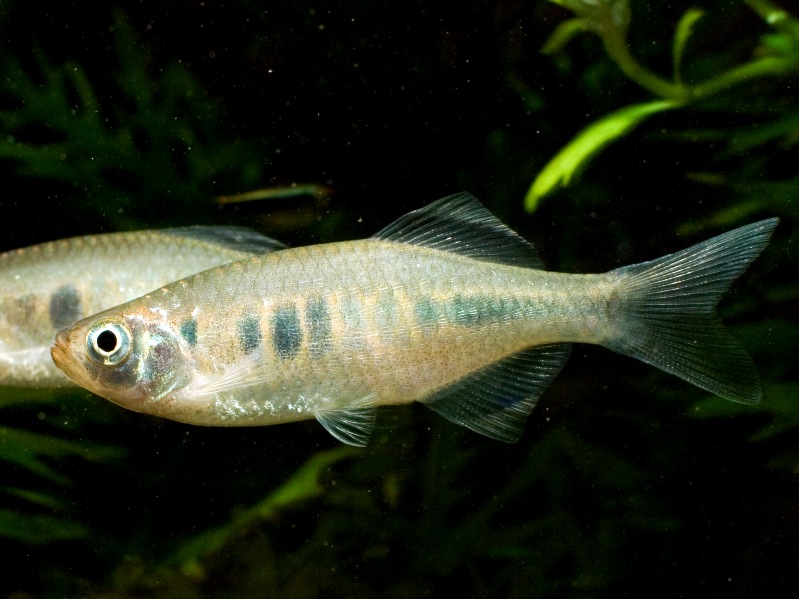
Devario xyropsBlue Moon 'Danio'
Fang & Kullander, 2009
Max length80mm SL3.1in SLTank120 × 45cm48 × 18inTemp18–26°C64–79°FpH6.0–8.0Thrives in an aquarium set up to resemble a flowing stream or river with a substrate of variably-sized, water-worn rocks, sand, fine gravel and perhaps some small boulders. This can be further furnished with driftwood roots or branches, and while the majority of aquatic plants will fail to thrive in such surroundings hardy types such as Microsorum, Bolbitis or Anubias spp. can be grown attached to the décor.
Epalzeorhynchos munense
Smith, 1934
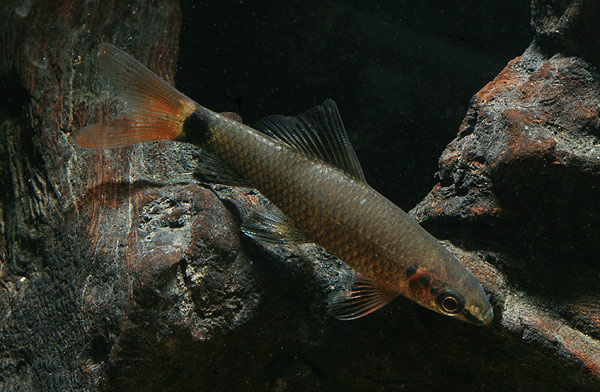
Max length120mm SL5in SLTank120 × 45cm48 × 18inTemp20–26°C68–79°FpH6.5–7.5This species does not appear to be in the aquarium hobby at time of writing though it may have been in the past, when exports of wild Epalzeorhynchos spp. still took place. Most members of the genus were formerly regarded as Labeo spp. and are thus referred to as such in older literature. According to Rainboth (1996) they're characterised by absence of a dorsal spine, possession of 10-13 branched dorsal fin rays, a thin membrane...
Esmaeilius arakensisArak Toothcarp
Teimori, Esmaeili, Gholami, Zarei, & Reichenbacher, 2012
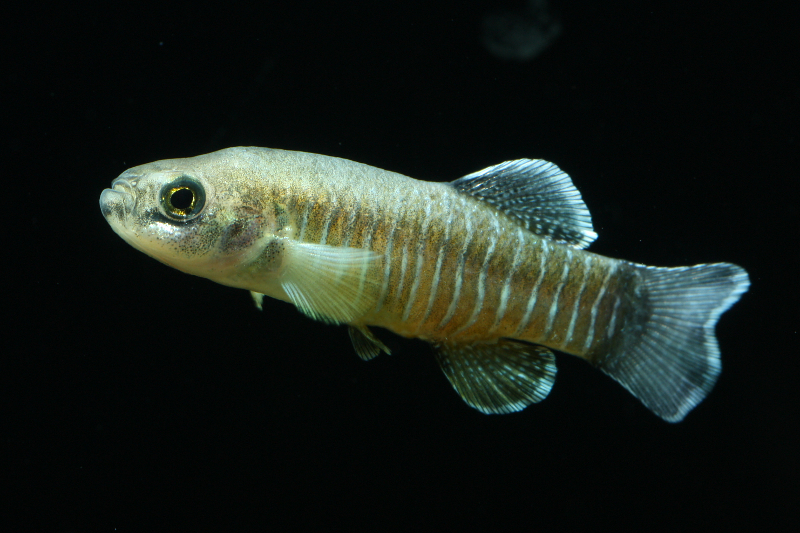
Max length35mm SL1.4in SLTank120 × 30cm48 × 12inTemp8–32°C46–90°FpH7.0–8.5This species was available in the aquarium hobby for a number of years prior to publication of the official description and was generally referred to as A. sp. 'Namak' or A. sp. 'Namak River'. It can be distinguished from other members of the genus by the following combination of characters: 10–12 anal-fin rays; 28–32 lateral line scales, 10–13 caudal peduncle scales; 8–10 gill rakers; 12–19, commonly 1...
Esomus metallicusStriped Flying Barb
Ahl, 1923
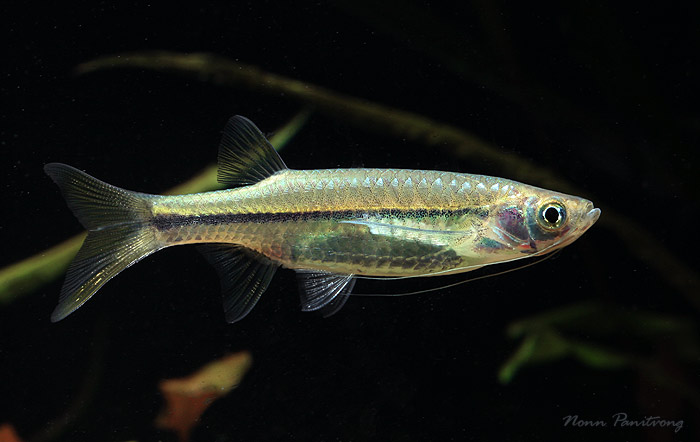
Max length75mm SL3.0in SLTank120 × 30cm48 × 12inTemp20–26°C68–79°FpH6.0–7.0There currently exist a dozen described Esomus spp. alhough few are seen in the aquarium trade and none are especially popular. Most are commonplace in their native countries and also quite plainly-patterned so generally overlooked by collectors. Their most common use in some areas is actually as a feeder fish in the aquaculture of larger species. They're characterised by greatly-enlarged pectoral fins and two pairs of barbels, of which the maxillary pair are extremely long and usually reach the pectoral fins.
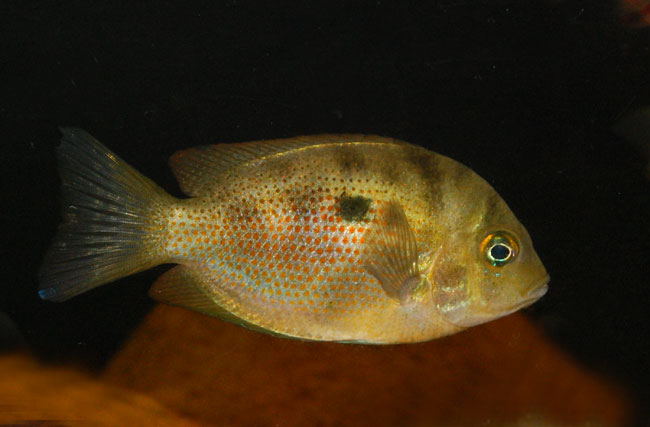
Etroplus maculatusOrange Chromide
Bloch, 1795
Max length80mm SL3.1in SLTank120 × 60cm48 × 24inTemp20–28°C68–82°FpH7.0–8.5Wild examples are rarely-seen in the aquarium hobby although selectively-bred ornamental strains are widely-available for which care is identical. These are normally traded as 'red' or 'yellow' chromide and have a solid yellow-orange colour pattern with no dark elements. It exhibits a widespread sympatry with the con...
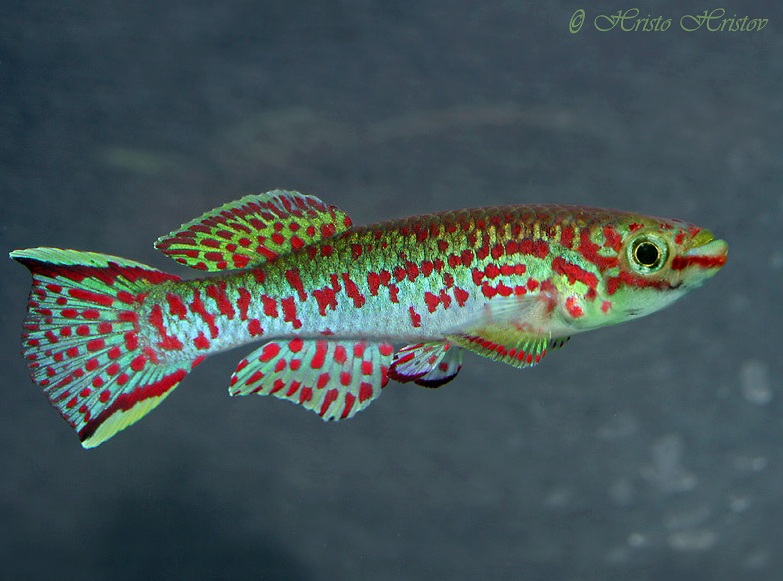
Fundulopanchax gardneriSteel-blue Killifish
Boulenger, 1911
Max length55mm SL2.2in SLTanknot recordedTemp20–26°C68–79°FpH6.0–7.5This species is also known as 'Gardner's Killi' and 'blue lyretail' and the commonly-available aquarium forms are perhaps among the best choices for those new to keeping killifishes being relatively hardy, colourful and easy to breed. A number of ornamental strains have also been line-bred by aquarists including 'gold' and 'albino'.
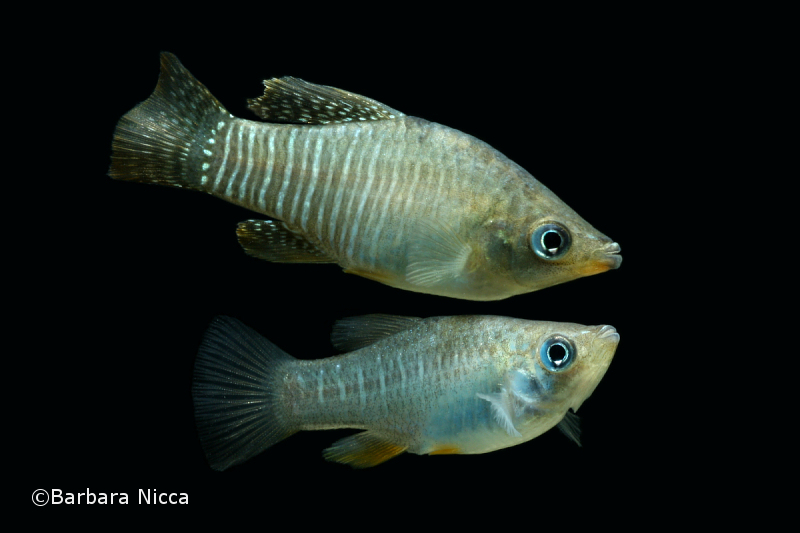
Fundulus xenicusDiamond Killifish
Jordan & Gilbert, 1882
Max length50mm SL2.0in SLTanknot recordedTemp21–35°C70–95°FpH7.5–9.0This species is not a common aquarium species but is occasionally available from specialist retailers or breeders. It was initially named Adinia multifasciata by Girard (1859) before later being redescribed as Fundulus xenicus (mispelled 'Fundnlus') by Jordan and Gilbert (1882). Body stout and trapezoidal in adults, body depth usually 2 to 3 times in standard length; scales large, fewer than 30 scales along midlateral scale row...
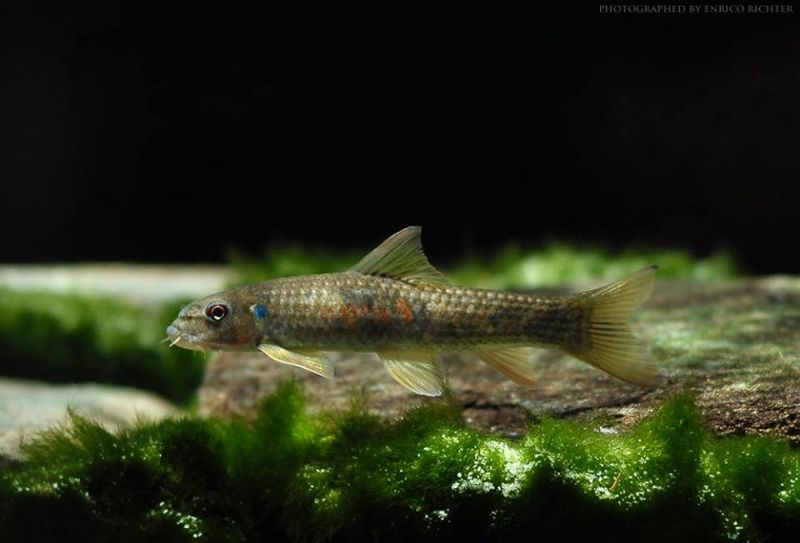
Garra rufaDoctor Fish
Heckel, 1843
Max length120mm SL5in SLTank120 × 45cm48 × 18inTemp14–20°C57–68°FpH6.0–8.0Fish referred to as G. rufa are marketed worldwide as 'doctor fish', with the questionable ability to remove dead and scaly skin and ease complaints such as psoriasis. These fish are quite commonly available in the aquarium trade as well, although in both cases it is unclear whether they represent G. rufa or another, related species.
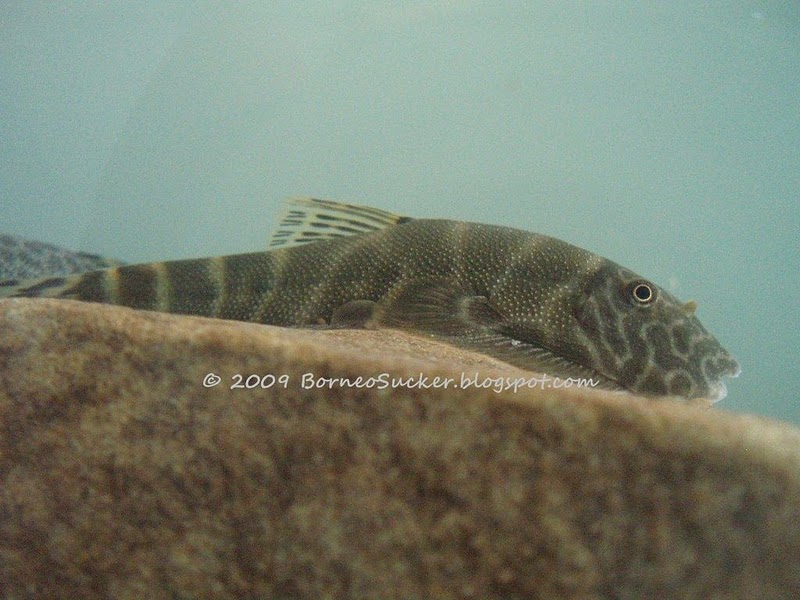
Gastromyzon extrorsus
Tan, 2006
Max length80mm SL3.1in SLTank75 × 30cm30 × 12inTemp20–24°C68–75°FpH6.0–8.0This species has probably not been seen in the aquarium trade yet but has been maintained by a few private collectors. It can be distinguished from congeners by the following combination of characters: secondary rostrum present; complete postoral pouch present; body colour brown with up to 9 thin gold stripes; head dorsum dark brown with gold reticulate pattern; subopercular groove absent; gill slit vertical; sublacrymal groove present; sno...
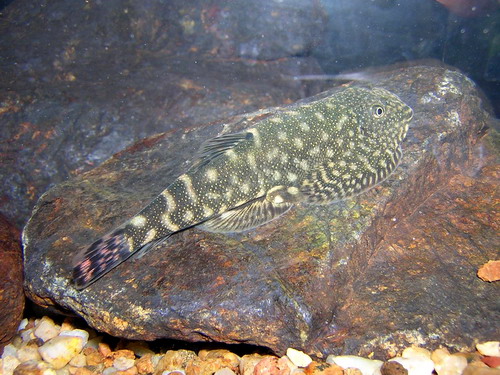
Gastromyzon sp. 'SK01'
authority not recorded
Max length50mm SL2.0in SLTank60 × 30cm24 × 12inTemp20–24°C68–75°FpH6.5–8.0This undescribed species has probably not been seen in the aquarium trade yet but is occasionally maintained private collectors. The 'SK' numbering system used here refers to 'South Kalimantan', home to several unidentified members of the genus. Gastromyzon spp. are placed into various 'species groups' (artificial assemblages of species which may or may not be monophyletic) for ease of reference, and based on colour and patterning G. sp. 'SK01' appears similar to members of the G. ridens group which also includes G. crenastus, G. stellatus and G. zebrinus.
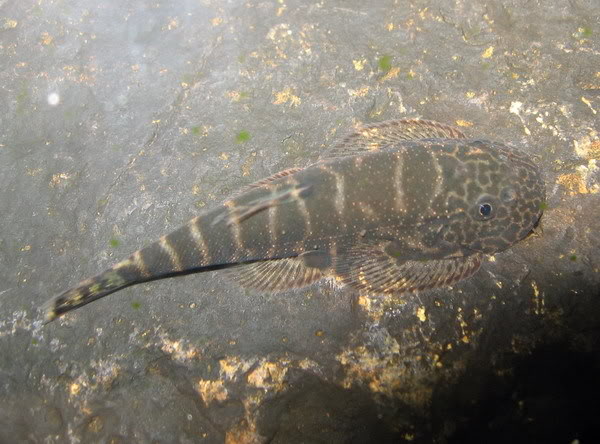
Gastromyzon sp. 'SK04'
authority not recorded
Max length65mm SL2.6in SLTank75 × 30cm30 × 12inTemp20–24°C68–75°FpH6.5–8.0For long-term success it's best to provide a mature aquarium with a plentiful supply of algae-covered rocks and other surfaces. If unable to grow sufficient algae in the main tank or you have a community containing numerous herbivorous fishes which consume what's available quickly it may be necessary to maintain a separate tank in which to grow algae on rocks and switch them with those in the main tank on a cyclical basis.
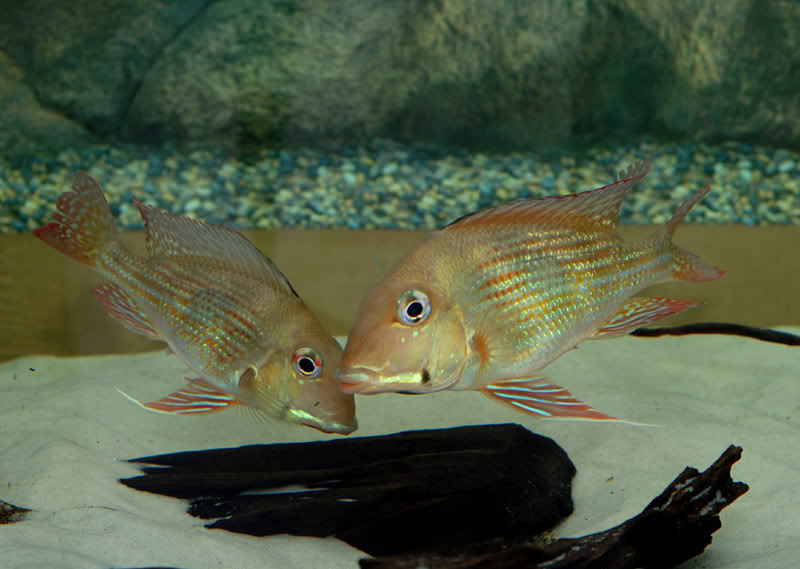
Geophagus brachybranchus
Kullander & Nijssen, 1989
Max length200mm SL8in SLTank180 × 60cm72 × 24inTemp26–30°C79–86°FpH5.0–7.0This species is generally rare in the aquarium hobby though oddly appears to be one of the commoner species in Australia where it's often referred to by the vernacular name 'black-throated eartheater'. It's a member of the nominal G. surinamensis 'group' of closely-related species within the genus and can be identified by a combination of characters including: presence of dark preopercular markings; no vertical bars on the flanks even when stressed/preserved; base of filaments on the first gill arch mostly covered by a flap of skin; exposed part of bra...