Results for “vernacular name”
Type a name: scientific, common, or one a species used to go by. Or narrow the catalogue with the filters.
Filters
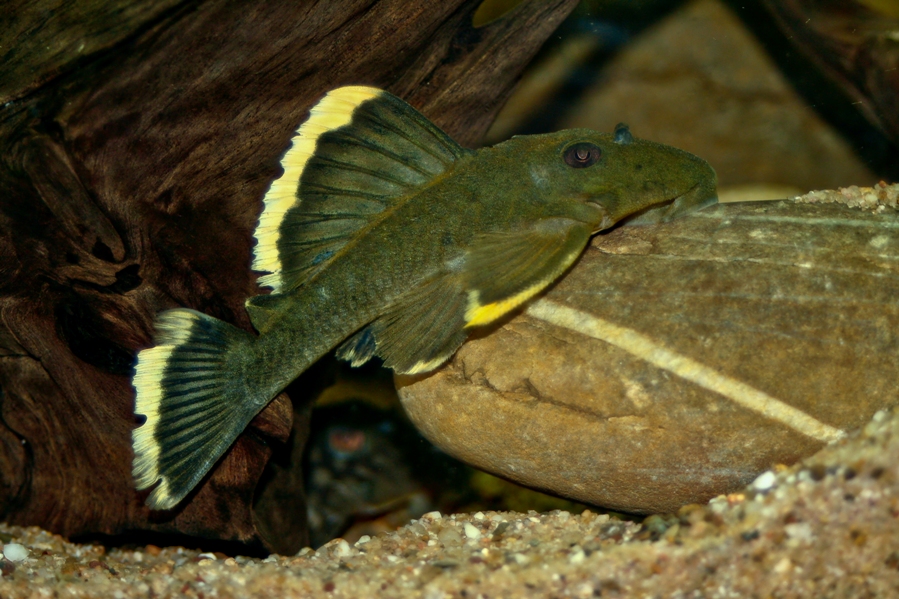
Baryancistrus chrysolomusMango Pleco
Rapp Py-Daniel, Zuanon & Ribeiro de Oliveira, 2011
Max length219mm SL9in SLTank120 × 45cm48 × 18inTemp27–32°C81–90°FpH6.0–7.5Prior to description this species was traded under the DATZ code L047 or the alternative vernacular name 'magnum pleco'. It can be distinguished from congeners by a combination of the following characters: presence of a broad, light-coloured (usually yellowish) distal band on the dorsal and caudal fins throughout life, slightly reduced in adults. The only other member of the genus to possess such bands is B. xanthellus but in that species they are reduced to small markings at the fin tips in adults, and the body is covered in pale, normally yellowish, spots.
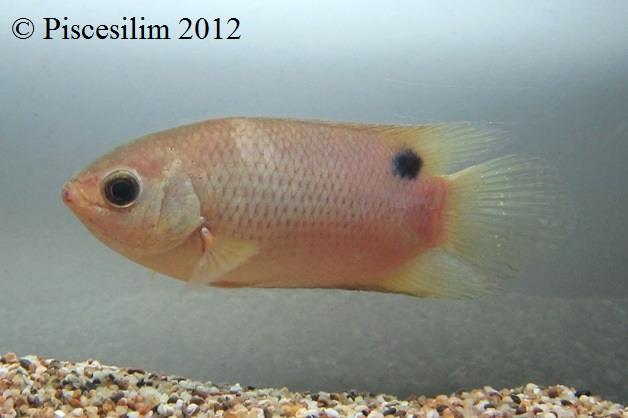
Belontia hasseltiJava Combtail
Cuvier, 1831
Max length200mm SL8in SLTank120 × 30cm48 × 12inTemp21–26°C70–79°FpH4.5–8.5This species is also referred to by the vernacular name 'Malay combtail'. In terms of external characters it differs most obviously from its only congener, B. signata by its overal brownish grey (vs. reddish) body colouration and presence of a mosaic-type patterning in the unpaired fins (vs. absence). The position of relatedness of the genus Belontia with respect to other anabantoids remains somewhat...
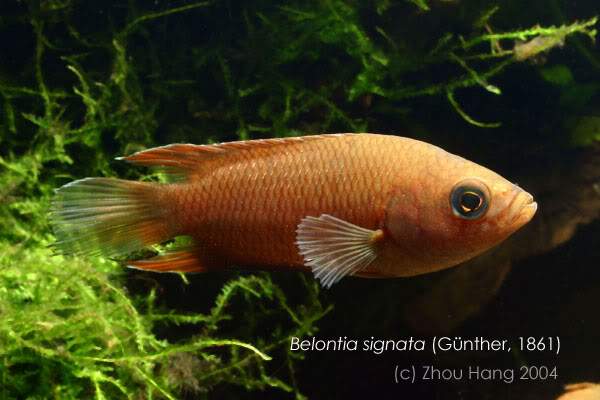
Belontia signataCeylonese Combtail
Günther, 1861
Max length120mm SL5in SLTank120 × 30cm48 × 12inTemp20–27°C68–81°FpH6.0–7.5This species is also traded/referred to by the vernacular name 'Ceylon fighting fish'. It differs from its only congener, B. hasselti, by its overall reddish (vs. brownish-grey) body colouration, and absence (vs. presence) of a mosaic-like patterning in the unpaired fins. At least three putative phenotypes have been recorded. The nominative, and commonest, mostly inhabits clear streams in rainier zones...
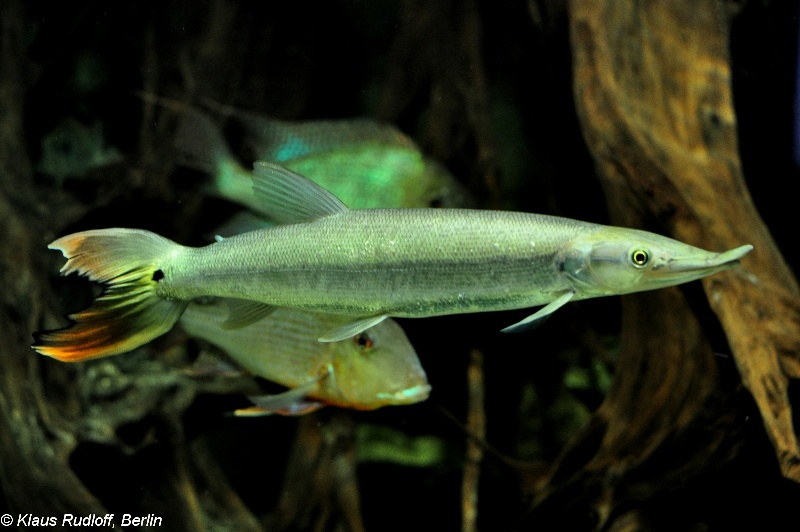
Boulengerella cuvieri
Spix & Agassiz, 1829
Max length800mm SL31in SLTanknot recordedTemp22–28°C72–82°FpH5.0–7.5It's known by various vernacular names including 'Pirá-pacu', 'Pira-pucu' or 'Diente de cao' (central Amazon), 'Bicuda' or 'Uena' (rio Tocantins), 'Bicuda' (rio Tapajós), 'Aguejeta' or 'Picua' (Venezuela), and 'Moruwi' or 'Pirapoko' (Guyana). The entire dorsal-fin base is located anteriorly to a vertical through the anal-fin origin and this character distinguishes it from all other ctenolucids except B. lucius and B. xyrekes.
Chaetostoma formosaeStriped Bulldog Pleco
Ballen, 2011
Max length105mm SL4in SLTank120 × 30cm48 × 12inTemp20–24°C68–75°FpH6.5–7.8This species is traded under a number of English vernacular names, of which some others include 'blonde bulldog pleco', 'blonde rubber pleco', 'blonde rubbernose pleco', 'striped rubber pleco', and 'striped rubbernose pleco'. It may also be seen referred to as 'L146', 'L146a', or 'L187b', these codes having been used for it in the Aqualog series of books. It can be told apart from all congeners except C. anale and C. jegui by...
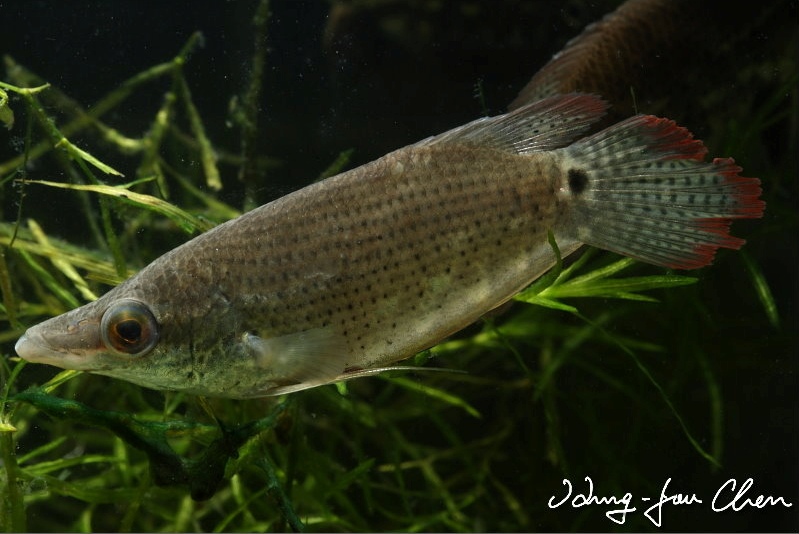
Ctenops nobilisFrail Gourami
McClelland, 1845
Max length100mm SL3.9in SLTank120 × 30cm48 × 12inTemp15–25°C59–77°FpH5.0–7.5This species is also referred to by the alternative vernacular name of 'noble gourami' and is currently the only recognised member of the genus Ctenops. It is usually regarded as being very difficult to keep whereas in reality it is quite adaptable once acclimatised but appears to react poorly to the export and shipping process meaning it is often seen on sale in poor condition and susceptible to or already infested with secondary health issues such as Oödinium, to which it appear...
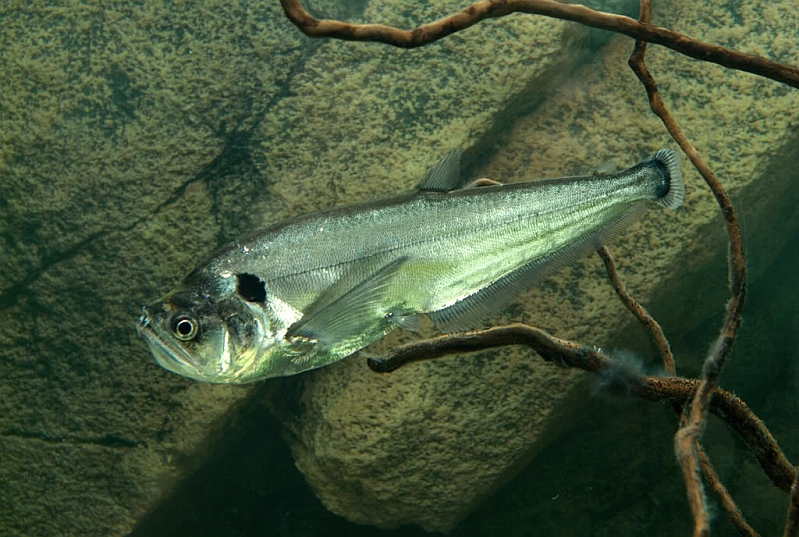
Cynodon gibbus
Agassiz, 1829
Max length280mm SL11in SLTank210 × 75cm84 × 30inTemp24–28°C75–82°FpH6.0–8.0This species is rare in the aquarium trade but is arguably more suitable for the home aquarium than some of its better-known relatives given its adult size and relatively docile behaviour. Other vernacular names include 'Dientón' (Peru), 'Perrito' (Ecuador), 'Payara-chata' or 'Payarin' (Venezuela) and 'Icanga', 'Minguilista' or 'Peice-cachorro' (Brazil), some of which are also applied to related species.
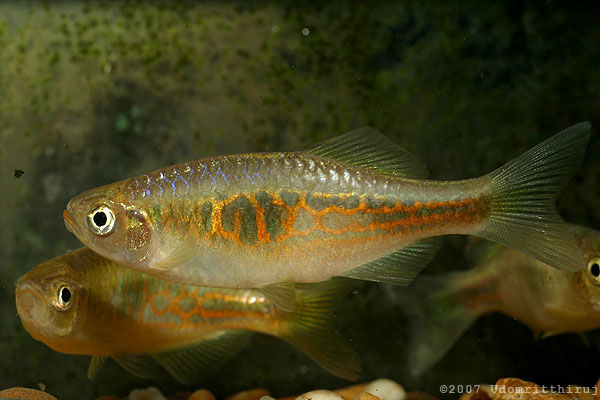
Devario sp. 'giraffe'
authority not recorded
Max length80mm SL3.1in SLTank120 × 30cm48 × 12inTemp18–26°C64–79°FpH6.0–8.0This unidentified species was first collected in 2007 but very little is known about it. The vernacular name refers to the colour pattern on the body which resembles that of a giraffe, and it's known to be collected in Myanmar although its distribution and natural habitat remain a mystery.
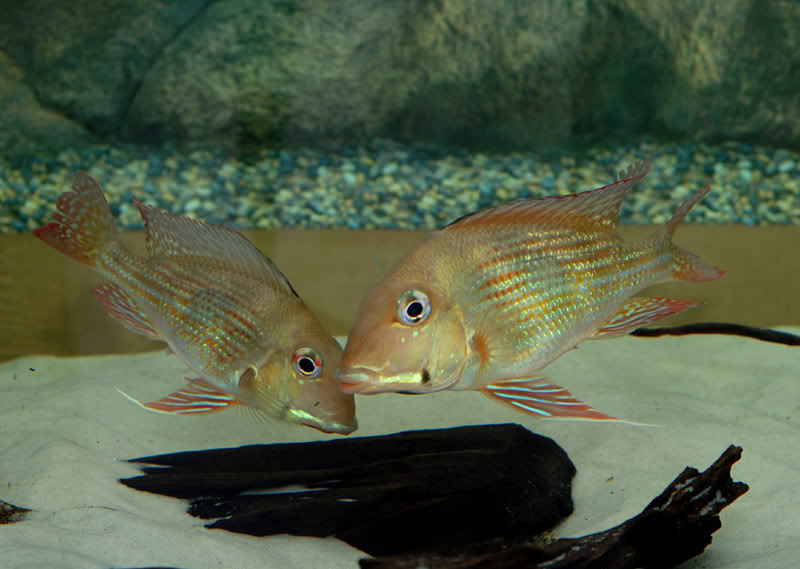
Geophagus brachybranchus
Kullander & Nijssen, 1989
Max length200mm SL8in SLTank180 × 60cm72 × 24inTemp26–30°C79–86°FpH5.0–7.0This species is generally rare in the aquarium hobby though oddly appears to be one of the commoner species in Australia where it's often referred to by the vernacular name 'black-throated eartheater'. It's a member of the nominal G. surinamensis 'group' of closely-related species within the genus and can be identified by a combination of characters including: presence of dark preopercular markings; no vertical bars on the flanks even when stressed/preserved; base of filaments on the first gill arch mostly covered by a flap of skin; exposed part of bra...
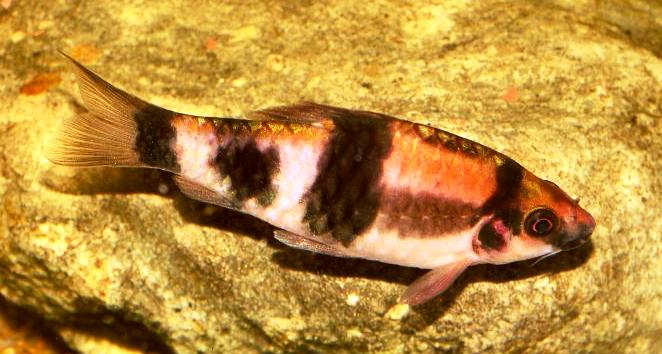
Haludaria fasciataMelon Barb
Jerdon, 1849
Max length70mm SL2.8in SLTank90 × 30cm36 × 12inTemp22–26°C72–79°FpH6.0–7.5This species is traded under various vernacular names including 'ember barb', 'banded barb' and 'black spot barb', and is perhaps among the more undervalued small cyprinids in the aquarium hobby being peaceful, relatively hardy, colourful, and of interesting behaviour. It exists in a number of colour for...
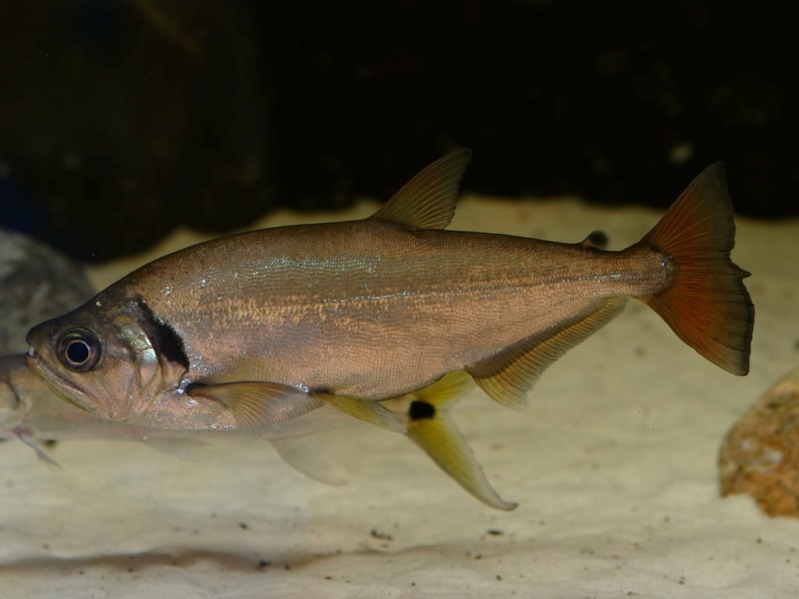
Hydrolycus tatauaia
Toledo-Piza, Menezes & Santos, 1999
Max length455mm SL18in SLTanknot recordedTemp24–28°C75–82°FpH6.0–8.0Vernacular names in Brazil include 'Cachorra' or 'Pirandirá', although these are also applied to congeners. It can be told apart from all congeners by the following combination of characters: head and body silvery with dark dorsal surface; an elongate dark blotch posterior to the opercle; dorsal, caudal and anal-fin rays reddish to orange proximally with some individual variation in intensity and tonality; adipose fin dark, with diffuse black pigmentation.
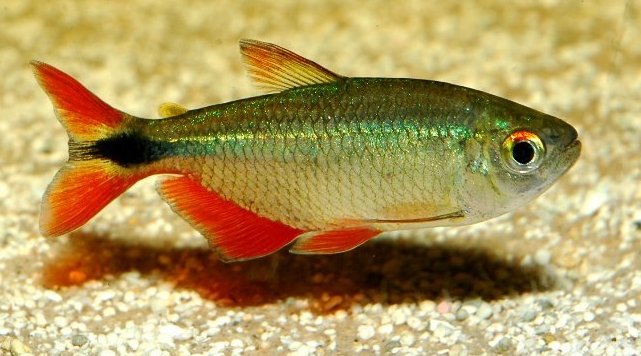
Hyphessobrycon anisitsiBuenos Aires Tetra
Eigenmann, 1907
Max length60mm SL2.4in SLTank90 × 30cm36 × 12inTemp16–28°C61–82°FpH5.5–8.5Widely-distributed throughout much of the Paraná and Uruguay river systems in Brazil, Paraguay, Argentina and Uruguay. Some records from Buenos Aires province, Argentina are now considered to refer to the congener H. togoi (Miquelarena and López, 2006) so the common vernacular name 'Buenos Aires tetra' may not...
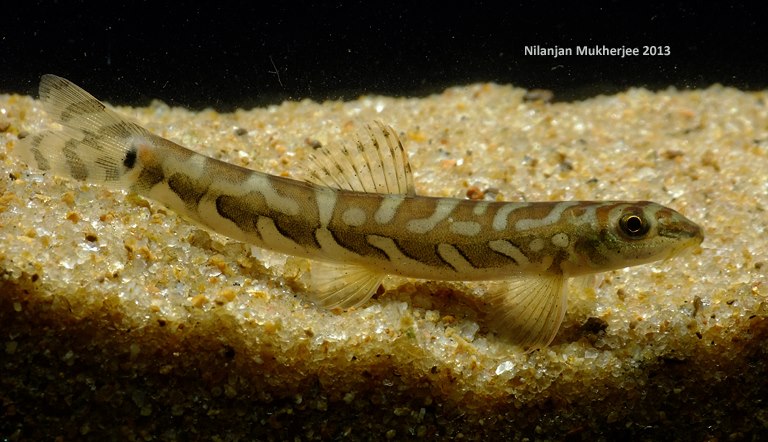
Mesonoemacheilus triangularisZodiac Loach
Day, 1865
Max length60mm SL2.4in SLTank75 × 30cm30 × 12inTemp18–25.5°C64–78°FpH6.0–7.5This species is also referred to by the alternative vernacular name 'Batik loach' and is the most-commonly traded member of the genus at present. It's easily-distinguished from congeners by body patterning which comprises a series of pale, oblique saddle-like markings edged in black and running along the dorsal surface, plus a similar set of bars originating from the otherwise plain ventral surface.
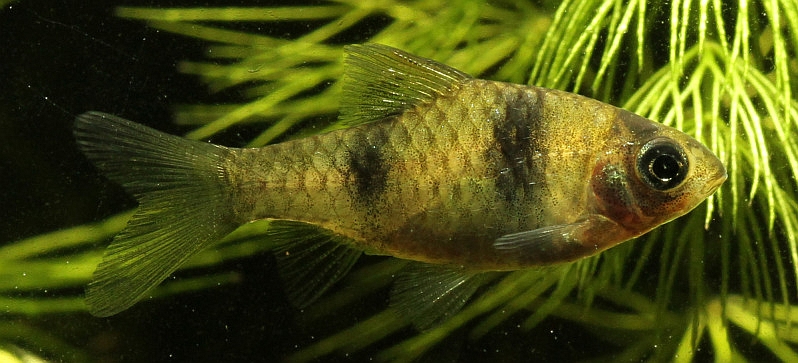
Pethia sp. 'Myanmar'
authority not recorded
Max length55mm SL2.2in SLTank75 × 30cm30 × 12inTemp18–24°C64–75°FpH6.0–7.5This fish has been widely misidentified and sold as the congener P. tiantian and its vernacular name of 'Burmese bumble-bee barb' but actually appears to be an undescribed member of the genus Pethia. This assemblage was erected by Pethiy...
Pseudogastromyzon myersi
authority not recorded
Max length60mm SL2.4in SLTank75 × 30cm30 × 12inTempnot recordedpH6.0–7.5This species is traded under various vernacular names including 'Chinese hillstream loach', 'Chinese butterfly plec' and 'Hong Kong Otocinclus. It's the commonest member of the genus in the hobby but has been frequently misidentified as the congener P. cheni in the past with the two often said to be indistinguishable in terms of colour pattern. Some sources additionally suggest the sole defining external character to be that in P. cheni the distance between the resp...
Serrasalmus maculatusMac
authority not recorded
Max length210mm SL8in SLTank120 × 45cm48 × 18inTemp21.1–30°C70–86°FpHnot recordedS. maculatus is one of the better choices for aquarists new to this group of fishes. It grows to a manageable size, is relatively hardy, attractive and usually quite inexpensive. It's sometimes referred to by the alternative vernacular names "gold piranha" or "golden mac" in the hobby. There are in excess of 30 described species of Serrasalmus many of which appear superficially similar and have confusing taxonomic histories. S. maculatus and S. spilopleura have often ...
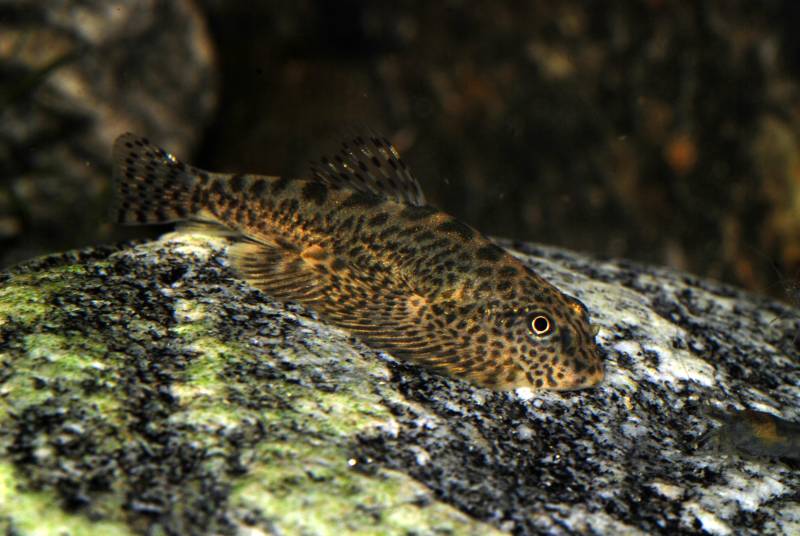
Sewellia speciosa
Roberts, 1998
Max length55mm SL2.2in SLTank75 × 30cm30 × 12inTemp20–24°C68–75°FpH6.0–7.5This species first became available in early 2010 and sometimes appears on trade lists under the vernacular names 'Laos sucker' or 'Laos Sakura sucker'. It's distinguishable from other members of the genus by the following combination of characters: body spotted and without stripes; no concentric bands on paired fins; origin of pelvic-fin below origin of dorsal-fin; origin of pectoral-fin posterior to corner of mouth; pelvic fin reaching origin of anal fin; small elevated ...
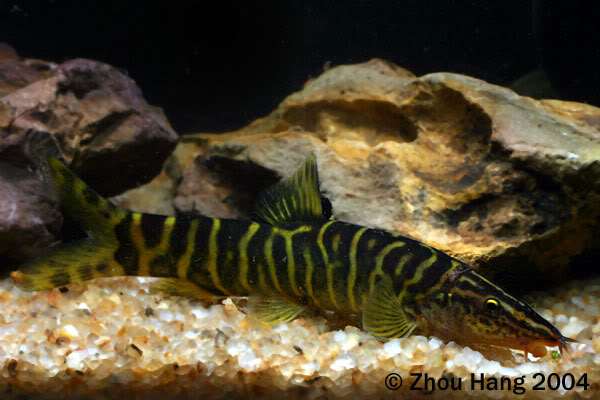
Sinibotia pulchraGolden Zebra Loach
Wu, 1939
Max length110mm SL4in SLTank120 × 30cm48 × 12inTemp20–25.5°C68–78°FpH6.5–8.0This species is also sold under the vernacular names 'golden Chinese loach' and '12-banded Chinese loach'. Along with S. robusta it's the most commonly-traded member of the genus, and the two are often imported in mixed batches, presumably because they occur and are thus collected together in nature. Like most congeners it has a highly flexible, sinuous body which makes it very interesting to observe. S. pulchra can be differentiated from...
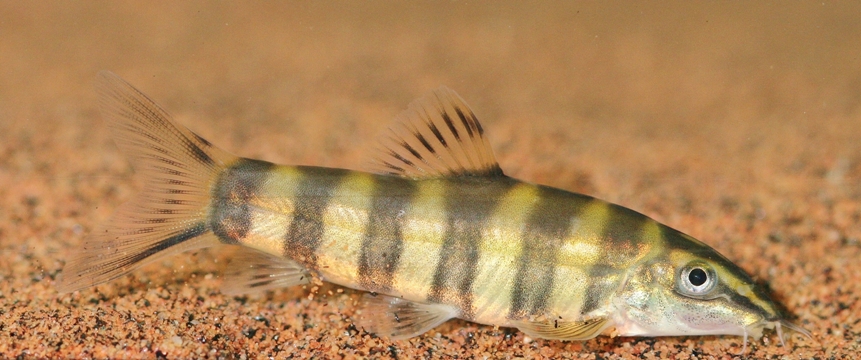
Sinibotia robustaKansu Loach
Wu, 1939
Max length100mm SL3.9in SLTank120 × 30cm48 × 12inTemp20–25.5°C68–78°FpH6.5–8.0This species is also sold under the vernacular names 'golden Chinese loach' and '12-banded Chinese loach'. Along with S. pulchra it's the most commonly-traded member of the genus, and the two are often imported in mixed batches, presumably because they occur and are thus collected together in nature.
Sorubim limaDuckbill Catfish
authority not recorded
Max length501mm SL20in SLTank200 × 75cm79 × 30inTemp23.3–30°C74–86°FpHnot recordedThis species is also known by the vernacular names "Hockey Stick Catfish", "Lima Shovelnose", "Chiripira", "Chucharón" and "Pico de pato". The genus Sorubim currently contains five recognised species. Of the others S. cuspicaudus is recorded from the parts of the Rio Essequibo, Rio Orinoco, Amazon and Lake Maracaibo basins, S. elongatus from the Rio Essequibo, Rio Orinoco Rio Mamore and Amazon and S. maniradii from the mid-to-upper Amaz...