Results for “vertical fin”
Type a name: scientific, common, or one a species used to go by. Or narrow the catalogue with the filters.
Filters
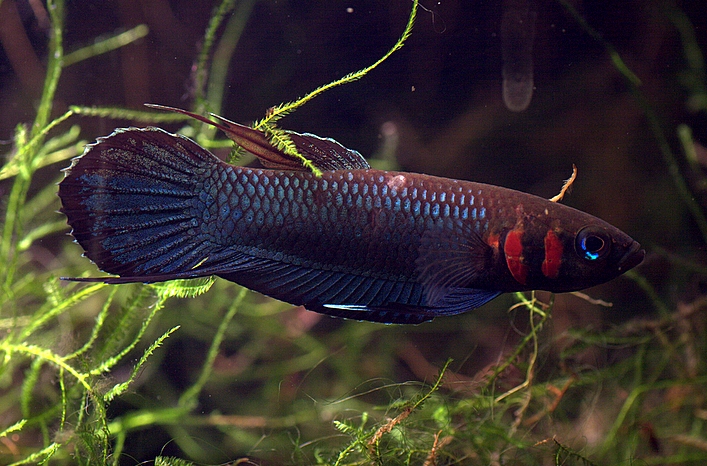
Betta foerschi
Vierke, 1979
Max length50mm SL2.0in SLTank60 × 30cm24 × 12inTemp22–28°C72–82°FpH4.0–6.0This species lends its name to the Betta foerschi group of closely-related species within the genus, of which members share the following set of characters: possession of iridescent blue or green unpaired fins; rays and interradial membranes in unpaired fins not contrasting; dorsal fin with thin, bright white distal band; opercle with two, reddish-yellow, vertical bars. Members are regarded as being closely-related to bubble nesting Betta specie...
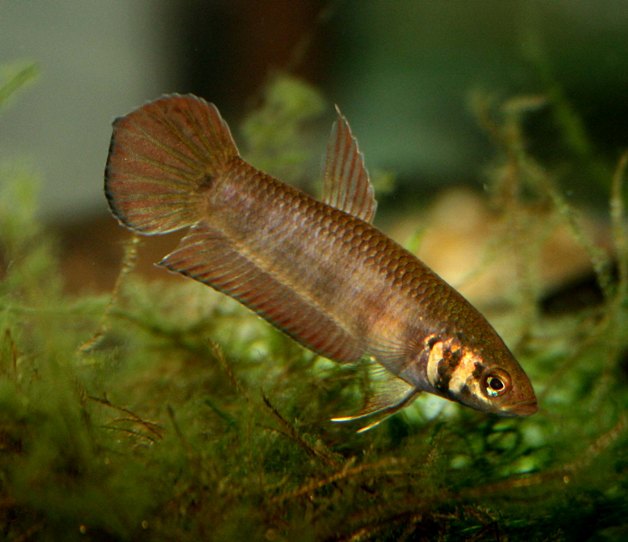
Betta mandor
Tan & Ng, 2006
Max length60mm SL2.4in SLTank60 × 30cm24 × 12inTemp22–27°C72–81°FpH4.0–6.5This species was known as B. sp. 'Mandor' or B. sp. 'ninja' prior to official description. It belongs to the Betta foerschi group/complex of closely-related species within the genus, of which members share the following set of characters: possession of iridescent blue or green unpaired fins; rays and interradial membranes in unpaired fins not contrasting; dorsal fin with thin, bright white distal band; opercle with two, reddish-yellow, vertical bars. Members are regarded as being closely-related to bubble-nesting Betta species since they share exhibit certain similarities in morp...
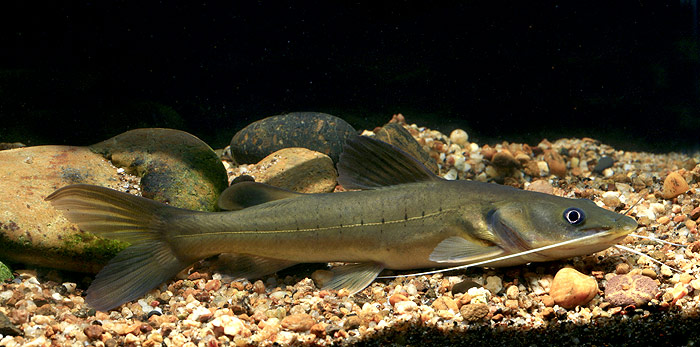
Hemibagrus peguensis
Boulenger, 1894
Max length286mm SL11in SLTanknot recordedTempnot recordedpHnot recordedMembers of this assemblage can be told apart from other congeners by possession of 44–46 vertebrae, an adipose-fin with a relatively short base (< 20 % SL), a colour pattern comprising either distinct black spots arranged in vertical columns or irregular black vertical lines running along the flanks, and normally a reddish or orangish caudal-fin in life.
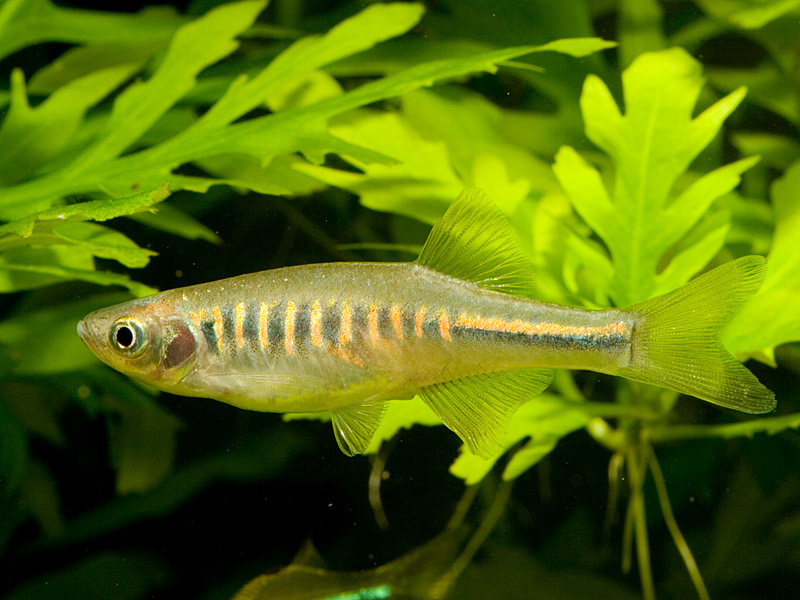
'Inlecypris' shanensis
Hora, 1928
Max length60mm SL2.4in SLTank80 × 30cm31 × 12inTemp18–26°C64–79°FpH6.0–8.0This species is sometimes referred to as 'Hora danio' or Salween danio'. It is distinguished from similar-looking species by a combination of characters as follows: lateral line complete or incomplete with 22-33 pored scales; absence of infraorbital process; 7 branched dorsal-fin rays; usually 10 or 11 branched anal-fin rays; barbels absent or rudimentary; flank markings comprising a series of narrow vertical bars on the anterior portion of each flank, fol...
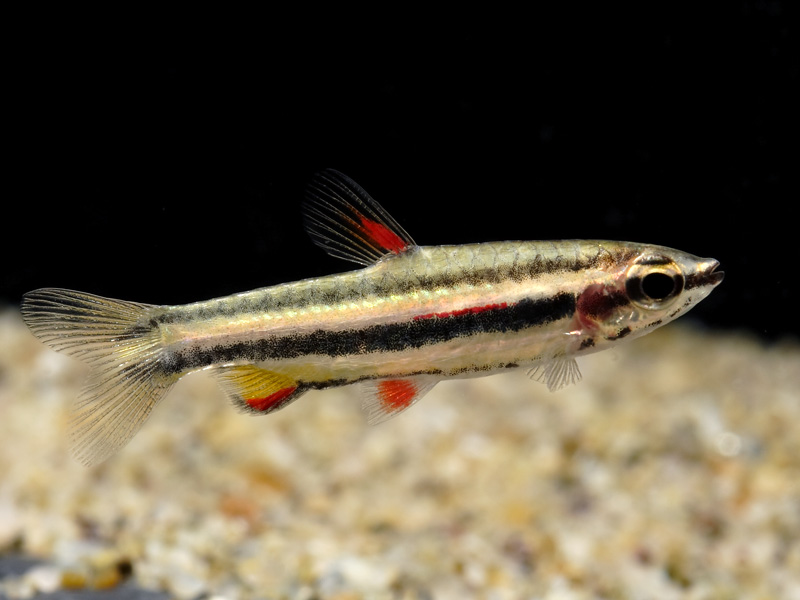
Nannostomus marginatusDwarf Pencilfish
Eigenmann, 1909
Max length25mm SL1.0in SLTank45 × 30cm18 × 12inTemp22–28°C72–82°FpH4.0–7.0There also exist a number of minor differences in colour pattern between populations. For example some Peruvian forms have yellow pigmentation on the body and fins, and those from Guyana and Suriname possess a short red stripe on vertical scale rows 6-9, above the central dark stripe on the body. Rio Negro forms have a similar red stripe but overlapping the central dark stripe and extending along most of the flank, while a form from Colombia has an elongate red stripe which is broken in two beneath the dorsal-fi...
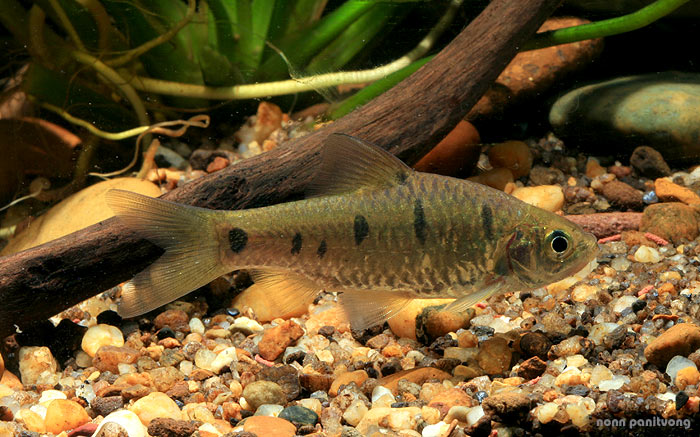
Barbodes aurotaeniatus
Tirant, 1885
Max length65mm SL2.6in SLTank80 × 30cm31 × 12inTemp18–26°C64–79°FpH6.0–7.5B. aurotaeniatus is uncommon in the aquarium trade. Following Kottelat (1998) it has a single pair of maxillary barbels, a complete lateral line and colour pattern usually comprising four small, vertically-orientated black markings on the flanks (located above anterior lateral line origin, below dorsal-fin origin, below posterior end of dorsal-fin base and on caudal peduncle, respectively) and one on the dorsal surface, below dorsal-fin origin.
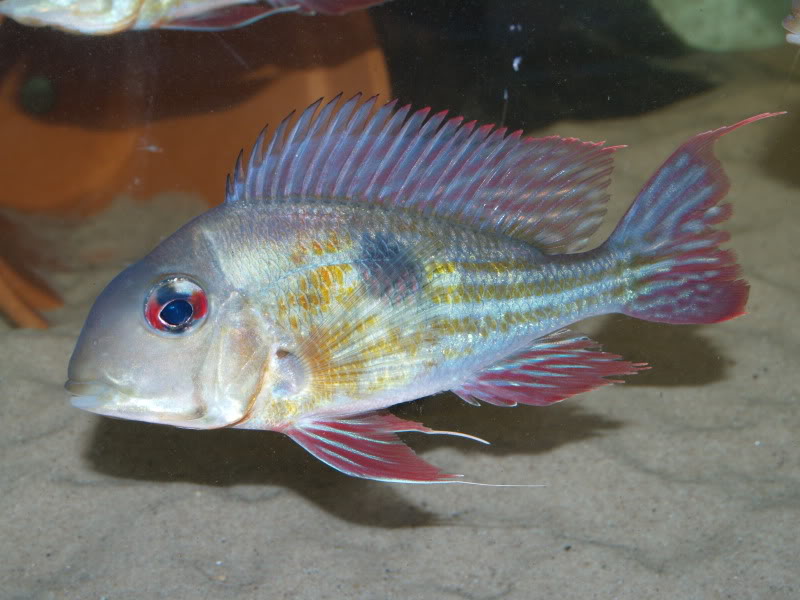
Geophagus proximus
Castelnau, 1855
Max length225mm SL9in SLTank180 × 60cm72 × 24inTemp24–32°C75–90°FpH4.0–7.0This species is rare in the hobby though it's name is often attached to shipments of other Geophagus species. It's a member of the nominal G. surinamensis 'group' of closely-related species within the genus and can be identified by a combination of characters including: possession of dark preopercular marking; no vertical bars on the flanks; relatively large, roughly oblong-shaped dark midlateral marking; caudal fin brownish with 3-5 light stripes on upper lobe and less well-defined stripes or mottled pattern of light spots with narrow dark interspaces on lower lobe.
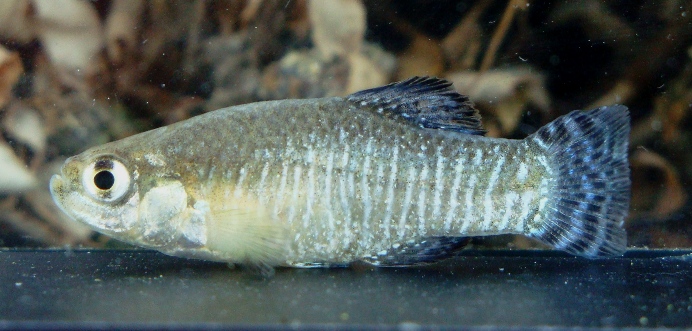
Apricaphanius baeticusBaetican Toothcarp
Doadrio, Carmona & Fernández-Delgado, 2002
Max length50mm SL2.0in SLTank120 × 30cm48 × 12inTemp2–30°C36–86°FpH7.0–9.0Prior to its description this species was considered a geographic variant of A. iberus but the 2002 paper revealed the pair to be genetically quite distinct and also highlighted some morphological differences. It is distinguished from A. iberus by possessing 8-9 (usually 8 ) branched dorsal-fin rays (vs. 8-9, sometimes 10), 9-11 branched anal-fin rays (vs. 8-9), a deeper, more elongate body shape, noticeably shorter snout, relatively thick (vs. thin) vertical bars in males and a flank patterning consisting of a few la...
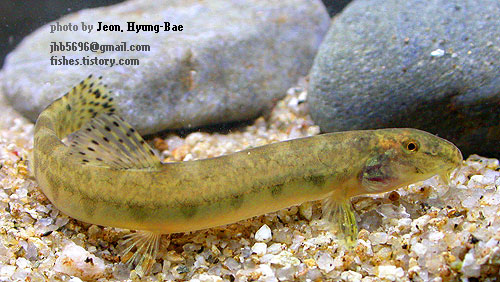
Iksookimia yongdokensis
Kim & Park, 1997
Max length160mm SL6in SLTank100 × 30cm39 × 12inTemp20–24°C68–75°FpH7.0–8.0Among them it's most similar to I. longicorpus and I. hugowolfeldi but can be distinguished by the following combination of characters: body patterning consisting of 9-13 dark vertical bars along the flanks plus a small dark spot at the base of the upper caudal-fin lobe; no black blotch or markings posterior to the operculum; reduced lamina circularis in males; interorbital width measures 14.7-17.8% o...
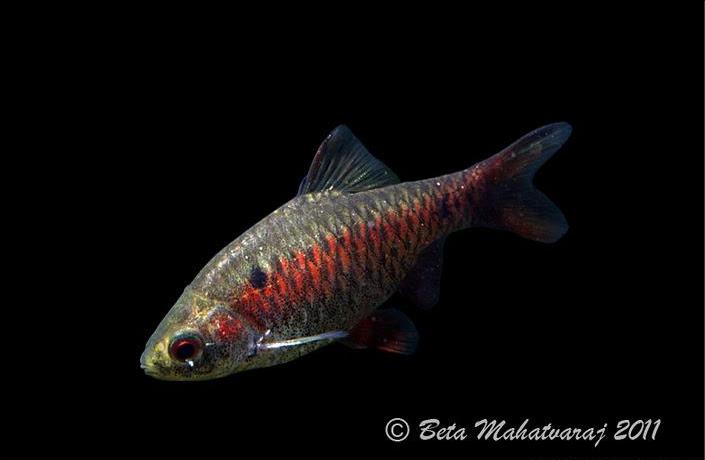
Pethia manipurensis
Menon, Rema Devi & Vishwanath, 2000
Max length62mm SL2.4in SLTank80 × 30cm31 × 12inTemp18–25°C64–77°FpH5.5–7.5Within this assemblage P. manipurensis is most similar to 'P.' meingangbii and P. padamya by virtue of the fact that males in all three possess orange-red pigmentation on the flanks and caudal-fin. It can be told apart most easily by the fact it possesses a relatively small, spot-like humeral marking, vs. a vertically-elongated, relatively large humeral marking in both the other species.
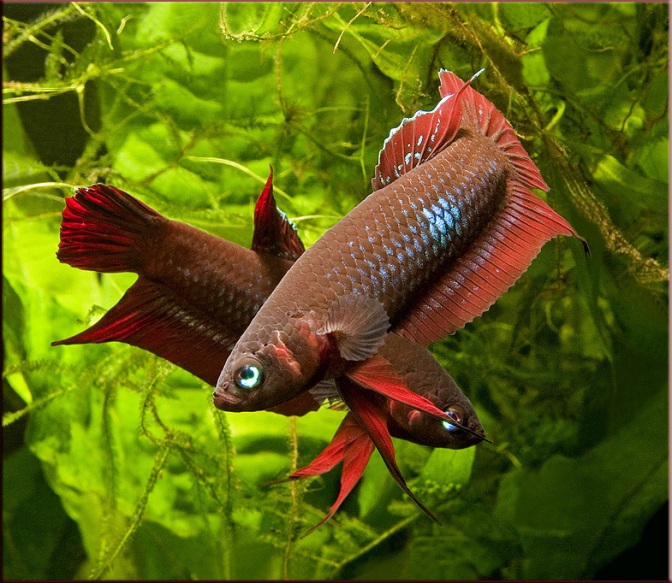
Betta coccinaScarlet Betta
Vierke, 1979
Max length40mm SL1.6in SLTank45 × 30cm18 × 12inTemp22–30°C72–86°FpH4.0–6.0B. coccina can be told apart from other members by the following combination of characters: iridescent green lateral blotch present in male, absent in female; body dark red in colour; no parallel vertical iridescent gold opercle bars; pelvic fin falcate with black filamentous tip, remainder red; median fins with discrete iridescent green spots; dorsal fin-rays 9-12; anal-fin rays 27-29; subdorsal scales 7-8; lateral scales 31-32; predorsal scales 18-21. The genus Betta is the most speciose within the family Osphronemidae with almost 70 reco...
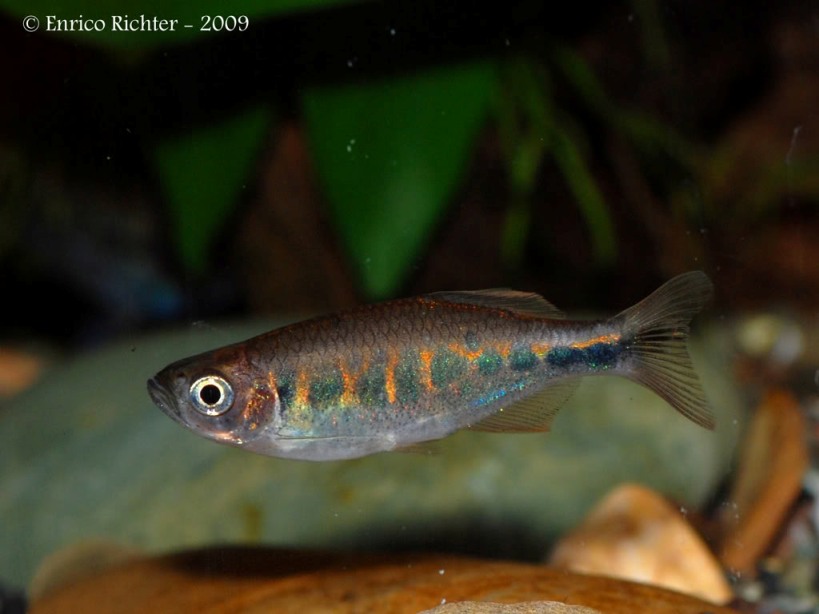
Devario pathiranaBarred 'Danio'
Kottelat & Pethiyagoda, 1990
Max length80mm SL3.1in SLTank120 × 45cm48 × 18inTemp23–26°C73–79°FpH6.0–7.5This species is diagnosable from other members of the genus primarily by its unique colour pattern which consists of 7-11 dark blue, irregularly-shaped, parallel vertical bars on the anterior portion of each flank plus a short horizontal stripe on the caudal peduncle which extends into the central caudal fin rays. Phylogenetic analyses suggest it's most closely-related to Indian Devario spp. plus D. xyrops from the western slope of the Rakhine Yoma mountains in Myanmar (Fang et al., 2009; Fang and Kullander, 2009).
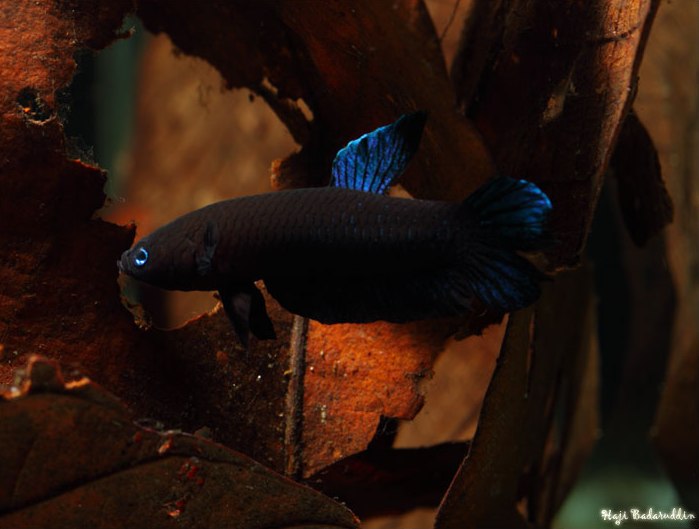
Betta persephone
Schaller, 1986
Max length35mm SL1.4in SLTank45 × 30cm18 × 12inTemp22–28°C72–82°FpH4.0–6.0B. persephone can be told apart from other members of the group by the following characters: no lateral blotch; body blackish; dorsal surface of head posterior to eye sloping gently; no parallel vertical iridescent gold opercle bars; pelvic-fin falcate with white filamentous tip, remainder black to reddish; median fins covered diffusely with light green iridescence; dorsal fin-rays 9; anal-fin rays 24-27; subdorsal scales 6-7; lateral scales 27-29; predorsal scales 17-18.
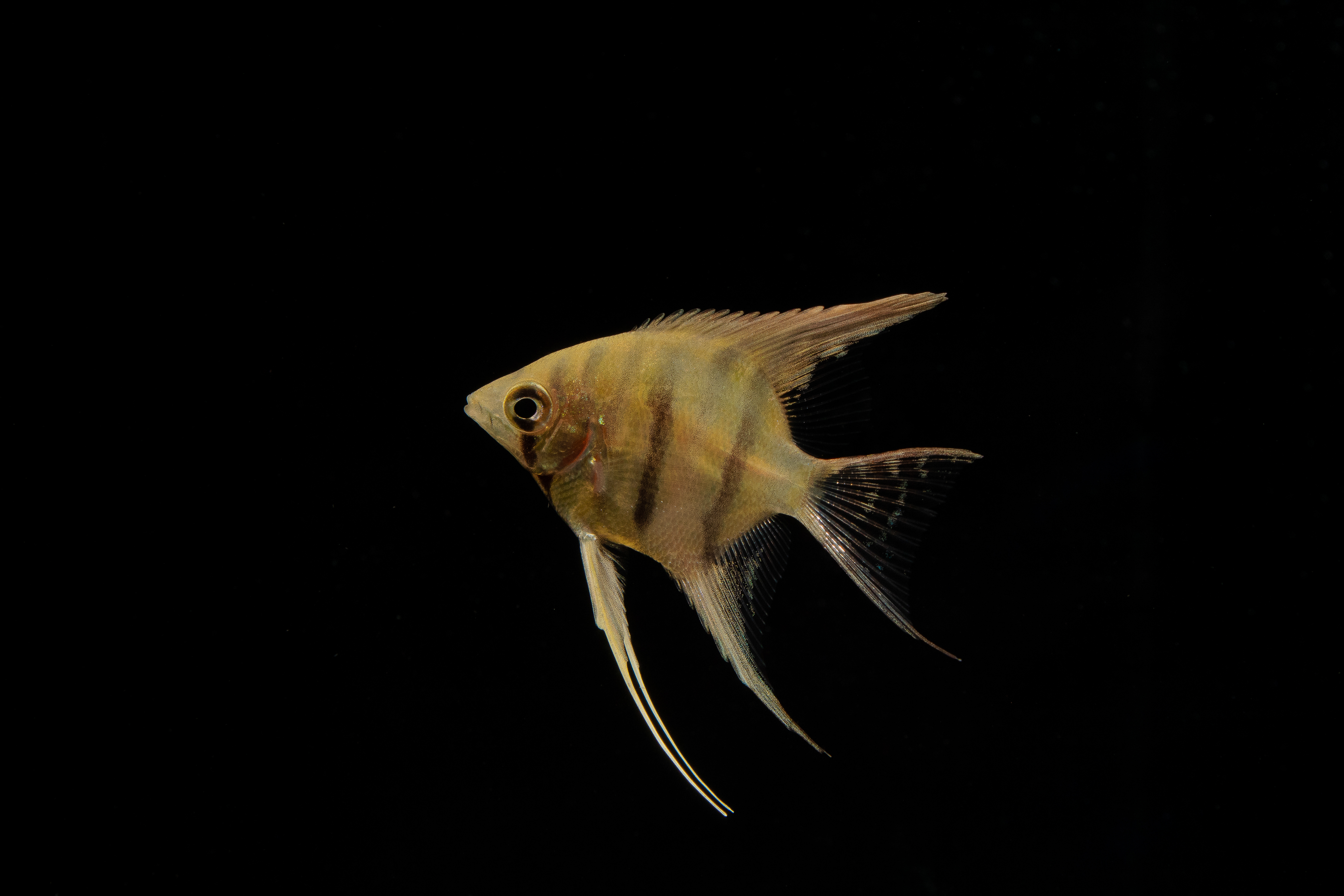
Pterophyllum leopoldiRoman Nose Angelfish
Gosse, 1963
Max length100mm SL3.9in SLTank90 × 30cm36 × 12inTemp22–29°C72–84°FpH5.0–7.0Pterophyllum leopoldi can be differentiated from other members of the genus by the presence of up to 11 vertical stripes on the body, though often only the 3 largest, boldest stripes can be seen. This species also shows a dark patch over the operculum. In adult specimens, a red/maroon hue over the back and fins is characteristic of the species, leading some to believe the most colourful natural form Angelfish. The name-sake roman nose possessed by the fish is also very distinctive and used as a meristic feature.
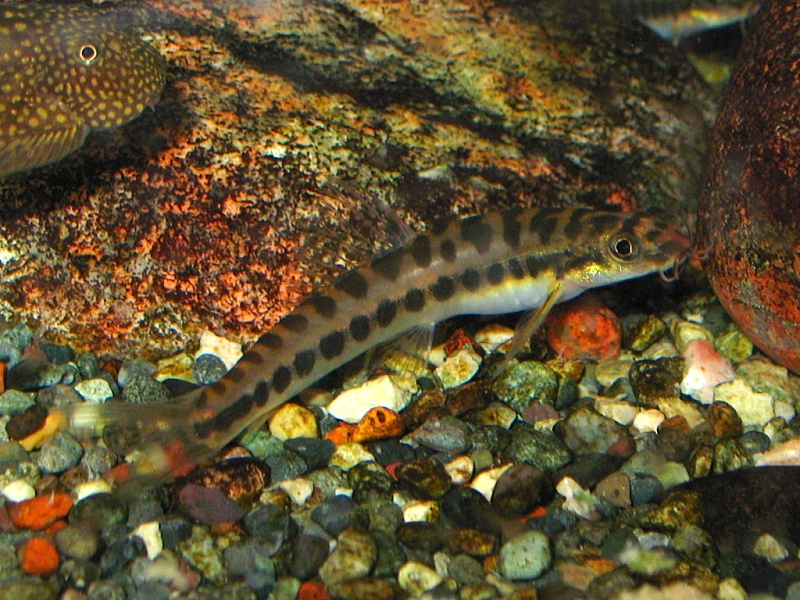
Nemacheilus masyaeArrow Loach
Smith, 1933
Max length70mm SL2.8in SLTank60 × 30cm24 × 12inTemp23–26°C73–79°FpH6.0–7.5This species was originally named Nemacheilus masyae but following ICZN rules the spelling was later corrected to N. masyai because it's named after a man. It can be distinguished from the majority of congeners by body patterning comprising 14-18 short, dark vertical bars on each flank, 12-17 saddle-like markings running along the dorsal surface, a dark spot on the caudal peduncle at the termination of the lateral line and a dark blotch in the lower half of the first few dorsal-fin rays.
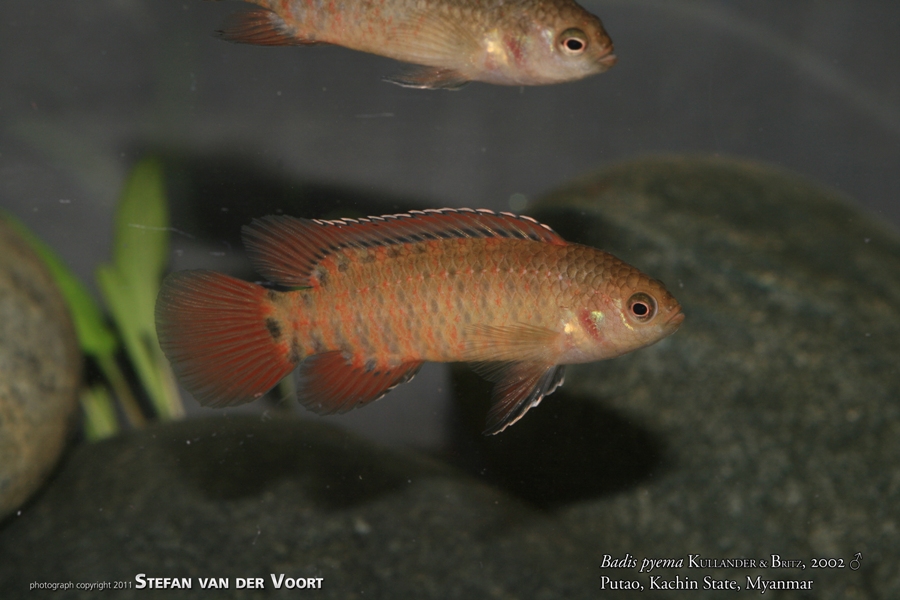
Badis pyema
Kullander & Britz, 2002
Max length45mm SL1.8in SLTank60 × 30cm24 × 12inTemp15–25°C59–77°FpH6.5–7.5Like most badids B. pyema is poorly documented in aquarium literature and has yet to find significant popularity in the hobby, though given its restricted natural distribution it is unlikely ever to be available in large numbers and has only been collected on three occasions to date. It has a very slender body shape, likely an adaptation to its habitat, and in this respect is similar to B. kyar. However B. kyar possesses relatively solid dark, uniform vertical bars on the flanks whereas in B. p...