Results for “barb”
Type a name: scientific, common, or one a species used to go by. Or narrow the catalogue with the filters.
Filters
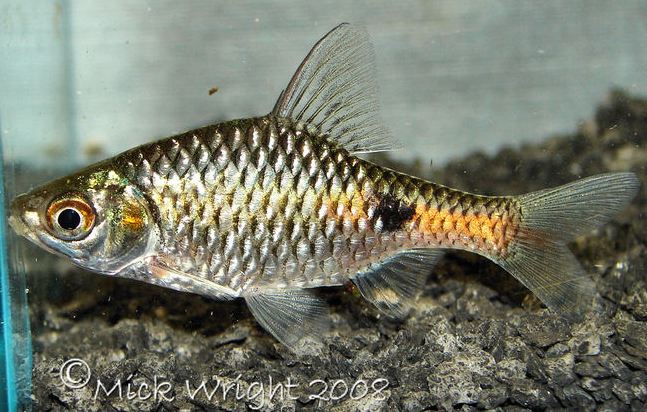
Puntius terioOnespot Barb
Hamilton, 1822
Matched on Barbus terio, a name it was formerly known by
Max length90mm SL3.5in SLTank80 × 30cm31 × 12inTemp18–26°C64–79°FpH6.5–7.5This species is uncommon in the aquarium trade which is a little surprising given its huge natural range. Different populations can vary in colour pattern to an extent though all share the defining aspects given by Hamilton, comprising a diffuse yellow-golden marking on the operculum plus a dark spot on the caudal peduncle. The latter is usually surrounded by a variably-sized golden-yellow margin, and the dorsal-fin often contains irregular dark spots and streaks, these sometimes forming a longitudinal band.
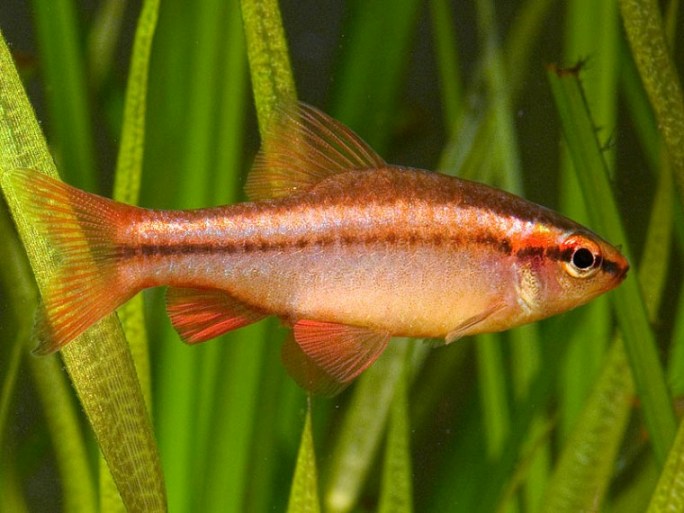
Puntius titteyaCherry Barb
Deraniyagala, 1929
Matched on Barbus titteya, a name it was formerly known by
Max length50mm SL2.0in SLTank60 × 30cm24 × 12inTemp20–27°C68–81°FpH6.0–8.0As of 2006 only 4.6% of the old forest was left with the remainder existing only in small, highly-fragmented patches, most covering areas less than 10 km², of which some are now officially-protected reserves. Kottawa Forest is one of these and comprises just 15-20 hectares of wet, evergreen jungle, though the combined Kottawa-Kombala forest covers around 1600 ha. A number of minor, pristine streams...
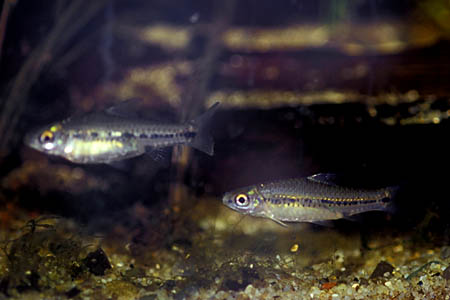
'Barbus' sublineatus
Daget, 1954
Max length100mm SL3.9in SLTank120 × 30cm48 × 12inTemp22–27°C72–81°FpH6.0–7.0The genus Barbus is in something of a confused state classification-wise. While there exist almost 340 putative species the vast majority of them do not appear to be closely-related to the genus Barbus sensu stricto. Berrebi et al. (1996) proposed that only the European, Southwest Asian and North African representatives should be included in Barbus (around 20 species) and that 'all species of Barbus sen...
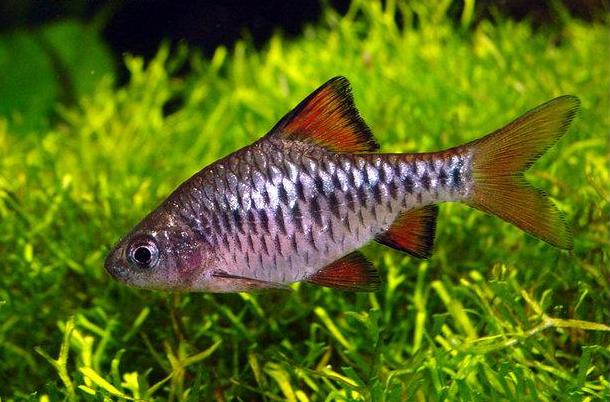
Oliotius oligolepisCheckered Barb
Bleeker, 1853
Matched on the common name Checkered Barb
Max length45mm SL1.8in SLTank75 × 30cm30 × 12inTemp18–25°C64–77°FpH5.5–7.5This species is also traded as 'checker barb', 'checkerboard barb', or 'island barb', and is among the most ubiquitous species available in the aquarium trade. It is farmed commercially in enormous numbers with wild examples rarely, if ever, available. It was formerly included in the polyphyletic catch-all genus Puntius which contained over 100 species, but this situation has been largely resolved since the turn of the century.
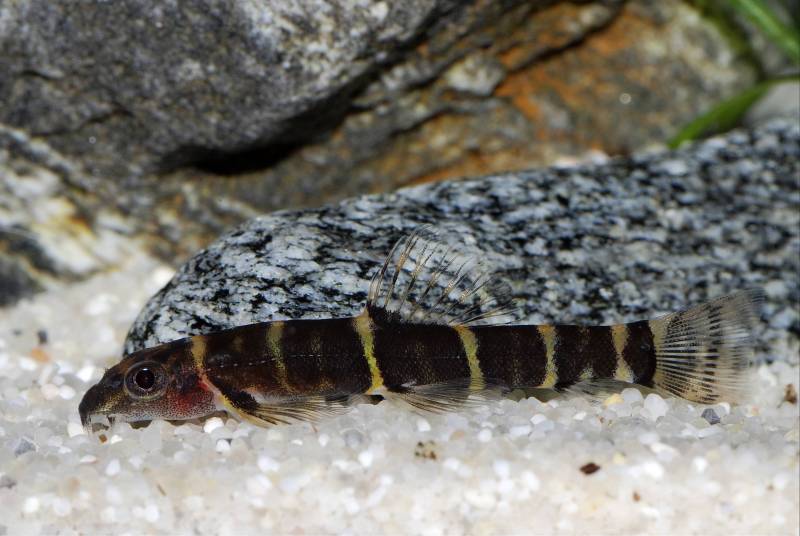
Barbucca diabolica
Roberts, 1989
Max length50mm SL2.0in SLTank60 × 30cm24 × 12inTemp20–25°C68–77°FpH5.5–7.5Barbucca spp. are uncommon in the aquarium trade but available periodically. There exist several undescribed species and it's possible that more than one has been exported, although to date only B. diabolica is officially recognised. Most of the fish we've seen possess red eyes (when viewed at certain angles), unique tuberculation and six dark body stripes as mentioned in Roberts' description although there are exceptio...
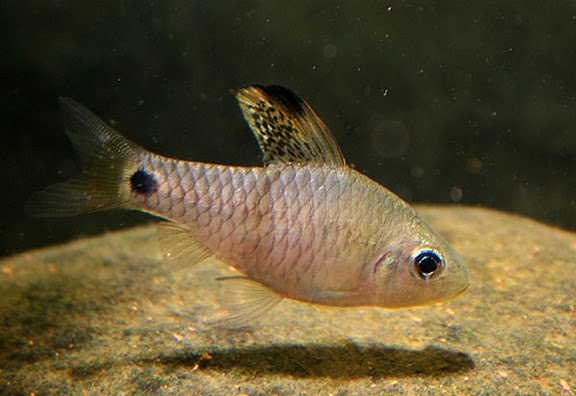
Oreichthys crenuchoidesDrape Fin Barb
Schäfer, 2009
Matched on the common name Drape Fin Barb
Max length45mm SL1.8in SLTank60 × 30cm24 × 12inTemp23–28°C73–82°FpH6.0–7.5This fish is sometimes traded as Oreichthys cosuatis, O. sp. 'high fin', O. 'umangii' (a nomen nudum that has only ever been applied to an image of a fish in the book 'Ornamental Aquarium Fish of India'; K. L.Tekriwal and A. A. Rao 1999), Puntius 'arunavii' or 'neon highfin barb'. It can be distinguished from congeners by the following combination of characters: absence of a dark marking in the anal-fin (vs. presence in other species); ½7½ scales scales between pelvic-fin origin and dorsal midline (vs. ½6½ in O. cosuatis and...
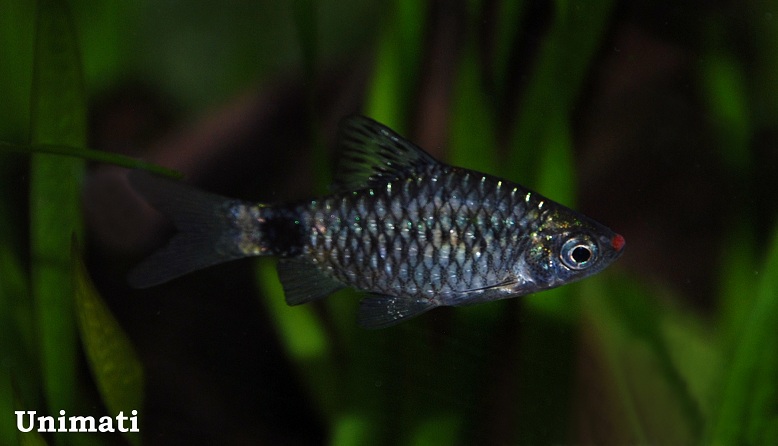
Pethia erythromycterLipstick Barb
Kullander, 2008
Matched on the common name Lipstick Barb
Max length35mm SL1.4in SLTank90 × 30cm36 × 12inTemp18–24°C64–75°FpH7.0–7.5This species first appeared in the aquarium hobby in 2006 and is sometimes traded under the name 'Tulip barb'. It was officially described by Kullander in early 2008 in a paper describing five new Puntius species from Kachin, all of which are superficially similar in possession of a dark band or blotch on the caudal peduncle. P. erythromycter can be distinguished b...
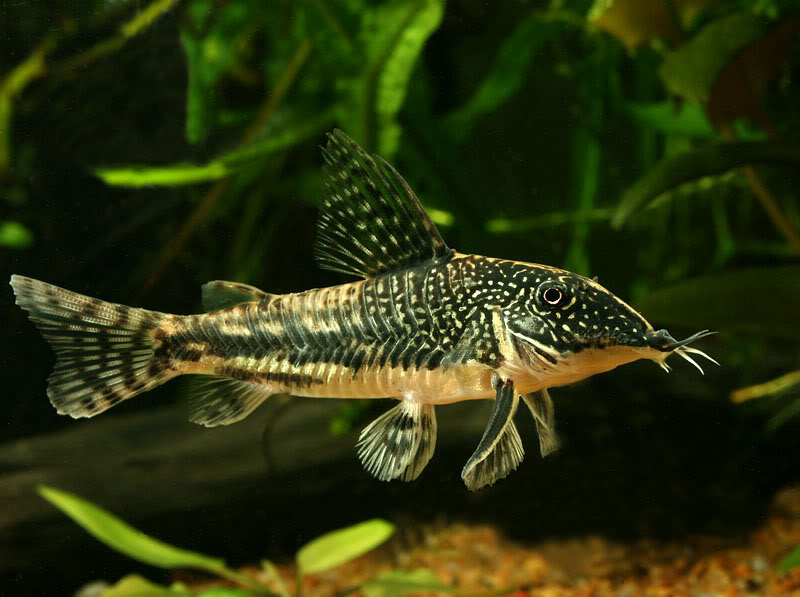
Scleromystax barbatusBanded 'Cory'
Quoy & Gaimard, 1824
Matched on Callichthys barbatus, a name it was formerly known by
Max length100mm SL3.9in SLTank120 × 45cm48 × 18inTemp16–24°C61–75°FpH5.5–7.5Scleromystax spp. are foraging omnivores, and most will accept sinking dried foods as well as small live and frozen varieties such as chironomid larvae (bloodworm), Tubifex, etc. Feeding a varied diet will ensure the fish are in optimum condition. Under no circumstances should they be expected to survive on 'left-overs' from other inhabitants of the aquarium or relied on to 'clean' the aquarium.
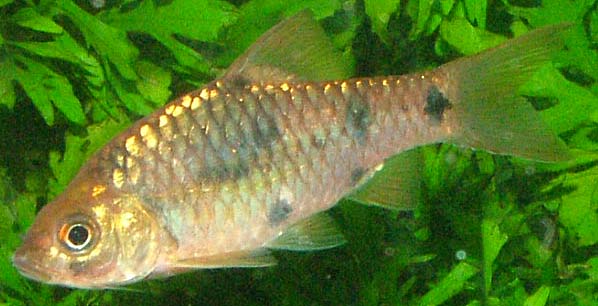
Barbodes banksi
Herre, 1940
Max length110mm SL4in SLTank120 × 45cm48 × 18inTemp22–28°C72–82°FpH6.0–7.5This species is not often seen in the aquarium hobby but occasionally exported as bycatch among shipments of other fishes. It was described as a subspecies of the closely-related 'P.' binotatus but is currently considered distinct on a tentative basis as per Ng and Tan (1999) who stated it is 'likely' that the two represent extreme colour forms of a single, variably-patterned species.
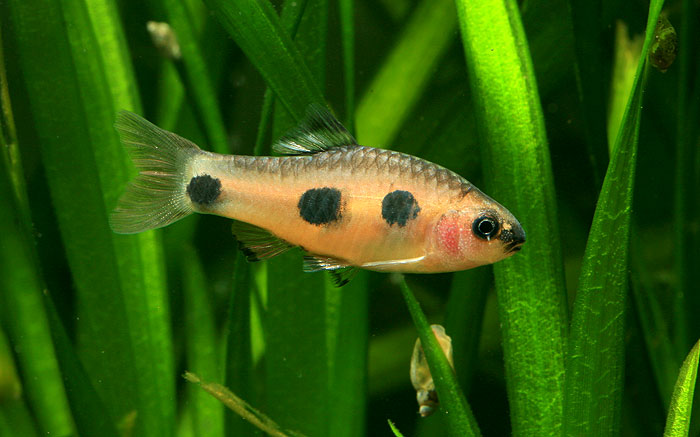
'Barbus' candens
Nichols & Griscom, 1917
Max length35mm SL1.4in SLTank45 × 30cm18 × 12inTemp17–24°C63–75°FpH5.0–7.0'B.' candens is not really suitable for most community aquaria as it has something of a shy, retiring nature and may be intimidated or outcompeted for food by larger/more boisterous tankmates. Choose similarly-sized, peaceful African species such as 'B.' jae, Aplocheilichthys spp., Ladigesia roloffi or Lepidarchus adonis. We suspect it will also do ok with many small South American characins, Otocinclus or smaller Corydoras catfish and other cyprinids like Trigonostigma or Boraras species.
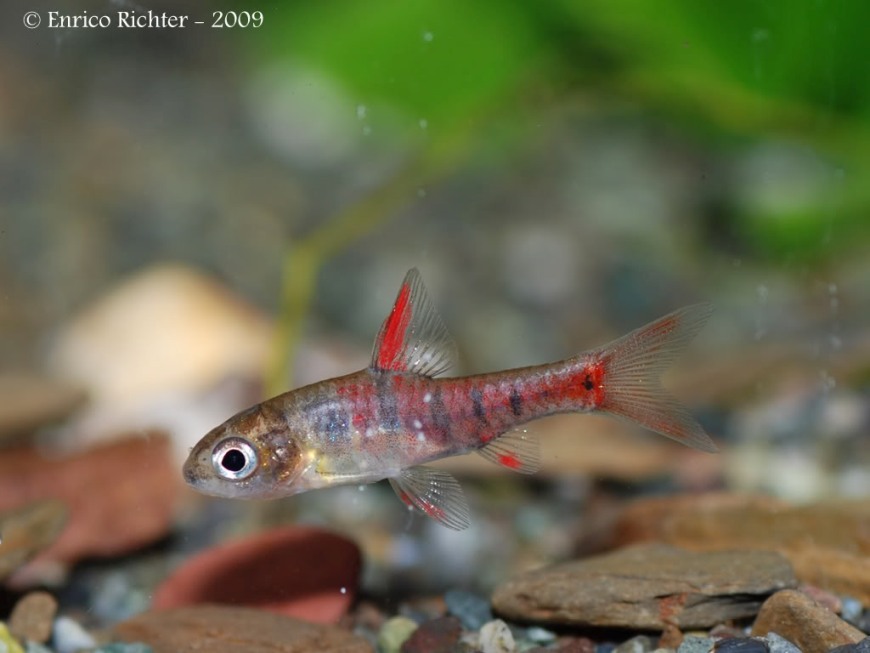
'Barbus' jae
Boulenger, 1903
Max length40mm SL1.6in SLTank45 × 30cm18 × 12inTemp17–24°C63–75°FpH5.0–6.5Although gregarious by nature it is a shoaling rather than schooling species which develops a distinct pecking order between males. It should ideally be maintained in a group of 8 or more but the tank must be of a sufficient size which will allow weaker individuals some respite from dominant conspecifics and decorated in such a way that many broken lines of sight are provided. Conversely if kept singly, in a very small group or in cramped conditions it can become withdrawn and subdominant fish may be bullied incessantly.
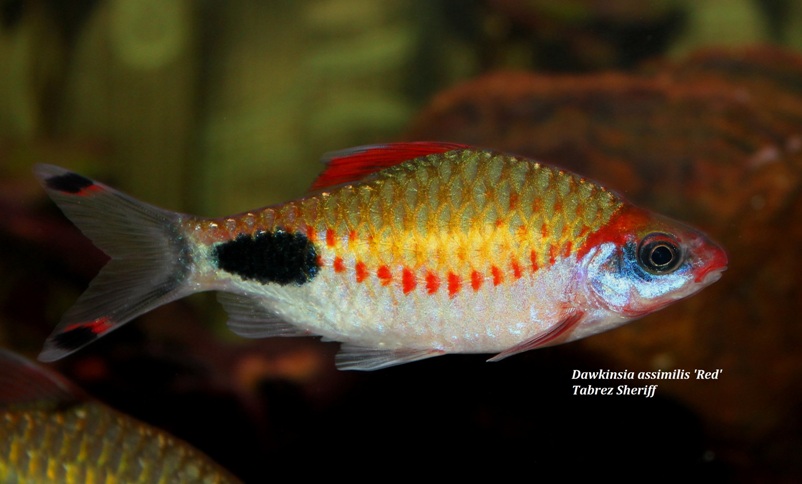
Dawkinsia assimilisMascara Barb
Jerdon, 1849
Matched on the common name Mascara Barb
Max length120mm SL5in SLTank120 × 45cm48 × 18inTemp19–25°C66–77°FpH6.0–7.0D. assimilis has been misidentified as Puntius mahecola (Valenciennes 1844) in the past but the identity of both species was resolved by Pethioyagoda and Kottelat (2005 a, 2005b). They inspected the syntypes of P. mahecola and concluded that though valid it isn't closely related to any Dawkinsia (then the Puntius filamentosus group) but is rather a smaller, silvery fish with a single dark blotch on the caudal peduncle, located entirely posterior to the anal-fin. It's wi....
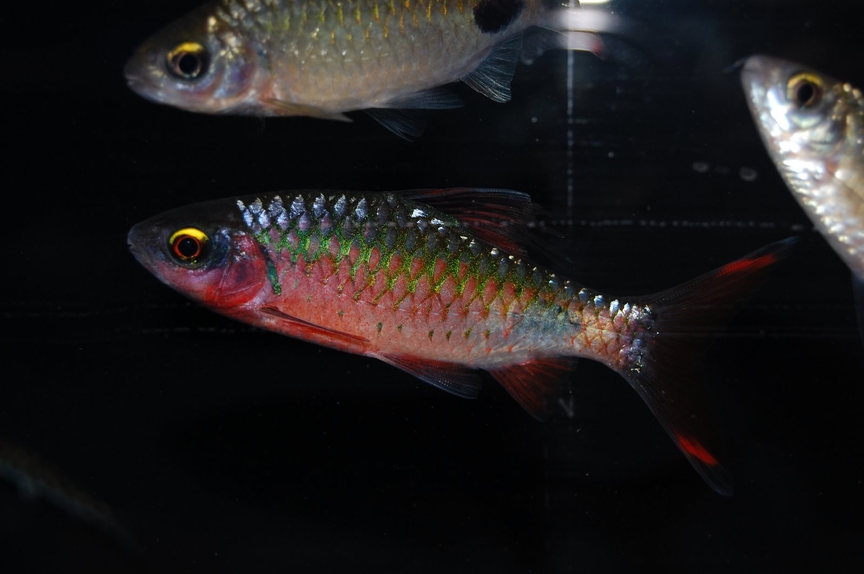
Dawkinsia filamentosaFilament Barb
Valenciennes, 1844
Matched on the common name Filament Barb
Max length120mm SL5in SLTank120 × 45cm48 × 18inTemp20–25°C68–77°FpH6.0–7.0Not difficult to keep in a well-maintained set-up, though we recommend aquascaping the tank to resemble a flowing stream/river with a substrate of variably-sized, water-worn rocks, sand, fine gravel and perhaps some small boulders. This can be further furnished with driftwood roots or branches, and while the majority of aquatic plants will fail to thrive in such surroundings hardy types such as Microsorum, Bolbitis or Anubias spp. can be grown attached to the décor.
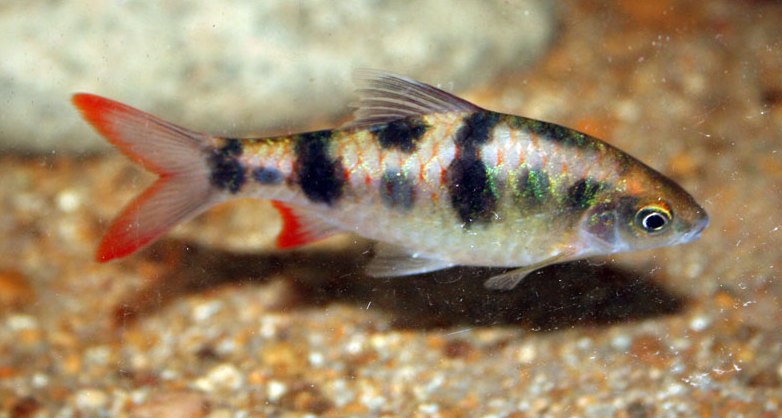
Dawkinsia tambraparniei'Arulius' Barb
Silas, 1954
Matched on the common name 'Arulius' Barb
Max length130mm SL5in SLTank120 × 45cm48 × 18inTemp18–25°C64–77°FpH6.0–8.0D. exclamatio should also have a sub-terminal mouth and lack dorsal-fin filaments but some specimens possess a terminal mouth and/or possess dorsal filaments, and one specimen also had black caudal-fin tips as typically seen in D. filamentosa, whereas the description states that the fin tips are only dusky and lack distinctive markings.
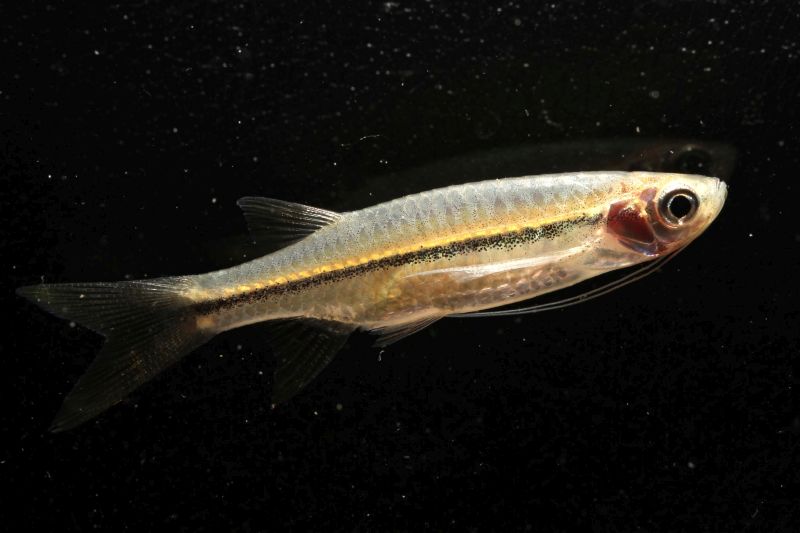
Esomus longimanusMekong Flying Barb
Lunel, 1881
Matched on the common name Mekong Flying Barb
Max length80mm SL3.1in SLTank120 × 30cm48 × 12inTemp20–28°C68–82°FpH6.0–8.0Known from the Mekong river basin in Thailand, Laos, Cambodia, and Vietnam, the Tonlé Sap river and lake system in Cambodia, and smaller, coastal drainages in southeast Thailand. Records from Peninsular Malaysia are likely to refer to other species. Type locality is given simply as 'Cambodia'.
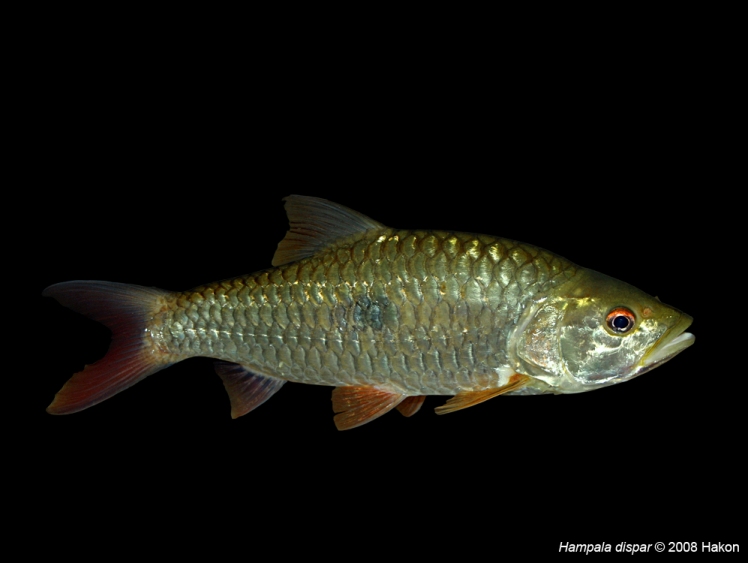
Hampala disparSpotted Hampala Barb
Smith, 1934
Matched on the common name Spotted Hampala Barb
Max length350mm SL14in SLTank240 × 60cm96 × 24inTemp20–25°C68–77°FpH6.0–8.0The genus currently contains seven species of which H. macrolepidota and, to a lesser extent, H. dispar are the only ones seen with any regularity in the aquarium trade. As well as having the widest distribution H. macrolepidota is also the largest member of the group. All representatives can appear superficially similar at first glance, the exception being H. lopezi which is endemic to a single island in The Philippines and displays a unique lateral band-like marking on the flanks.
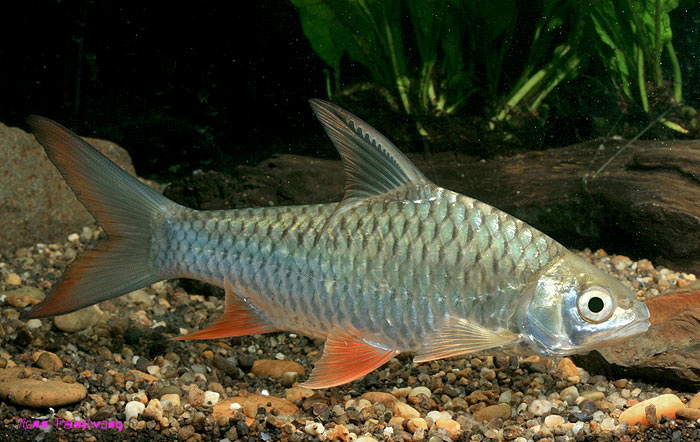
Hypsibarbus malcolmiGoldfin Tinfoil Barb
Smith, 1945
Matched on the common name Goldfin Tinfoil Barb
Max length500mm SL20in SLTanknot recordedTemp20–26°C68–79°FpH6.0–8.0H. malcolmi is distinguished from congeners by the following combination of characters: 12-17 (usually 14-15) rakers on first gill arch; usually 16 circumpeduncular scale rows; less than 30 lateral line scales; some branched lateral line canals, but branching not extensive, median portion of dorsal-fin dark.
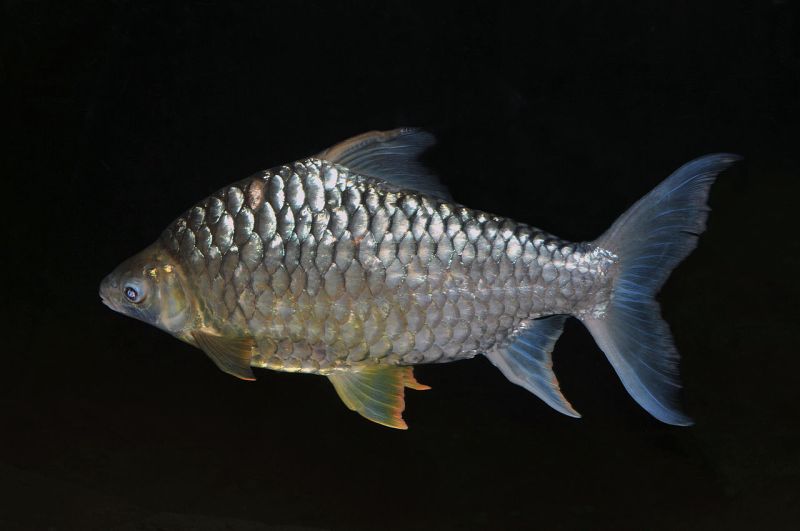
Hypsibarbus pierreiYellow Eyed Silver Barb
Sauvage, 1880
Matched on the common name Yellow Eyed Silver Barb
Max length300mm SL12in SLTanknot recordedTempnot recordedpHnot recordedKnown from the middle and lower Mekong basins in Laos, Thailand, Cambodia, and Vietnam, plus the Dong Nai drainage in central Vietnam. Type locality is 'Rapids of Dang-nai, Bien Hoa Province, Thailand', which corresponds to what is now the city of Biên Hòa in Đồng Nai province, southern Vietnam.
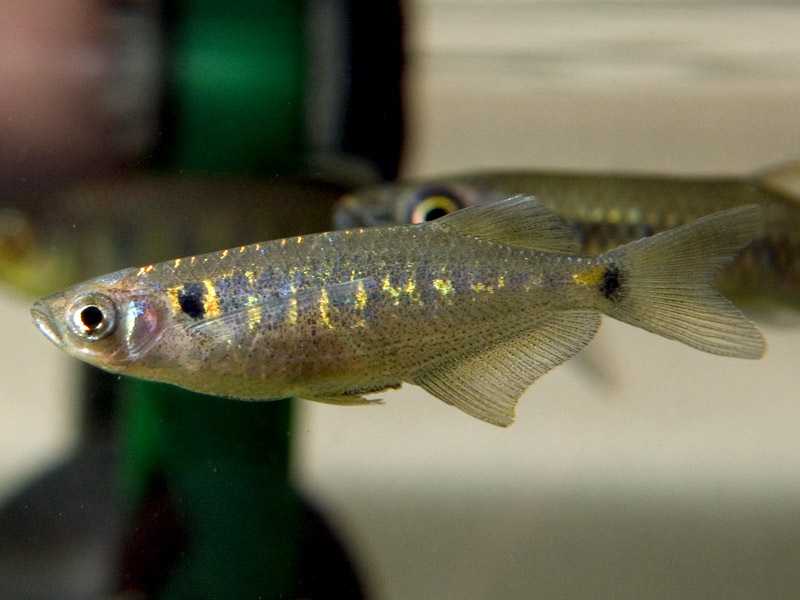
Laubuka laubucaIndian Glass Barb
Hamilton, 1822
Matched on the common name Indian Glass Barb
Max length60mm SL2.4in SLTank120 × 30cm48 × 12inTemp18–24°C64–75°FpH6.0–8.0Probably endemic to northern India, Bangladesh, and Nepal. Records from Sri Lanka, southern India, Myanmar, Thailand, Laos, Cambodia, Vietnam, Malaysia, and Indonesia appear to represent other species. Given the distribution of L. siamensis, it seems likely that many of the fish entering the aquarium trade are this species and not L. laubuca. The two species can be distinguished b...
Periophthalmus barbarusAtlantic Mudskipper
authority not recorded
Max length150mm SL6in SLTanknot recordedTemp25–30°C77–86°FpH7.0–8.5Due to its highly amphibious nature this must be one of the most interesting, endearing species that can be kept in aquaria. Some specimens rarely enter deep water, preferring to sit in the shallows with the body submerged and eyes protruding above the surface. Others seem to favour resting completely exposed on rocks, sand or bogwood, returning to the water periodically to wet themselves. Subdominant individuals (those that are unable to secure a favourable territory) tend to attach themselves ...