Results for “lateral”
Type a name: scientific, common, or one a species used to go by. Or narrow the catalogue with the filters.
Filters
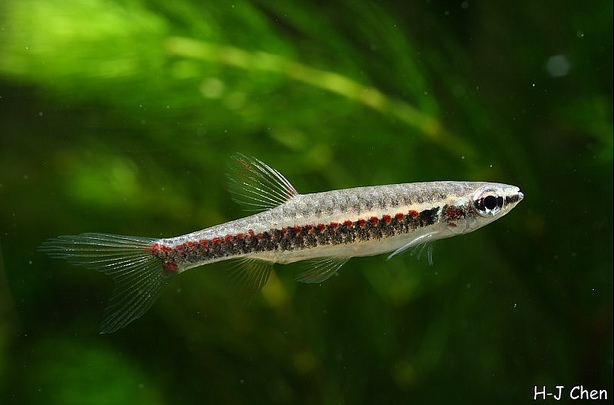
Copella nattereri
Steindachner, 1876
Max length45mm SL1.8in SLTank60 × 30cm24 × 12inTemp20–28°C68–82°FpH4.0–7.0This species is sometimes traded as C. sp. 'red line', 'spotted tetra' or as its congener C. nigrofasciata. In the past it's name was also widely applied to the fish now identified as C. callolepis and C. meinkeni, and this misidentification continues to an extent although the two are easily-distinguished by the fact that C. nattereri is the only one of the three possessing a dark lateral stripe on each side of the body.
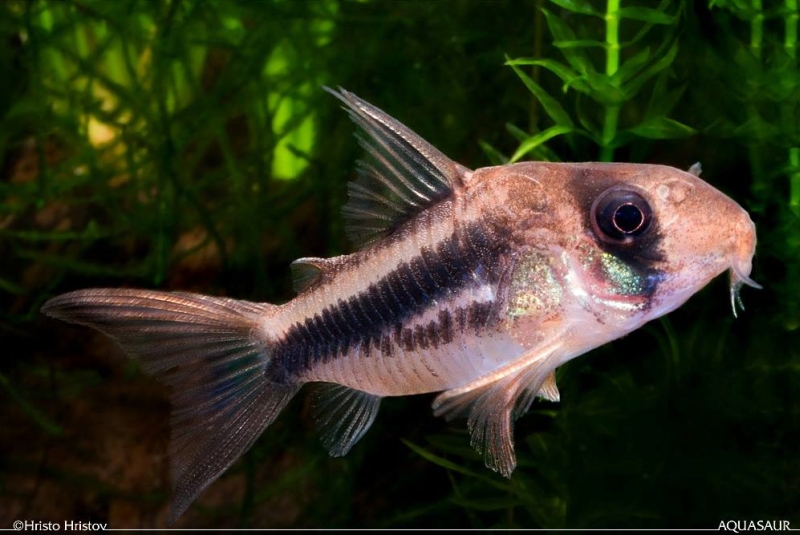
Corydoras axelrodiAxelrod's Cory
Rössel, 1962
Max length50mm SL2.0in SLTanknot recordedTemp22–26°C72–79°FpH5.0–7.0This species is somewhat variable in appearance and can have between 1-3 dark lateral stripes on each flank, for example. It's also known by the alternative common name 'pink corydoras'. It looks similar to the congener C. loxozonus plus unidentified fishes which have been assigned the codes C003 and CW021, and all four are sometimes traded under the fabricated names C. 'deckeri' or C. sp. 'decker/deker'.
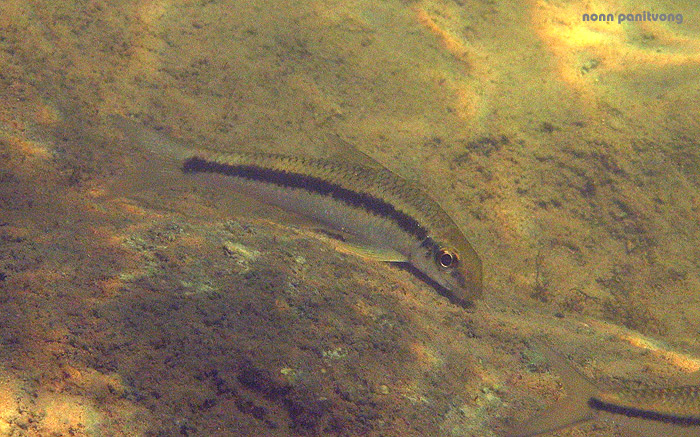
Crossocheilus burmanicus
Hora, 1936
Max length120mm SL5in SLTank150 × 45cm60 × 18inTemp20–26°C68–79°FpHnot recordedWe've been unable to obtain a diagnosis for this species to date but it can at least be distinguished from those congeners traded as 'Crossocheilus siamensis' (an invalid name synonymous with C. oblongus, which is itself of questionable identity), 'Siamese algae eater', or 'SAE' by the fact that the dark lateral stripe does not extend into the caudal-fin. Members of Crossocheilus are characterised by...
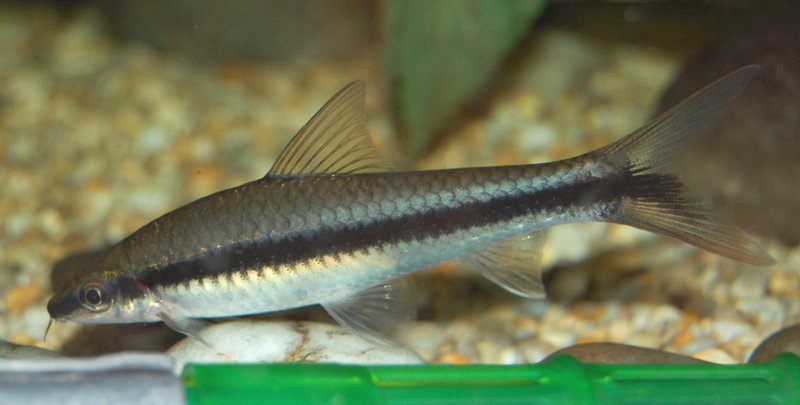
Crossocheilus nigriloba
Popta, 1904
Max length150mm SL6in SLTank150 × 45cm60 × 18inTemp20–26°C68–79°FpH6.0–7.5While separating some of the fish that may be found on sale as 'C. siamensis' is a tricky task, C. nigriloba is quite simple to identify. The dark lateral body stripe uniquely breaks up into a series of blotches when the fish are sparring, stressed or sleeping and the lower caudal fin lobe contains dark pigmentation suffused with red. The latter feature has given rise to the trade name of 'penguin flying fox'.
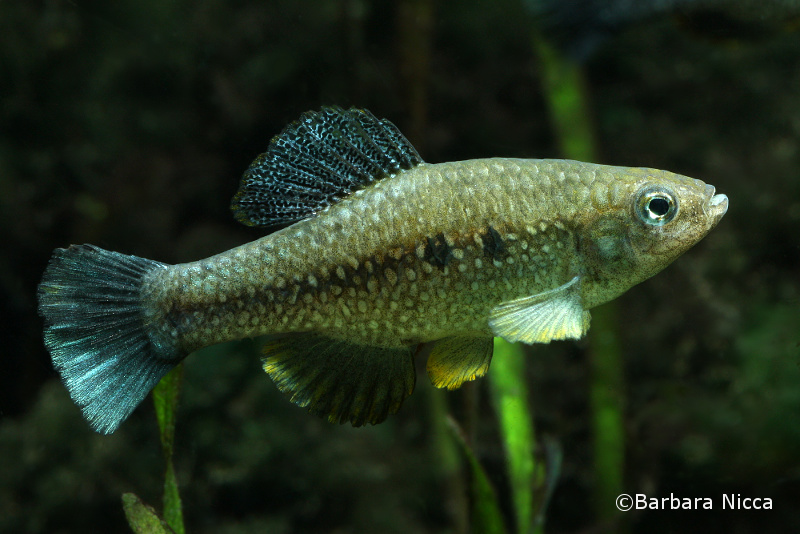
Cualac tessellatusCheckered Pupfish
Miller, 1956
Max length70mm SL2.8in SLTank60 × 30cm24 × 12inTemp20–30°C68–86°FpH7.5–8.5Endemic to a handful of natural springs in the Río Verde valley, San Luis Potosí state, Central Mexico. The valley is believed to have once been filled by a large lake and the relict springs are part of the elevated Río (river) Verde basin which later drains into the much larger Río Pánuco system. Much of the aquatic fauna found in the valley is endemic to the area but in many cases threatened by introduced species.
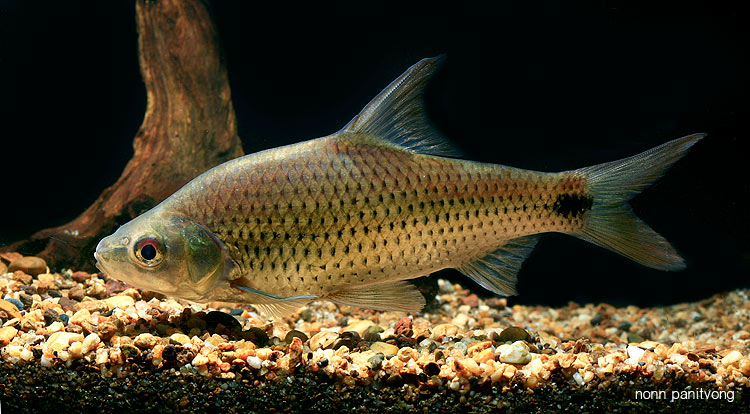
Cyclocheilichthys armatus
Valenciennes, 1842
Max length230mm SL9in SLTank180 × 60cm72 × 24inTemp20–26°C68–79°FpH6.0–8.0It can be distinguished from congeners by possessing one or two pairs of barbels, a black blotch at the base of the caudal-fin, and rows of dark spots along the lateral scale rows. Members of Cyclocheilichthys are characterised by possessing a serrated dorsal fin spine, 9 branched pelvic fin rays, a conical snout, small, subterminal...
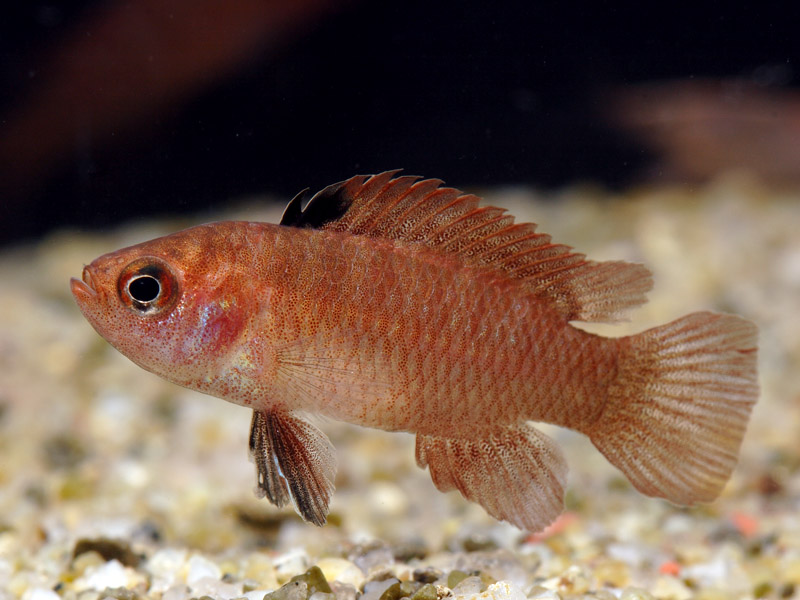
Dario hysginon
Kullander & Britz, 2002
Max length20mm SL0.8in SLTank45 × 30cm18 × 12inTemp20–24°C68–75°FpH6.5–7.5This species is traded under various names such as 'red melon Dario' or 'flame red Dario'. Among congeners D. dayingensis is most similar since it differs only in a few meristic counts and by its slightly larger adult size. D. hysginon can be told apart by possessing 22-24, usually 23, lateral scales (vs. 24-25 in D. dayingensis), 8½ (vs. 9½) scales in the transverse scale row, a...
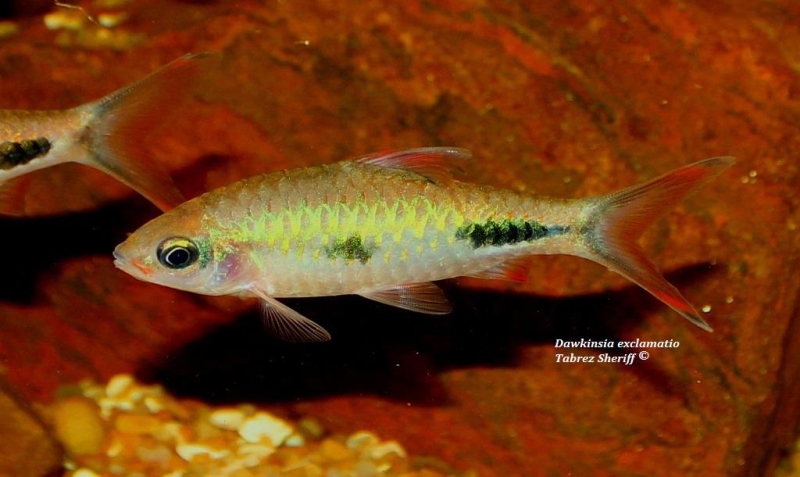
Dawkinsia exclamatio
Pethiyagoda & Kottelat, 2005
Max length100mm SL3.9in SLTank120 × 45cm48 × 18inTemp19–25°C66–77°FpH6.0–7.5There is a case, however, to suggest that D. exclamatio is not actually a distinct taxon but rather a natural hybrid between D. assimilis and a D. arulius-like fish (possibly D. rubrotinctus) which occur together at its type locality in the Kallada River at Thenmalai. The potential of hybridisation is evidenced by the somewhat intermediate colour pattern in that it possesses a (roughly) W-shaped mid-lateral blot...
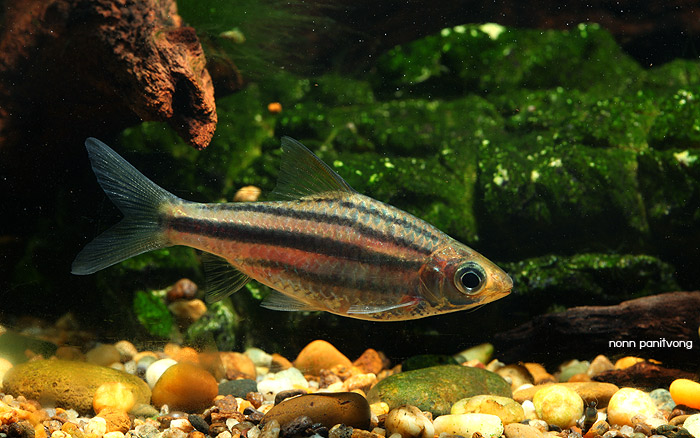
Desmopuntius johorensisStriped Barb
Duncker, 1904
Max length100mm SL3.9in SLTank120 × 45cm48 × 18inTemp20–25°C68–77°FpH5.0–7.0D. johorensis can be distinguished by the following combination of characters: 5-6 dark, lateral stripes on body in specimens larger than 40 mm; stripes immediately above and below the central stripe (stripes '+1' and '-1', respectively) located on scale rows +2 and -2, not touching dorsal and ventral midlines (except in some small specimens from Peninsular Malaysia); stripes broad, typically between 0.5-1 scale rows deep...
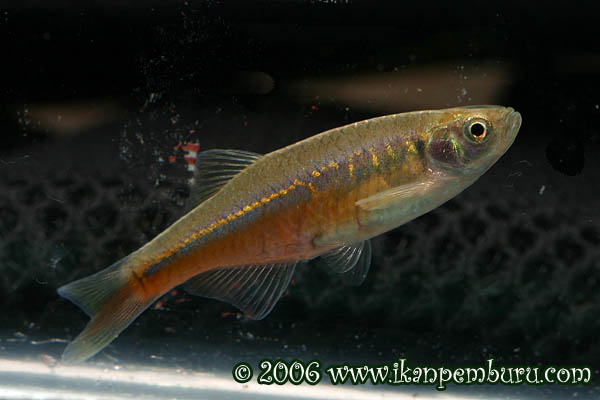
Devario chrysotaeniatus
Chu, 1981
Max length75mm SL3.0in SLTank120 × 30cm48 × 12inTemp23–26°C73–79°FpH6.0–7.0This species is poorly known and first appeared in the hobby during 2005 but has rarely been seen since, probably because its natural waters lie outside the range of most commercial collectors. It can be distinguished by a combination of characters including: lateral line complete; infraorbital process absent; two pairs of short barbels; 8-9 branched dorsal fin rays; 12-13 branched anal fin rays; P stripe originating above pelvic fin and extending to en...
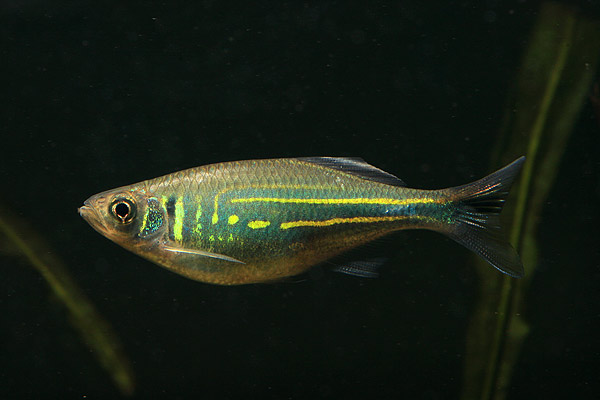
Devario malabaricusGiant 'Danio'
Jerdon, 1849
Max length80mm SL3.1in SLTank120 × 45cm48 × 18inTemp18–25°C64–77°FpH6.0–8.0This species is frequently confused with the congener D. aequipinnatus auct. but their identitities are in a state of confusion, particularly that of the latter. There are however a handful of characters which separate these two nominal species from one another. D. malabaricus possesses a moderately deep body, 35-38 scales in the lateral se...
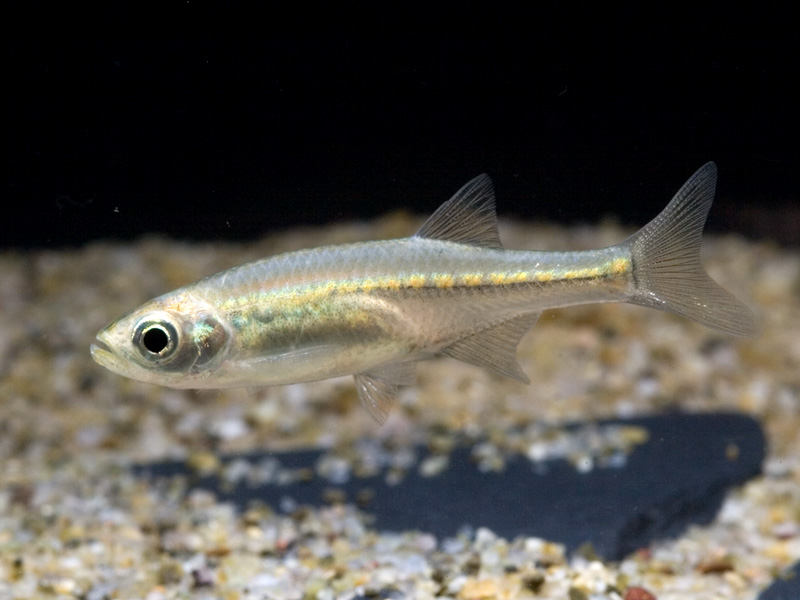
Devario sp. 'purple cypris'
authority not recorded
Max length45mm SL1.8in SLTank75 × 30cm30 × 12inTempnot recordedpHnot recordedThis unidentified species has only appeared in the aquarium trade on a handful of occasions and it has been widely misidentified as Devario jayarami (Barman, 1984). It differs from D. jayarami by possessing 9-10 lateral bars which progressively increase in size posteriorly (vs. 12-13 bars which decrease in size posteriorly), 12 anal-fin rays (vs. 15-16) and a blunter head profile with a lack of convexity behind the head (vs. head profile conical with noticeable convexity behind the head).
Dianema longibarbisPorthole Catfish
authority not recorded
Max length100mm SL3.9in SLTank90 × 38cm36 × 15inTemp24–28°C75–82°FpH5.5–7.5So named because of the row of spots running along the lateral line, the porthole cat is a good community species. Newly imported fish tend to be a little delicate and are susceptible to disease. This is at least in part because all specimens sold for the trade are wild caught. Once acclimatised, it usually proves very hardy and can be exceptionally long-lived for a fish of this size, having the potential to survive for over 10 years....
Dimidiochromis compressicepsMalawi Eye-Biter
authority not recorded
Max length250mm SL10in SLTank150 × 38cm60 × 15inTemp23–28°C73–82°FpH7.5–8.8D. compressiceps is an ambush predator in nature, its laterally compressed shape and head-down hunting position allowing it to remain hidden among Vallisneria beds and making it tricky to spot in open water. It has a dark stripe running from the snout along the back to the tail which serves to provide further camouflage. Despite its common name, it does not prey solely on the eyes of other species, preferring to hunt small fish (particularly juvenile Copadichromis sp.). It swallows these tai...
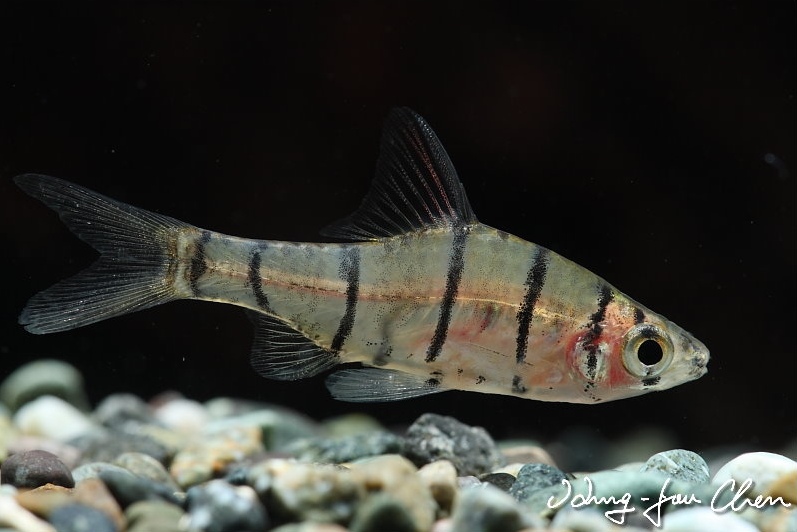
Eirmotus octozona
Schultz, 1959
Max length36mm SL1.4in SLTank60 × 30cm24 × 12inTemp22–26°C72–79°FpH5.0–7.0E. octozona can be told apart from congeners by the following combination of characters: bar 1 present; presence of a large and distinct black mark anterior to anus, visible in lateral and ventral views; simple dorsal-fin rays black, sometimes extending onto first branched ray; other rays hyaline or with diffused chromatophores on last dorsal-fin ray, adjacent to upper extremity of bar 6; 25-31 serrae on last simple dorsal-fin ray; uppermost ray of pectoral-fin with faint black margin; width of bar 5 equal to 1-1½ lat...
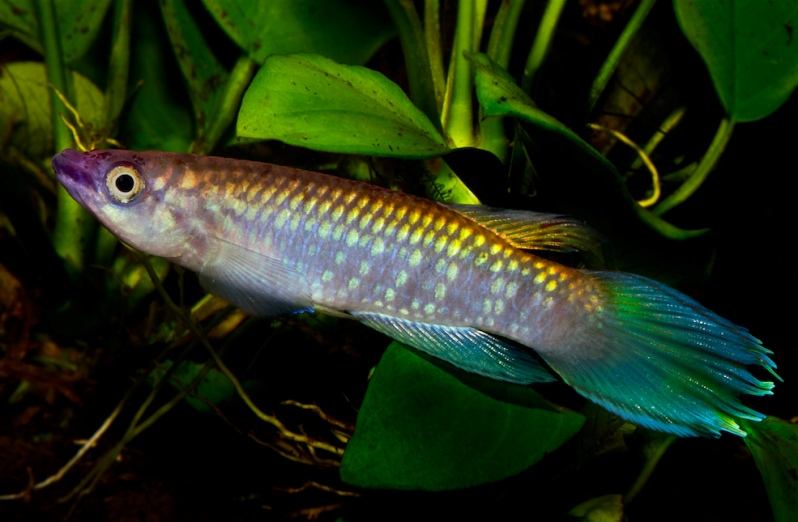
Epiplatys fasciolatusBanded Epiplatys
Günther, 1866
Max length80mm SL3.1in SLTank80 × 30cm31 × 12inTemp20–27°C68–81°FpH5.0–7.0Native to northwestern Africa with a range extending southwards from Guinea-Bissau through coastal parts of Guinea and Sierra Leone as far as western Liberia, around the city of Monrovia. Type locality was originally given as 'Sierra Leone' and 'Upper Nile' but this was later changed to 'Freetown, 8°30'N, 13°15'W, Sierra Leon', referring to the capital of Sierra Leone.
Eretmodus cyanostictusStriped Goby Cichlid
authority not recorded
Max length80mm SL3.1in SLTank90 × 30cm36 × 12inTemp24–28°C75–82°FpH8.0–9.0Also known as the Tanganyikan Clown, this is one of the so-called Tanganyikan goby cichlids. They occur only in the upper few feet of water around rocky shores, also known as the surge zone, where they scrape algae from the rocks with their specialised teeth. This habitat is typified by breaking waves and strong currents. They have a few adaptations allowing them to inhabit such an environment. The swim bladder is rendered useless to reduce their buoyancy. They also have a longand a laterally co...
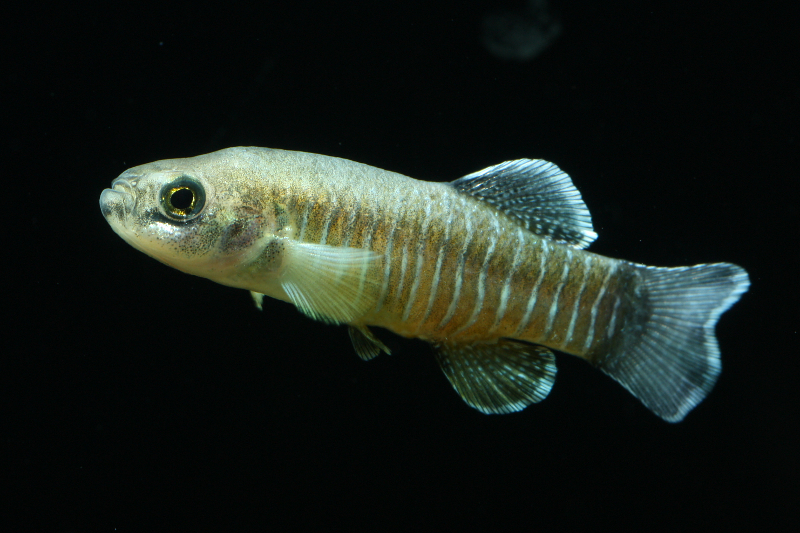
Esmaeilius arakensisArak Toothcarp
Teimori, Esmaeili, Gholami, Zarei, & Reichenbacher, 2012
Max length35mm SL1.4in SLTank120 × 30cm48 × 12inTemp8–32°C46–90°FpH7.0–8.5This species was available in the aquarium hobby for a number of years prior to publication of the official description and was generally referred to as A. sp. 'Namak' or A. sp. 'Namak River'. It can be distinguished from other members of the genus by the following combination of characters: 10–12 anal-fin rays; 28–32 lateral line scales, 10–13 caudal peduncle scales; 8–10 gill rakers; 12–19, commonly 1...
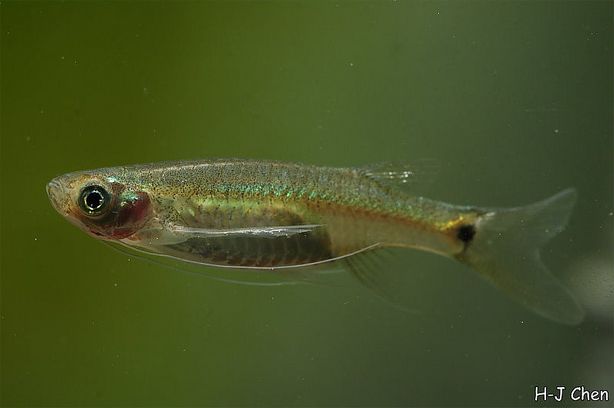
Esomus caudiocellatus
Ahl, 1924
Max length40mm SL1.6in SLTank120 × 30cm48 × 12inTemp20–26°C68–79°FpHnot recordedE. caudiocellatus can be told apart from congeners by lacking a dark lateral stripe and possessing a prominent dark marking on the caudal peduncle. In recent years a number of phylogenetic studies involving Esomus and its near relatives have been conducted and conflicting results published. For example a 2003 study by Fang et al. concluded that the genus is the sister group, i.e., most closely-related to...
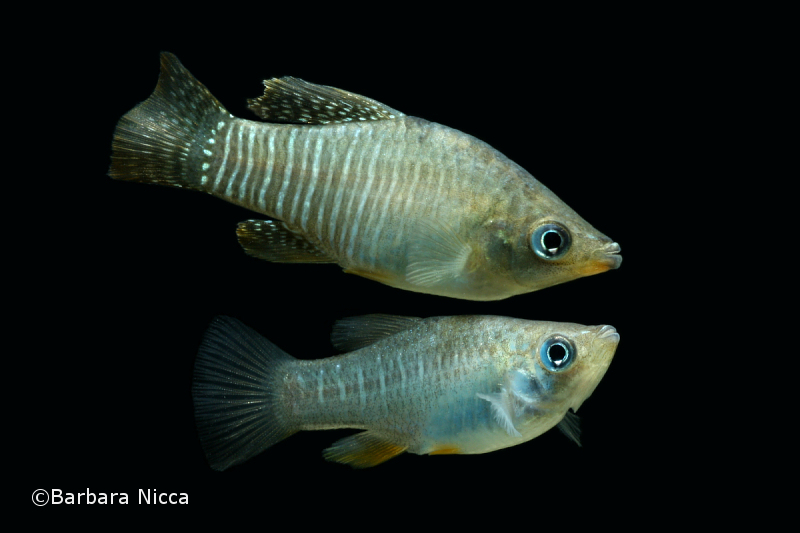
Fundulus xenicusDiamond Killifish
Jordan & Gilbert, 1882
Max length50mm SL2.0in SLTanknot recordedTemp21–35°C70–95°FpH7.5–9.0This species is not a common aquarium species but is occasionally available from specialist retailers or breeders. It was initially named Adinia multifasciata by Girard (1859) before later being redescribed as Fundulus xenicus (mispelled 'Fundnlus') by Jordan and Gilbert (1882). Body stout and trapezoidal in adults, body depth usually 2 to 3 times in standard length; scales large, fewer than 30 scales along midlateral scale row...