Results for “species name”
Type a name: scientific, common, or one a species used to go by. Or narrow the catalogue with the filters.
Filters
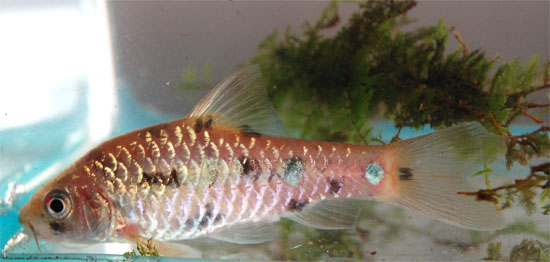
Barbodes everetti
Boulenger, 1894
Max length120mm SL5in SLTank120 × 45cm48 × 18inTemp18–28°C64–82°FpH6.0–7.0This species is uncommon in the aquarium hobby, although the scientific name is widely misapplied to Barbodes dunckeri, a similar-looking species native to Peninsular Malaysia and Singapore commonly referred to as 'clown barb' and labelled as B. everetti in the majority of available literature. The two are quite easy to tell apart, with B. everetti an overall less...
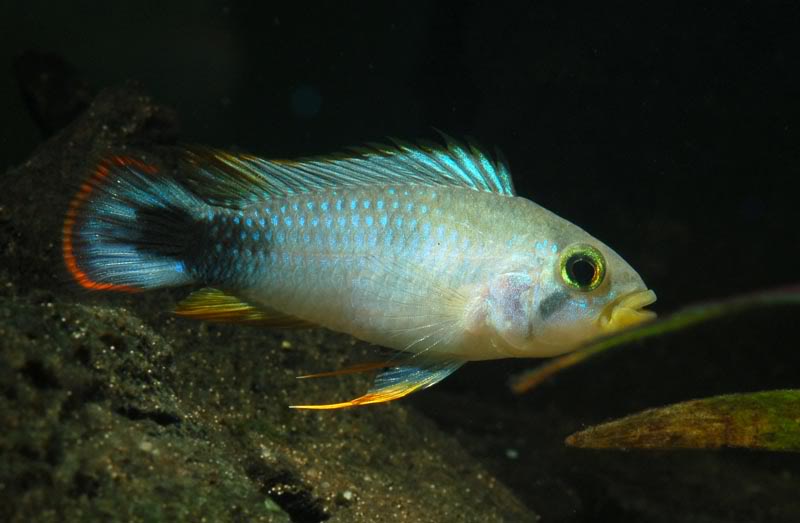
Apistogramma panduro
Römer, 1987
Max length♂ 75 · ♀ 55mm SL♂ 3.0 · ♀ 2.2in SLTank60 × 30cm24 × 12inTemp22–29°C72–84°FpH4.0–6.5This species is also known by the alternative vernacular names 'blue panda cichlid', 'blue sky dwarf cichlid and 'azure cichlid' as well as the confusing trade name A.sp. 'pandurini'. It has also been assigned the 'A' number A183 under the DATZ system with possibly conspecific, related forms similarly numbered A184 or A185 depending on locality. It can be distinguished from similar-looking species by the length of the lower jaw which characte...
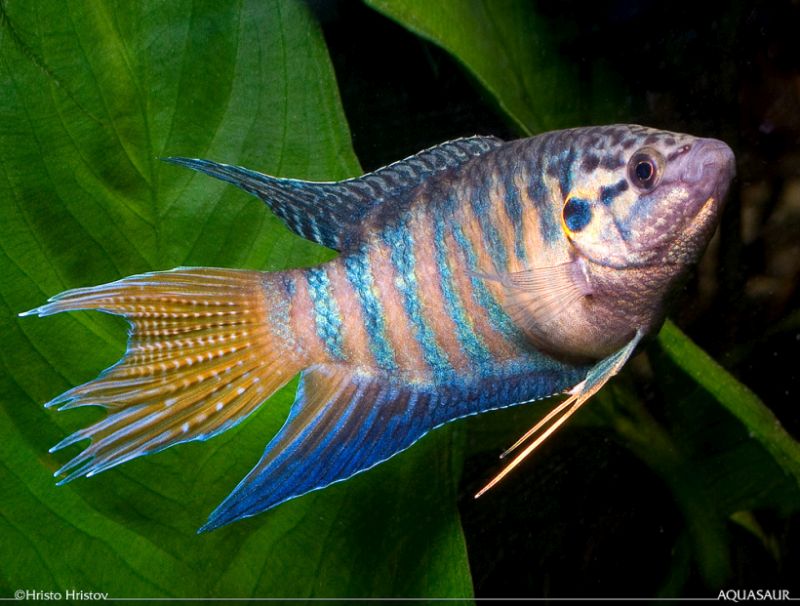
Macropodus opercularisParadise Fish
Linnaeus, 1758
Max length80mm SL3.1in SLTank80 × 30cm31 × 12inTemp10–22°C50–72°FpH6.0–8.0M. opercularis is a classic aquarium fish, having been introduced to the hobby by a French soldier named Gerault in 1869. Of the initial 100 specimens shipped, 22 survived and were successfully bred later that same year by another Frenchman, the Parisian Pierre Carbonnier. This gives the species the distinction of being one of the very first ornamental fish imported to Europe. It is also known as 'Chinese fighting fish', 'paradise gourami', and 'blue paradise fish'.
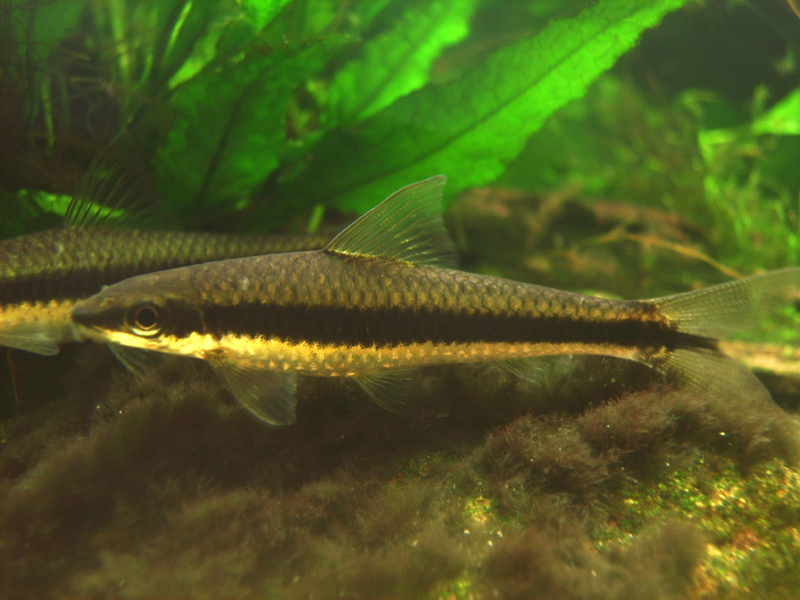
Crossocheilus langeiSiamese Algae Eater
Bleeker, 1860
Max length150mm SL6in SLTank150 × 45cm60 × 18inTemp20–26°C68–79°FpH6.0–7.5C. oblongus is another name widely misused in the trade but that species has seemingly never been exported and was described as a blueish fish with yellow fins. It's native to streams of Gunung Salak mountain in Bogor Regency, West Java, Indonesia where collecting of ornamental fishes is almost non-existent. Other species of laterally-striped Crossocheilus also exist and may be available from time-to-time but are more easily told apart from the group described above.
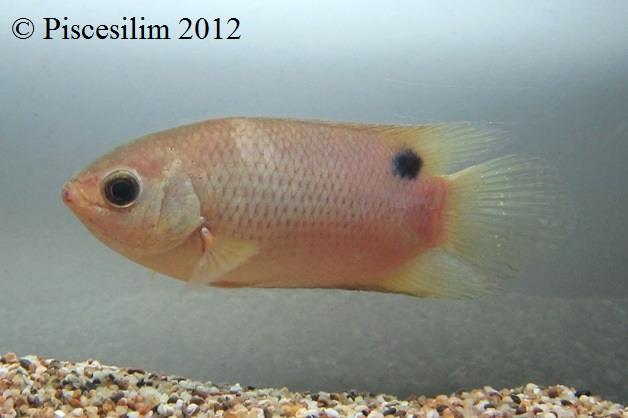
Belontia hasseltiJava Combtail
Cuvier, 1831
Max length200mm SL8in SLTank120 × 30cm48 × 12inTemp21–26°C70–79°FpH4.5–8.5This species is also referred to by the vernacular name 'Malay combtail'. In terms of external characters it differs most obviously from its only congener, B. signata by its overal brownish grey (vs. reddish) body colouration and presence of a mosaic-type patterning in the unpaired fins (vs. absence). The position of relatedness of the genus Belontia with respect to other anabantoids remains somewhat...
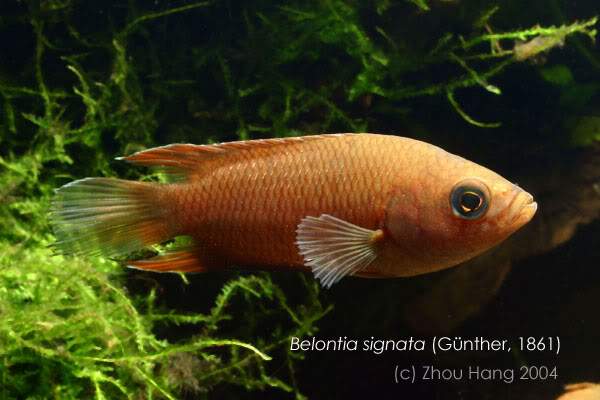
Belontia signataCeylonese Combtail
Günther, 1861
Max length120mm SL5in SLTank120 × 30cm48 × 12inTemp20–27°C68–81°FpH6.0–7.5This species is also traded/referred to by the vernacular name 'Ceylon fighting fish'. It differs from its only congener, B. hasselti, by its overall reddish (vs. brownish-grey) body colouration, and absence (vs. presence) of a mosaic-like patterning in the unpaired fins. At least three putative phenotypes have been recorded. The nominative, and commonest, mostly inhabits clear streams in rainier zones...
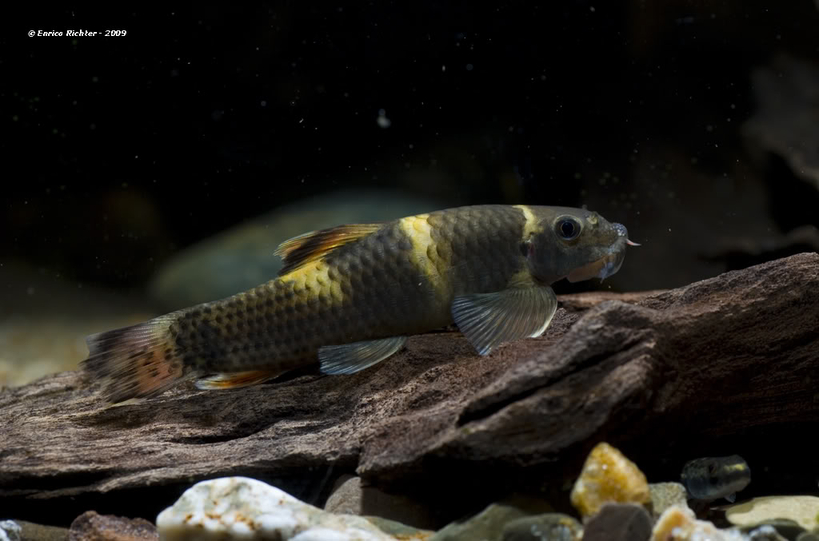
Garra flavatraPanda Garra
Kullander & Fang, 2004
Max length90mm SL3.5in SLTank90 × 30cm36 × 12inTemp22–27°C72–81°FpH6.5–7.5Garra species are usually included in the subfamily Labeoninae/Cyprininae (name varies with author) which by current thinking is further divided into several tribes and subtribes (Stiassny and Getahun, 2007). The putatively monophyletic subtribe Garraina comprises Garra plus numerous other genera including the well-known Crossocheilus and Epalzeorhynchos. Within this division their closest relatives are members of Discogobio, Discocheilus and Placocheilus (the lat...
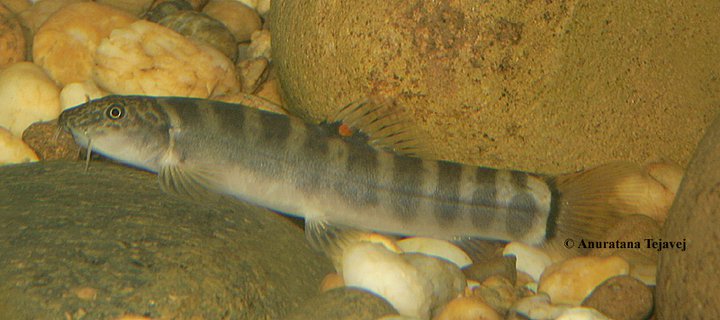
Schistura nicholsi
Smith, 1933
Max length74mm SL2.9in SLTank120 × 30cm48 × 12inTemp20–26°C68–79°FpH6.0–7.5This species is sometimes traded for aquaria but its name also appears to have been widely misapplied to other fishes. It can be identified via the following combination of characters: presence of 8-10 quite regular dark bars...
Dermogenys pusillaWrestling Halfbeak
authority not recorded
Max length55mm SL2.2in SLTank60 × 38cm24 × 15inTemp24–28°C75–82°FpH6.5–8.0Halfbeaks derive their common name from the elongated lower jaw shared by all species. The 'wrestling' moniker given to this particular species is due to the tendency of males to fight with each other, often locking jaws in the process. It is used as a fighting fish in some of its native countries, with wagers being placed on the outcome of fights between males. The two fish are placed in a small container for fighting purposes, as they will spar incessantly in such confined conditions...
Melanotaenia trifasciataBanded Rainbowfish
authority not recorded
Max length150mm SL6in SLTank120 × 30cm48 × 12inTemp24–33°C75–91°FpH6.5–8.0M. trifasciata exhibits a wide variation in colour and patterning depending on locality, and it's very important that the different morphs are not mixed in the aquarium, as they will hybridise freely. These different forms are often distinguished by the addition of the name of collection locality being added to the scientific name of the fish. It's thought that several species may in fact be in evidence here, and a reclassification will probably occur at some point As with many othe...
Thayeria ifatiHalf-striped Penguin Tetra
authority not recorded
Max length50mm SL2.0in SLTank60 × 38cm24 × 15inTemp23–28°C73–82°FpHnot recordedThere are only three species in the genus Thayeria, of which T. ifati is the least often seen in the hobby. This is a shame as it's a very pretty little fish. The holotype was collected from the upper Rio Maroni, close to the settlement of Gaa Kabaon on the French Guiana/Suriname border by the famous ichthyologist Jacques Géry in 1957. Géry also described the species in 1959. Of its congeners, it was the type species T. obliqua that was originally given the common name of &quo...
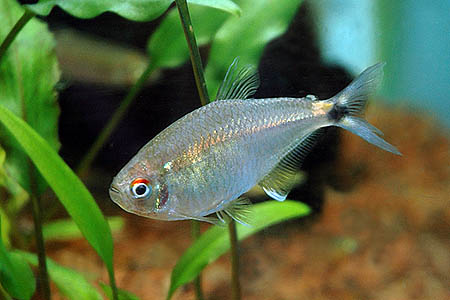
Astyanax bimaculatusTwo Spot Astyanax
Linnaeus, 1758
Max length150mm SL6in SLTank120 × 60cm48 × 24inTemp20–28°C68–82°FpH5.5–7.5A. bimaculatus is not a popular aquarium fish but is available on occasion exception, most often as a contaminant among shipments of other species. It's identity is also in question to an extent with the name currently applied to what is considered to represent a species complex comprising at least four taxa.
Pseudanos trimaculatusThree-spot Headstander
authority not recorded
Max length125mm SL5in SLTanknot recordedTemp23–27°C73–81°FpH6.0–7.5This species was formerly known as Anostomus trimaculatus and this name is still used in much of the available literature. It is now invalid, however. The genus Pseudanos contains 3 other known species, P. gracilis, P. irinae and the recently described P. winterbottomi. Care for these species is as for P. trimaculatus....
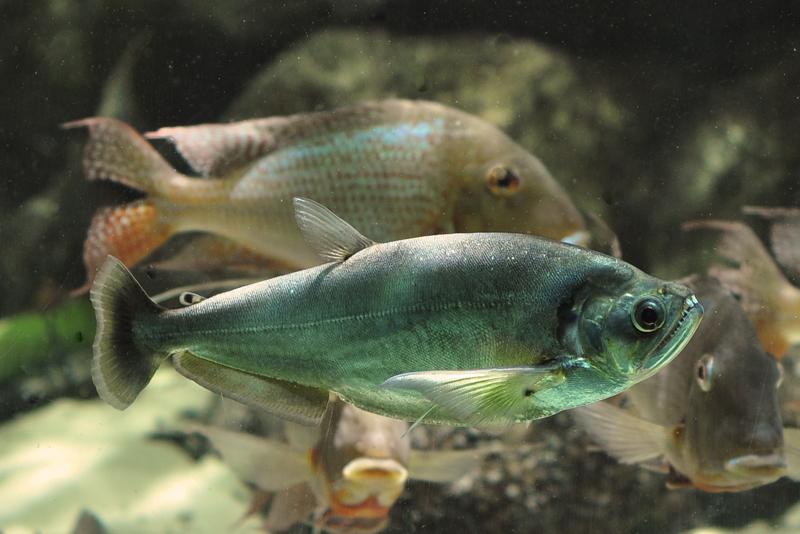
Hydrolycus scomberoidesVampire Tetra
Cuvier, 1819
Max length300mm SL12in SLTank210 × 75cm84 × 30inTemp24–28°C75–82°FpH6.0–8.0This species may be referred to using a variety of names including 'scomb', 'sabre tooth tetra', 'sabre tusk barracuda', 'dog tooth characin, 'vampire fish', 'Cachorra' or Pirandirá (the latter two names being used in Brazil where they're also applied to congeners). It's regularly confused with the payara, H. armatus, though that species grows considerably larger, is pop...
Thayeria boehlkeiFalse Penguin Tetra
authority not recorded
Max length36mm SL1.4in SLTank60 × 38cm24 × 15inTemp22–28°C72–82°FpHnot recordedThere are only three species in the genus Thayeria, of which T. boehlkei is by far the most popular in the hobby. Of its congeners, it was the type species T. obliqua that was originally given the common name of "penguin" fish or tetra, although T. boehlkei is usually sold under the same name (we've also seen it on sale as "hockeystick" tetra). The two are easy to tell apart, as in T. boehlkei the thick black stripe extending from the lower lobe of the travels laterally ...
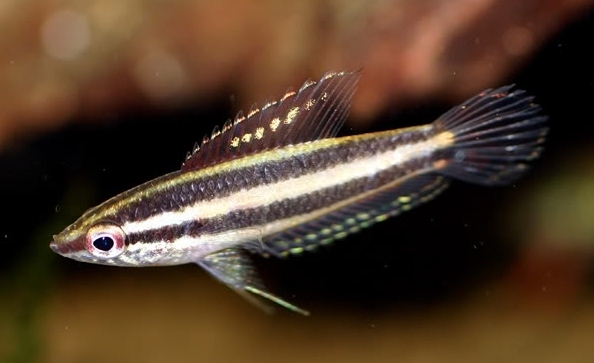
Parosphromenus bintan
Kottelat & Ng, 1998
Max length26mm SL1.0in SLTank40 × 20cm16 × 8inTemp22–28°C72–82°FpH3.0–6.5This species is not generally available in the aquarium hobby on a commercial basis but is occasionally collected and distributed by private aquarists. It's name is sometimes misapplied to commercial shipments of other species, and there also exist a number of other fish with rounded caudal-fins that may or may not be conspecific, including P. sp. 'blue line' and P. sp. 'Selatan' from Sumatra.
Inpaichthys kerriPurple Emperor Tetra
authority not recorded
Max length35mm SL1.4in SLTank60 × 38cm24 × 15inTemp24–27°C75–81°FpH5.5–7.0This pretty little species can be seen for sale with various common names, including the 'blue emperor', 'regal' or 'royal' tetra. It's sometimes confused with the emperor tetra, Nematobrycon palmeri but can be easily distinguished as it possesses an adipose fin, whilst Nematobrycon species do not. The genus Inpaichthys is currently monotypic (contains only one species), and like other related genera such as Hyphessobrycon its taxonomic status is Incertae s...
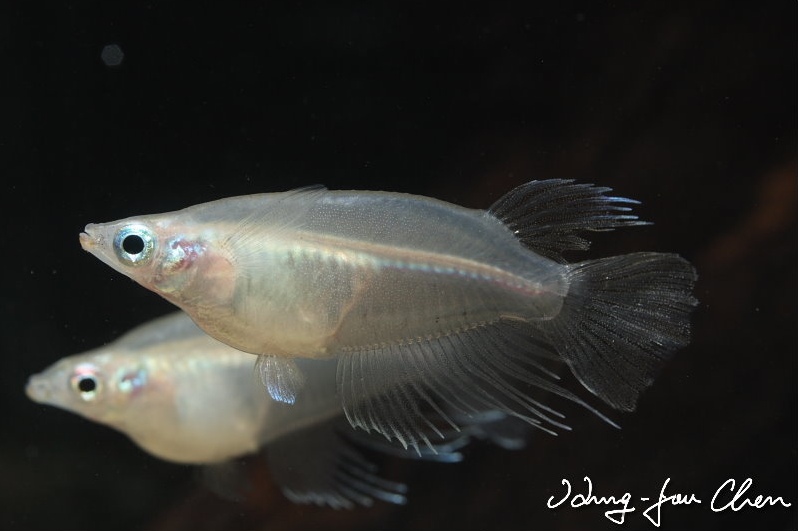
Oryzias dancenaIndian Ricefish
Hamilton, 1822
Max length35mm SL1.4in SLTank45 × 30cm18 × 12inTemp23–27°C73–81°FpH6.5–8.5This species continues to be mislabelled as O. melastigma, a name currently considered invalid by the majority of recent workers, or O. javanicus, a valid but distinct taxon. Roberts (1998) demonstrated that MClelland's description of Aplocheilus melastigmus, later renamed O. melastigma, does not correspond with any known Oryzias species from the Indian subcontinent or Myanmar since it's said to have a dark spot in the dorsal-fin and an excessively slim body, among other anomalies.
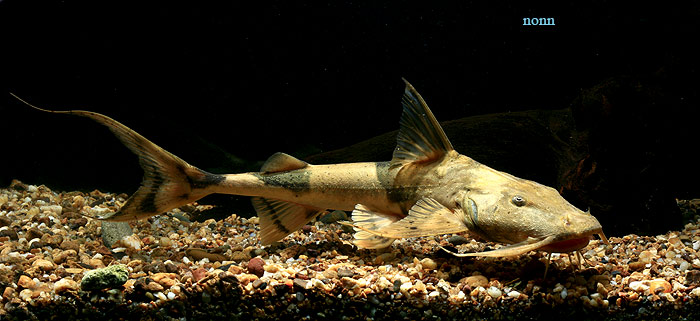
Bagarius bagarius
Hamilton, 1822
Max lengthnot recordedTanknot recordedTempnot recordedpHnot recordedThere is considerable confusion surrounding the identity of B. bagarius with its name having been widely applied to a relatively small species that is said to reach only 200 mm SL and considered to be common in northern India and much of Indochina.
Chaetostoma formosaeStriped Bulldog Pleco
Ballen, 2011
Max length105mm SL4in SLTank120 × 30cm48 × 12inTemp20–24°C68–75°FpH6.5–7.8This species is traded under a number of English vernacular names, of which some others include 'blonde bulldog pleco', 'blonde rubber pleco', 'blonde rubbernose pleco', 'striped rubber pleco', and 'striped rubbernose pleco'. It may also be seen referred to as 'L146', 'L146a', or 'L187b', these codes having been used for it in the Aqualog series of books. It can be told apart from all congeners except C. anale and C. jegui by...