Results for “congener”
Type a name: scientific, common, or one a species used to go by. Or narrow the catalogue with the filters.
Filters
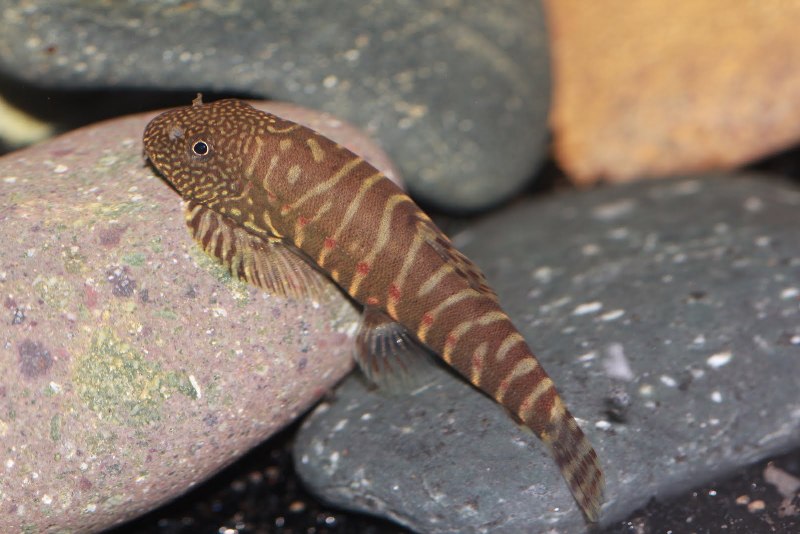
Erromyzon sp. 'ER02'
authority not recorded
Max length50mm SL2.0in SLTank60 × 30cm24 × 12inTemp18–24°C64–75°FpH6.5–8.0This fish remains in need of identification, and we've chosen to list unidentified members of the genus using an 'ER' numbering system in the absence of definitive information. It's quite easy to distinguish from congeners since it's the only species known to possess a colour pattern comprising a dark base colour and series of thin, paler vertical bars on the body and similarly-coloured spots on the head.
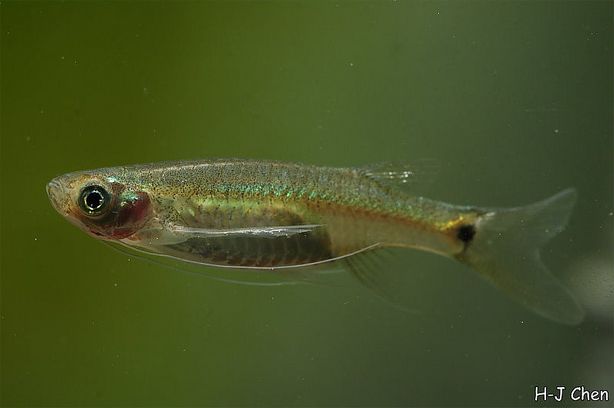
Esomus caudiocellatus
Ahl, 1924
Max length40mm SL1.6in SLTank120 × 30cm48 × 12inTemp20–26°C68–79°FpHnot recordedE. caudiocellatus can be told apart from congeners by lacking a dark lateral stripe and possessing a prominent dark marking on the caudal peduncle. In recent years a number of phylogenetic studies involving Esomus and its near relatives have been conducted and conflicting results published. For example a 2003 study by Fang et al. concluded that the genus is the sister group, i.e., most closely-related to...
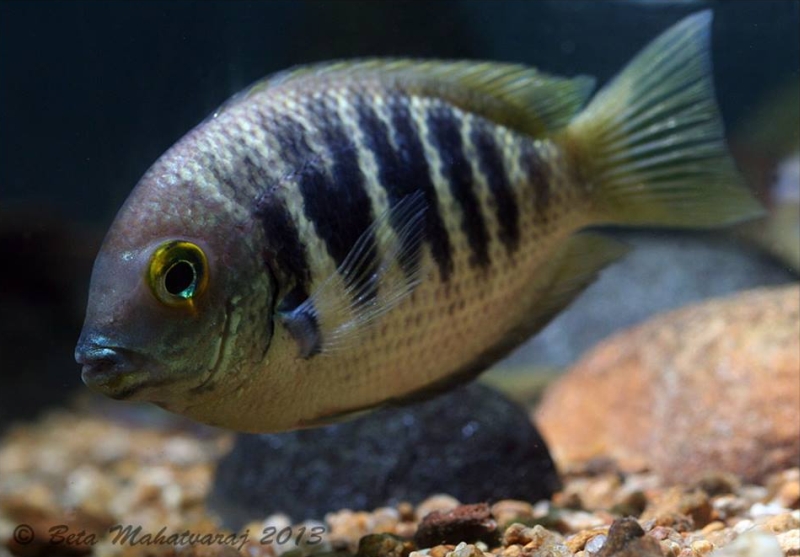
Etroplus canarensisCanara Pearlspot Cichlid
Day, 1877
Max length110mm SL4in SLTank120 × 45cm48 × 18inTemp22–32°C72–90°FpH6.0–7.5Etroplus is the only cichlid genus native to the Indian subcontinent and Sri Lanka and currently comprises three species among which E. canarensis is uniquely limited to freshwater and restricted in range. Its congeners E. maculatus and E. suratensis are both euryhaline inhabiting estuaries, coastal lagoons and the lower reaches of rivers around coastlines of western and southern India plus northern Sri Lanka.
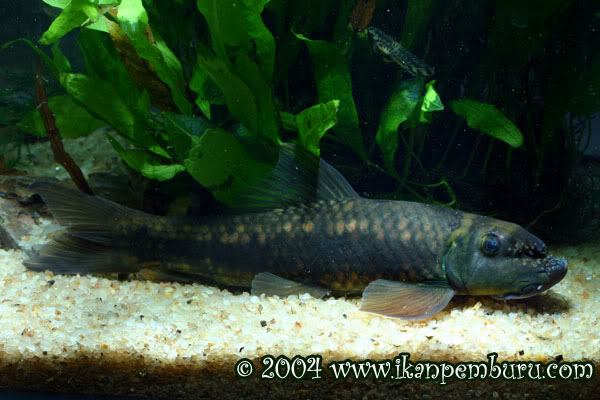
Garra bispinosa
Zhang, 2005
Max length130mm SL5in SLTanknot recordedTempnot recordedpHnot recordedG. bispinosa can be distinguished from all other congeners in Southeast Asia and China by the following combination of characters: a conspicuous, quadrate, anteriorly-directed proboscis orientated ventrally against the snout and anteriorly adorned with a single, large, uniscupid, acanthoid tubercle on the distal tip of each lobe; snout with a deep groove across its tip to form a transverse lobe; 34-35 lateral...
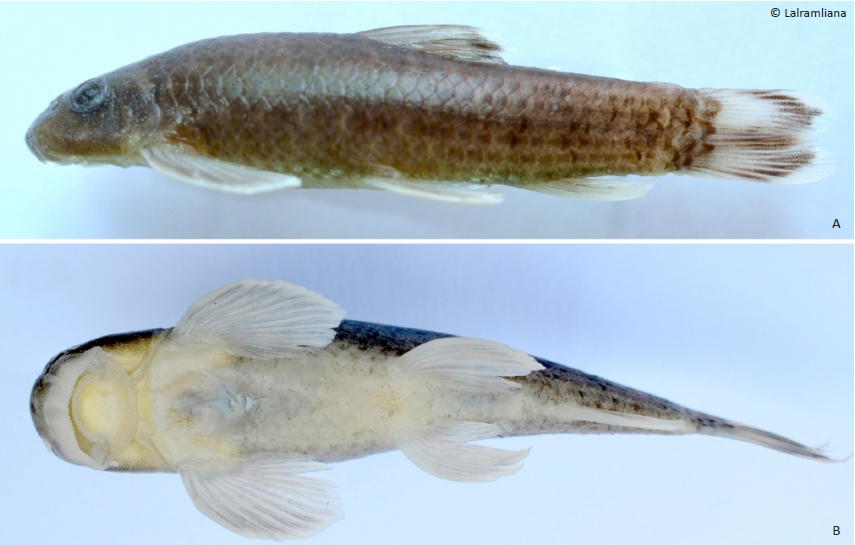
Garra dampaensis
Laironunga, Lainuntluanga & Lairamliana, 2013
Max length55mm SL2.2in SLTanknot recordedTempnot recordedpHnot recordedThis species can be told apart from Indian congeners by the following combination of characters: no transverse groove or proboscis on the snout; tip of dorsal fin falcate; long axillary scale present at the base of pelvic fin, reaching base of last pelvic fin ray; 27–29 lateral-line scales, 10–11 regularly arranged predorsal scales; W-shaped black band across middle of caudal fin; presence of scales on the abdomen.
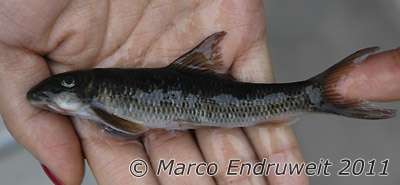
Garra imberba
Garman, 1912
Max length120mm SL5in SLTanknot recordedTempnot recordedpHnot recordedThis species can be distinguished from congeners inhabiting the Red River basin in Yunnan province, China, by the following combination of characters: no barbels; 46-52 lateral line scales; 16 circumpeduncular scales; pharyngeal teeth in 3 rows, 2.4.5-5.4.2; snout rounded, no secondary rostrum, no longitudinal...
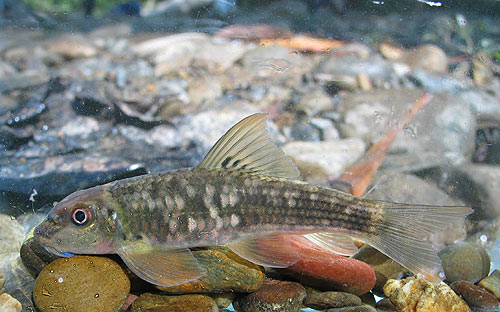
Garra notata
Blyth, 1860
Max length120mm SL5in SLTanknot recordedTempnot recordedpHnot recordedG. notata is one of a number of congeners to lack both a transverse groove and a proboscis on the snout. It also possesses 33-34 lateral line scales and a series of dark spots at the base of the dorsal-fin rays, and lacks scales on the lower portion of the body and abdomen. The genus Garra is a particularly enigmatic grouping with new taxa...
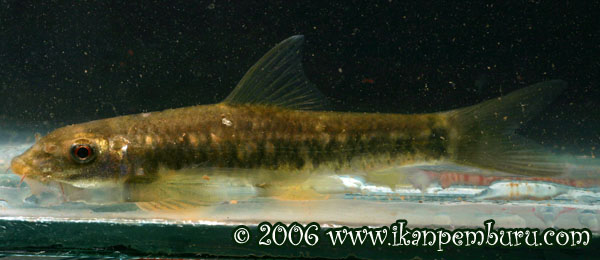
Garra qiaojiensis
Wu & Yao, 1977
Max length175mm SL7in SLTanknot recordedTempnot recordedpHnot recordedG. qiaojiensis can be differentiated from closely-related congeners by the configuration of its proboscis, which is quadrate (1.6-1.8 times wider than long), reflected downwards against the snout and heavily tuberculated anteriorly, and the relative size of its mental disc which measures 48.7-55.9 % HL.
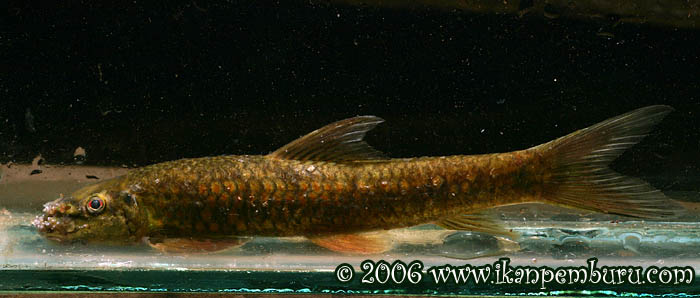
Garra rotundinasus
Zhang, 2006
Max length185mm SL7in SLTanknot recordedTempnot recordedpHnot recordedPrior to its description, G. rotundinasus was considered to represent the congener G. gravleyi, but the latter is now accepted to occur only in the Salween and Manipur river basins. These two are separated from all other Garra species in China and Southeast Asia by possession of a weakly-devel...
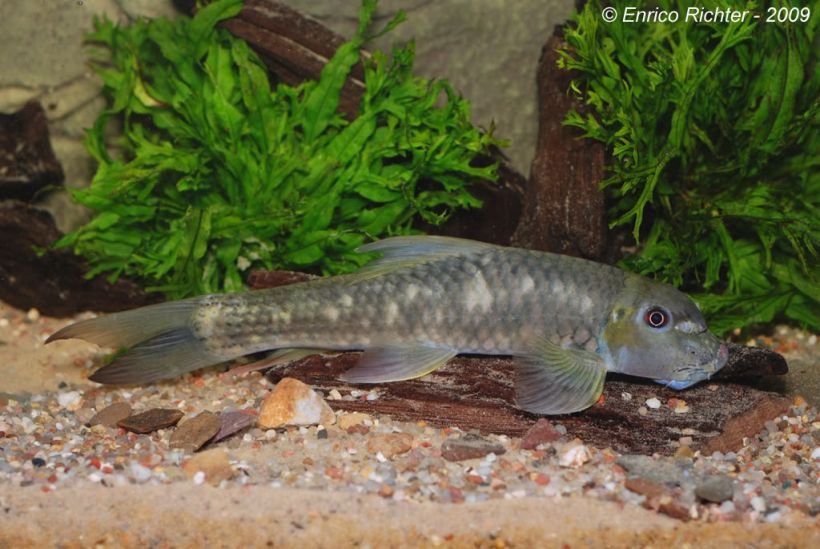
Garra salweenica
Hora & Mukerji, 1934
Max length175mm SL7in SLTanknot recordedTempnot recordedpHnot recordedG. salweenica can be distinguished from other congeners inhabiting the Salween watershed by the following combinatuion of characters: body brownish; presence of a trilobed proboscis on the snout; snout blunt; a series of black spots at the base of the central dorsal-fin rays; presence of longitudinal stripes on the posterior portion of the body; a dark marking at the tip of the upper (and lower in some specimens) caudal-fin lobe; body depth 22.4-25.3 % SL.
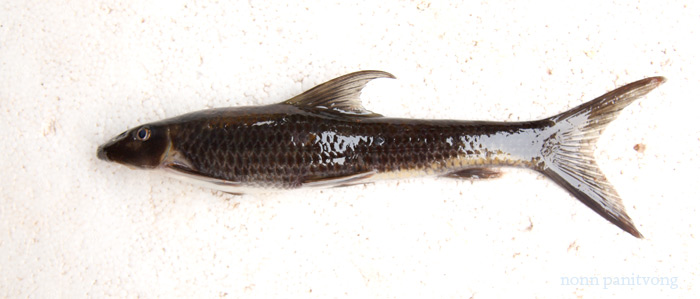
Garra theunensis
Kottelat, 1998
Max length300mm SL12in SLTanknot recordedTempnot recordedpHnot recordedThis species can be distinguished from congeners in Southeast Asia and China by the following combination of characters: plain brown body and fins, sometimes with 6-8 narrow, faintly distinct, longitudinal stripes; snout triangular in dorsal view, with small tubercules and without transverse groove...
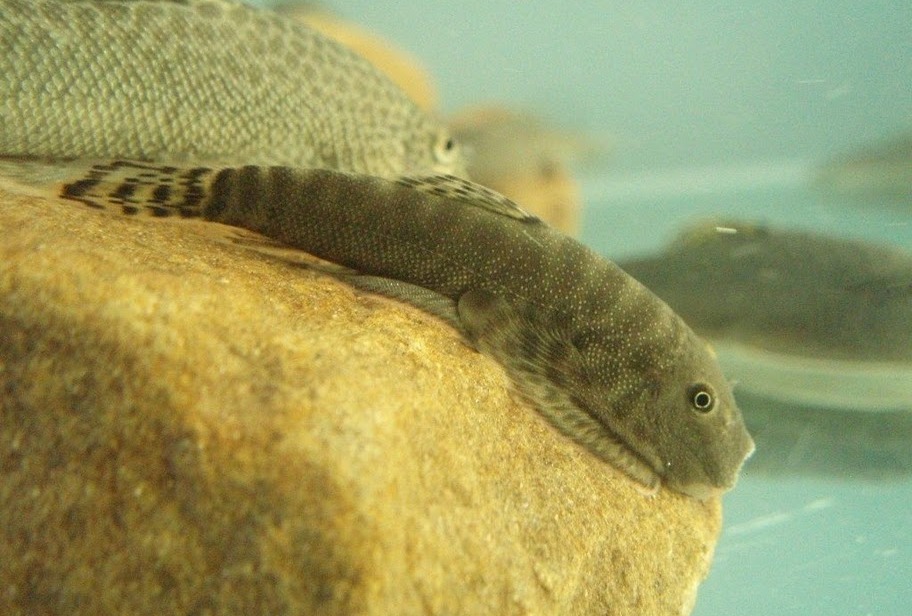
Gastromyzon cornusaccus
Tan, 2006
Max length50mm SL2.0in SLTank75 × 30cm30 × 12inTemp20–24°C68–75°FpH6.0–8.0G. cornusaccus can be distinguished from congeners by the following combination of characters: secondary rostrum present; incomplete postoral pouch present reduced to pockets located posterior to mouth corners; sublacrymal groove present and visible when viewed laterally; juveniles with thick, cream-coloured bars and blotches on body, adults uniformly-coloured; head dorsum plain; subopercular groove absent; gill slit vertical; snout truncate when viewed dorsally; no scales on abdomen; 55-61 lateral line scale...
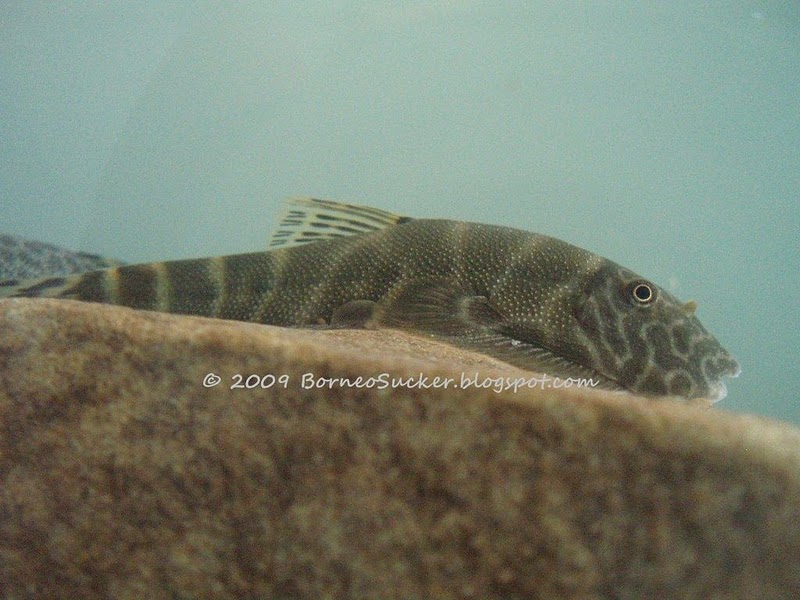
Gastromyzon extrorsus
Tan, 2006
Max length80mm SL3.1in SLTank75 × 30cm30 × 12inTemp20–24°C68–75°FpH6.0–8.0This species has probably not been seen in the aquarium trade yet but has been maintained by a few private collectors. It can be distinguished from congeners by the following combination of characters: secondary rostrum present; complete postoral pouch present; body colour brown with up to 9 thin gold stripes; head dorsum dark brown with gold reticulate pattern; subopercular groove absent; gill slit vertical; sublacrymal groove present; sno...
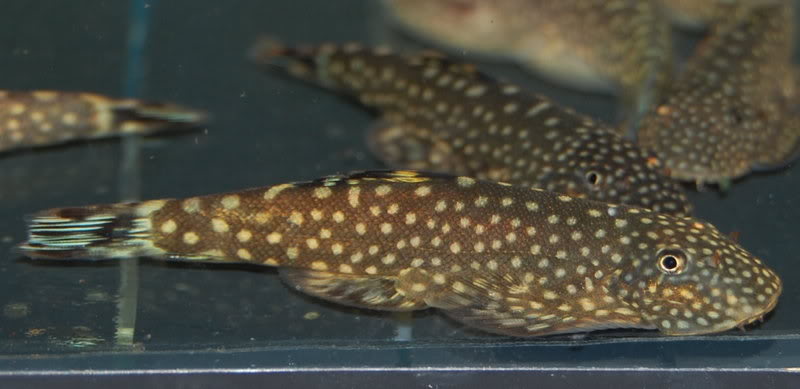
Gastromyzon scitulus
Tan & Leh, 2006
Max length45mm SL1.8in SLTank75 × 30cm30 × 12inTemp20–24°C68–75°FpH6.0–7.5It can be distinguished from congeners by the following combination of characters: gill slit angular; presence of subopercular groove, running continuous to origin of pectoral-fin; body black with numerous, small, evenly-spaced light brown spots; head dorsum black with numerous cream spots; pectoral and pelvic fins with cream spots; caudal-fin with iridescen...
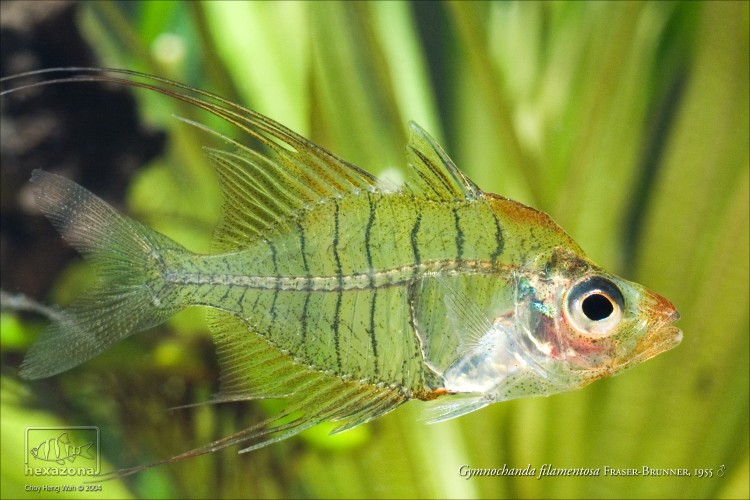
Gymnochanda filamentosa
Fraser-Brunner, 1955
Max length32mm SL1.3in SLTank60 × 30cm24 × 12inTemp20–28°C68–82°FpH4.0–6.0G. filamentosa has appeared in the ornamental trade but is evidently delicate and therefore recommended only to experienced aquarists. It can be told apart from congeners by the following combination of characters: possession of filamentous dorsal and anal-fin rays in males; body transparent to translucent yellowish-brown colour in life; absence of a highly-extended second anal-fin spine; absence of carmine-red pigmentation in the dorsal, anal an...
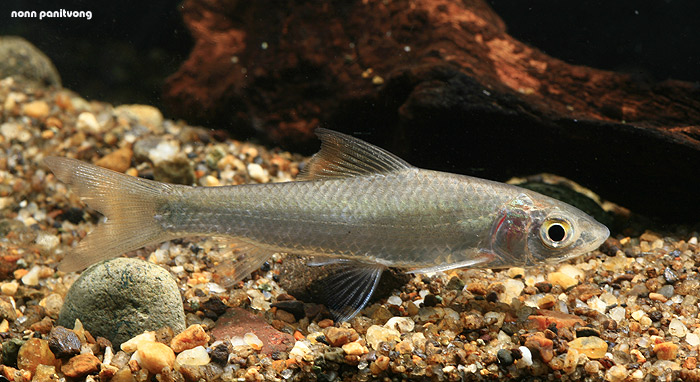
Gymnostomus lobatus
Smith, 1945
Max length150mm SL6in SLTanknot recordedTempnot recordedpHnot recordedG. lobatus can be distinguished from congeners by the following combination of characters: possession of 32-33 + 2-3 lateral line scales; 5½ scale rows between lateral line and base of dorsal-fin; body relatively slender, depth fits 3.7-4.0 times in SL; snout often projecting strongly; body plain silver in colour.
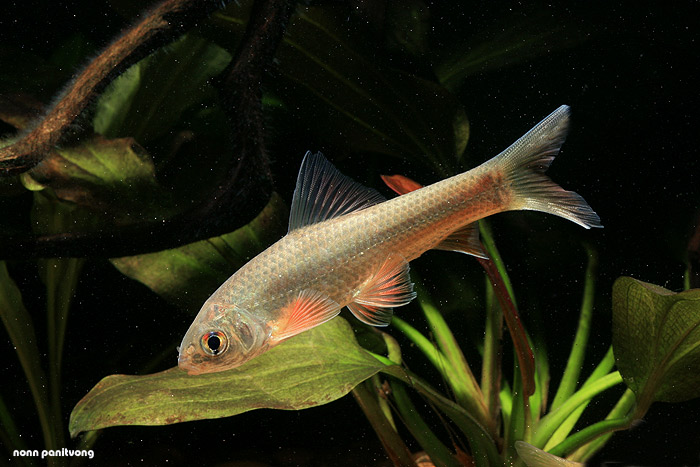
Gymnostomus ornatapinnis
Roberts, 1997
Max length100mm SL3.9in SLTanknot recordedTempnot recordedpHnot recordedG. ornatapinnis can be distinguished from congeners by the following combination of characters: head small; snout relatively short and blunt; caudal peduncle very deep; pectoral, pelvic, and anal fins usually reddish-orange or rose-tinted; pelvic and anal fins often with white tips; barbels completely absent.
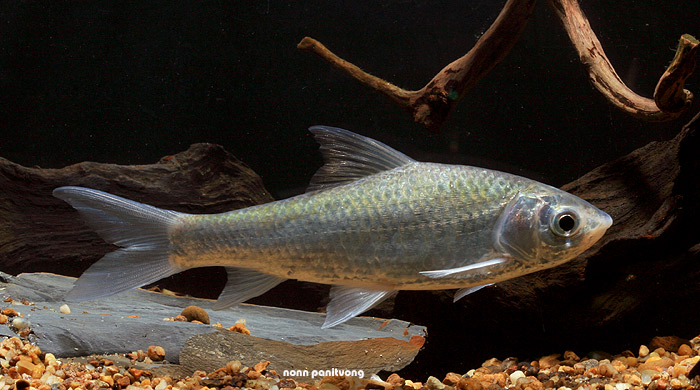
Gymnostomus siamensisSiamese Mud Carp
Sauvage, 1881
Max length150mm SL6in SLTanknot recordedTempnot recordedpHnot recordedG. siamensis can be distinguished from congeners by the following combination of characters: possession of 5½ lateral line scales; body relatively deep, depth fits 3.2-3.4 times in SL; head large and broad, width fits 5.5-6.7 times in SL; snout not or only weakly projecting; body plain silver in colour with no dark marking on caudal peduncle.
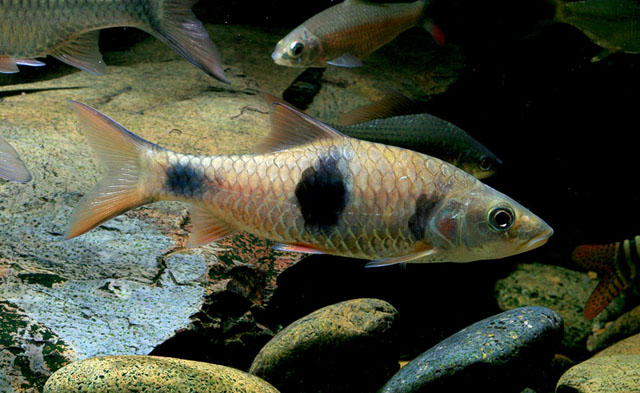
Hampala salweenensis
Doi & Taki, 1994
Max length201mm SL8in SLTank240 × 60cm96 × 24inTemp20–26°C68–79°FpH6.0–8.0This species is poorly-known in the aquarium hobby and may have never been maintained outside its native countries. It can be distinguished from congeners by the following combination of characters: 26-27 lateral line scales; two roundish, dark blotches on each flank, one beneath dorsal-fin origin and above the lateral line, the other on the caudal peduncle and passing thro...
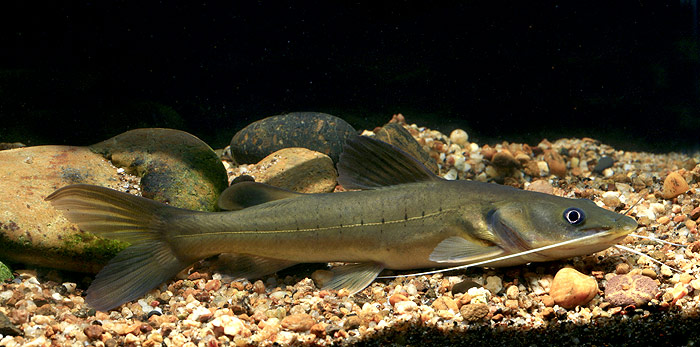
Hemibagrus peguensis
Boulenger, 1894
Max length286mm SL11in SLTanknot recordedTempnot recordedpHnot recordedMembers of this assemblage can be told apart from other congeners by possession of 44–46 vertebrae, an adipose-fin with a relatively short base (< 20 % SL), a colour pattern comprising either distinct black spots arranged in vertical columns or irregular black vertical lines running along the flanks, and normally a reddish or orangish caudal-fin in life.