Results for “lateral”
Type a name: scientific, common, or one a species used to go by. Or narrow the catalogue with the filters.
Filters
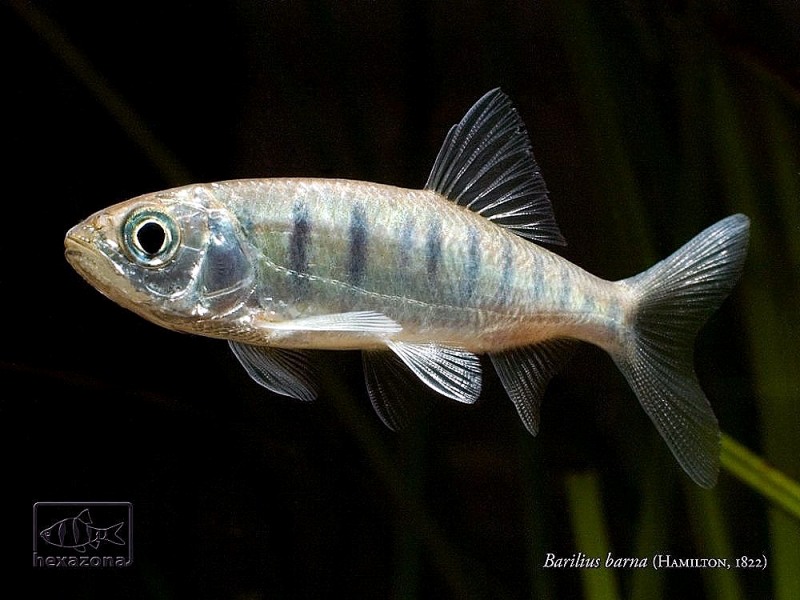
Opsarius barna
Hamilton, 1822
Max length130mm SL5in SLTank150 × 60cm60 × 24inTemp16–24°C61–75°FpH6.0–8.0This species occasionally appears in the ornamental trade, usually as 'striped hill trout' or 'banded hill trout'. It can be distinguished from congeners by the following combination of characters: lateral line complete with 40-42 scales; barbels absent; 10-13 anal-fin rays; body with 9-11 dark blue vertical bars; last dorsal-fin ray extending to caudal-fin base.
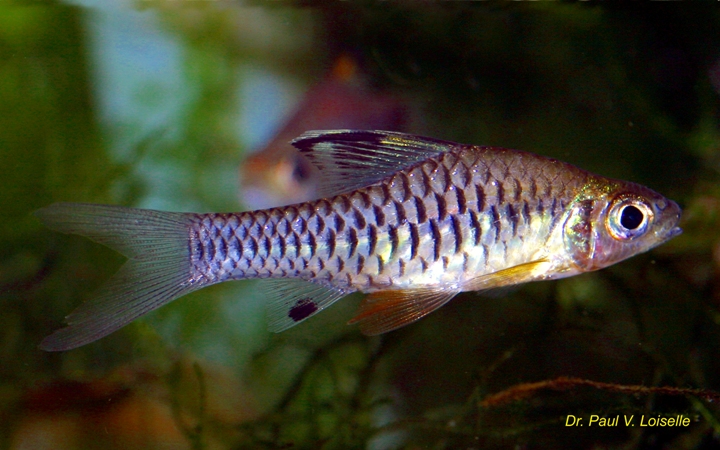
Oreichthys cosuatis
Hamilton, 1822
Max length43mm SL1.7in SLTank60 × 30cm24 × 12inTemp24–28°C75–82°FpH6.5–7.5An assortment of undescribed Oreichthys spp. from India, Myanmar and Thailand are currently traded as O. cosuatis. It can be distinguished from other described members of the genus by lacking a black blotch on the caudal peduncle, plus the following combination of characters: 2-3 perforated scales in lateral line; ½6½ between pelvic-fin origin and dorsal midline; presence of dark stripe in centre of anal-fin, forming a triangular blotch in adult individuals; dorsal-fin with whitish tip and broad, black, subdistal margin in the upper portion of the fin; 11-13 rows...
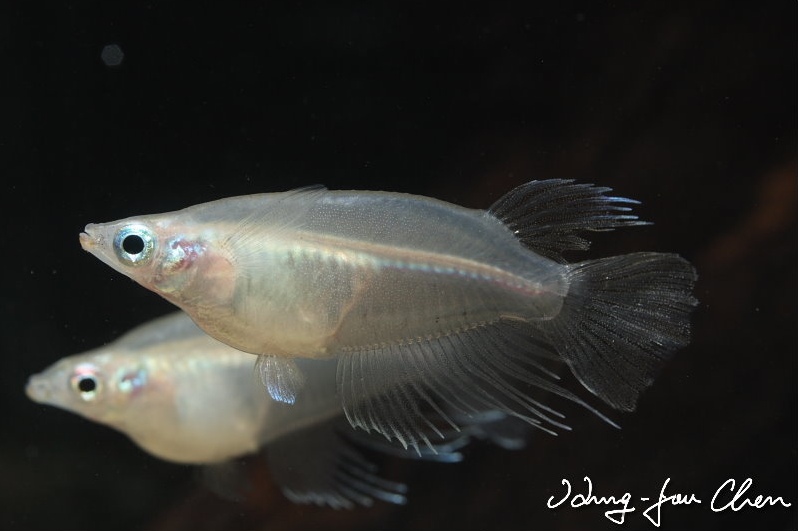
Oryzias dancenaIndian Ricefish
Hamilton, 1822
Max length35mm SL1.4in SLTank45 × 30cm18 × 12inTemp23–27°C73–81°FpH6.5–8.5This species continues to be mislabelled as O. melastigma, a name currently considered invalid by the majority of recent workers, or O. javanicus, a valid but distinct taxon. Roberts (1998) demonstrated that MClelland's description of Aplocheilus melastigmus, later renamed O. melastigma, does not correspond with any known Oryzias species from the Indian subcontinent or Myanmar since it's said to have a dark spot in the dorsal-fin and an excessively slim body, among other anomalies.
Oxydoras nigerRipsaw Catfish
authority not recorded
Max length900mm SL35in SLTank240 × 60cm96 × 24inTempnot recordedpH6.0–7.0Previously referred to a Pseudodoras niger, the Ripsaw Cat is a fish only for the experienced fishkeeper due to its large adult size. Although a visually stunning fish, realistically, it is best suited to public aquaria. Much more peaceful than its common name suggests, which it gets from the spines that run down the lateral line of the fish. This fish is becoming more readily available to the hobby and prices are also falling, meaning that many fishkeepers are being tempted into buying a fis...
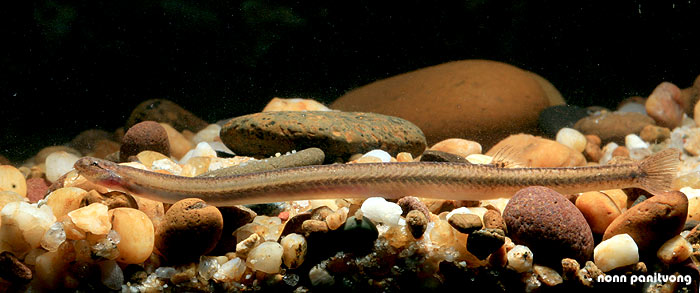
Pangio anguillaris
Vaillant, 1902
Max length120mm SL5in SLTank60 × 30cm24 × 12inTemp22–29°C72–84°FpH6.0–7.5One of a handful of Pangio spp. traded under the generic name 'eel loach'. Wild populations tend to differ in colour pattern to some extent, with some exhibiting a more intense lateral stripe while others display an irregular pattern of fine dark spots on the body, for example.
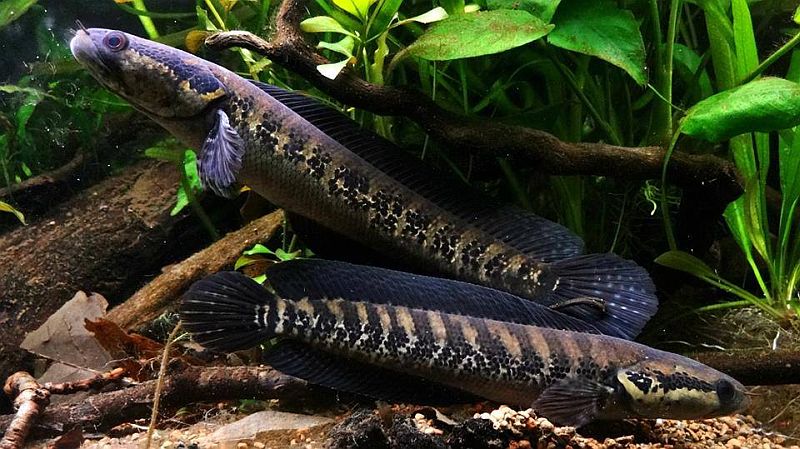
Parachanna africana
Steindachner, 1879
Max length300mm SL12in SLTank120 × 60cm48 × 24inTemp20–25°C68–77°FpH5.0–7.5Following Bonou and Teugels (1985), P. africana can be distinguished from congeners by the following combination of characters: colour pattern unique, comprising a series of 8-11 dark, chevron-shaped markings extending along the body posterior to the pectoral fins; 19-24 scales in the transverse series; lateral line complete with 73-83 pored scales; 45-48 dorsal-fin rays 45-48; 32-35 anal-fin rays.
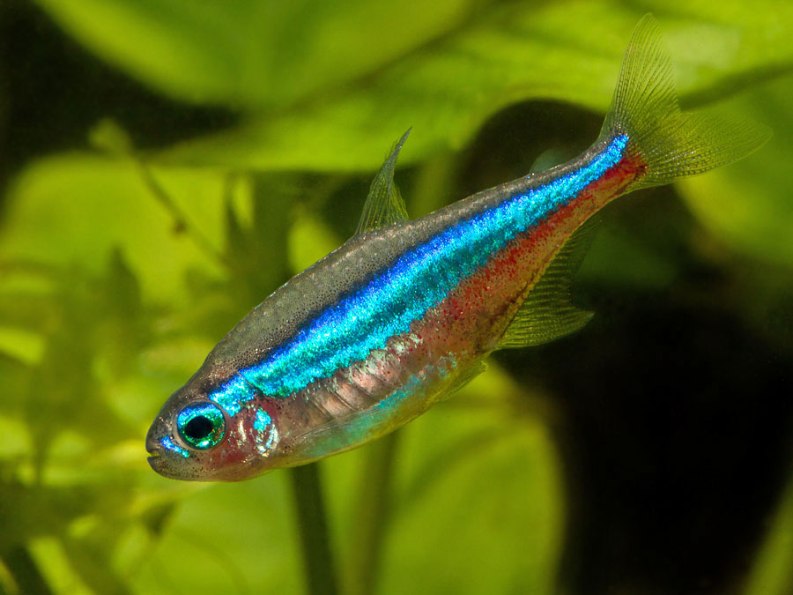
Paracheirodon simulansGreen Neon Tetra
Géry, 1963
Max length25mm SL1.0in SLTank45 × 30cm18 × 12inTemp21–35°C70–95°FpH3.0–6.5For aquarists perhaps more useful are the subtle differences in colour pattern with P. simulans differing from both P. innesi and P. axelrodi in possessing a greener (vs. bluer) lateral stripe which covers more (vs. less) of the eye/head and extends to the caudal-fin base (vs. terminating anterior to caudal-fin base), a lesser (vs. greater) amount of relatively duller (vs. brighter) red pigmentation on the flanks. The taxonomic history of all three species is complicated with earlier authors such as Géry (1960, 1977) ten...
Pareutropius buffeiThree Striped African Glass Catfish
authority not recorded
Max length80mm SL3.1in SLTank75 × 30cm30 × 12inTemp24–28°C75–82°FpH6.0–7.5Formerly known as Eutropiellus buffei, this midwater swimming, diurnal catfish is very often sold as "Debauwi catfish". Pareutropius debauwi is a closely related species which is, in fact, seldom imported. Adults of the two species can be distinguished by several characteristics. In buffei there are three lateral stripes along the body, whilst debauwi possesses only one. Buffei also has black spots in the upper and lower parts of the caudal fin, and the fin itself has rounded lobes. Th...
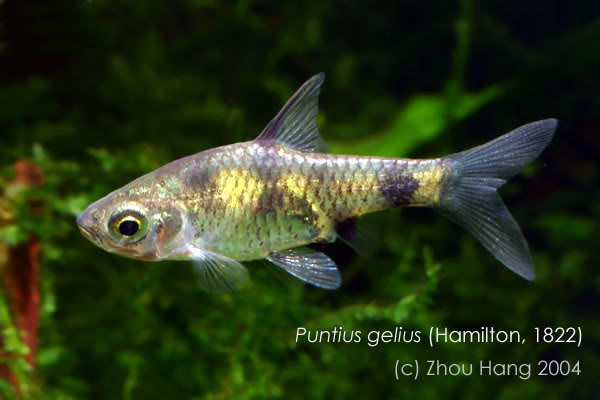
Pethia aurea
Knight, 2013
Max length25mm SL1.0in SLTank45 × 30cm18 × 12inTemp18–24°C64–75°FpH6.0–7.0This species was considered to be a phenotype of the similar-looking P. gelius prior to its description. Following Knight (2013) it is included a group of closely-related species alongside P. gelius and P. canius, the trio being distinguished from other members of the genus Pethia by the following combination of characters: lateral line incomplete with 3-4 por...
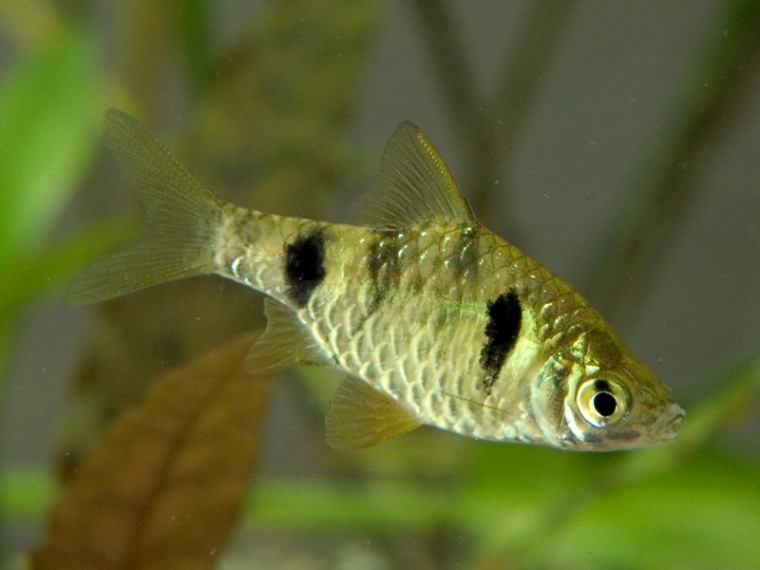
Pethia phutunioDwarf Barb
Hamilton, 1822
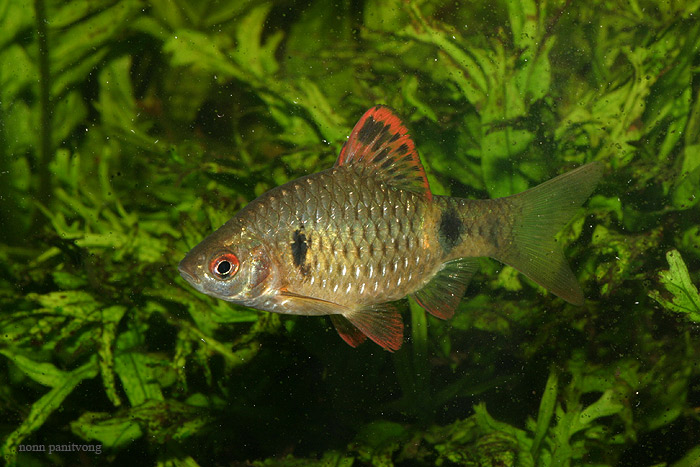
Max length30mm SL1.2in SLTank60 × 30cm24 × 12inTemp21–26°C70–79°FpH6.0–7.0In P. phutonio the flank markings comprise two black, vertically-orientated blotches, one posterior to the operculum and the other on the caudal peduncle, and within the P. conchonius group this patterning is shared with P. bandula, P. cumingii, P. didi, P. meingangbii, P. padamya, and P. tiantian. It can be told apart from these by the following combination of characters: smaller adult size of 25 - 30 mm vs. at least 35 - 40 mm; minute maxillary barbels; incomplete lateral line with ab...
Pethia stoliczkana
Day, 1871
Max length50mm SL2.0in SLTank75 × 30cm30 × 12inTemp18–26°C64–79°FpH6.0–7.5This species is confused with P. ticto in much of the available literature and is sometimes listed as a synonym of it. Although some populations of the two species possess a similar colour pattern (there are reports of a P. ticto variant from the south of West Bengal state in India with a red, black-flecked dorsal-fin, for example) they do not occur in the same waters in nature and can be distinguished by examining the lateral line. This is complete in...
Pseudosphromenus cupanusSpiketail Paradisefish
Cuvier, 1831
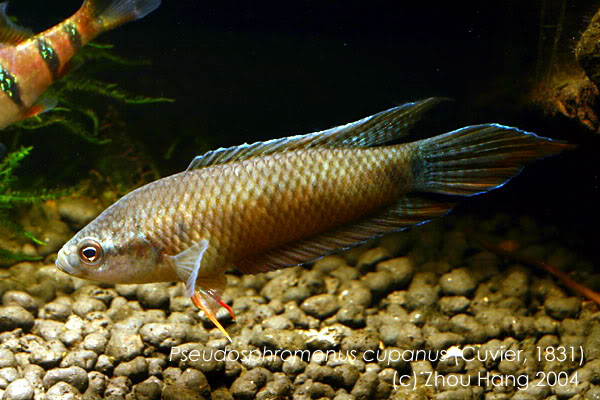
Max length65mm SL2.6in SLTank60 × 30cm24 × 12inTemp20–28°C68–82°FpH6.0–7.5This species is most easily told apart from its only congener P. dayi by lacking (vs. possessing) two dark, irregular lateral stripes on the head and body, and a shorter caudal-fin in males. The results of phylogenetic analyses by Rüber et al. (2006) suggest that Pseudosphromenus is most closely-related to Malpulutta in an evolutionary sense.
Puntius cholaSwamp Barb
Hamilton, 1822
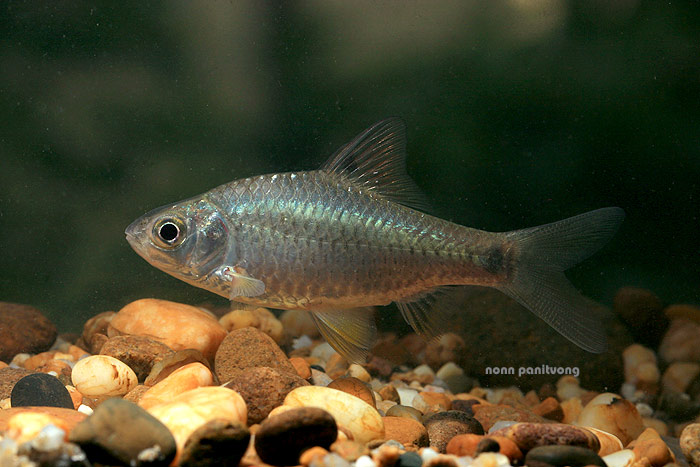
Max length130mm SL5in SLTank120 × 45cm48 × 18inTemp18–26°C64–79°FpH5.5–8.0P. chola was retained in Puntius sensu stricto, of which members are defined by the following combination of characters: adult size usually less than 120 mm SL; maxillary barbels absent or present; rostral barbels absent; 3-4 unbranched and 8 branched dorsal-fin rays; 3 unbranched and 5 branched anal-fin rays; last unbranched dorsal-fin ray weak or strong and unserrated; lateral line complete with 22-28 pored body scales...
Pygocentrus pirayaPiraya
Cuvier, 1819
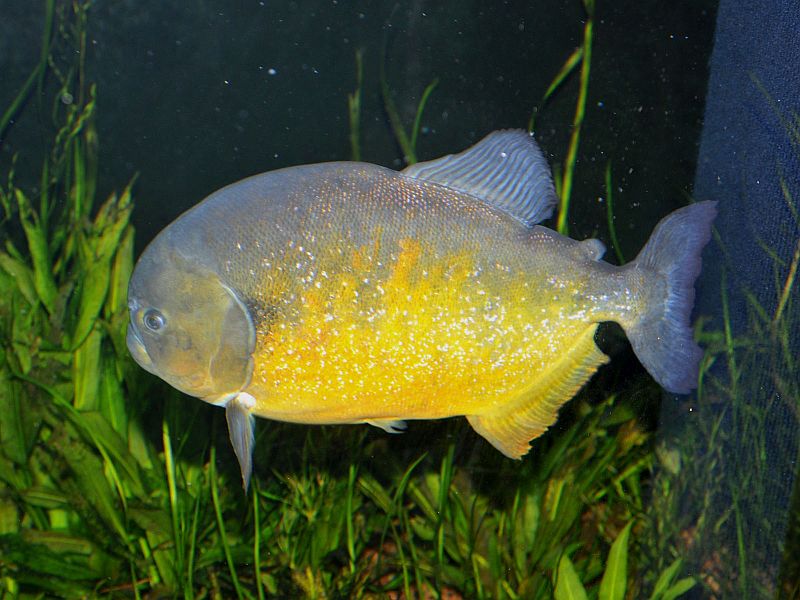
Max length350mm SL14in SLTanknot recordedTemp20–28°C68–82°FpH6.0–8.0Following Fink (1993), P. piraya can be distinguished from congeners by the following combination of characters: adipose fin with rays in larger specimens (vs. always without rays in other Pygocentrus species); branched dorsal-fin rays 15-18, usually 16 (vs. 14-18, usually 15); usually 7 neural spines anterior to first pterygiophore (vs. usually 6); vertebrae 36-39, usually 38 (vs. 35-38, usually 36). It can also be identified by colour pattern since it possesses distinctive bright yellow-orange pigmentation on the lower jaw, opercle and lateral body in life.
Rasbora cephalotaeniaPorthole Rasbora
authority not recorded
Max length130mm SL5in SLTank120 × 45cm48 × 18inTemp22–25°C72–77°FpHnot recordedThis species is not often exported which is a shame as it makes an elegant, peaceful resident of the larger community tank. It can be easily distinguished from similar-looking congeners such as R. einthovenii and R. jacobsoni by examining the dark lateral stripe that extends lengthways along the body of the fish as in R. cephalotaenia it is composed of a series of dark spots whereas in the other species it forms a continous solid line. Rainboth's 'Fishes of the Cambodian Mekong'...
Rasbora lacrimulaRed Cherry Rasbora
authority not recorded
Max length31mm SL1.2in SLTank45 × 30cm18 × 12inTemp22.2–25.6°C72–78°FpHnot recordedThis species is also traded as 'Bornean redfin rasbora', 'sunshine rasbora' and 'dwarf volcano rasbora' and first appeared in the hobby during the latter part of 2010. It can be told apart from all other members of the genus by a combination of the following characters: possession of small tubercules on the dorsal surface, posterior to theand continuing onto the upper part of caudal fin, visible as an irregular 'crest' when a specimen is viewed laterally; ...
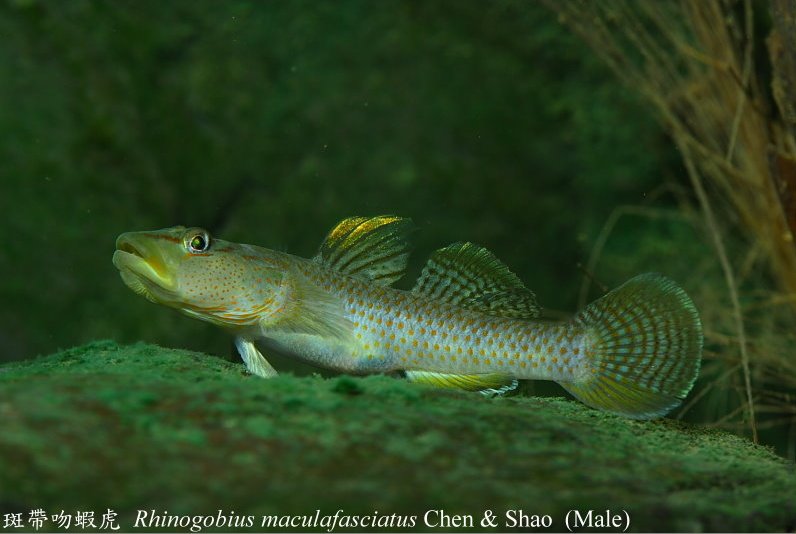
Rhinogobius maculafasciatus
Chen & Shao, 1996
Max length50mm SL2.0in SLTank60 × 30cm24 × 12inTemp18–24°C64–75°FpH6.0–8.0This species may not yet have appeared in the ornamental trade but it has been collected by a few individuals. It can be told apart from related species from Taiwan by possessing 30-32 longitudinal (lateral) scales vs. 32-39 in other species, and 6-8 scale rows between the origin of the first dorsal-fin and upper pectoral-fin base vs. 9-15 in other species.
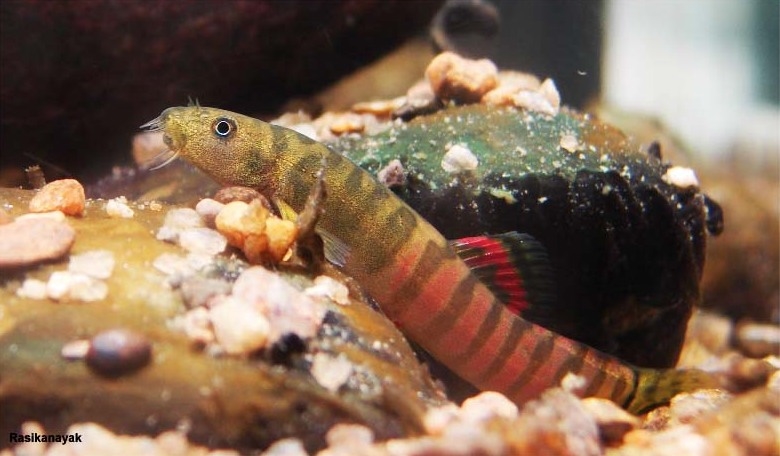
Schistura kodaguensis
Menon, 1987
Max length36mm SL1.4in SLTank60 × 30cm24 × 12inTemp20–25°C68–77°FpH6.0–7.5This species is not a well-known aquarium fish but is maintained by a number of Indian enthusiasts. It can be told apart from related species by the following combination of characters as per Sreekantha et al. (2006): pectoral-fin rays 10; absence of black spot at base of dorsal-fin; presence of rows of spots on caudal-fin; lateral line incomplete; caudal-fin slightly emarginate; 11-14 vertical bars on the body.
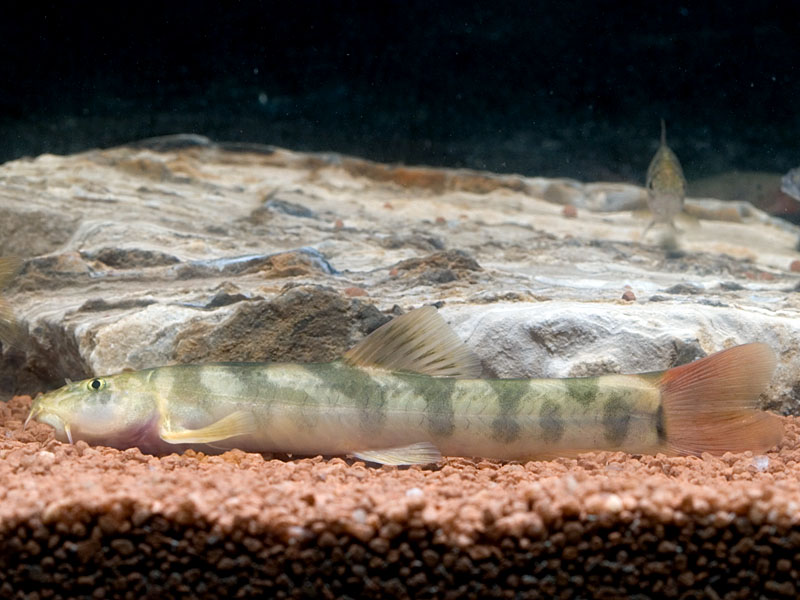
Schistura spilota
Fowler, 1934
Max length100mm SL3.9in SLTank120 × 30cm48 × 12inTemp20–26°C68–79°FpH6.0–7.5Not a commonly species in the aquarium hobby but sporadically available in shipments of wild fishes from Thailand. Following Kottelat (1990) it's a member of a group of species possessing a complete or near-complete lateral line, 8 ½ branched dorsal-fin rays, 17 branched caudal-fin rays and lacking sexual dimorphism (the latter is not strictly true - see above). Its colour pattern is quite distinctive, howe...
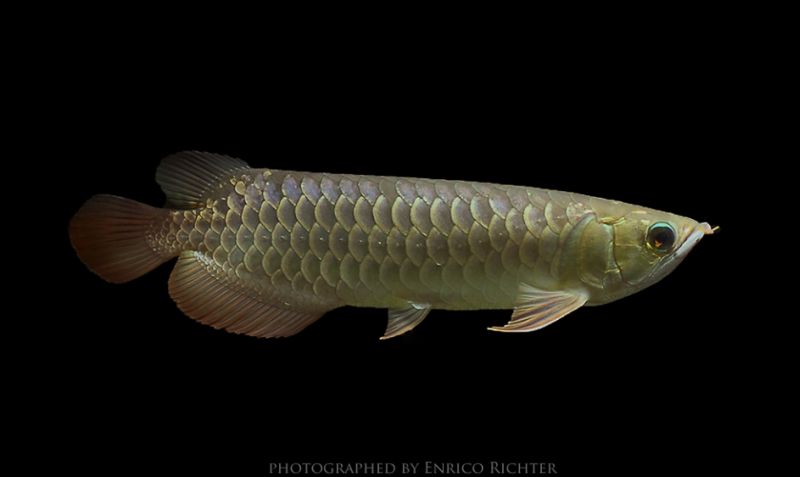
Scleropages formosusAsian Arowana
Müller & Schlegel, 1840
Max length900mm SL35in SLTanknot recordedTemp22–28°C72–82°FpH5.0–8.0This species is distinguished from its Australian congeners S. jardinii and S. leichardti by possessing a lower number of lateral line scales (21-26 vs 32-36). It occurs naturally in a number of colour forms of which three were elevated to distinct species status in 2003, but the current majority view is that all represent S. formosus pending a detailed review. Kottelat (2013) mentions that the red form may...