Results for “brood”
Type a name: scientific, common, or one a species used to go by. Or narrow the catalogue with the filters.
Filters
Pseudocrenilabrus multicolorDwarf Egyptian Mouth-brooder
authority not recorded
Matched on the common name Dwarf Egyptian Mouth-brooder
Max length80mm SL3.1in SLTanknot recordedTemp20–26°C68–79°FpH6.5–7.2This species was one of the first cichlid species to be spawned in captivity and has been in the hobby for over a century. It is less popular than it once was but remains a good choice for the beginner as it is tolerant of a wide range of water conditions and is easily bred. There currently exist 2 subspecies, Pseudocrenilabrus multicolor multicolor and P. m. victoriae. These are quite distinct in terms of colouration and patterning and exist as separate populations in nature. Both subspecie...
Pseudocrenilabrus philanderSouthern Mouth-Brooder
authority not recorded
Matched on the common name Southern Mouth-Brooder
Max length75mm SL3.0in SLTank120 × 30cm48 × 12inTemp22–25°C72–77°FpH6.5–7.5This species is not often seen in the hobby, which is a pity as it is a stunning fish with interesting behaviour. If you do manage to get some, be sure to provide the best possible conditions from the start, as they appear to travel quite badly and losses are common. There are currently 3 subspecies, Pseudocrenilabrus philander philander, P. p. dispersus and P. p. luebberti. However, recent studies suggest as many as 11 distinct populations exist, differing in location, colour, patterning, be...
Synodontis multipunctataCuckoo Synodontis
authority not recorded
Max length150mm SL6in SLTank120 × 30cm48 × 12inTemp24–28°C75–82°FpH7.5–8.5The reason we have recommended the use of non-Tanganyikan cichlid hosts above is because a successful captive spawning using Tanganyikan cichlid species has never been recorded! This may be due to an evolutionary process that has been observed in the lake, in which many cichlid species appear to have learned to avoid S. multipunctata when breeding. This is similar to the rejection of alien eggs by the host species in brood-parasatising birds. Because no species of brood parasatising catfish occu...
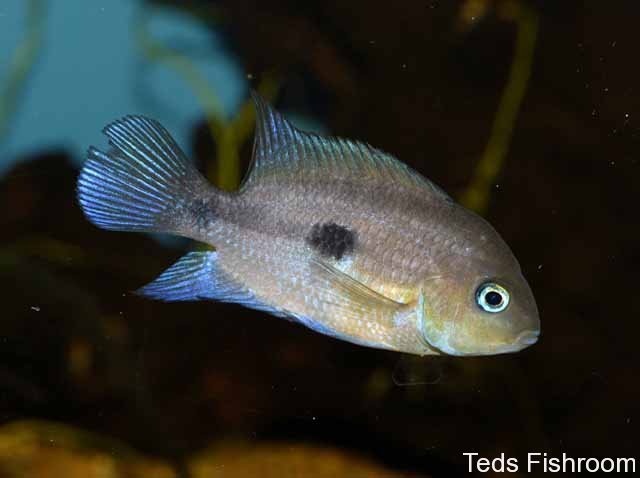
Cryptoheros myrnae
Loiselle, 1997
Max length♂ 100 · ♀ 80mm SL♂ 3.9 · ♀ 3.1in SLTank90 × 30cm36 × 12inTemp23–26°C73–79°FpH7.0–8.5In its natural waters, females have been observed caring for mixed broods containing both their own fry and those of another cichlid, Amphilophus bussingi. It is unknown if these are mixed by accident (as the two species have also been recorded tending broods in close proximity to one another) or if this represents an adaptive behaviour to increase numbers in a brood and therefore decrease the chance of predation.
Lamprologus callipterus
authority not recorded
Max length150mm SL6in SLTank90 × 30cm36 × 12inTemp24–27°C75–81°FpH7.5–9.0In nature, the spawning nests of large male fish may measure several meters across and contain hundreds of snail shells. Interestingly, when they are protecting brooding females males do not eat and eventually become so weak that their territories are taken over by stronger fish. Immature and sub-dominant males can be seen over areas of open substrate where they feed voraciously in large shoals. Females are only ever found in areas containing the nests of dominant males. It appears that the ...
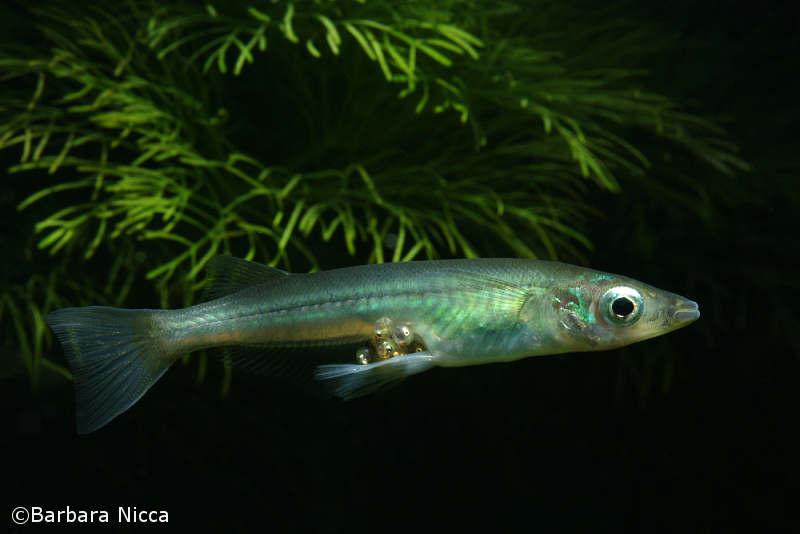
Oryzias sarasinorumSarasin's Buntingi
Popta, 1905
Max length60mm SL2.4in SLTank100 × 30cm39 × 12inTemp24–29°C75–84°FpH7.0–8.0Utilises a strategy which has become known as 'pelvic brooding'. Spawning tends to occur in the early morning, with dominant males darkening in colouration and defending their space by driving away potential competitors, while approaching ripe females in a rigid 'head-down' position. The eggs normally number 8-12 and are expelled as a single mass while being fertilised simultaneously, after which they continue to hang from th...
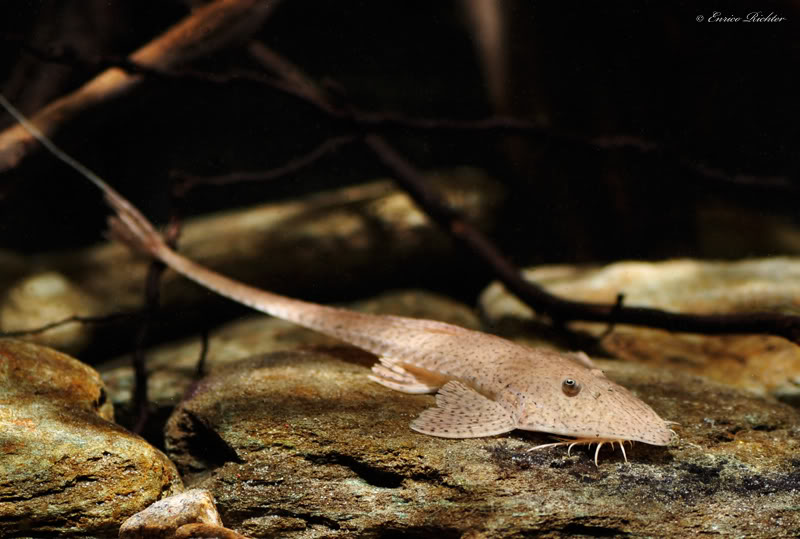
Pseudohemiodon laticepsGiant Whiptail Catfish
Regan, 1904
Max length300mm SL12in SLTank180 × 60cm72 × 24inTemp18–24°C64–75°FpH6.0–7.5A paternal 'lip brooder' which has been bred in aquaria. Post-spawning the male carries the eggs attached to his labial barbels for a period of 12-14 days after which the fry hatch with a large yolk sac attached, this being absorbed over the next 48 hours or so. During incubation the behaviour of the male i...
Variabilichromis moorii
authority not recorded
Max length100mm SL3.9in SLTanknot recordedTemp23–27°C73–81°FpH7.5–9.0V. moorii exists in several geographical morphs but interestingly the only variation in colour occurs in juvenile fish. All adults exhibit a dark patterning but depending on locality the fry may be dark (like adults), yellow or orange with the yellow and orange juveniles taking on the adult colouration as they mature. It is has been observed that the forms which undergo this colour change may 'plant' broods among fry of other species with similarly coloured young, leaving them to be gu...