Results for “eye spot”
Type a name: scientific, common, or one a species used to go by. Or narrow the catalogue with the filters.
Filters
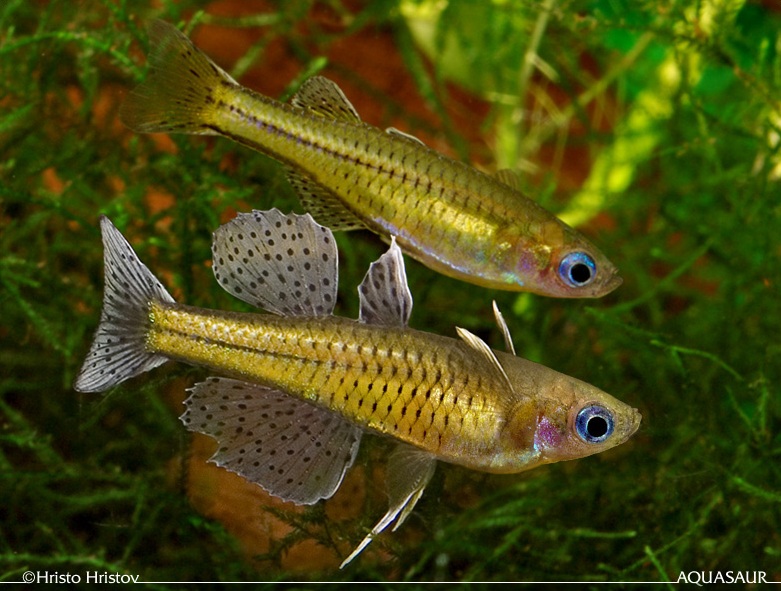
Pseudomugil gertrudaeSpotted Blue-eye
Weber, 1911
Matched on the common name Spotted Blue-eye
Max length38mm SL1.5in SLTank45 × 30cm18 × 12inTemp21–28°C70–82°FpH4.5–7.5Described from 'Rivulet in sago forest at Ngaiguli, Terangan, Aru Island, Aru Islands, Maluku, Indonesia', corresponding to the island now normally referred to as 'Trangan' in the Aru Islands group, eastern Indonesia. The islands are located in the Arafura Sea, with western New Guinea to the north and the Arnhem Land Region of Australia's Northern Territory to the south, and though they lie within Maluku province of eastern Indonesia, are part of the Australian continent in a geological sense.
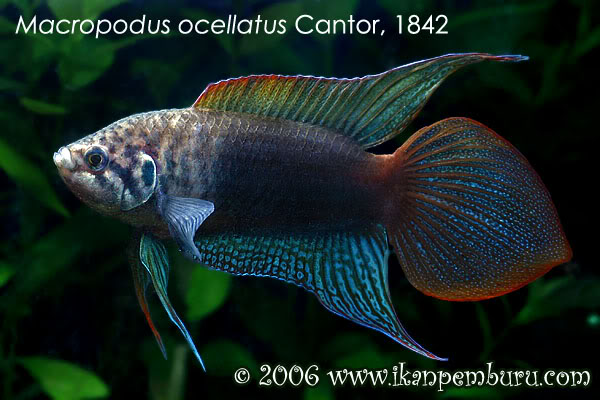
Macropodus ocellatusRoundtail Paradise Fish
Cantor, 1842
Max length80mm SL3.1in SLTank80 × 30cm31 × 12inTemp10–22°C50–72°FpH6.0–7.5M. ocellatus can be distinguished from congeners by the following combination of characters: caudal-fin rounded; eye stripe not connecting spot on posterior projection of opercle with eye; dorsal-fin rays filamentous posterior to a vertical through the posterior anal-fin rays in adults; 16-19 spinous dorsal-fin rays; 6-13 rakers on ceratobranchial of first gill arch; posterior tip or margin of body scales not darker than scales.
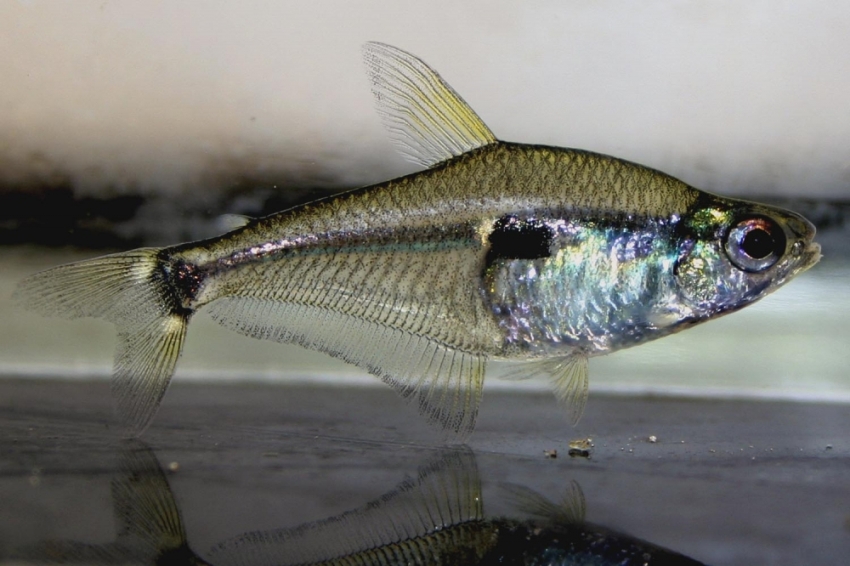
Phenacogaster tegatus
Eigenmann, 1911
Max length45mm SL1.8in SLTank60 × 30cm24 × 12inTemp20–28°C68–82°FpH6.0–7.5This species has been traded as 'six-eyed tetra' in reference to its colour pattern comprising two dark spots on each flank plus the eye. Based on the extensive review of the genus by Lucena and Malabarba (2010), in which nine new species were described, P. tegatus can be told apart from congeners by the following combination of characters: lateral line incomplete with 8-13 perforated scales; laterally elongate humera...
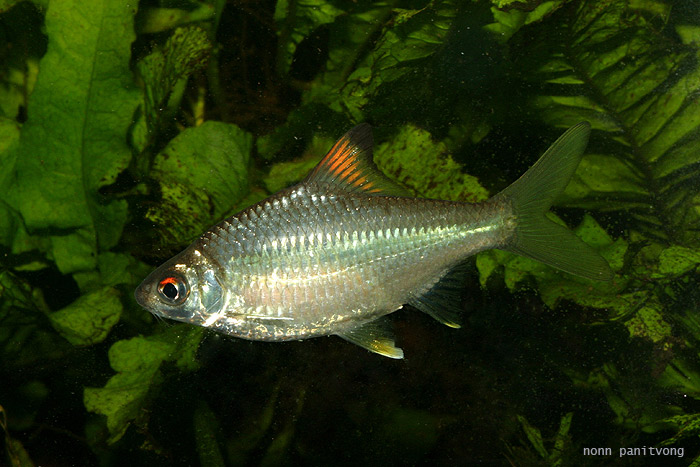
Mystacoleucus argenteus
Day, 1888
Max length140mm SL6in SLTank120 × 45cm48 × 18inTemp20–27°C68–81°FpH6.0–7.5All Mystacoleucus species possess a procumbent predorsal spine orientated towards the head, though it can be difficult to spot with the naked eye. This can become entangled in an aquarium net so care must be taken when handling the fish. The trait is shared by members of Tor, Spinibarbus and Paraspinibarbus although there exists no strong evidence to suggest that these genera form a monophyletic lineage and it is...
Lamprologus kungweensisOcellated Shell-dweller
authority not recorded
Max length80mm SL3.1in SLTank75 × 30cm30 × 12inTemp23–27°C73–81°FpH7.5–9.0L. kungweensis can be distinguished from similar species such as L. hecqui by the gold colour on the top of the eye. It also has a distinctive black spot towards the back of the dorsal fin. It is not often seen in the hobby....
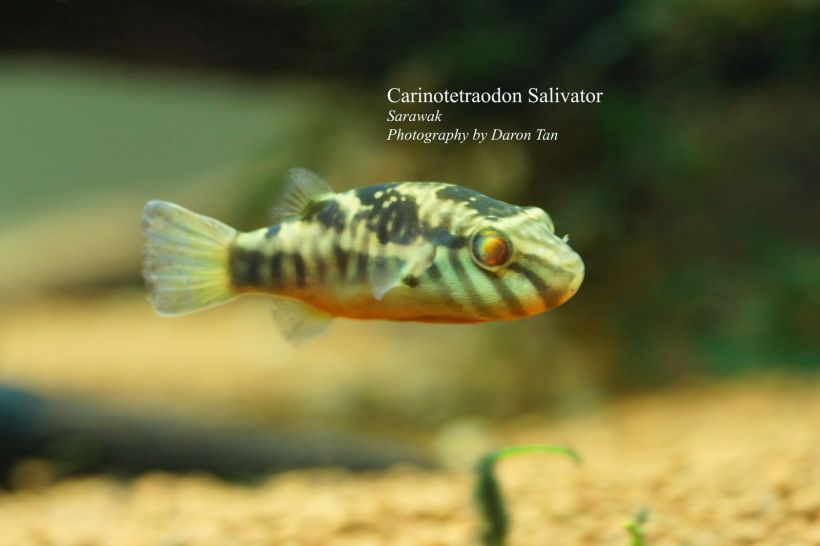
Carinotetraodon salivator
Lim & Kottelat, 1995
Max length50mm SL2.0in SLTank60 × 30cm24 × 12inTemp20–28°C68–82°FpH5.0–7.5It is included in a group often referred to as 'red-eyed puffers', which currently contains four recognised species distributed in Indochina and the Greater Sunda Islands. It can be distinguished from C. borneensis, C. irrubesco, and C. lorteti, the remaining members of this group, by the following combination of characters: 11 dorsal-fin rays; 16 pectoral-fin rays; 11-13 anal-fin rays; 11 caudal-fin rays; eyes not bulging above the head; in males dorsal-fin hyaline, black spot on dorsal-fin base present, pectoral-fin base hyaline, anal-fin hyaline with no black spot at base...
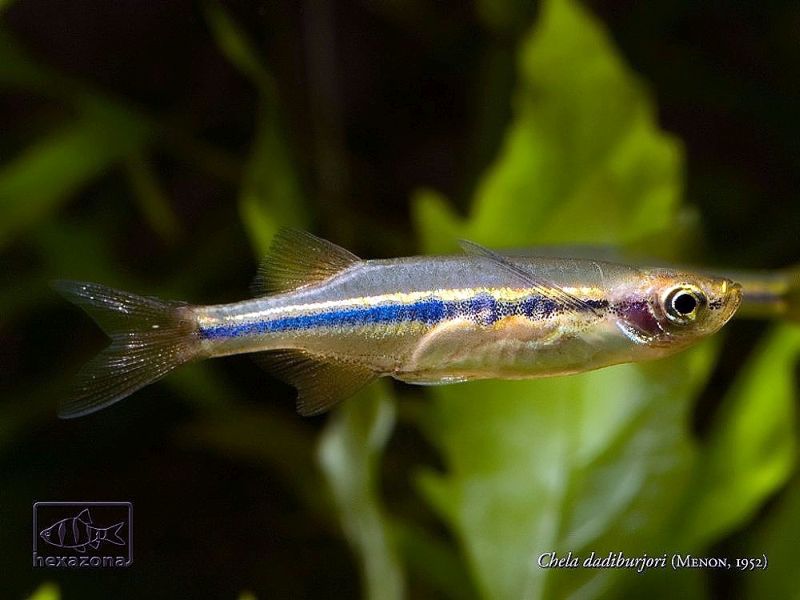
Laubuka dadiburjoriDadio
Menon, 1952
Max length30mm SL1.2in SLTank90 × 30cm36 × 12inTemp20–24°C68–75°FpH6.0–7.5It can be distinguished from other members of the genus by the following characters: lateral line absent or perforating only 2-5 scales; pharyngeal teeth hooked; body size small, not exceeding 30 mm SL; body depth less than 25 % SL; colour pattern comprising a dark bluish lateral stripe extending from the eye to the caudal peduncle, typically, but not always, forming 2-5 circular spots along its length.
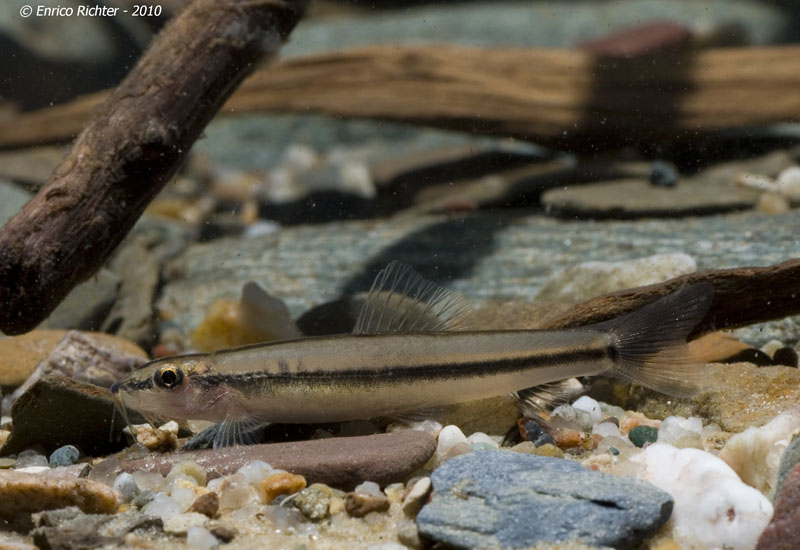
Nemacheilus binotatus
Smith, 1933
Max length45mm SL1.8in SLTank60 × 30cm24 × 12inTemp23–26°C73–79°FpH6.0–7.5N. binotatus is distinguished from similar-looking congeners such as N. longistriatus and N. ornatus by its unique body patterning consisting very simply of two dark stripes, one running along the dorsal surface and the other from the tip of the snout, through the eye and along the flank. There are usually 1-3 small, vertically-orientated spots extending above the lateral stripe between the pectoral-fin and dorsal fins. These are su...
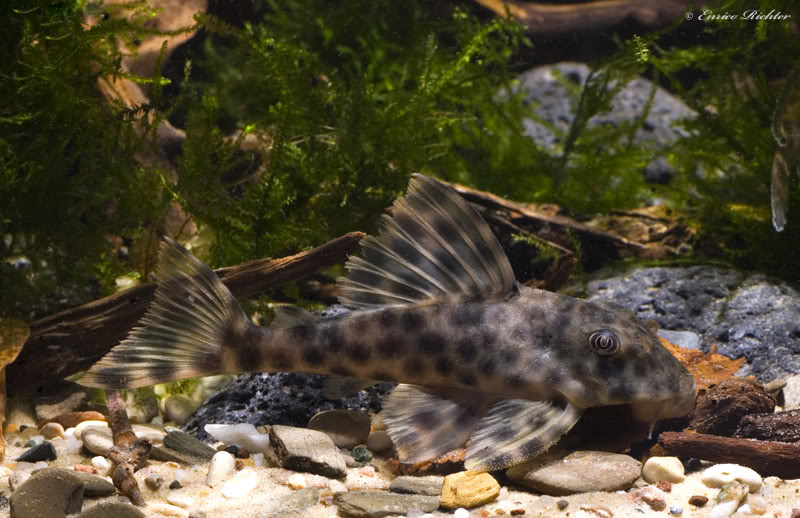
Peckoltia oligospilaL006
Günther, 1864
Max length100mm SL3.9in SLTank120 × 30cm48 × 12inTemp24–30°C75–86°FpH5.5–7.5This species can be distinguished from all congeners except P. bachi and some specimens of P. furcata by possessing only faint spots and saddles on the body. It can be told apart from P. bachi by possession of narrow (vs. wide) pelvic-fin spines, having the eyes positioned high (vs. low) on the head, and distinctly round (vs. appearing more as a mottling) spots on the body.
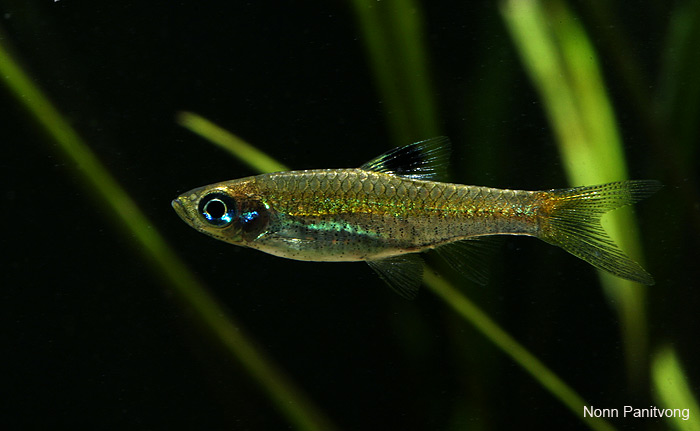
Brevibora dorsiocellataEyespot Rasbora
Duncker, 1904
Max length35mm SL1.4in SLTank45 × 30cm18 × 12inTemp20–25°C68–77°FpH5.0–7.5B. dorsiocellata is sometimes traded as 'green-eyed', 'emerald-eyed' or 'hi-spot' rasbora. There appear to exist several geographical forms of the species at least two of which have been seen in the trade. The most common is the rather plain-coloured fish that is produced commercially in large numbers and has gained popularity due to the bright green/blue reflective patch in the lower part of the eye.
Vieja bifasciataRed-spotted Cichlid
authority not recorded
Max length300mm SL12in SLTanknot recordedTemp27–29°C81–84°FpH7.0–8.5Vieja bifasciata are often confused for vieja synspilum but can be told apart as bifasciata have two prominent horizontal lines running between their eyes (hence the name). They are a very colourful fish and respond to their owner's presence - usually looking for food! Bifasciata are not particularly demanding in terms of water parameters and easy to keep, especially if suitable tankmates can be found. It is sometimes the case that a pair of fish that will not live together in a tank on ...
Dimidiochromis compressicepsMalawi Eye-Biter
authority not recorded
Max length250mm SL10in SLTank150 × 38cm60 × 15inTemp23–28°C73–82°FpH7.5–8.8D. compressiceps is an ambush predator in nature, its laterally compressed shape and head-down hunting position allowing it to remain hidden among Vallisneria beds and making it tricky to spot in open water. It has a dark stripe running from the snout along the back to the tail which serves to provide further camouflage. Despite its common name, it does not prey solely on the eyes of other species, preferring to hunt small fish (particularly juvenile Copadichromis sp.). It swallows these tai...
Synodontis nigriventrisUpside-down Catfish
authority not recorded
Max length100mm SL3.9in SLTanknot recordedTemp24–28°C75–82°FpH6.0–7.5One of the commonest Synos seen for sale, S. nigriventris is occasionally confused with S. contractus. However, on close inspection the species are easy to tell apart as S. nigriventris lacks the large head and mouth and larger eye of S. contractus. The scientific name nigriventris refers to the fact that the belly of this fish is darker than the dorsal area. This is a form of camouflage, making the fish harder to spot by predators above, such as predatory fish, birds etc. It is a basic re...
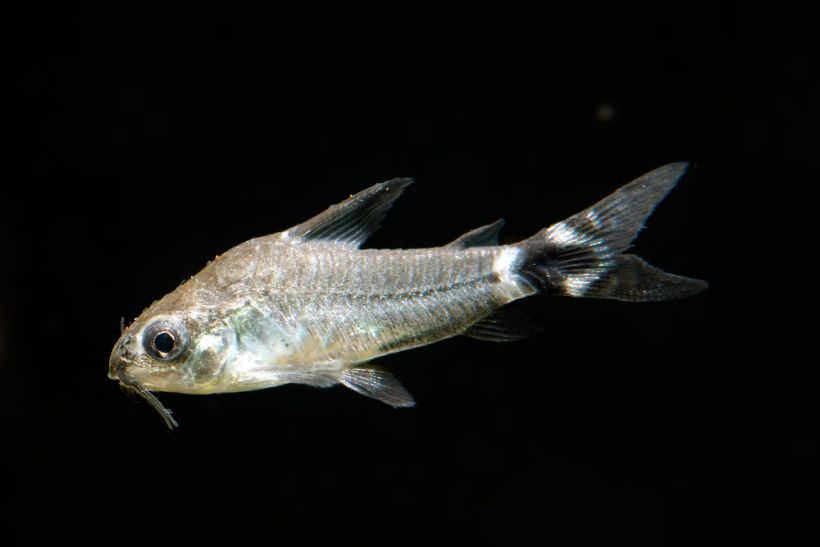
Corydoras hastatusTail-spot Pygmy Cory
Eigenmann & Eigenmann, 1888
Max length32mm SL1.3in SLTank60 × 30cm24 × 12inTemp20–26°C68–79°FpH6.0–7.5It exhibits slightly different behaviour to the majority of congeners in that it tends to swim in midwater and spends a large proportion of its time away from the substrate. Its morphology exhibits corresponding adaptations towards a pelagic existence with a relatively large eye, a more terminal mouth position, more strongly-forked caudal-fin, and more symmetrical body shape than most other Corydoras species.
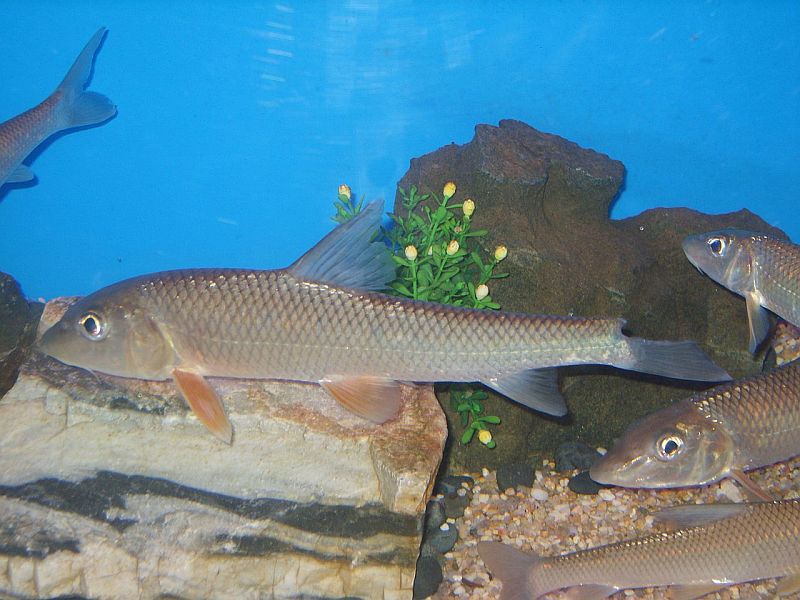
Hemibarbus labeoBarbel Steed
Pallas, 1776
Max length450mm SL18in SLTanknot recordedTempnot recordedpHnot recordedThis species can be distinguished from other members of the genus by the following combination of characters: absence of dark spots on body in adults; body elongate with slightly convex dorsal profile; head longer than body is deep; snout much longer than postorbital head length; lips well developed, lateral lobes of lower lip broad and thick with folds, median process small; barbel thickness shorter or equal to eye diameter; dorsal spine strong, ⅔ of HL; dorsal-fin origin closer to tip of snout than caudal-fin base base; 15+ gill rakers; 6½ branched anal-fin rays; posterior simple dorsal-fin rays ossified and spinous.
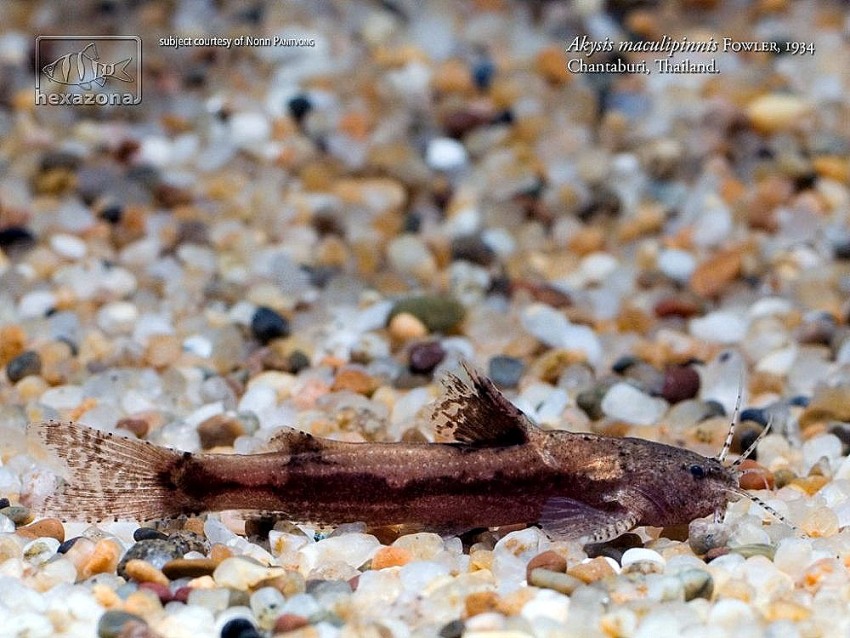
Akysis maculipinnisSpotfin Stream Catfish
Fowler, 1934
Max length35mm SL1.4in SLTank45 × 30cm18 × 12inTemp16.5–24°C62–75°FpH6.0–7.5This species has been exported for the aquarium hobby and ranks among the smaller members of the family. It can be differentiated from all other Akysis species by the following combination of characters: head length 22.0-28.6% of standard length (SL); caudal peduncle depth 8.8-10.7% of SL; anal-fin base length 15.2-19.1% of SL; eye diameter 12-16% of head length (HL); nasal barbel length 57 92% of HL; posession of 3-4 serrae on the posterior edge ofspine; body patterning mottled with indistinct ...