Results for “gill”
Type a name: scientific, common, or one a species used to go by. Or narrow the catalogue with the filters.
Filters
Monopterus albusSwamp Eel
authority not recorded
Max length1000mm SL39in SLTank180 × 60cm72 × 24inTemp25–28°C77–82°FpH6.0–8.0An incredibly hardy species, M. albus has the ability to travel over land for short distances if kept moist and as mentioned above, often burrows into moist earth (sometimes up to a depth of 1.5 metres!) in order to survive dry conditions. It has only a single gill slit, located on the bottom of the throat, that allows it to trap air in its specially adapted gills. These contain an accessory breathing organ, which takes the form of a pair of lung-like sacs at the rear of the gill chamber. In thi...
Betta akarensis
Regan, 1910
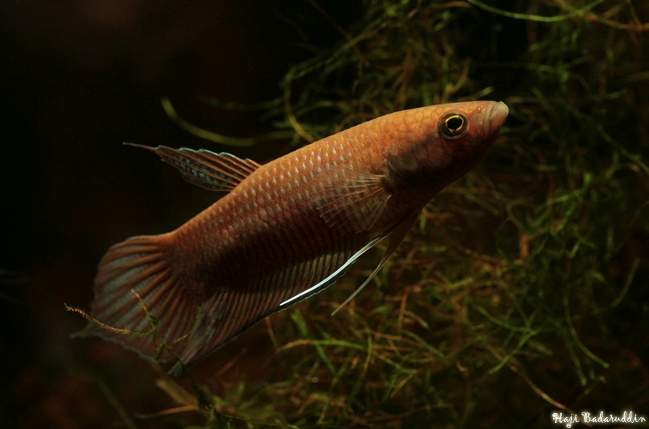
Max length80mm SL3.1in SLTank60 × 30cm24 × 12inTemp21–27°C70–81°FpH5.5–7.5Like others in the suborder Anabantoidei this species possesses an accessory breathing organ known as the labyrinth. So-called due to its maze-like structure this organ allows the fish to breathe atmospheric air to a certain extent. Comprising paired suprabranchial organs formed via expansion of the epibranchial (upper) section of the first gill arch and housed in a chamber above the gills, it contains...
Garra fuliginosa
Fowler, 1934
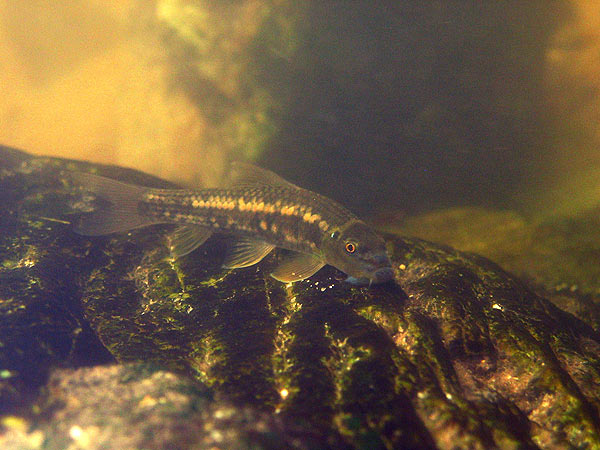
Max length150mm SL6in SLTank150 × 45cm60 × 18inTemp20–27°C68–81°FpHnot recordedFollowing Rainboth (1996) distinguishing characters for G. fuliginosa include: presence of rostral and maxillary barbels; a well-developed, trilobed rostrum; possession of 10 gill rakers on the lower portion of the first gill arch; no mid-lateral body stripe; 32-34 lateral line scales; body dark with random lighter scales in places. Kottelat (2001) states that the species can be told apart from other Garra occurring in Laos by a combination of: snout with a secondary rostrum, proboscis about twice as wide...
Labeo bogaViolet Shark
Hamilton, 1822
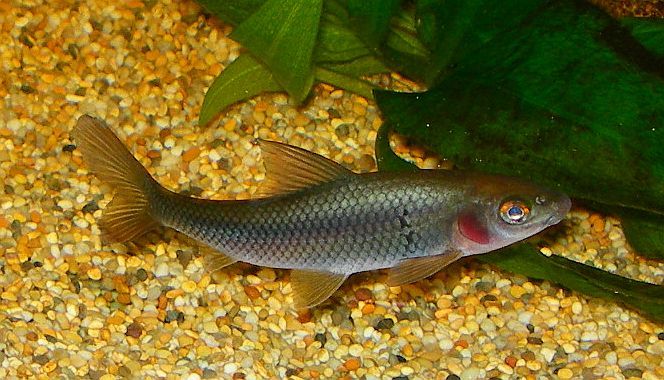
Max length250mm SL10in SLTank240 × 60cm96 × 24inTemp18–24°C64–75°FpH6.0–8.0Despite its unsuitability for the majority of home aquaria, this species is available in the aquarium trade on an irregular basis, and has also been marketed as 'violet-gilled shark', 'red-gilled violet shark' and 'blushing violet shark'. It appears likely that L. boga as currently recognised represents a complex of closely-related species.
Sundasalanx microps
Roberts, 1981
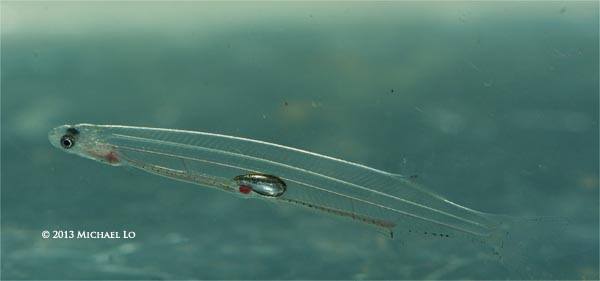
Max length20mm SL0.8in SLTank45 × 30cm18 × 12inTemp22–26°C72–79°FpHnot recordedThe genus Sundasalanx is distributed throughout much of Southeast Asia and currently comprises seven species which have primarily been distinguished on the basis of oral and dental morphology, gill rakers and eye size. S. microps possesses 0-3 small conical teeth on ceratobranchial 5, 0-2 minute gill rakers on the first arch and a small eye measuring less...
Amia calvaBowfin
Linnaeus, 1766
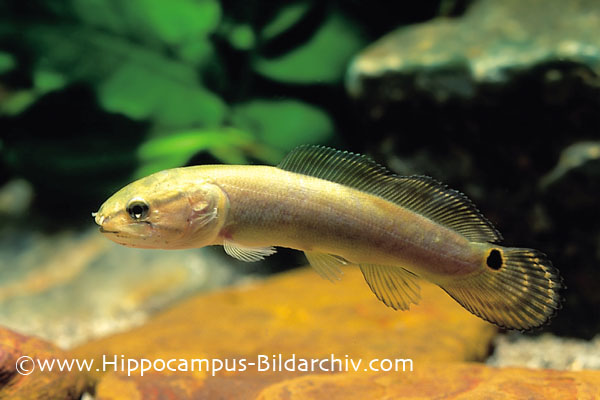
Max length900mm SL35in SLTank180 × 60cm72 × 24inTemp15–24°C59–75°FpH6.0–7.5Rare in the hobby, the bowfin is a stunning specimen fish for the aquarist with the means to house it properly. It is the sole remaining species in the family Amiidae, an ancient and primitive group that is related to the garfish. It possesses the ability to breathe atmospheric air, via an enormous, highly vascularised accessory breathing organ that extends throughout the entire body cavity. The gills are stiffened in order to prevent them collapsing outside the water and, provided it's kep...
Aulonocara baenschiNew Yellow Regal Peacock
Meyer & Riehl, 1985
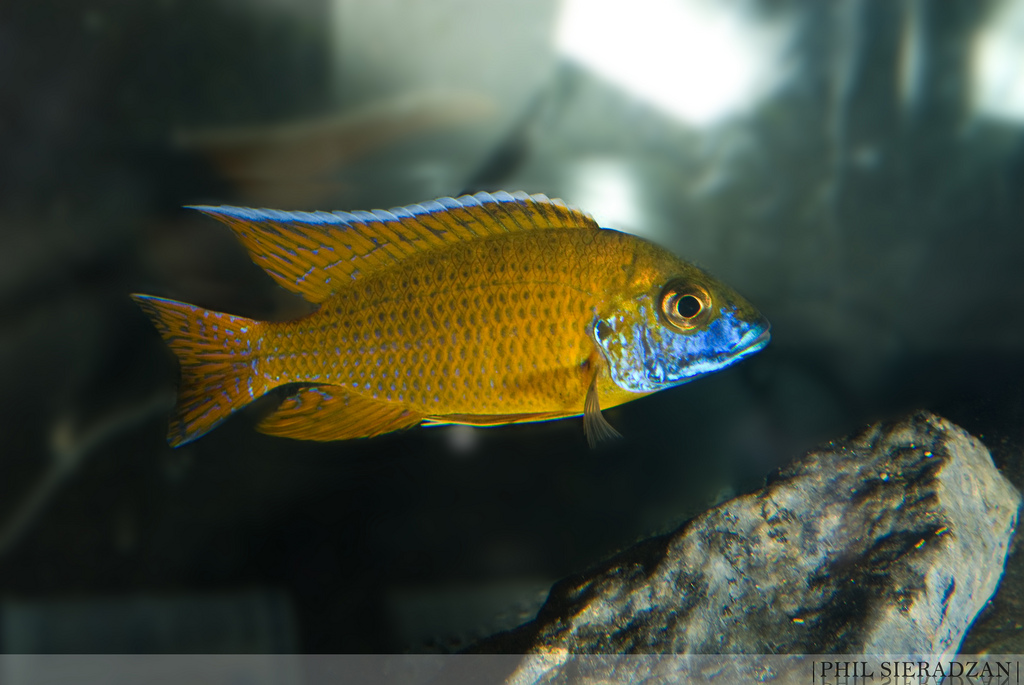
Max length♂ 120 · ♀ 90mm SL♂ 5 · ♀ 3.5in SLTank120 × 45cm48 × 18inTemp25–29°C77–84°FpH7.5–9.0This species may also be sold variously as 'yellow regal cichlid', 'Baensch's peacock', 'sunshine peacock' and 'Nkhomo-Benga peacock'. The easiest way to distinguish it from similar-looking congeners is to look at the profile of the snout, which is steeper and more curved than that of its congeners. Aulonocara spp. are benthophagous by nature employing a method of feeding whereby mouthfuls of substrate are taken and sifted for edible items with the remaining material expelled via the gills and mouth. They're equally-skilled at hunting as grazing, tending to hover above the substrate until tiny movements are detected, and possess enlarged sensory pores on the head which assist in this technique.
Aulonocara ethelwynnaeNorthern Aulonocara
Meyer, Riehl & Zetzsche, 1987
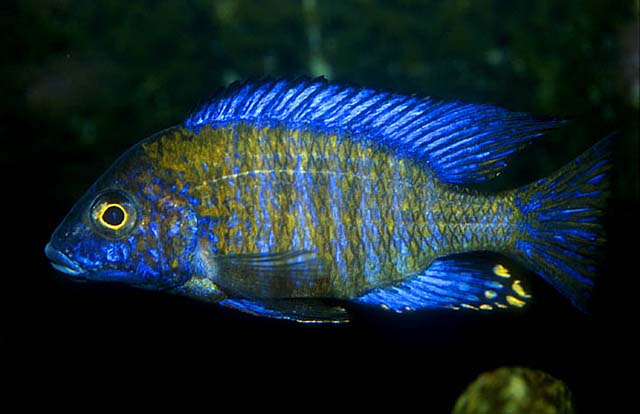
Max length110mm SL4in SLTank90 × 45cm36 × 18inTemp22–26°C72–79°FpH7.4–9.0Endemic to Lake Malawi where it was described from and only occurs around 'Chitendi Island', now normally referred to as Chitande island plus a short stretch of coastline between Ngara and Chilumba along the lake's northwestern shoreline. Aulonocara spp. are benthophagous by nature employing a method of feeding whereby mouthfuls of substrate are taken and sifted for edible items with the remaining material expelled via the gills and mouth. They're equally-skilled at hunting as grazing, tending to hover above the substrate until tiny movements are detected, and possess enlarged sensory pores on the head which assist in this technique.
Callochromis macropsBig-eyed Mouthbrooder
authority not recorded
Max length135mm SL5in SLTank120 × 45cm48 × 18inTemp24–27°C75–81°FpH7.8–9.5Members of the genus Callochromis feed in a similar way to the South American "eartheaters" such as Geophagus species. They extract invertebrates and other items hidden in the substrate by taking in mouthfulls of sand and sifting it through the gills. The common term "sand sifters" is applied to these and other Tanganyikan species that inhabit a similar ecological niche, such as Enantiopus and Xenotilapia spp. Several geographical colour forms of this species exist. These ...
Crossocheilus elegans
Kottelat & Tan, 2011
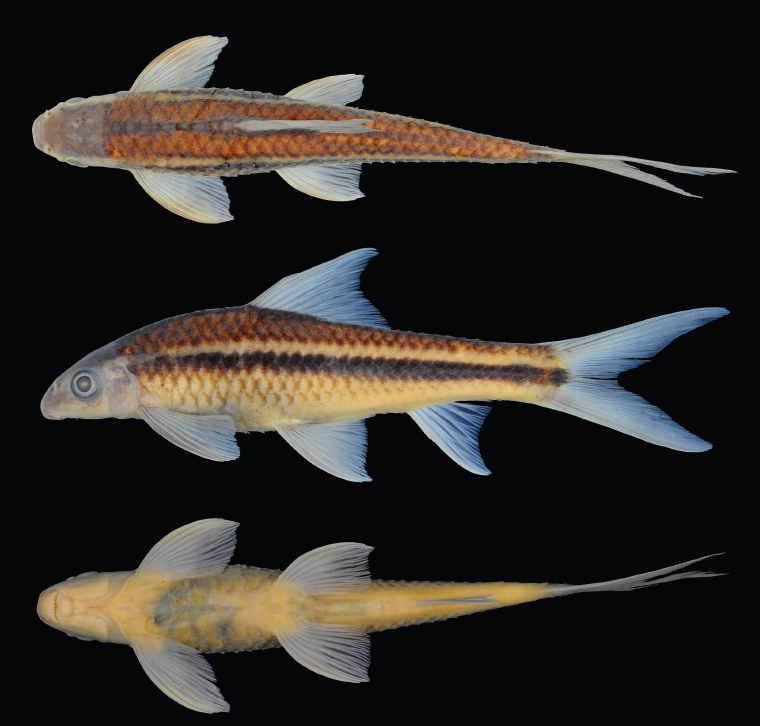
Max length110mm SL4in SLTank150 × 45cm60 × 18inTemp20–25.5°C68–78°FpHnot recordedThis species can be most easily distinguished from other members of the genus by its colour pattern which consists of a blackish midlateral stripe extending from the tip of the gill opening to the middle of the caudal-fin base, which is separated from the dark brown dorsum by a pale yellowish brown stripe. This differs from the pattern seen in other Crossocheilus species with a black midlateral stripe in which the the dorsum is olive brown and much paler than the midlateral stripe, there is no yellow stripe between the dorsum and the black stripe, and the black stripe extends to the tip of the snout.
Ctenopoma murieiOcellated Bushfish
authority not recorded
Max length75mm SL3.0in SLTank60 × 30cm24 × 12inTemp24–28°C75–82°FpH6.0–7.5One of the smallest species in the genus, it is rarely seen in the trade. A pity, as its diminutive size makes for an ideal aquarium subject. Like others in the suborder Anabantoidei, the species possesses an accessory breathing organ known as the labyrinth organ. So-called due to its maze-like structure, this organ allows the fish to breathe atmospheric air to a certain extent. It is formed by a modification of the first gill arch, and consists of many highly vascularised, folded flaps of sk...
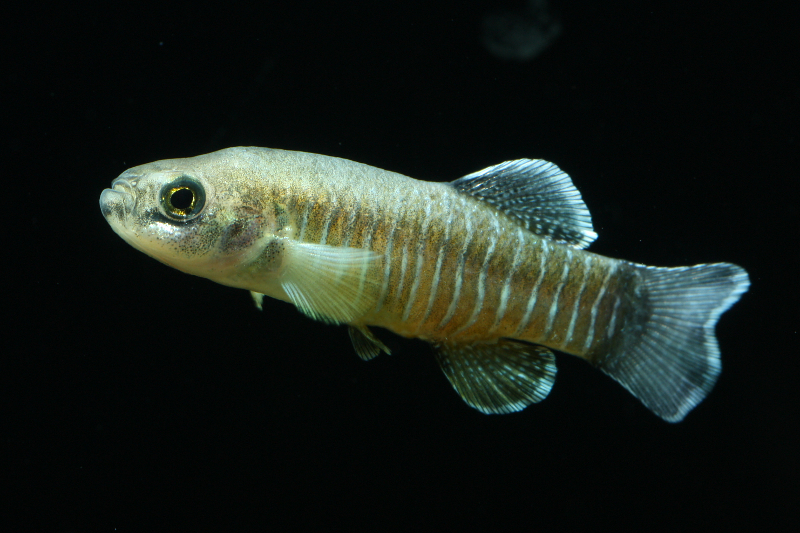
Esmaeilius arakensisArak Toothcarp
Teimori, Esmaeili, Gholami, Zarei, & Reichenbacher, 2012
Max length35mm SL1.4in SLTank120 × 30cm48 × 12inTemp8–32°C46–90°FpH7.0–8.5This species was available in the aquarium hobby for a number of years prior to publication of the official description and was generally referred to as A. sp. 'Namak' or A. sp. 'Namak River'. It can be distinguished from other members of the genus by the following combination of characters: 10–12 anal-fin rays; 28–32 lateral line scales, 10–13 caudal peduncle scales; 8–10 gill rakers; 12–19, commonly 1...
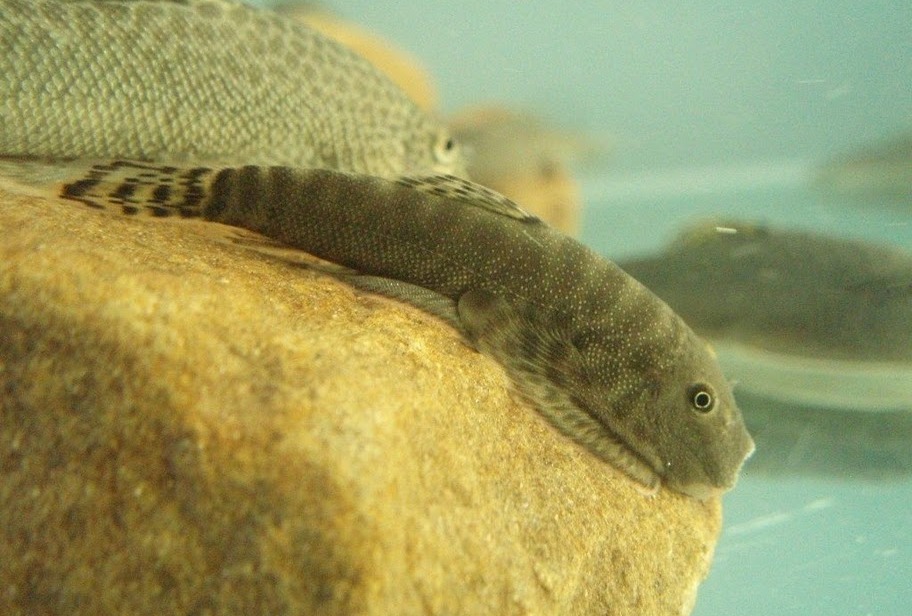
Gastromyzon cornusaccus
Tan, 2006
Max length50mm SL2.0in SLTank75 × 30cm30 × 12inTemp20–24°C68–75°FpH6.0–8.0G. cornusaccus can be distinguished from congeners by the following combination of characters: secondary rostrum present; incomplete postoral pouch present reduced to pockets located posterior to mouth corners; sublacrymal groove present and visible when viewed laterally; juveniles with thick, cream-coloured bars and blotches on body, adults uniformly-coloured; head dorsum plain; subopercular groove absent; gill slit vertical; snout truncate when viewed dorsally; no scales on abdomen; 55-61 lateral line scale...
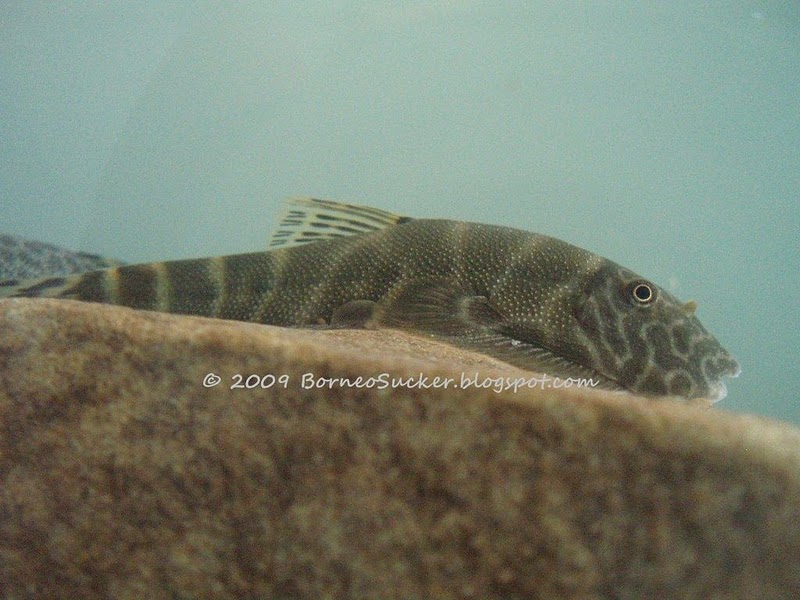
Gastromyzon extrorsus
Tan, 2006
Max length80mm SL3.1in SLTank75 × 30cm30 × 12inTemp20–24°C68–75°FpH6.0–8.0This species has probably not been seen in the aquarium trade yet but has been maintained by a few private collectors. It can be distinguished from congeners by the following combination of characters: secondary rostrum present; complete postoral pouch present; body colour brown with up to 9 thin gold stripes; head dorsum dark brown with gold reticulate pattern; subopercular groove absent; gill slit vertical; sublacrymal groove present; sno...
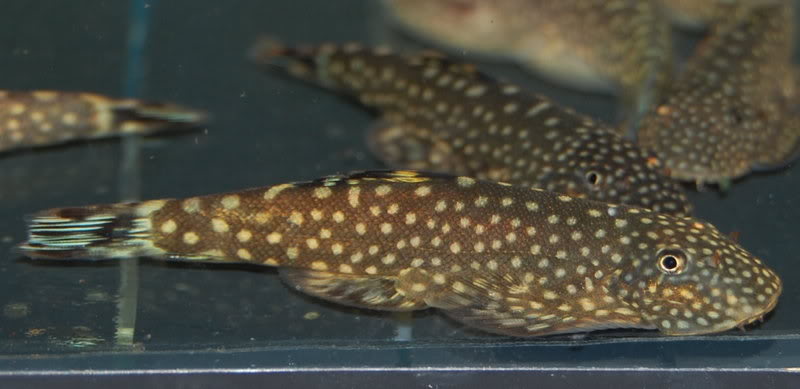
Gastromyzon scitulus
Tan & Leh, 2006
Max length45mm SL1.8in SLTank75 × 30cm30 × 12inTemp20–24°C68–75°FpH6.0–7.5It can be distinguished from congeners by the following combination of characters: gill slit angular; presence of subopercular groove, running continuous to origin of pectoral-fin; body black with numerous, small, evenly-spaced light brown spots; head dorsum black with numerous cream spots; pectoral and pelvic fins with cream spots; caudal-fin with iridescen...
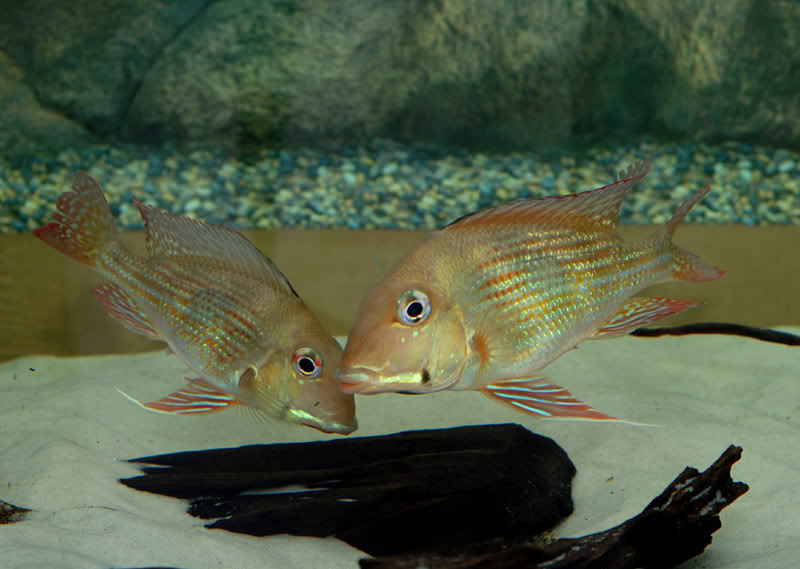
Geophagus brachybranchus
Kullander & Nijssen, 1989
Max length200mm SL8in SLTank180 × 60cm72 × 24inTemp26–30°C79–86°FpH5.0–7.0This species is generally rare in the aquarium hobby though oddly appears to be one of the commoner species in Australia where it's often referred to by the vernacular name 'black-throated eartheater'. It's a member of the nominal G. surinamensis 'group' of closely-related species within the genus and can be identified by a combination of characters including: presence of dark preopercular markings; no vertical bars on the flanks even when stressed/preserved; base of filaments on the first gill arch mostly covered by a flap of skin; exposed part of bra...
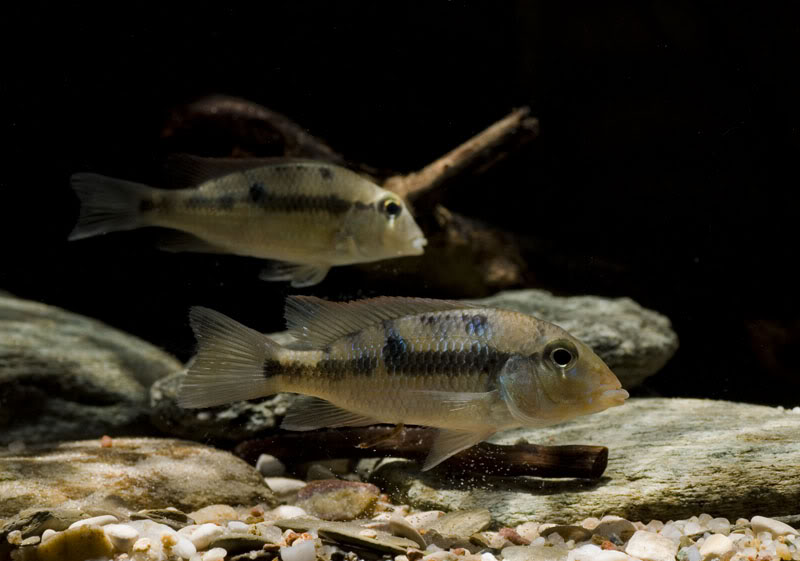
'Geophagus' crassilabrisPanamanian Eartheater
Steindachner, 1876
Max length240mm SL9in SLTank180 × 60cm72 × 24inTemp22–30°C72–86°FpH6.0–8.0The most essential item of décor is a soft, sandy substrate so that the fish can browse naturally (see 'Diet'). Coarser materials such as gravel or small pebbles can inhibit feeding, damage gill filaments and even be ingested with the potential of internal damage or blockages. Additional furnishings ar...
Gnathochromis permaxillaris
authority not recorded
Max length150mm SL6in SLTank120 × 30cm48 × 12inTemp22–27°C72–81°FpH7.5–9.0This species was originally classified in the genus Limnochromis. There are a couple of colour morphs available and these should not be mixed in aquaria, as they may hybridise. In nature, this fish feeds in a similar way to Geophagus species, in that it will sift sand through its gills to extract invertebrates hidden in the substrate. It is a deep water fish and has been recorded foraging at depths of up to 200 metres. These movements seem to be related to the presence of the plankton on which...
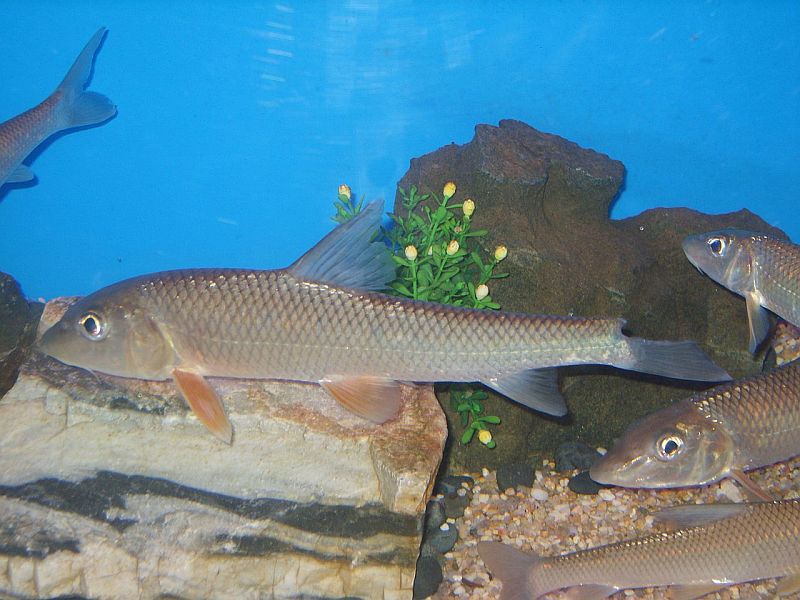
Hemibarbus labeoBarbel Steed
Pallas, 1776
Max length450mm SL18in SLTanknot recordedTempnot recordedpHnot recordedThis species can be distinguished from other members of the genus by the following combination of characters: absence of dark spots on body in adults; body elongate with slightly convex dorsal profile; head longer than body is deep; snout much longer than postorbital head length; lips well developed, lateral lobes of lower lip broad and thick with folds, median process small; barbel thickness shorter or equal to eye diameter; dorsal spine strong, ⅔ of HL; dorsal-fin origin closer to tip of snout than caudal-fin base base; 15+ gill rakers; 6½ branched anal-fin rays; posterior simple dorsal-fin rays ossified and spinous.
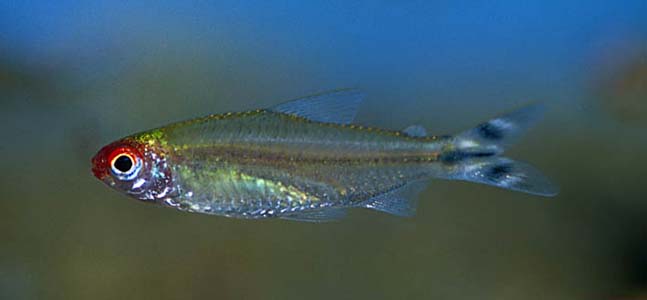
Hemigrammus rhodostomusRummy-nose tetra
authority not recorded
Max length50mm SL2.0in SLTanknot recordedTemp24–27°C75–81°FpH5.5–7.0This is the 'real' rummy-nose. The species most often sold as such is, in fact, the firehead tetra, H. bleheri. These 2 are very similar in appearance, as is the 'false' rummy-nose, Petitella georgiae. The 3 species can distinguished by several factors. The first, is by the extent to which the red colouration on the head of the fish extends into the body. H. bleheri is the only one of the 3 in which the red extends beyond the gill covers. The amount of red colouration on ...