Results for “gill cover”
Type a name: scientific, common, or one a species used to go by. Or narrow the catalogue with the filters.
Filters
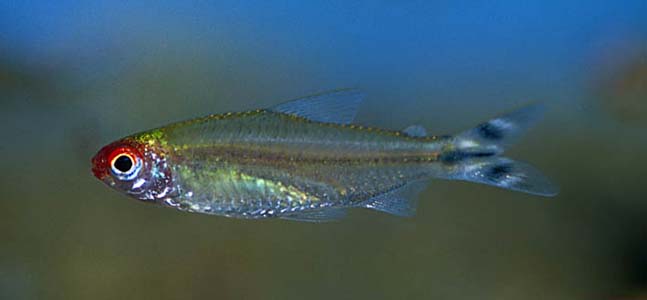
Hemigrammus rhodostomusRummy-nose tetra
authority not recorded
Max length50mm SL2.0in SLTanknot recordedTemp24–27°C75–81°FpH5.5–7.0This is the 'real' rummy-nose. The species most often sold as such is, in fact, the firehead tetra, H. bleheri. These 2 are very similar in appearance, as is the 'false' rummy-nose, Petitella georgiae. The 3 species can distinguished by several factors. The first, is by the extent to which the red colouration on the head of the fish extends into the body. H. bleheri is the only one of the 3 in which the red extends beyond the gill covers. The amount of red colouration on ...
Neolamprologus olivaceous
authority not recorded
Max length80mm SL3.1in SLTanknot recordedTemp23–27°C73–81°FpH7.5–9.0This species is included in the so-called "Brichardi complex", which also includes N. brichardi, crassus, falcicula, gracilis, pulcher, savoryi and splendens. These should not be mixed in aquaria, as they will hybridise freely. N. olivaceouscan be distinguished from others in the complex by the two curved markings on the gill cover. It is possible that it is synonymous with N. pulcher, as proposed by Konings (1993)....
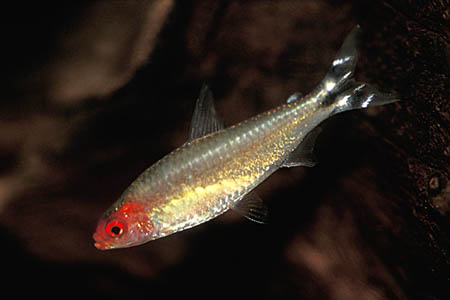
Petitella georgiaeFalse Rummy-nose
authority not recorded
Max length50mm SL2.0in SLTanknot recordedTemp22–26°C72–79°FpH5.5–7.0This is one of three species commonly sold under the name "rummy-nose tetra". The commonest of these is the firehead tetra, Hemigrammus bleheri, whilst the "true" rummy-nose is Hemigrammus rhodostomus. All three are very similar in appearance, but can be distinguished by several factors. The first is by the extent to which the red colouration on the head of the fish extends into the body. H. bleheri is the only one of the 3 in which the red extends beyond the gill covers. ...
Scleropages jardiniiAustralian Arowana
authority not recorded
Max length900mm SL35in SLTank180 × 60cm72 × 24inTemp24–29°C75–84°FpH6.8–7.5Although S. jardinii superficially resembles its Asian cousins, it is not considered as desirable an aquarium inhabitant, nor is it classed as being at risk in nature. It can be easily distinguished from the asian species by its much smaller scale size, greater lateral scale count (32-35 as opposed to 21-25 in the asian aros) and duller patterning. It differs from its Australian relative S. leichardtii by its more sloping head, downward-pointing barbels and patterned gill covers. The base colour...
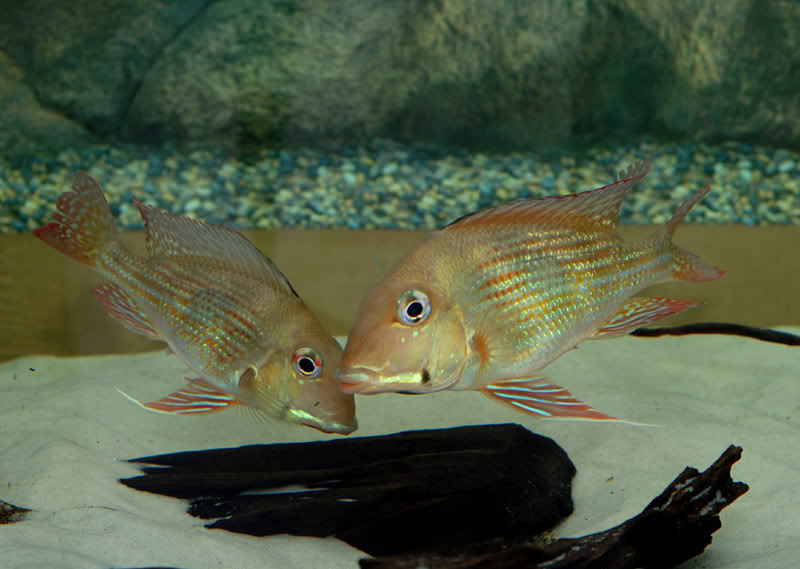
Geophagus brachybranchus
Kullander & Nijssen, 1989
Max length200mm SL8in SLTank180 × 60cm72 × 24inTemp26–30°C79–86°FpH5.0–7.0This species is generally rare in the aquarium hobby though oddly appears to be one of the commoner species in Australia where it's often referred to by the vernacular name 'black-throated eartheater'. It's a member of the nominal G. surinamensis 'group' of closely-related species within the genus and can be identified by a combination of characters including: presence of dark preopercular markings; no vertical bars on the flanks even when stressed/preserved; base of filaments on the first gill arch mostly covered by a flap of skin; exposed part of bra...