Results for “hyaline”
Type a name: scientific, common, or one a species used to go by. Or narrow the catalogue with the filters.
Filters
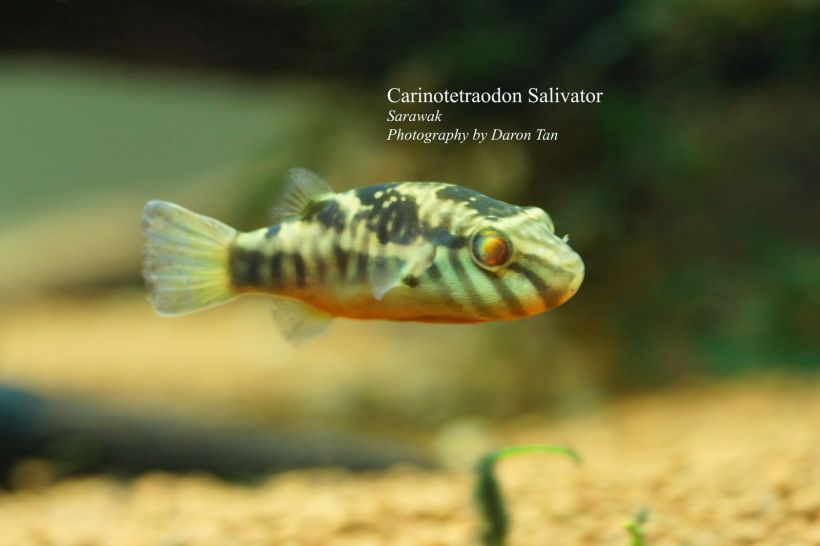
Carinotetraodon salivator
Lim & Kottelat, 1995
Max length50mm SL2.0in SLTank60 × 30cm24 × 12inTemp20–28°C68–82°FpH5.0–7.5It is included in a group often referred to as 'red-eyed puffers', which currently contains four recognised species distributed in Indochina and the Greater Sunda Islands. It can be distinguished from C. borneensis, C. irrubesco, and C. lorteti, the remaining members of this group, by the following combination of characters: 11 dorsal-fin rays; 16 pectoral-fin rays; 11-13 anal-fin rays; 11 caudal-fin rays; eyes not bulging above the head; in males dorsal-fin hyaline, black spot on dorsal-fin base present, pectoral-fin base hyaline, anal-fin hyaline with no black spot at base...
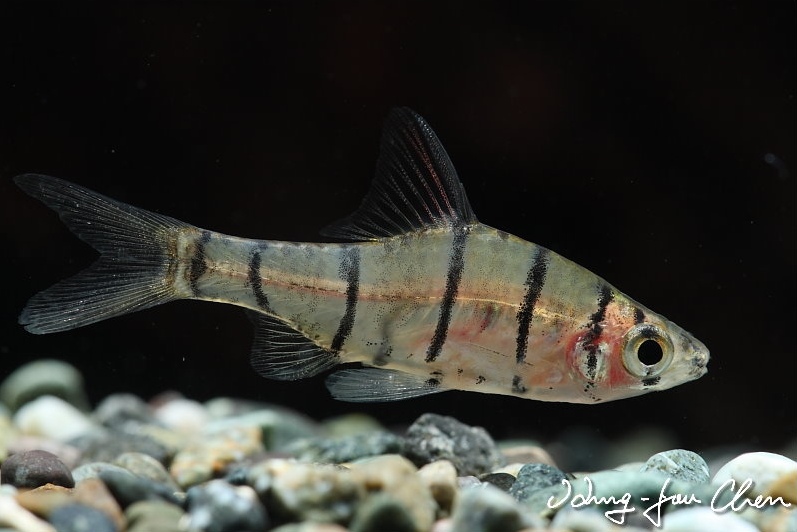
Eirmotus octozona
Schultz, 1959
Max length36mm SL1.4in SLTank60 × 30cm24 × 12inTemp22–26°C72–79°FpH5.0–7.0E. octozona can be told apart from congeners by the following combination of characters: bar 1 present; presence of a large and distinct black mark anterior to anus, visible in lateral and ventral views; simple dorsal-fin rays black, sometimes extending onto first branched ray; other rays hyaline or with diffused chromatophores on last dorsal-fin ray, adjacent to upper extremity of bar 6; 25-31 serrae on last simple dorsal-fin ray; uppermost ray of pectoral-fin with faint black margin; width of bar 5 equal to 1-1½ lat...
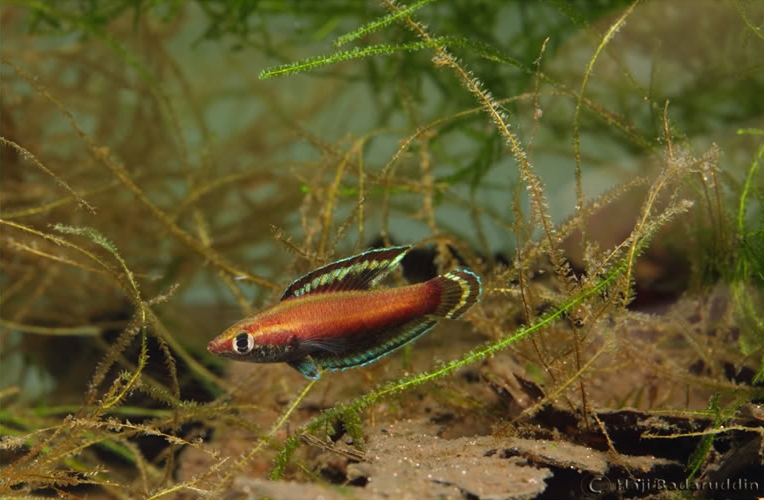
Parosphromenus nagyi
Schaller, 1985
Max length35mm SL1.4in SLTank40 × 20cm16 × 8inTemp22–28°C72–82°FpH3.0–6.5In males the dorsal, anal and caudal have a black subdistal band bordered on either side by bluish iridescent bands, with the inner one significantly thicker. The pelvic fins are iridescent emerald green with a dark blotch at the base and a subdistal dark spot, while the pectoral fins are hyaline.