Results for “ova”
Type a name: scientific, common, or one a species used to go by. Or narrow the catalogue with the filters.
Filters
Rasbora kottelati
authority not recorded
Max length70mm SL2.8in SLTank120 × 30cm48 × 12inTemp23–28°C73–82°FpHnot recordedIt is unclear if this species has been available in the aquatic trade as collections from its native waters only occur sporadically, therefore we have based much of the information here on experience with its closest relative R. kalochroma. These two are almost identical in appearance and share some meristic features but R. kottelati possesses an additional, oval-shaped dark blotch on the caudal peduncle, lacks the stripe in the middle of the seen in R. kalochroma and is consequently easy to dis...
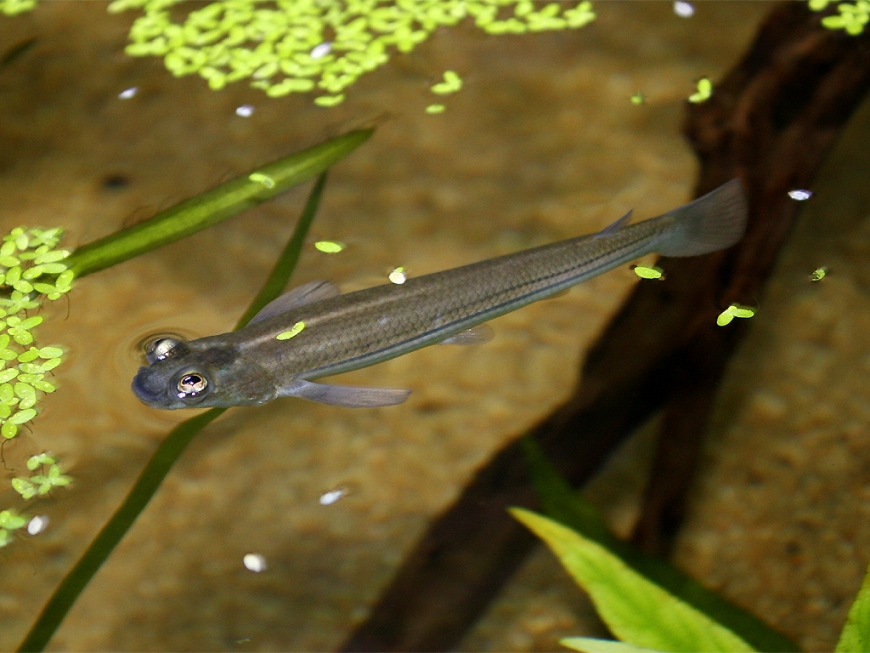
Anableps anablepsFour-Eyed Fish
Linnaeus, 1758
Max length260mm SL10in SLTank150 × 45cm60 × 18inTemp25–31°C77–88°FpH7.5–9.0The eye of Anableps species is split horizontally by a band of epithelial tissue. It has two corneas, two pupils, a single, egg-shaped lens and one retina that's also split into two sections. The lens is oval and asymmetric with the upper part flattened as in the human eye and the lower section curved as in most other fishes. The upper cornea is thicker and enriched with glycogen which possibly helps to protect it from drying and UV irradiation. Two horizontal flaps of the iris are thought ...
Hemichromis lifaliliBlood-Red Jewel Cichlid
authority not recorded
Max length100mm SL3.9in SLTank75 × 30cm30 × 12inTemp23–26°C73–79°FpH6.0–7.8Often confused with Hemichromis bimaculatus. These species can be easily distinguished as H. lifalili have only two black spots on the flanks whereas H. bimaculatus has three, having an extra spot on the caudal peduncle. It can also be told apart from the similar red form of H. guttatus by comparing the midlateral markings of the two. In lifalli the marking is round and is situated above the lateral line. In guttatus the marking is oval in shape and some of it extends below the lateral line. ...
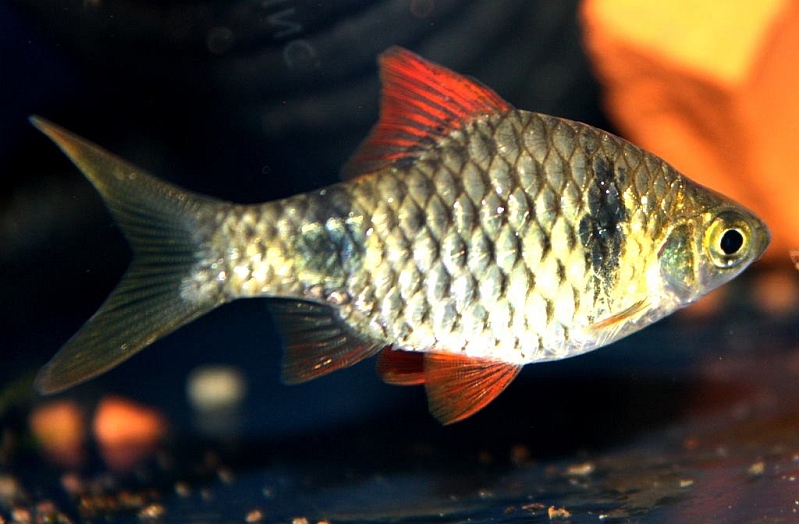
Pethia reval
Meegaskumbura, Silva, Maduwage & Pethiyagoda, 2008
Max length34mm SL1.3in SLTank75 × 30cm30 × 12inTemp18–26°C64–79°FpH6.0–7.5This species was considered a colour form of the related Pethia cumingii prior to its description. It can be told apart from P. cumingii by the following combination of characters: maximum standard length 33.6 mm (vs. 41.2 mm); smaller eye diameter (9.8-10.5, vs. 10.8-12.1 % SL); 11+13 (vs. 11+15) vertebrae; cleithrum with a single spine (vs. smooth); proximal arm of fifth ceratobranchial with an oval...