Results for “polyp”
Type a name: scientific, common, or one a species used to go by. Or narrow the catalogue with the filters.
Filters
Polypterus weeksiiMottled Bichir
authority not recorded
Max length550mm SL22in SLTank150 × 60cm60 × 24inTempnot recordedpHnot recordedP. weeksii is one of the "upper-jawed" tribe of polypterids so named on account of the upper jaw being longer than or equal in length to the lower jaw. It is one of the rarer bichir species in the hobby. Like other bichirs it is an incredibly hardy, nocturnal species with very poor vision, relying on its excellent sense of smell to locate food. This species along with others of its genus are some of the last surviving relatives of very ancient species. Fossils of earlier relatives have...
Chiloglanis polypogonAfrican Suckermouth Catfish
authority not recorded
Max length55mm SL2.2in SLTank45 × 30cm18 × 12inTemp22–26°C72–79°FpH6.5–7.0This fish belongs to a very distinctive genus of mochokid. There are almost 50 species of Chiloglanis described to science, but most are never imported and even the commoner species, such as this one, are seen only rarely. They are very difficult to identify down to species level, as many are very similar in looks. Some are strongly sexually dimorphic with the males having thickened or enlarged anal and caudal fins. Chiloglanis are also sometimes confused with the other 2 genera of African sucke...
Polypterus bichir bichirNile Bichir
authority not recorded
Max length720mm SL28in SLTank180 × 60cm72 × 24inTemp22–28°C72–82°FpH6.0–8.0An incredibly hardy, nocturnal species with very poor vision, P. delhezi relies on its excellent sense of smell to locate food. This species, along with others of its genus, is one of the last surviving relatives of very ancient species. Fossils of earlier relatives have been found that date back to the Triassic Period, which occured during the early development of the dinosaurs more than 200 million years ago. They have several interesting adaptations. The swim bladder is divided into 2 par...
Polypterus delheziArmoured Bichir
authority not recorded
Max length350mm SL14in SLTank120 × 45cm48 × 18inTemp24–30°C75–86°FpH6.0–8.0An incredibly hardy, nocturnal species with very poor vision, P. delhezi relies on its excellent sense of smell to locate food. This species, along with others of its genus, is one of the last surviving relatives of very ancient species. Fossils of earlier relatives have been found that date back to the Triassic Period, which occured during the early development of the dinosaurs more than 200 million years ago. They have several interesting adaptations. The swim bladder is divided into 2 par...
Polypterus endlicheri endlicheriSaddled Bichir
authority not recorded
Max length750mm SL30in SLTank210 × 120cm84 × 48inTemp22–27°C72–81°FpH6.0–8.0An incredibly hardy, nocturnal species with very poor vision, P. endlicheri endlicheri relies on its excellent sense of smell to locate food. This species, along with others of its genus, are some of the last surviving relatives of very ancient species. Fossils of earlier relatives have been found that date back to the Triassic Period, which occured during the early development of the dinosaurs more than 200 million years ago. They have several interesting adaptations. The swim bladder is div...
Polypterus ornatapinnisOrnate Bichir
authority not recorded
Max length600mm SL24in SLTank180 × 60cm72 × 24inTemp25–28°C77–82°FpH6.0–8.0An incredibly hardy, nocturnal species with very poor vision, []iP. ornatapinnis relies on its excellent sense of smell to locate food. This species along with others of its genus are some of the last surviving relatives of very ancient species. Fossils of earlier relatives have been found that date back to the Triassic Period, which occured during the early development of the dinosaurs more than 200 million years ago. They have several interesting adaptations. The swim bladder is divided int...
Polypterus palmas palmasMarbled Bichir
authority not recorded
Max length325mm SL13in SLTank120 × 45cm48 × 18inTemp25–28°C77–82°FpH6.0–7.0An incredibly hardy, nocturnal species with very poor vision, P. delhezi relies on its excellent sense of smell to locate food. This species, along with others of its genus, is one of the last surviving relatives of very ancient species. Fossils of earlier relatives have been found that date back to the Triassic Period, which occured during the early development of the dinosaurs more than 200 million years ago. They have several interesting adaptations. The swim bladder is divided into 2 par...
Polypterus retropinnisWest African Bichir
authority not recorded
Max length350mm SL14in SLTank120 × 45cm48 × 18inTemp25–28°C77–82°FpH6.0–8.0Also known as the Speckled Bichir, this is an incredibly hardy, nocturnal species with very poor vision. P. retropinnis relies on its excellent sense of smell to locate food. This species along with others of its genus are some of the last surviving relatives of very ancient species. Fossils of earlier relatives have been found that date back to the Triassic Period, which occured during the early development of the dinosaurs more than 200 million years ago. They have several interesting adapt...
Polypterus senegalus senegalusSenegal Bichir
authority not recorded
Max length500mm SL20in SLTank150 × 60cm60 × 24inTemp24–28°C75–82°FpH6.2–7.8An incredibly hardy, nocturnal species with very poor vision, P. senegalus relies on its excellent sense of smell to locate food. This species, along with others of its genus, are some of the last surviving relatives of very ancient species. Fossils of earlier relatives have been found that date back to the Triassic Period, which occured during the early development of the dinosaurs more than 200 million years ago. They have several interesting adaptations. The swim bladder is divided into 2 ...
Polypterus teugelsi
authority not recorded
Max length400mm SL16in SLTank150 × 60cm60 × 24inTemp25–28°C77–82°FpH7.0–7.5An incredibly hardy, nocturnal species with very poor vision, P. teugseli relies on its excellent sense of smell to locate food. This species along with others of its genus are some of the last surviving relatives of very ancient species. Fossils of earlier relatives have been found that date back to the Triassic Period, which occured during the early development of the dinosaurs more than 200 million years ago. They have several interesting adaptations. The swim bladder is divided into 2 parts...
Erpetoichthys calabaricusRopefish
authority not recorded
Max length900mm SL35in SLTank150 × 60cm60 × 24inTemp23–30°C73–86°FpH6.0–7.5This is the only species in the genus Erpetoichthys, and is an incredibly hardy, nocturnal species. Due to its poor vision, the Ropefish relies on its excellent sense of smell to locate food. It's closely related to the Polypterus genus and both these are some of the last surviving relatives of very ancient species. Fossils of earlier relatives have been found that date back to the Triassic Period, which occured during the early development of the dinosaurs, more than 200 million years ago....
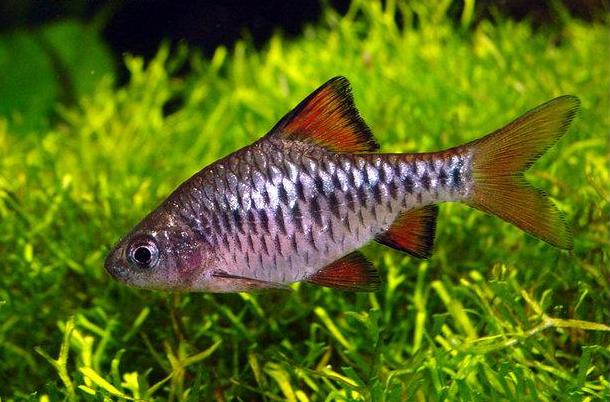
Oliotius oligolepisCheckered Barb
Bleeker, 1853
Max length45mm SL1.8in SLTank75 × 30cm30 × 12inTemp18–25°C64–77°FpH5.5–7.5This species is also traded as 'checker barb', 'checkerboard barb', or 'island barb', and is among the most ubiquitous species available in the aquarium trade. It is farmed commercially in enormous numbers with wild examples rarely, if ever, available. It was formerly included in the polyphyletic catch-all genus Puntius which contained over 100 species, but this situation has been largely resolved since the turn of the century.
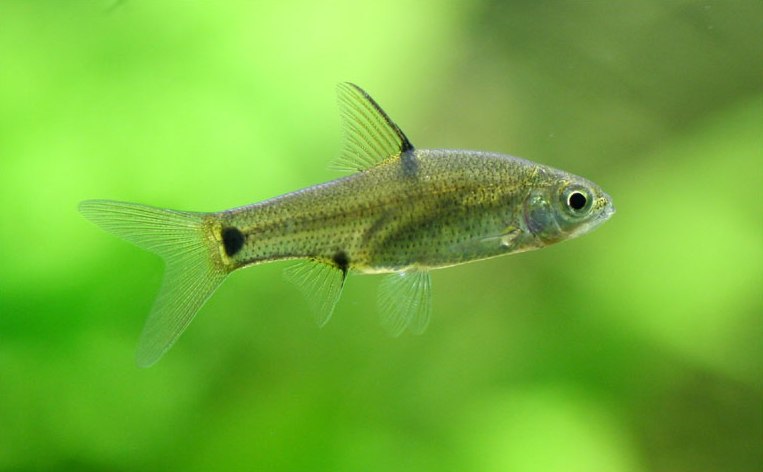
Puntius sharmai
Menon & Rema Devi, 1993
Max length40mm SL1.6in SLTank60 × 30cm24 × 12inTemp20–26°C68–79°FpH5.5–7.5This species is almost unheard of in the aquarium hobby outside of India but is maintained by some private collectors. It's distinguished from similar species by possessing a single pair of maxillary barbels, a relatively elongate body, and distinctive black spot above the anterior anal-fin base. The genus Puntius was for a number of years viewed as a polyphyletic catc...
Rasbora paucisqualis
authority not recorded
Max length40mm SL1.6in SLTank60 × 30cm24 × 12inTemp22.2–25.6°C72–78°FpHnot recordedRainboth's 'Fishes of the Cambodian Mekong' characterised members of Rasbora by possession of an unbranched, non-spiny firstray and seven soft dorsal rays, origin of thein the middle of the body, five branchedrays, a small mouth not extending below the eye and a lack of barbels. It's long been recognised as a polyphyletic lineage as noted by Kottelat (1999) amongst others, and in 2010 the results of a phylogenetic analysis by T. Y. Liao et al. suggested a number of changes in...
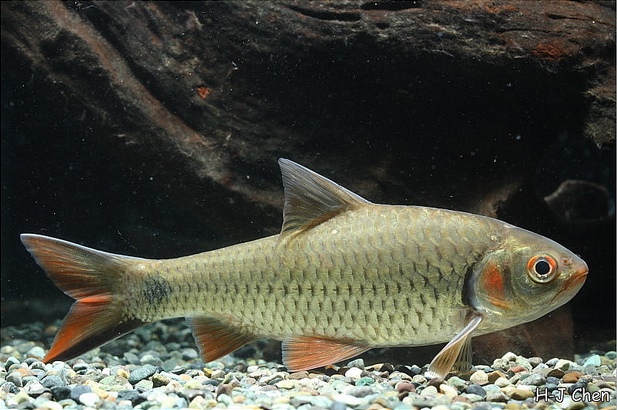
Systomus orphoides
Valenciennes, 1842
Max length250mm SL10in SLTank200 × 60cm79 × 24inTemp18–26°C64–79°FpH6.0–8.0The genus Puntius is currently viewed as something of a catch-all for well over 100 species of small to mid-sized cyprinid. Most experts agree that a full revision is required with the likely outcome that many species will be placed into new or different genera since it is clearly polyphyletic. When describing the grouping in 1822 Hamilton identified the defining characteristics as: presence or absence o...
Xenomystus nigriAfrican Knifefish
authority not recorded
Max length300mm SL12in SLTank120 × 45cm48 × 18inTemp23–28°C73–82°FpH5.8–7.5Originally classified in the genus Notopterus and reclassified in 1984, this is now the only described species of Xenomystus and has several interesting characteristics. Its swim bladder is specially adapted to act as an accessory breathing organ in a similar fashion to Polypteriids. It must rise to the surface to take a gulp of air periodically, often emitting a bell-like sound as it does so. X. nigri is often confused with the similar looking but far more aggressive Asian knifefish, Notopt...
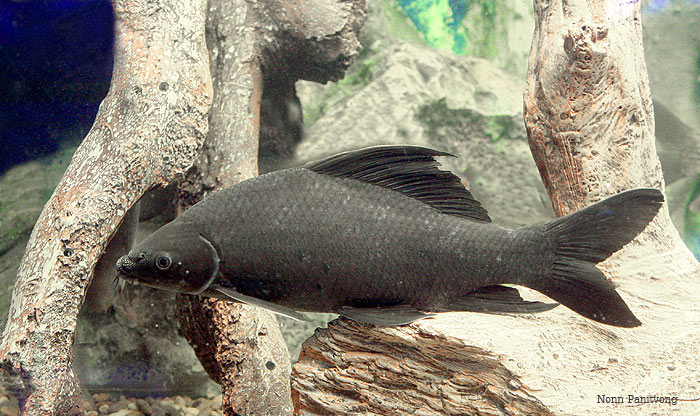
Labeo chrysophekadionBlack Shark
Bleeker, 1849
Matched on Rohita polyporos, a name it was formerly known by
Max length600mm SL24in SLTanknot recordedTemp20–26°C68–79°FpH6.0–8.0L. chrysophekadion is also known as 'black sharkminnow'. It continues to be available in the ornamental trade despite its patent unsuitability for the home aquarium, and an albino form has been selectively bred for the purpose. It can be distinguished from other members of the genus by the following combination...