Results for “proximal”
Type a name: scientific, common, or one a species used to go by. Or narrow the catalogue with the filters.
Filters
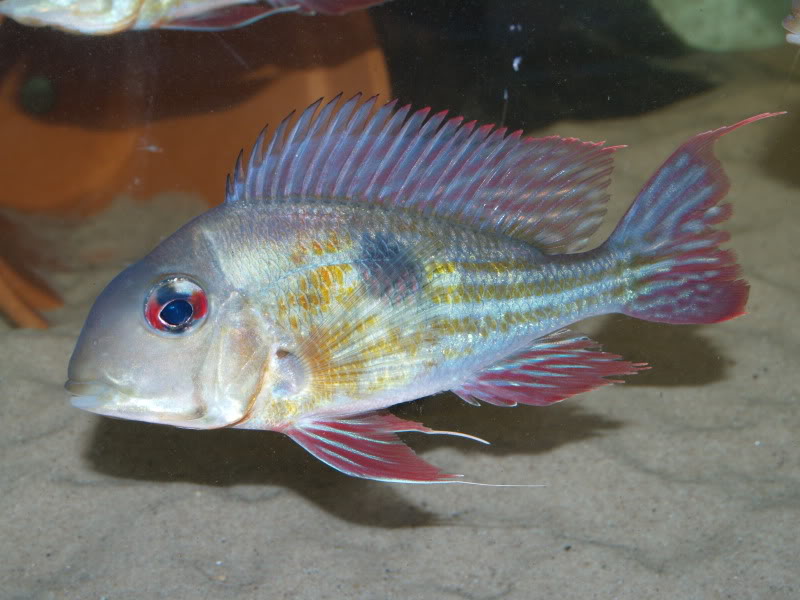
Geophagus proximus
Castelnau, 1855
Matched on Chromys proxima, a name it was formerly known by
Max length225mm SL9in SLTank180 × 60cm72 × 24inTemp24–32°C75–90°FpH4.0–7.0This species is rare in the hobby though it's name is often attached to shipments of other Geophagus species. It's a member of the nominal G. surinamensis 'group' of closely-related species within the genus and can be identified by a combination of characters including: possession of dark preopercular marking; no vertical bars on the flanks; relatively large, roughly oblong-shaped dark midlateral marking; caudal fin brownish with 3-5 light stripes on upper lobe and less well-defined stripes or mottled pattern of light spots with narrow dark interspaces on lower lobe.
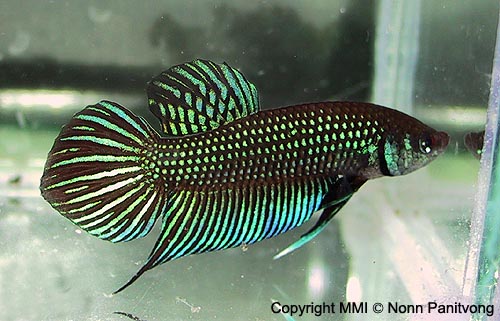
Betta mahachaiensis
Kowasupat, Panijpan, Ruenwongsa & Sriwattanarothai, 2012
Max length60mm SL2.4in SLTank45 × 30cm18 × 12inTemp22–28°C72–82°FpH7.0–8.5Known only from a handful of localities in Bangkok, Samut Sakhon, Samut Songkhram and Samut Prakan provinces in central Thailand, all of which lie on the coast of the Gulf of Thailand. Most habitats are in close proximity to Bangkok, which continues to expand rapidly, are considered under extreme threat, and recent surveys have failed to confirm that the fish is still present in Samut Songkhram and Samut Prakan.
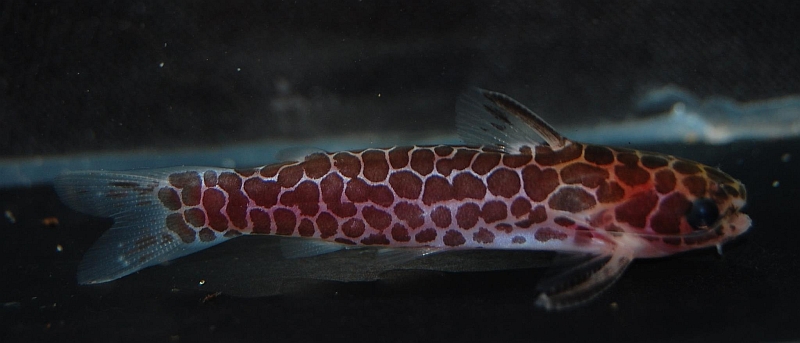
Centromochlus reticulatusReticulated Driftwood Catfish
Mees, 1974
Max length27mm SL1.1in SLTank60 × 30cm24 × 12inTemp22–28°C72–82°FpH5.0–7.5The genus Centromochlus is diagnosable by members having the proximal anal-fin radials enlarged and fused to each other at the base, forming a single ossified structure. It's sometimes included in the putative subfa...
Copadichromis azureus
authority not recorded
Max length160mm SL6in SLTank150 × 45cm60 × 18inTemp26–28°C79–82°FpH7.5–8.5Together with the recently erected genus Mchenga, Copadichromis species form an exclusive group of Malawian cichlids commonly referred to as "Utaka" (prounounced "ooh-taw-kuh"). They're specialised to a pelagic lifestyle, and can be found living in huge numbers throughout much of Lake Malawi. Some tend to remain in the proximity of underwater reefs or rocky shorelines, while others occur mainly in more featureless, sandy habitats. Here they face the oncoming current, us...
Copadichromis borleyi
authority not recorded
Max length200mm SL8in SLTank150 × 45cm60 × 18inTemp25–29°C77–84°FpH7.5–8.5Together with the recently erected genus Mchenga, Copadichromis species form an exclusive group of Malawian cichlids commonly referred to as "Utaka" (prounounced "ooh-taw-kuh"). They're specialised to a pelagic lifestyle, and can be found living in huge numbers throughout much of Lake Malawi. Some tend to remain in the proximity of underwater reefs or rocky shorelines, while others occur mainly in more featureless, sandy habitats. Here they face the oncoming current, usi...
Copadichromis chrysonotus
authority not recorded
Max length160mm SL6in SLTank150 × 45cm60 × 18inTemp25–29°C77–84°FpH7.5–8.5Together with the recently erected genus Mchenga, Copadichromis species form an exclusive group of Malawian cichlids commonly referred to as "Utaka" (prounounced "ooh-taw-kuh"). They're specialised to a pelagic lifestyle, and can be found living in huge numbers throughout much of Lake Malawi. Some tend to remain in the proximity of underwater reefs or rocky shorelines, while others occur mainly in more featureless, sandy habitats. Here they face the oncoming current, usi...
Copadichromis ilesi
authority not recorded
Max length175mm SL7in SLTank150 × 45cm60 × 18inTemp25–29°C77–84°FpH7.5–8.5Together with the recently erected genus Mchenga, Copadichromis species form an exclusive group of Malawian cichlids commonly referred to as "Utaka" (prounounced "ooh-taw-kuh"). They're specialised to a pelagic lifestyle, and can be found living in huge numbers throughout much of Lake Malawi. Some tend to remain in the proximity of underwater reefs or rocky shorelines, while others occur mainly in more featureless, sandy habitats. Here they face the oncoming current, usi...
Copadichromis virginalis
authority not recorded
Max length130mm SL5in SLTank150 × 45cm60 × 18inTemp25–29°C77–84°FpH7.5–8.5Together with the recently erected genus Mchenga, Copadichromis species form an exclusive group of Malawian cichlids commonly referred to as "Utaka" (prounounced "ooh-taw-kuh"). They're specialised to a pelagic lifestyle, and can be found living in huge numbers throughout much of Lake Malawi. Some tend to remain in the proximity of underwater reefs or rocky shorelines, while others occur mainly in more featureless, sandy habitats. Here they face the oncoming current, usi...
Craterocephalus stercusmuscarum stercusmuscarumFly-specked Hardyhead
authority not recorded
Max length70mm SL2.8in SLTank76 × 30cm30 × 12inTempnot recordedpHnot recordedA rarely seen species in the trade, although it's kept quite often by Australian hobbyists. Members of this genus are thought to have a more ancient association with Australian freshwaters than most others found in these habitats. Craterocephalus also contains the most species of any Australian freshwater fish genus. It has been shown that there are quite large genetic differences between groups of the species living in close proximity to each other, and even sharing the same waters. In ...
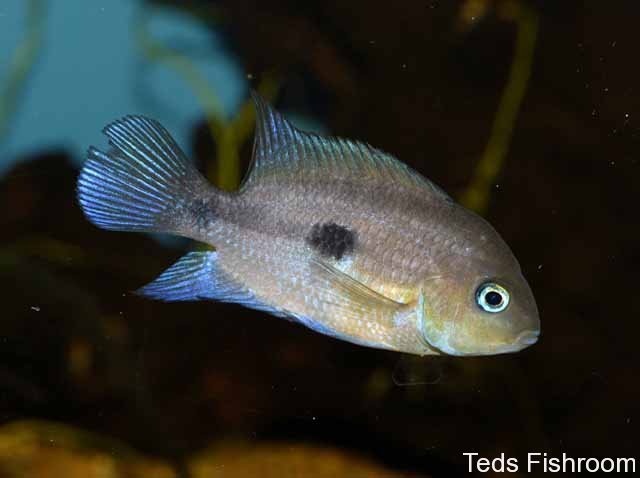
Cryptoheros myrnae
Loiselle, 1997
Max length♂ 100 · ♀ 80mm SL♂ 3.9 · ♀ 3.1in SLTank90 × 30cm36 × 12inTemp23–26°C73–79°FpH7.0–8.5In its natural waters, females have been observed caring for mixed broods containing both their own fry and those of another cichlid, Amphilophus bussingi. It is unknown if these are mixed by accident (as the two species have also been recorded tending broods in close proximity to one another) or if this represents an adaptive behaviour to increase numbers in a brood and therefore decrease the chance of predation.
Hydrolycus tatauaia
Toledo-Piza, Menezes & Santos, 1999
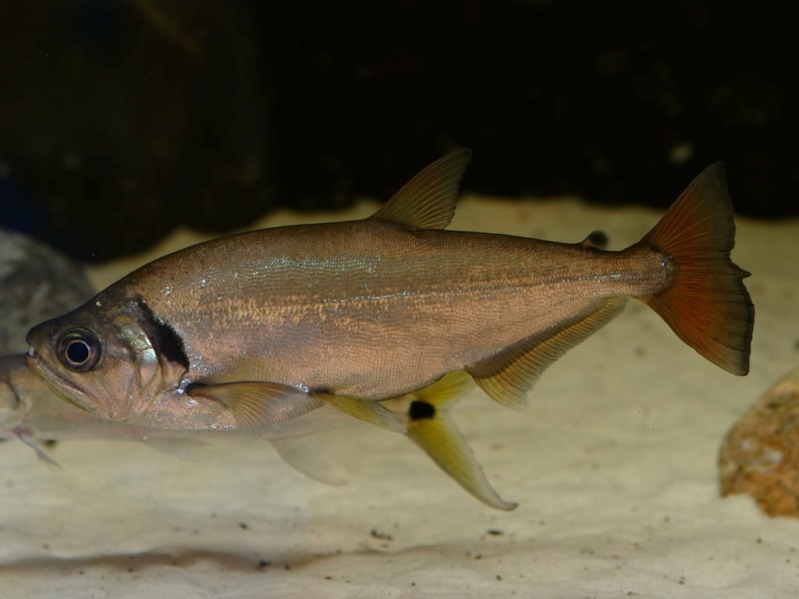
Max length455mm SL18in SLTanknot recordedTemp24–28°C75–82°FpH6.0–8.0Vernacular names in Brazil include 'Cachorra' or 'Pirandirá', although these are also applied to congeners. It can be told apart from all congeners by the following combination of characters: head and body silvery with dark dorsal surface; an elongate dark blotch posterior to the opercle; dorsal, caudal and anal-fin rays reddish to orange proximally with some individual variation in intensity and tonality; adipose fin dark, with diffuse black pigmentation.
Pethia reval
Meegaskumbura, Silva, Maduwage & Pethiyagoda, 2008
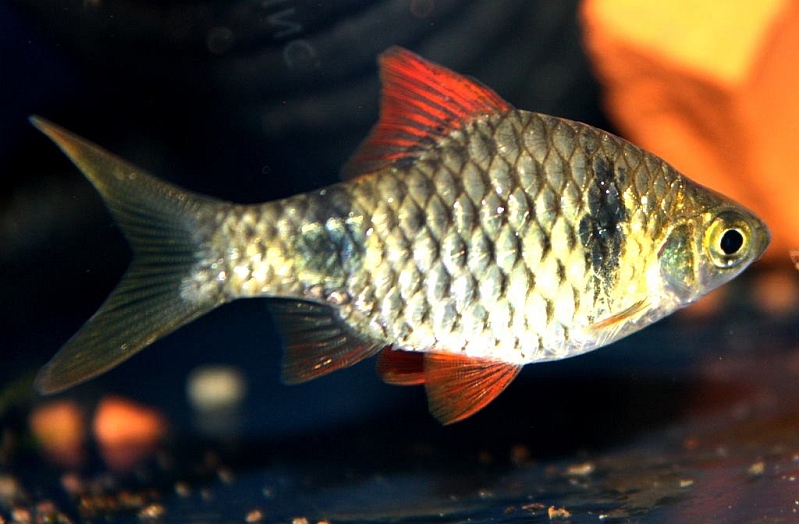
Max length34mm SL1.3in SLTank75 × 30cm30 × 12inTemp18–26°C64–79°FpH6.0–7.5This species was considered a colour form of the related Pethia cumingii prior to its description. It can be told apart from P. cumingii by the following combination of characters: maximum standard length 33.6 mm (vs. 41.2 mm); smaller eye diameter (9.8-10.5, vs. 10.8-12.1 % SL); 11+13 (vs. 11+15) vertebrae; cleithrum with a single spine (vs. smooth); proximal arm of fifth ceratobranchial with an oval...