Results for “terminal mouth”
Type a name: scientific, common, or one a species used to go by. Or narrow the catalogue with the filters.
Filters
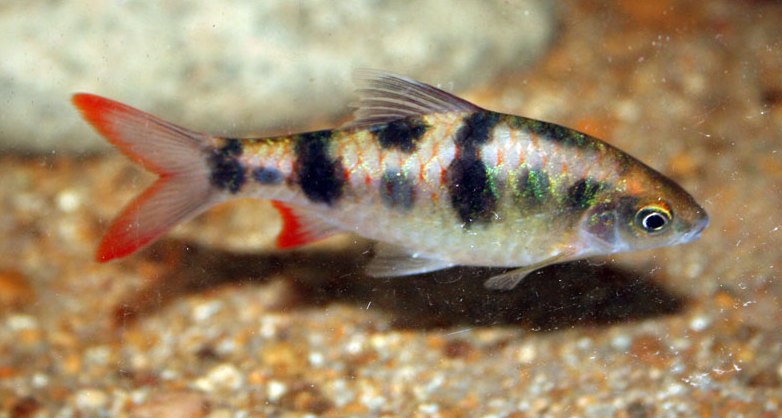
Dawkinsia tambraparniei'Arulius' Barb
Silas, 1954
Max length130mm SL5in SLTank120 × 45cm48 × 18inTemp18–25°C64–77°FpH6.0–8.0D. exclamatio should also have a sub-terminal mouth and lack dorsal-fin filaments but some specimens possess a terminal mouth and/or possess dorsal filaments, and one specimen also had black caudal-fin tips as typically seen in D. filamentosa, whereas the description states that the fin tips are only dusky and lack distinctive markings.
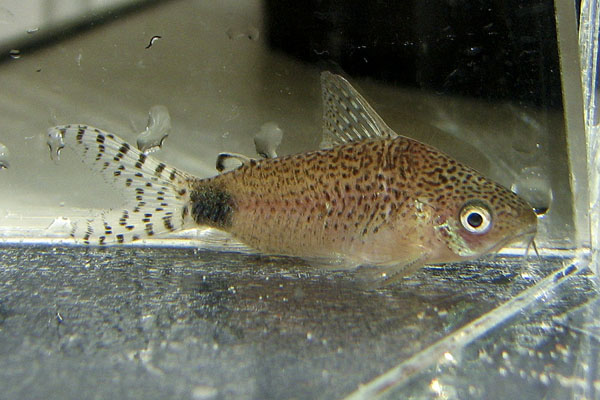
Corydoras guaporeGuaporé Cory
Knaack, 1961
Max length50mm SL2.0in SLTank90 × 30cm36 × 12inTemp22–28°C72–82°FpH5.0–7.0C. guapore is a sought after aquarium fish although it is not often traded. It exhibits slightly different behaviour to the majority of congeners in that it tends to form aggregations in midwater and spends a large proportion of its time away from the substrate. Its morphology exhibits corresponding adaptations towards a pelagic existence with a relatively large eye, a more terminal mouth position, more strongly-forked caudal-fin, and more symmetrical body shape than most other Corydoras species.
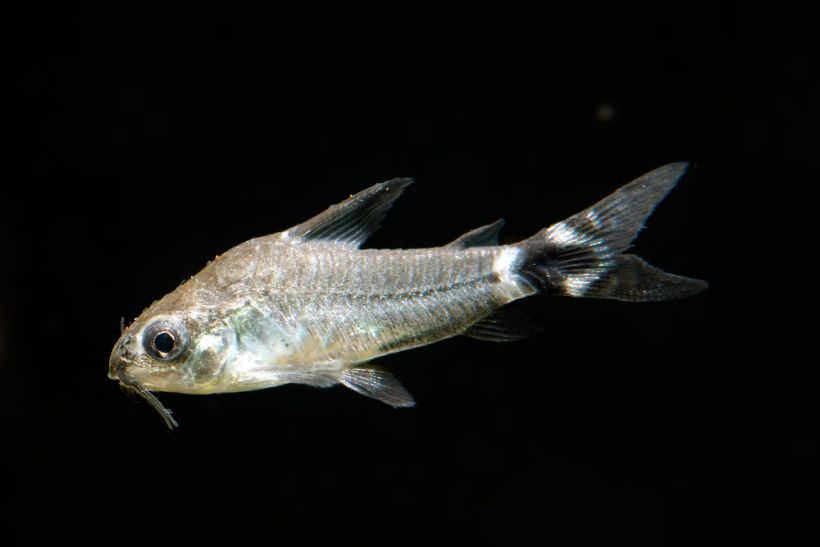
Corydoras hastatusTail-spot Pygmy Cory
Eigenmann & Eigenmann, 1888
Max length32mm SL1.3in SLTank60 × 30cm24 × 12inTemp20–26°C68–79°FpH6.0–7.5It exhibits slightly different behaviour to the majority of congeners in that it tends to swim in midwater and spends a large proportion of its time away from the substrate. Its morphology exhibits corresponding adaptations towards a pelagic existence with a relatively large eye, a more terminal mouth position, more strongly-forked caudal-fin, and more symmetrical body shape than most other Corydoras species.
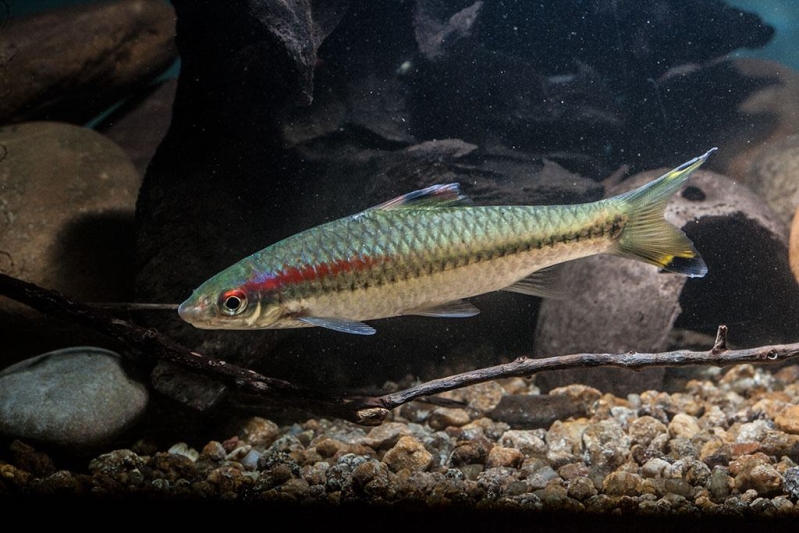
Sahyadria chalakkudiensis
Menon, Rema Devi & Thobias, 1999
Max length125mm SL5in SLTank120 × 45cm48 × 18inTemp15–25°C59–77°FpH6.5–7.5S. chalakkudiensis can be told apart from S. denisonii by possession of an inferior mouth (vs. subterminal) and presence of a black marking in the dorsal-fin (vs. absence), and the scarlet body stripe being duller and terminating beneath or anterior to the dorsal-fin origin (vs. brighter and terminating beneath the centre of the dorsal-fin).