Results for “character”
Type a name: scientific, common, or one a species used to go by. Or narrow the catalogue with the filters.
Filters
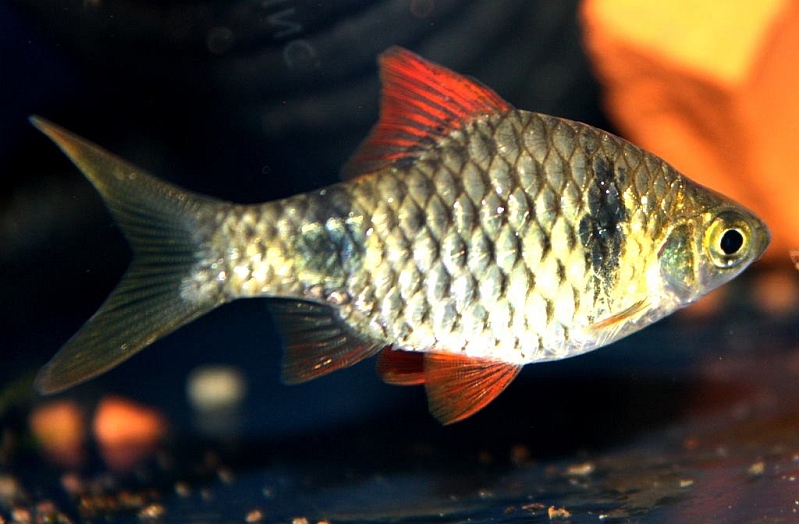
Pethia reval
Meegaskumbura, Silva, Maduwage & Pethiyagoda, 2008
Max length34mm SL1.3in SLTank75 × 30cm30 × 12inTemp18–26°C64–79°FpH6.0–7.5This species was considered a colour form of the related Pethia cumingii prior to its description. It can be told apart from P. cumingii by the following combination of characters: maximum standard length 33.6 mm (vs. 41.2 mm); smaller eye diameter (9.8-10.5, vs. 10.8-12.1 % SL); 11+13 (vs. 11+15) vertebrae; cleithrum with a single spine (vs. smooth); proximal arm of fifth ceratobranchial with an oval...
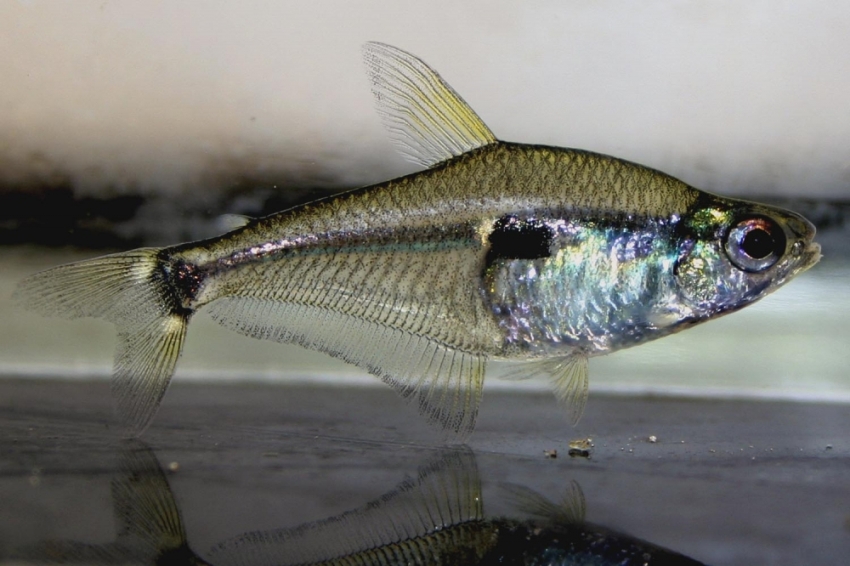
Phenacogaster tegatus
Eigenmann, 1911
Max length45mm SL1.8in SLTank60 × 30cm24 × 12inTemp20–28°C68–82°FpH6.0–7.5This species has been traded as 'six-eyed tetra' in reference to its colour pattern comprising two dark spots on each flank plus the eye. Based on the extensive review of the genus by Lucena and Malabarba (2010), in which nine new species were described, P. tegatus can be told apart from congeners by the following combination of characters: lateral line incomplete with 8-13 perforated scales; laterally elongate humera...
Potamotrygon castexiOtorongo Ray
authority not recorded
Max length600mm SL24in SLTanknot recordedTemp24–28°C75–82°FpHnot recordedIn Brazil P. castexi is currently banned from export, although it can still be legally obtained from other countries. There's a high level of polychromatism (differences in colour and pattern) displayed by this species, and in the hobby some of the colour forms have been given distinguishing names. Below is a list of some of the commoner varieties, along with some defining characteristics: Otorongo Ray (also known as "Jaguar" Ray, P25, P26, P28 or P35): This popular variant has...
Pseudogastromyzon laticeps
authority not recorded
Max length67mm SL2.6in SLTank75 × 30cm30 × 12inTempnot recordedpH6.0–7.5It appears that this species has not yet appeared in the western hobby, probably because commercial fish collections don't normally take place in its native waters although the goby Rhinogobius zhoui has been available occasionally. We're unable to provide details of distinguishing characters since no diagnostic key to the genus exists in English at time of writing, but based on the images available it does appear to possess reddish dorsal and caudal fins. The specimens pictured were i...
Pseudogastromyzon myersi
authority not recorded
Max length60mm SL2.4in SLTank75 × 30cm30 × 12inTempnot recordedpH6.0–7.5This species is traded under various vernacular names including 'Chinese hillstream loach', 'Chinese butterfly plec' and 'Hong Kong Otocinclus. It's the commonest member of the genus in the hobby but has been frequently misidentified as the congener P. cheni in the past with the two often said to be indistinguishable in terms of colour pattern. Some sources additionally suggest the sole defining external character to be that in P. cheni the distance between the resp...
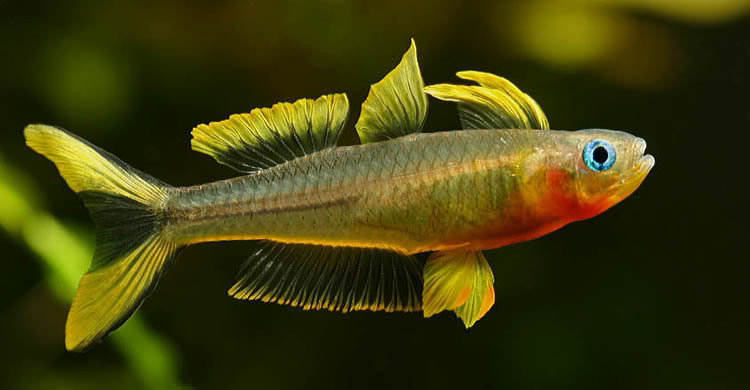
Pseudomugil furcatusForktail Blue-eye
Nichols, 1955
Max length60mm SL2.4in SLTank60 × 30cm24 × 12inTemp24–28°C75–82°FpH7.0–8.0This species is also traded as 'forktail rainbowfish' or 'yellow forktail', and it's also undergone several changes in scientific name since description. Pseudomugil furcatus is the original designation, but Allen (1980) created the genus Popondetta for it on the basis of morphological characters including number of anal-fin rays (16-20 in P. furcatus, 8-12 in other Pseudomugil spp.), absence of anterior...
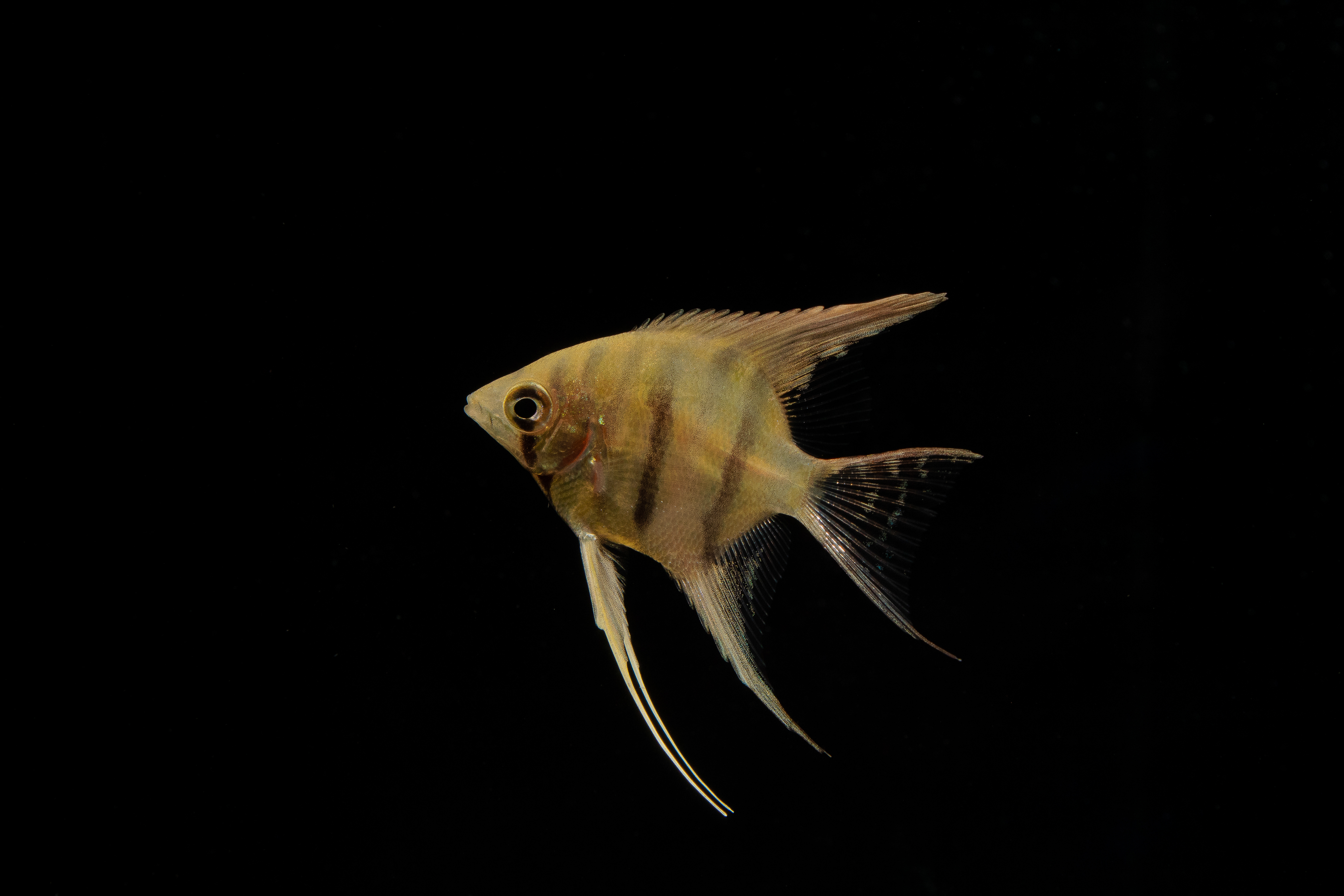
Pterophyllum leopoldiRoman Nose Angelfish
Gosse, 1963
Max length100mm SL3.9in SLTank90 × 30cm36 × 12inTemp22–29°C72–84°FpH5.0–7.0Pterophyllum leopoldi can be differentiated from other members of the genus by the presence of up to 11 vertical stripes on the body, though often only the 3 largest, boldest stripes can be seen. This species also shows a dark patch over the operculum. In adult specimens, a red/maroon hue over the back and fins is characteristic of the species, leading some to believe the most colourful natural form Angelfish. The name-sake roman nose possessed by the fish is also very distinctive and used as a meristic feature.
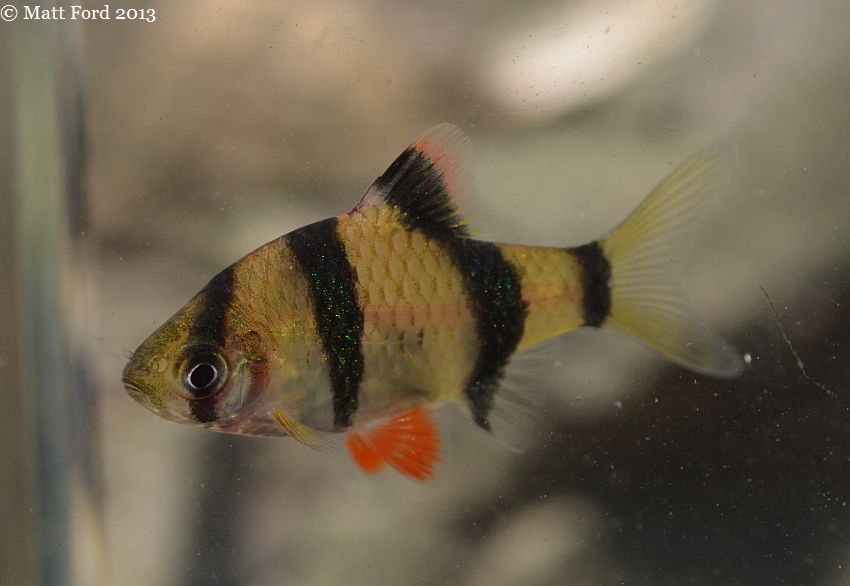
Puntigrus anchisporus
Vaillant, 1902
Max length60mm SL2.4in SLTank80 × 30cm31 × 12inTemp20–26°C68–79°FpH5.5–7.0This species occasionally appears in the aquarium hobby, but the trade is largely reliant on commercially-produced 'tiger barbs' of questionable origin. It is distinguished from congeners by the following combination of characters: lateral line complete; 14 circumpeduncular scales; 21-23+2 scales in the lateral row; dorsal-fin black with red outer band; pelvic fins red.
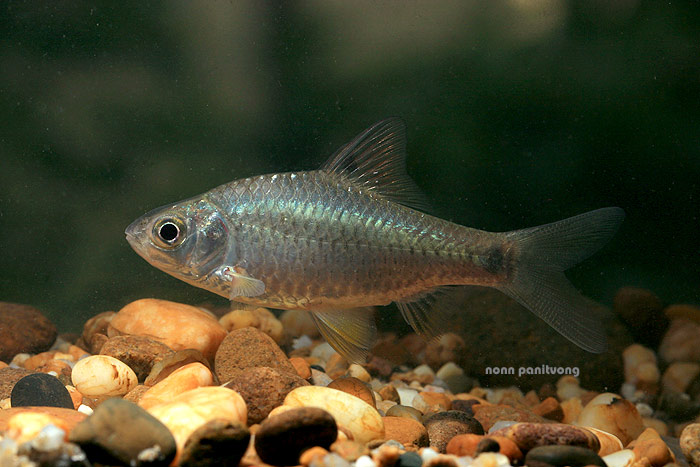
Puntius cholaSwamp Barb
Hamilton, 1822
Max length130mm SL5in SLTank120 × 45cm48 × 18inTemp18–26°C64–79°FpH5.5–8.0P. chola was retained in Puntius sensu stricto, of which members are defined by the following combination of characters: adult size usually less than 120 mm SL; maxillary barbels absent or present; rostral barbels absent; 3-4 unbranched and 8 branched dorsal-fin rays; 3 unbranched and 5 branched anal-fin rays; last unbranched dorsal-fin ray weak or strong and unserrated; lateral line complete with 22-28 pored body scales...
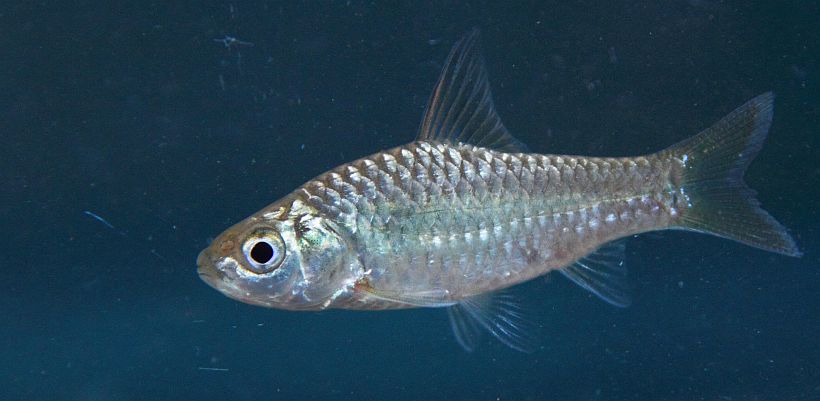
Puntius kamalikaKami's Barb
Silva, Maduwage & Pethiyagoda, 2008
Max length75mm SL3.0in SLTank120 × 30cm48 × 12inTemp20–27°C68–81°FpHnot recordedPrior to its description P. kamalika was referred to as P. amphibius, a putatively valid species probably restricted to western India. It differs from all congeners in the following combination of characters: 4½/1/2½ scales in a transverse line between the mid-dorsal...
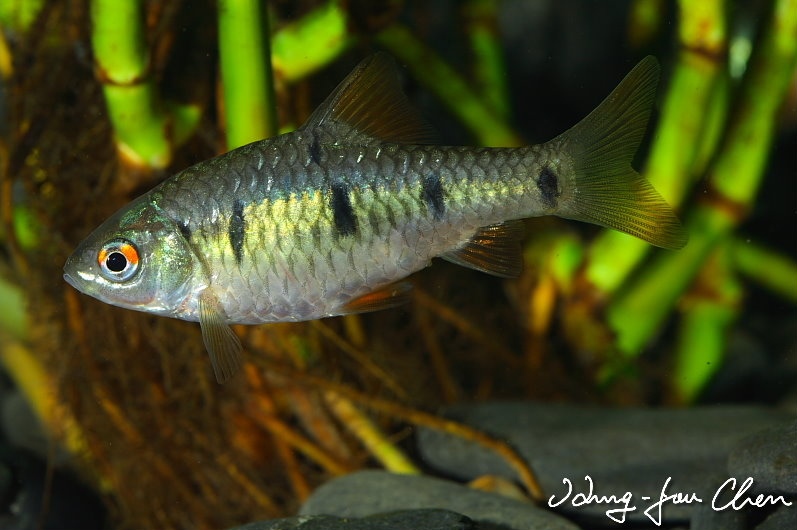
'Puntius' snyderi
Oshima, 1919
Max length75mm SL3.0in SLTank90 × 30cm36 × 12inTemp18–24°C64–75°FpH6.0–8.0This species is almost identical to the wild form of 'P.' semifasciolatus which is best known as the 'golden barb' in the aquarium hobby due to the popularity of a yellowish ornamental strain. The natural colour pattern is greenish in both species, however, and in terms of external characters they're only reliably distinguished by the fact that 'P.' semifasciolatus possesses a pair of prominent maxillary barbels wherea...
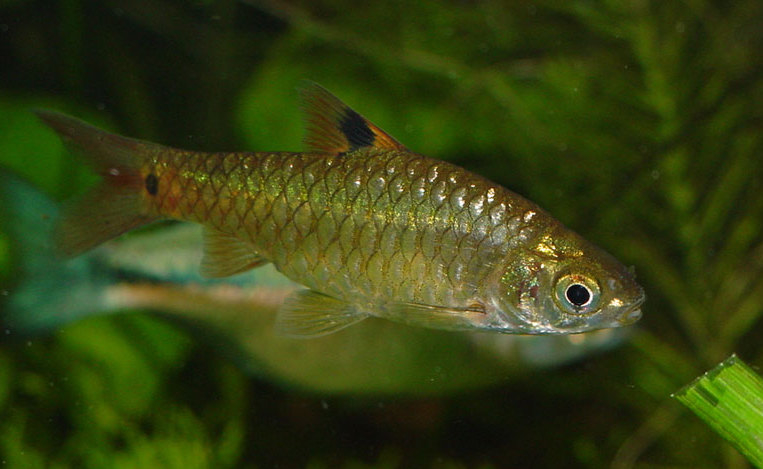
Puntius vittatusGreenstripe Barb
Day, 1865
Max length45mm SL1.8in SLTank75 × 30cm30 × 12inTemp18–26°C64–79°FpH6.0–7.5It can be told apart from similar-looking congeners such as P. crescentus and P. muzaffarpurensis by the following combination of characters: barbels absent; lateral line incomplete with up to 5 pored scales; 20-22 lateral line scales; 8 predorsal scales; dorsal-fin with a vertically-orientated black streak and a black tip with orange markings; a dark spot at the base of the caudal peduncle.
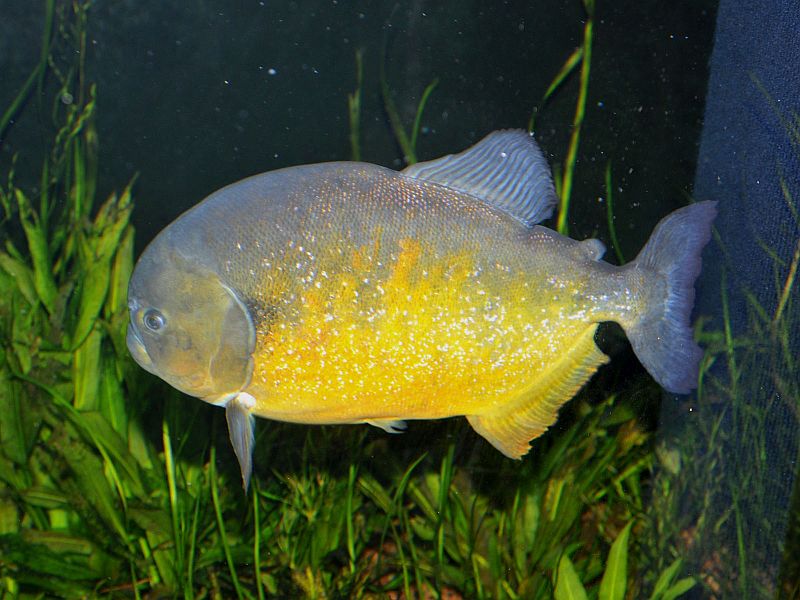
Pygocentrus pirayaPiraya
Cuvier, 1819
Max length350mm SL14in SLTanknot recordedTemp20–28°C68–82°FpH6.0–8.0Following Fink (1993), P. piraya can be distinguished from congeners by the following combination of characters: adipose fin with rays in larger specimens (vs. always without rays in other Pygocentrus species); branched dorsal-fin rays 15-18, usually 16 (vs. 14-18, usually 15); usually 7 neural spines anterior to first pterygiophore (vs. usually 6); vertebrae 36-39, usually 38 (vs. 35-38, usually 36). It can also be identified by colour pattern since it possesses distinctive bright yellow-orange pigmentation on the lower jaw, opercle and lateral body in life.
Rasbora caudimaculataGreater Scissortail Rasbora
authority not recorded
Max length150mm SL6in SLTank150 × 45cm60 × 18inTemp20–26°C68–79°FpHnot recordedThis striking species may also be seen on sale with the trade name of 'red scissortail'. It can be distinguished from the similar-looking R. trilineata by the presence of orange/red colouration in the with other diagnostic features including black tips to the caudal lobes, 11-12 predorsal scale rows and a dark reticulated pattern to the edges of the scales. The 'scissortail' moniker is derived from the characteristic twitching motion of the when the fish is at rest. Rainb...
Rasbora einthoveniiBrilliant Rasbora
authority not recorded
Max length90mm SL3.5in SLTank120 × 30cm48 × 12inTemp22–26°C72–79°FpHnot recordedThis is one of the more commonly-seen rasboras in the hobby and is ideal for the medium-sized community set-up. It shares some close similarities with R. jacobsoni but can be most easily identified by the fact it lacks dark reticulated scales above the lateral stripe. This stripe also has noticeably more uneven or "crinkly" edges in R. einthovenii than in R. jacobsoni or indeed any other species of laterally-striped Rasbora. A further distinguishing combination of characters for both t...
Rasbora lacrimulaRed Cherry Rasbora
authority not recorded
Max length31mm SL1.2in SLTank45 × 30cm18 × 12inTemp22.2–25.6°C72–78°FpHnot recordedThis species is also traded as 'Bornean redfin rasbora', 'sunshine rasbora' and 'dwarf volcano rasbora' and first appeared in the hobby during the latter part of 2010. It can be told apart from all other members of the genus by a combination of the following characters: possession of small tubercules on the dorsal surface, posterior to theand continuing onto the upper part of caudal fin, visible as an irregular 'crest' when a specimen is viewed laterally; ...
Rasbora paucisqualis
authority not recorded
Max length40mm SL1.6in SLTank60 × 30cm24 × 12inTemp22.2–25.6°C72–78°FpHnot recordedRainboth's 'Fishes of the Cambodian Mekong' characterised members of Rasbora by possession of an unbranched, non-spiny firstray and seven soft dorsal rays, origin of thein the middle of the body, five branchedrays, a small mouth not extending below the eye and a lack of barbels. It's long been recognised as a polyphyletic lineage as noted by Kottelat (1999) amongst others, and in 2010 the results of a phylogenetic analysis by T. Y. Liao et al. suggested a number of changes in...
Rasbora rasboraGangetic Scissortail Rasbora
authority not recorded
Max length130mm SL5in SLTank120 × 45cm48 × 18inTemp20–25°C68–77°FpHnot recordedThis species is rarely seen in the trade and little has been written regarding its captive care. It's possible that several colour forms may exist depending on collection locality. Rainboth's 'Fishes of the Cambodian Mekong' characterised members of Rasbora by possession of an unbranched, non-spiny firstray and seven soft dorsal rays, origin of thein the middle of the body, five branchedrays, a small mouth not extending below the eye and a lack of barbels. It's long b...
Rasbora sarawakensis
authority not recorded
Max length50mm SL2.0in SLTank60 × 38cm24 × 15inTemp22–26°C72–79°FpHnot recordedR. sarawakensis is poorly-documented in the aquarium literature and we're not even sure if it has been exported for the hobby although it may be worth looking out for among shipments of wild fish from southern/western Borneo. We find this a little odd as it is an attractive, very peaceful little fish that would suit many home aquaria and is apparently quite common across its natural range. Rainboth's 'Fishes of the Cambodian Mekong' characterised members of Rasbora by poss...
Rasbora trilineataScissortail Rasbora
authority not recorded
Max length150mm SL6in SLTank120 × 45cm48 × 18inTemp22–25°C72–77°FpHnot recordedThis popular species is also known as the 'three-lined' rasbora and provided a large enough tank is available it is an excellent choice for those new to the hobby. The 'scissortail' moniker is derived from the characteristic twitching motion of the when the fish is at rest. It can be distinguished from the similar R. caudimaculata by lacking red colouration in the and from R. spilocerca by its much larger size. Several geographical forms appear to exist as some wild populatio...