Results for “aquarium”
Type a name: scientific, common, or one a species used to go by. Or narrow the catalogue with the filters.
Filters
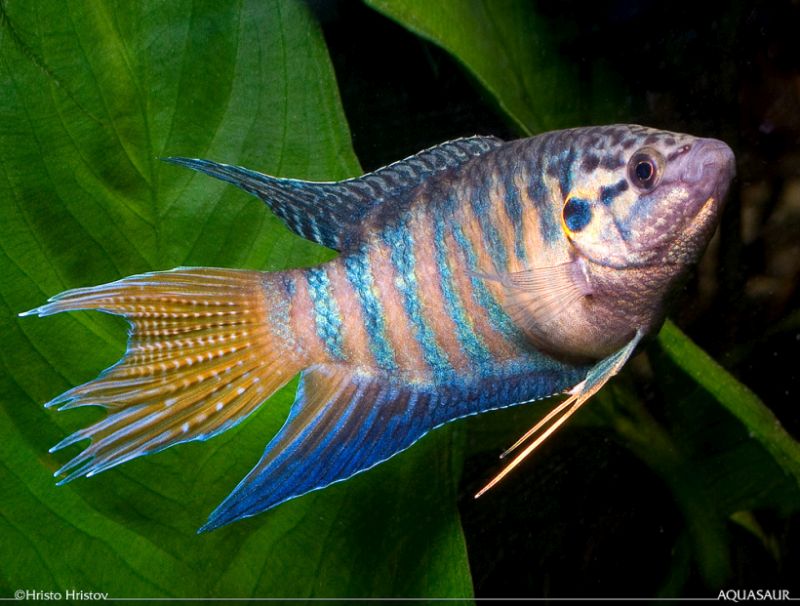
Macropodus opercularisParadise Fish
Linnaeus, 1758
Max length80mm SL3.1in SLTank80 × 30cm31 × 12inTemp10–22°C50–72°FpH6.0–8.0M. opercularis is a classic aquarium fish, having been introduced to the hobby by a French soldier named Gerault in 1869. Of the initial 100 specimens shipped, 22 survived and were successfully bred later that same year by another Frenchman, the Parisian Pierre Carbonnier. This gives the species the distinction of being one of the very first ornamental fish imported to Europe. It is also known as 'Chinese fighting fish', 'paradise gourami', and 'blue paradise fish'.
Marosatherina ladigesiCelebes Rainbowfish
authority not recorded
Max length80mm SL3.1in SLTank76 × 30cm30 × 12inTemp22–28°C72–82°FpH7.0–8.0For many years, this species was included in the genus Telmatherina, and is still listed as such in much of the avilable literature. In fact it's now the only species in the recently erected genus Marosatherina. Unfortunately, it has been overfished for the aquarium trade in its native waters and is listed as 'vulnerable' on the IUCN red list of threatened species. Thankfully, it's now being mass-produced on fish farms in both the Far East and Eastern Europe, meaning that few...
Melanotaenia boesemaniBoeseman's rainbowfish
authority not recorded
Max length110mm SL4in SLTank120 × 30cm48 × 12inTemp27–30°C81–86°FpH7.0–8.0This uniquely-patterned species is one of the most popular rainbowfish in the hobby and can be found swimming in most dealers' tanks. However, virtually all these fish are mass-produced on fish farms in the Far East and Eastern Europe. M. boesmani is actually quite rare in nature, and is on the IUCN red list of endangered species. Unfortunately this is one species on which the aquarium trade has had a massively detrimental effect, with an estimated one million fish a year being collected to...
Melanotaenia lacustrisLake Kutubu Rainbowfish
authority not recorded
Max length120mm SL5in SLTank120 × 30cm48 × 12inTemp20–25°C68–77°FpH7.0–9.0Unfortunately the prisitine environment form where this fish comes is being threatened by overfishing (much of it for the aquarium trade) and industry, with an oil development being built at one end of the lake during the 1990s. M. lacustris has therefore been given "vulnerable" status on the IUCN red list. The lake was designated a Wetland of International Importance in 1998, as both it and the Kikori Basin where it lies contain some of the earth's greatest biodiversity in terms ...
Melanotaenia splendida inornataCheckered Rainbowfish
authority not recorded
Max length150mm SL6in SLTank120 × 30cm48 × 12inTemp26–33°C79–91°FpH6.5–8.0There are currently 4 described subspecies of Melanotaenia splendida. The principle differences are generally in colour, pattern and fin counts, although even these vary depending on the locality of the fish. The different forms and subspecies should not be mixed in the aquarium, as they may hybridise. Adult specimens are rarely seen for sale, and it's the much drabber juvenile fish that are almost always offered in dealers tanks. However, exercise some patience (even on a good diet, full c...
Melanotaenia splendida rubrostriataRed-striped Rainbowfish
authority not recorded
Max length125mm SL5in SLTank120 × 30cm48 × 12inTemp24–30°C75–86°FpHnot recordedThere are currently 4 described subspecies of Melanotaenia splendida, of which this species is one of the most colourful. The principle differences are generally in colour, pattern and fin counts, although even these vary depending on the locality of the fish. The different forms and subspecies should not be mixed in the aquarium, as they may hybridise. Adult specimens are rarely seen for sale, and it's the much drabber juvenile fish that are almost always offered in dealers tanks. However,...
Melanotaenia splendida splendidaEastern Rainbowfish
authority not recorded
Max length150mm SL6in SLTank120 × 30cm48 × 12inTemp20–30°C68–86°FpH5.0–8.0There are currently 4 described subspecies of Melanotaenia splendida. The principle differences are generally in colour, pattern and fin counts, although even these vary depending on the locality of the fish. M s. splendida in particular also exhibits a wide variation in colour and patterning depending on locality within the subspecies, and the species name is often suffixed with a place name when the fish are seen for sale. The different forms and subspecies should not be mixed in the aquarium,...
Melanotaenia trifasciataBanded Rainbowfish
authority not recorded
Max length150mm SL6in SLTank120 × 30cm48 × 12inTemp24–33°C75–91°FpH6.5–8.0M. trifasciata exhibits a wide variation in colour and patterning depending on locality, and it's very important that the different morphs are not mixed in the aquarium, as they will hybridise freely. These different forms are often distinguished by the addition of the name of collection locality being added to the scientific name of the fish. It's thought that several species may in fact be in evidence here, and a reclassification will probably occur at some point As with many othe...
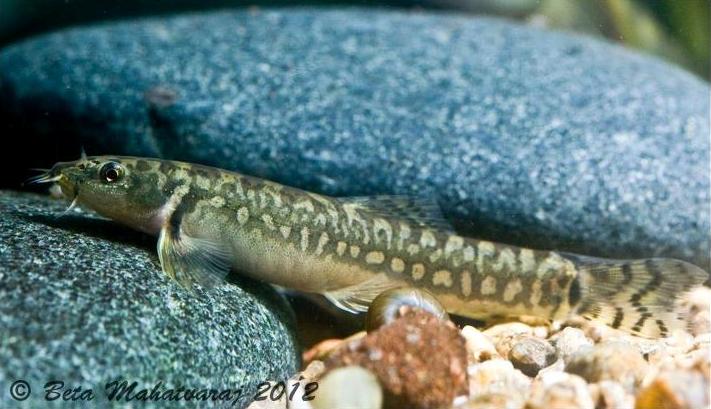
Mesonoemacheilus herrei
Nalbant & Bãnãrescu, 1982
Max length60mm SL2.4in SLTank60 × 30cm24 × 12inTemp18–25.5°C64–78°FpH6.0–7.5It's unclear if this species has ever been exported for the aquarium hobby outside of India but there may be a chance of finding the occasional specimen mixed in with shipments of M. guentheri or M. triangularis. It was earlier considered synonymous and may still be confused with M. guentheri since both species share similar body patterning consisting of rows of yellowish, dark-edged spots.
Microctenopoma ansorgiiOrnate ctenopoma
authority not recorded
Max length70mm SL2.8in SLTanknot recordedTemp20–27°C68–81°FpH5.5–7.5This is the most colourful of the African anabantoids and is much sought after by hobbyists. A male in full breeding dress is truly a sight to behold. In nature it can be found in small streams, inhabiting areas of dense vegetation close to the riverbanks. It is difficult to collect a lot of fish from these habitats and so M. ansorgei is relatively rare in the hobby. These fish can be difficult to acclimatise but once settled are very hardy and can live up to 5 years in the aquarium....
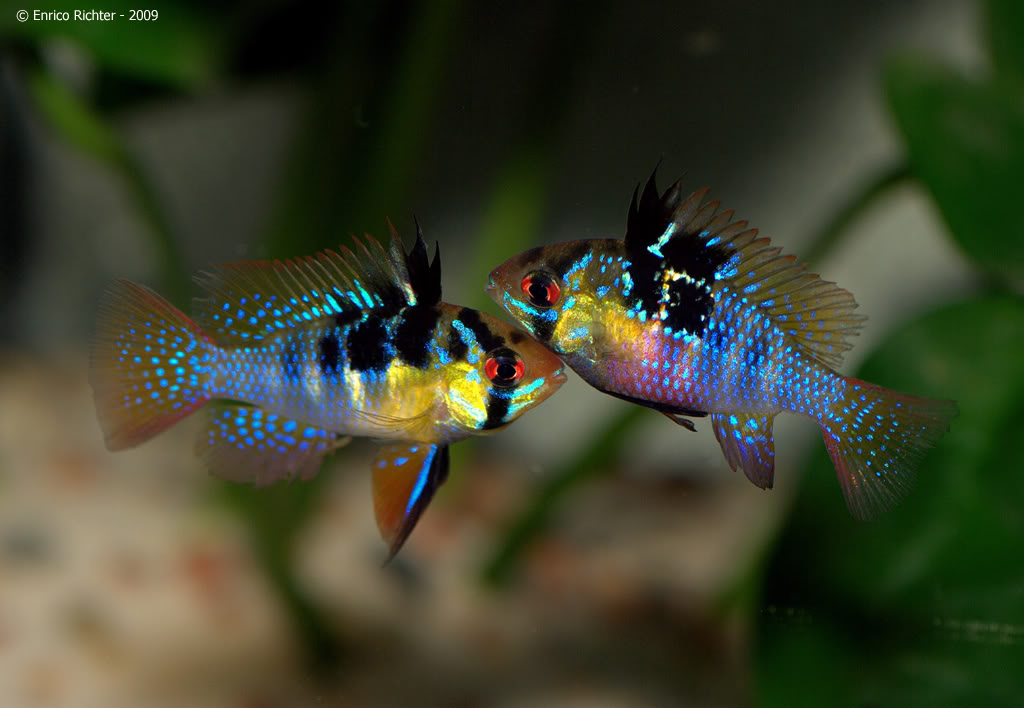
Mikrogeophagus ramireziRam
Myers & Harry, 1948
Max length40mm SL1.6in SLTank60 × 30cm24 × 12inTemp27–30°C81–86°FpH4.0–7.0M. ramirezi is also known by the names 'Ramirez' dwarf cichlid' and 'butterfly cichlid' and is among the more popular dwarf cichlids in the aquarium hobby. As a result, it is produced on a commercial basis in huge numbers and a number of ornamental strains have been developed including 'gold', 'long-finned' (both blue and gold forms; also traded as 'lyre-tail', 'veil-tail' and 'hi-fin'), 'electric/neon blue', 'super neon blue gold' 'pearl/perlmutt' and 'balloon'.
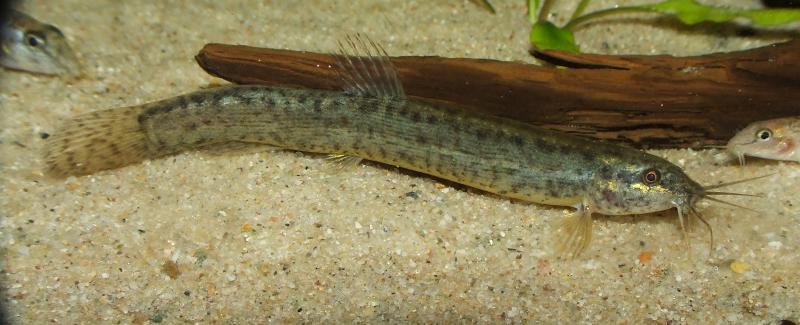
Misgurnus dabryanusLarge-scaled Loach
Dabry de Thiersant, 1872
Max length90mm SL3.5in SLTank90 × 30cm36 × 12inTemp16–23°C61–73°FpH6.0–8.0It's actually sold in the aquarium hobby on a regular basis but almost always labelled as or mixed in with Misgurnus anguillicaudatus and is thus poorly documented. Although quite simi...
Myloplus rubripinnisRedhook
authority not recorded
Max length250mm SL10in SLTank180 × 38cm72 × 15inTemp23–27°C73–81°FpH6.0–7.0The Redhook is another species commonly sold as a Silver Dollar in the trade. It can be distinguished from those species as the black-trimmed, redis much more obvious than any of the metynnis species. The Redhook is also capable of growing much larger than its Silver Dollar relatives. This species was until recently referred to as myleus rubripinnis and is still widel y referred to as such. The Redhook is sometimes described as a difficult fish to care for but, given a large enough aquarium, ...
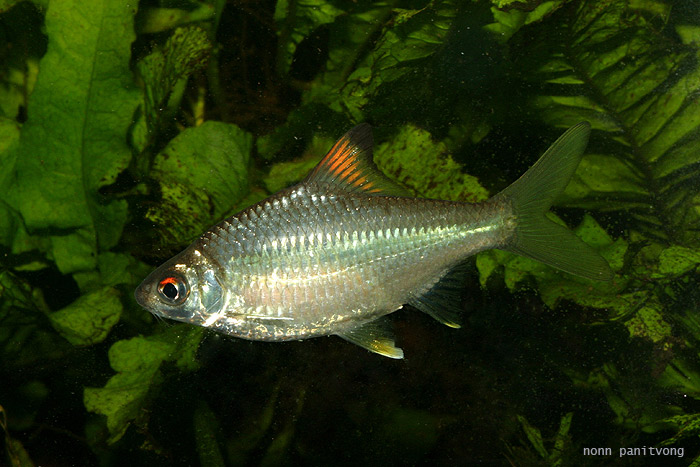
Mystacoleucus argenteus
Day, 1888
Max length140mm SL6in SLTank120 × 45cm48 × 18inTemp20–27°C68–81°FpH6.0–7.5All Mystacoleucus species possess a procumbent predorsal spine orientated towards the head, though it can be difficult to spot with the naked eye. This can become entangled in an aquarium net so care must be taken when handling the fish. The trait is shared by members of Tor, Spinibarbus and Paraspinibarbus although there exists no strong evidence to suggest that these genera form a monophyletic lineage and it is...
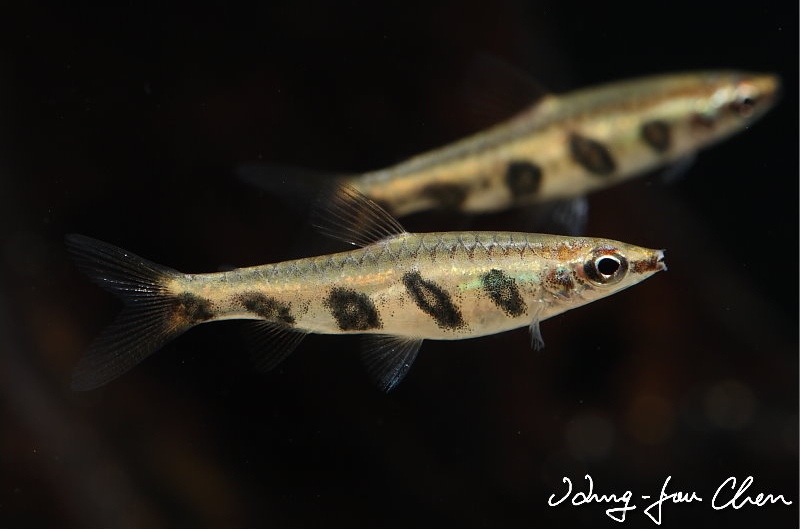
Nannostomus espeiBarred Pencilfish
Meinken, 1956
Max length30mm SL1.2in SLTank60 × 30cm24 × 12inTemp22–28°C72–82°FpH4.0–6.5This species is sometimes traded as 'Espei's', 'four-barred' or 'banded' pencilfish and is sought after in the aquarium hobby, though normally quite expensive to buy. It's most-easily identified by its unique colour pattern of 5 dark, vertically-orientated bar-like markings on each flank, this in direct contrast to the horizontal stripes seen in other congeners...
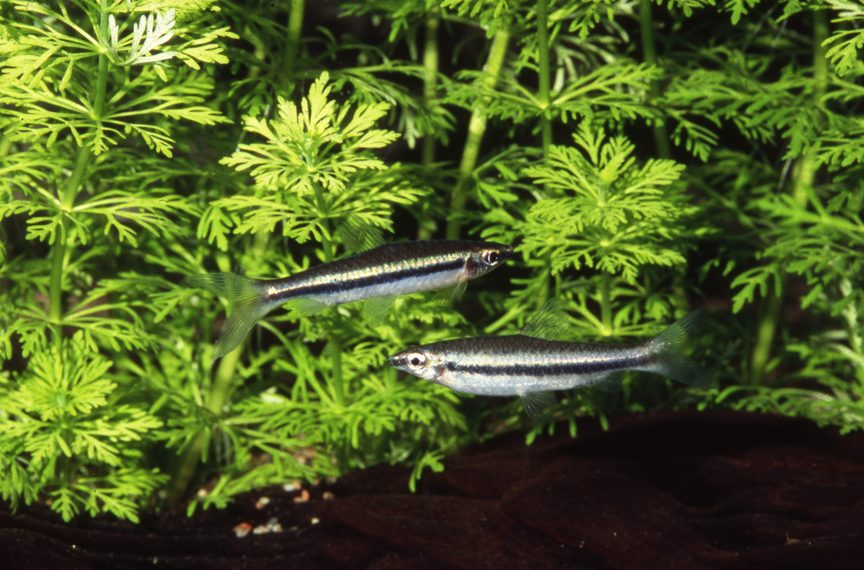
Nannostomus grandis
Zarske, 2011
Max length46mm SL1.8in SLTank60 × 30cm24 × 12inTemp22–28°C72–82°FpH5.0–7.0This species is poorly-known in the aquarium hobby but is sometimes exported as bycatch among shipments of other species, especially Nannostomus beckfordi to which it appears quite similar. The easiest way to tell the two apart is that N. grandis lacks pale white or bluish tips to the ventral fins. It can be further distinguished from all congeners by the following combination of characters: body size up to 46.2 mm, the largest in the genus; bo...
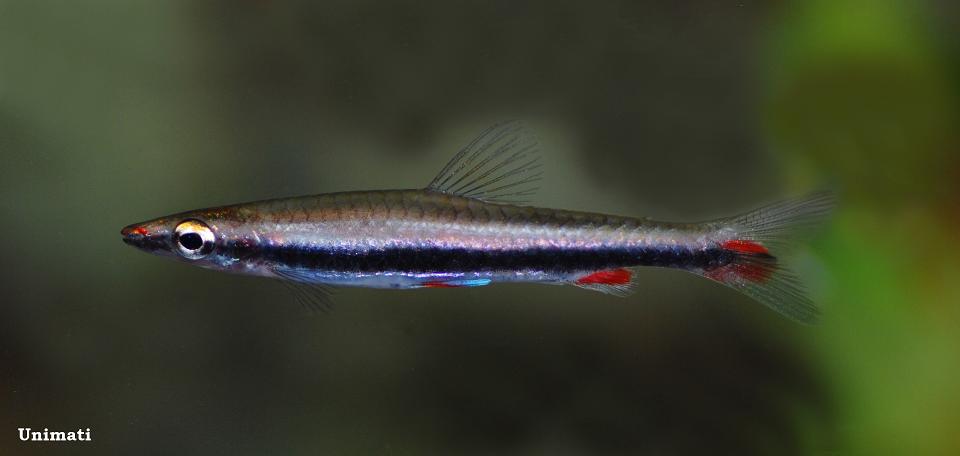
Nannostomus harrisoniBlackstripe Pencilfish
Eigenmann, 1909
Max length45mm SL1.8in SLTank60 × 30cm24 × 12inTemp22–28°C72–82°FpH5.0–7.0This species is quite rare in the aquarium hobby and is not often available in numbers, more often being exported as bycatch among shipments of the congener N. eques. Following Weitzman and Cobb (1975) it can be diagnosed by the following combin...
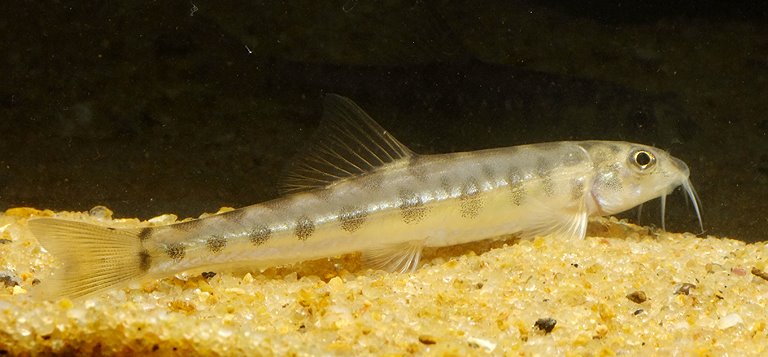
'Nemacheilus' corica
Hamilton, 1822
Max length45mm SL1.8in SLTank60 × 30cm24 × 12inTemp15–24°C59–75°FpH6.0–8.0This species has been widely regarded as a member of the genus Nemacheilus since the late 1970s with the vast majority of subsequent authors considering it as such, although in the aquarium hobby it's more commonly referred to Schistura.
Neoceratodus forsteriAustralian Lungfish
authority not recorded
Max length1700mm SL67in SLTank180 × 90cm72 × 36inTemp22–28°C72–82°FpH6.5–8.0Lungfish are among the most intriguing of "oddball" aquarium subjects, being able to survive in the most extreme conditions. They are very ancient fish, having remained virtually unchanged for millions of years. Unlike its African relatives, N. forsteri cannot survive in completely dry conditions for long, although it does require access to atmospheric air to survive. It possesses only a single lung (the African species have paired lungs), which is formed via a modification of the swim...
Neolamprologus brevis
authority not recorded
Max length60mm SL2.4in SLTanknot recordedTemp23–27°C73–81°FpH7.5–9.0N. brevis is one of the commoner species of shell dweller available in the hobby. Several colour morphs are available including "sunspot", "katabe" and "sambia". As mentioned above, it is often found in areas within Lake Tanganyika where relatively few snail shells collect and in these areas, pairs of fish will share the same shell. This behaviour may or may not be observed in the aquarium, depending on the number of shells provided and the individual fish. The terr...