Results for “pre-”
Type a name: scientific, common, or one a species used to go by. Or narrow the catalogue with the filters.
Filters
Tetraodon lineatusFahaka Puffer
authority not recorded
Max length430mm SL17in SLTanknot recordedTemp24–26°C75–79°FpH6.5–7.5Puffer fish are so called as they have the ability to inflate their elastic stomachs with water or air. This is usually a response to some kind of threat, although in the aquarium many specimens appear to inflate themselves for no apparent reason. The fish becomes 2 or 3 times it's normal size, big enough to scare away many potential predators, or difficult to swallow. Puffers are also one of the few fish that can actually blink or close their eyes. Many parts of the body of puffers cont...
Tetraodon mbuGiant Puffer
authority not recorded
Max length750mm SL30in SLTank240 × 90cm96 × 36inTemp24–26°C75–79°FpH7.0–8.0Puffer fish are so called as they have the ability to inflate their elastic stomachs with water or air. This is usually a response to some kind of threat, although in the aquarium many specimens appear to inflate themselves for no apparent reason. The fish becomes 2 or 3 times its normal size, big enough to scare away many potential predators, or difficult to swallow. Puffers also have several other interesting adaptations. They are one of the few fish that can actually blink or close their ...
Tetraodon miurusCongo Puffer
authority not recorded
Max length150mm SL6in SLTank75 × 30cm30 × 12inTemp24–28°C75–82°FpH6.8–7.5Puffer fish are so called as they have the ability to inflate their elastic stomachs with water or air. This is usually a response to some kind of threat, although in the aquarium many specimens appear to inflate themselves for no apparent reason. The fish becomes 2 or 3 times its normal size, big enough to scare away many potential predators, or difficult to swallow. Puffers also have several other interesting adaptations. They are one of the few fish that can actually blink or close their ...
Tetraodon nigroviridisGreen Spotted Puffer
authority not recorded
Max length170mm SL7in SLTank120 × 30cm48 × 12inTemp24–28°C75–82°FpH7.5–8.5Puffer fish are so called as they have the ability to inflate their elastic stomachs with water or air. This is usually a response to some kind of threat, although in the aquarium many specimens appear to inflate themselves for no apparent reason. The fish becomes 2 or 3 times it's normal size, which makes the fish both big enough to scare away many potential predators, and difficult to swallow. Many parts of the body of puffers contain the deadly neurotoxin tetrodoxin. This is the same ...
Tetraodon palembangensisHumpback Puffer
authority not recorded
Max length195mm SL8in SLTank120 × 30cm48 × 12inTemp24–28°C75–82°FpH6.8–7.6Puffer fish are so called as they have the ability to inflate their elastic stomachs with water or air. This is usually a response to some kind of threat, although in the aquarium many specimens appear to inflate themselves for no apparent reason. The fish becomes 2 or 3 times it's normal size, which makes the fish both big enough to scare away many potential predators, and difficult to swallow. Many parts of the body of puffers contain the deadly neurotoxin tetrodoxin. This is the same ...
Tetraodon suvattiiArrowhead Puffer
authority not recorded
Max length150mm SL6in SLTanknot recordedTemp22–26°C72–79°FpH6.5–7.5Puffer fish are so called as they have the ability to inflate their elastic stomachs with water or air. This is usually a response to some kind of threat, although in the aquarium many specimens appear to inflate themselves for no apparent reason. The fish becomes 2 or 3 times its normal size, big enough to scare away many potential predators, or difficult to swallow. Puffers also have several other interesting adaptations. They are one of the few fish that can actually blink or close their ...
Thayeria ifatiHalf-striped Penguin Tetra
authority not recorded
Max length50mm SL2.0in SLTank60 × 38cm24 × 15inTemp23–28°C73–82°FpHnot recordedThere are only three species in the genus Thayeria, of which T. ifati is the least often seen in the hobby. This is a shame as it's a very pretty little fish. The holotype was collected from the upper Rio Maroni, close to the settlement of Gaa Kabaon on the French Guiana/Suriname border by the famous ichthyologist Jacques Géry in 1957. Géry also described the species in 1959. Of its congeners, it was the type species T. obliqua that was originally given the common name of &quo...
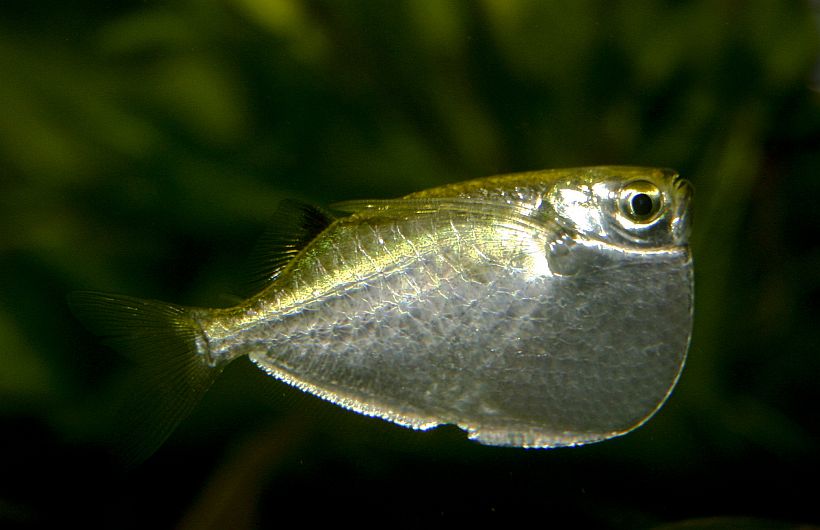
Thoracocharax stellatusSpotfin Hatchetfish
Kner, 1858
Max length70mm SL2.8in SLTank120 × 45cm48 × 18inTemp20–28°C68–82°FpH5.0–7.5T. stellatus is superficially similar to its only congener T. securis, but can immediately be identified by the presence (vs. absence) of a prominent dark spot in the dorsal-fin. It is sometimes traded as 'platinum hatchetfish'. The genus Thoracocharax was originally erected by Fowler in 1906 as a subgenus of Gasteropelecus, but was elevated to generic status by Weitzman (1960).
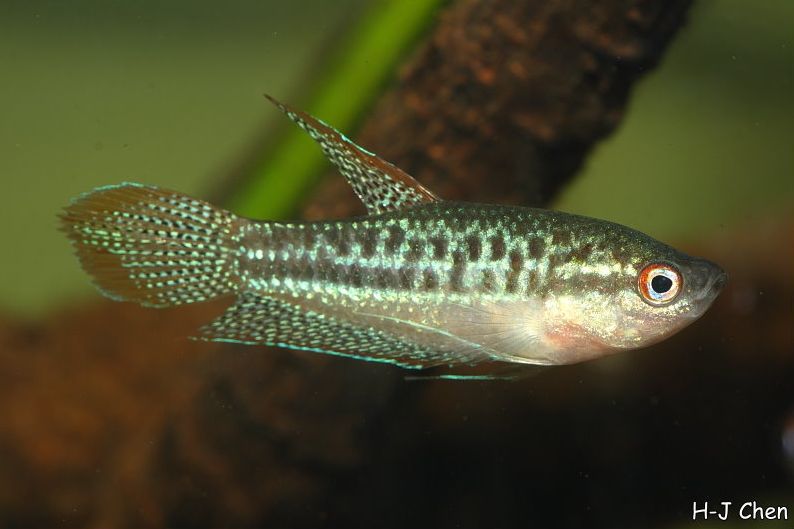
Trichopsis pumilaSparkling Gourami
Arnold, 1936
Max length40mm SL1.6in SLTank45 × 30cm18 × 12inTemp22–28°C72–82°FpH5.0–7.5It can be distinguished from congeners by its small adult size and presence of a single solid dark midlateral stripe on the body, above which is a series of dark blotches forming a second stripe. In the similar but larger, T. schalleri the upper stripe is more variable depending on the mood of the fish, sometimes fading entirely.
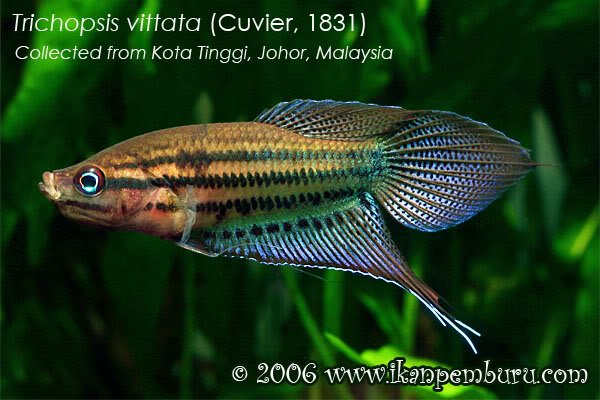
Trichopsis vittataCroaking gourami
Cuvier, in Cuvier & Valenciennes, 1831
Max length70mm SL2.8in SLTank60 × 30cm24 × 12inTemp22–28°C72–82°FpH5.0–7.5The common name is derived from the ability of genus members to produce audible sounds via a specialised pectoral mechanism which is unique within the family Osphronemidae. The structure comprises modified pectoral-fin tendons and muscles which are stretched and plucked by basal elevations of two fin rays in a similar way to guitar strings via rapid beating of the fins. The pectoral-fins beat alternately, each able to generate short or long bursts of sound. These sounds are produced by both sexes, predom...
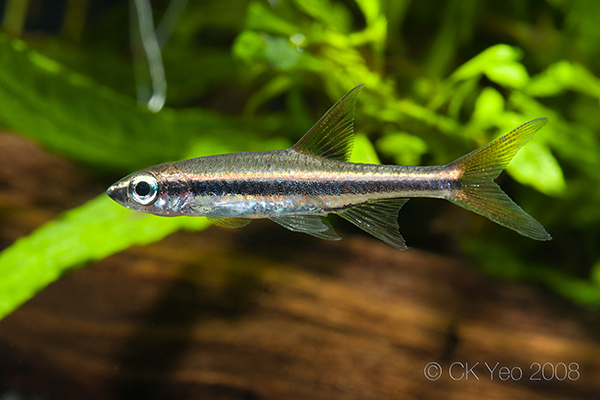
Trigonopoma gracile
Kottelat, 1991
Max length55mm SL2.2in SLTank75 × 30cm30 × 12inTemp21–26°C70–79°FpH4.0–7.0This species occurs in several colour forms depending on collection locality with some exhibiting more intense pigmentation in the fins or an additional reddish lateral stripe, for example. It's sometimes said to closely resemble and occur sympatrically with Rasbora agilis, but that name is currently considered a junior synonym of the congener Trigonopoma pauciperforatum. R. agilis had previously been us...
Triportheus angulatusDusky Narrow Hatchetfish
authority not recorded
Max length165mm SL6in SLTank120 × 30cm48 × 12inTemp22–30°C72–86°FpH5.0–7.5An attractive but not often seen species in the hobby. This is quite odd considering how common it is in many of its native habitats, where it is known as sardina. It has very strong pectoral muscles, and uses these to jump from the water to catch flying insects or to escape potential predators. It can make leaps of several metres in length....
Vieja bifasciataRed-spotted Cichlid
authority not recorded
Max length300mm SL12in SLTanknot recordedTemp27–29°C81–84°FpH7.0–8.5Vieja bifasciata are often confused for vieja synspilum but can be told apart as bifasciata have two prominent horizontal lines running between their eyes (hence the name). They are a very colourful fish and respond to their owner's presence - usually looking for food! Bifasciata are not particularly demanding in terms of water parameters and easy to keep, especially if suitable tankmates can be found. It is sometimes the case that a pair of fish that will not live together in a tank on ...
Vieja reganiRegan's Cichlid
authority not recorded
Max length300mm SL12in SLTanknot recordedTemp24–26°C75–79°FpH6.8–7.5An attractive, if uncommonly seen cichlid. In common with many Central American cichlids, these fish can pose in a challenge in terms of accomodation and it not uncommon to end up having to house these fish individually. Previously described as cichlasoma regani, it is still occasionally sold under this name.
Xenopterus naritusGolden Puffer
authority not recorded
Max length285mm SL11in SLTank120 × 45cm48 × 18inTemp24–28°C75–82°FpH6.5–7.5Puffer fish are so called as they have the ability to inflate their elastic stomachs with water or air. This is usually a response to some kind of threat though in the aquarium many specimens appear to inflate themselves for no apparent reason. The fish becomes 2 or 3 times its normal size, big enough to scare away many potential predators, or become difficult to swallow. Puffers are also one of the few fish that can actually blink or close their eyes. Many parts of the body of puffers contai...
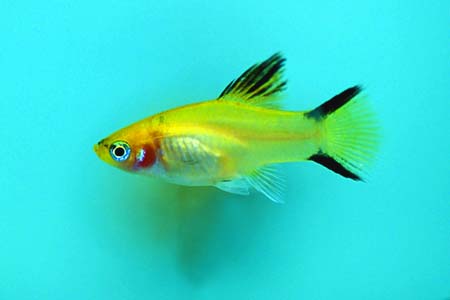
Xiphophorus maculatusPlaty
Gunther, 1866
Max length50mm SL2.0in SLTank60 × 30cm24 × 12inTemp20–26°C68–79°FpH7.0–8.2Another massively popular aquarium fish, with dozens of selectively bred varieties available, including mickey mouse, wagtail, tuxedo, moon, blue, red, comet and hi-fin. Some of these are produced by crossbreeding with X.helleri or X. variatus. Unfortunately many commercially bred platies are not very hardy due to inbreeding and over-production and are prone to disease and premature death. Wild fish are almost never seen in the hobby. As long as the ph remains above neutral this fish is ...
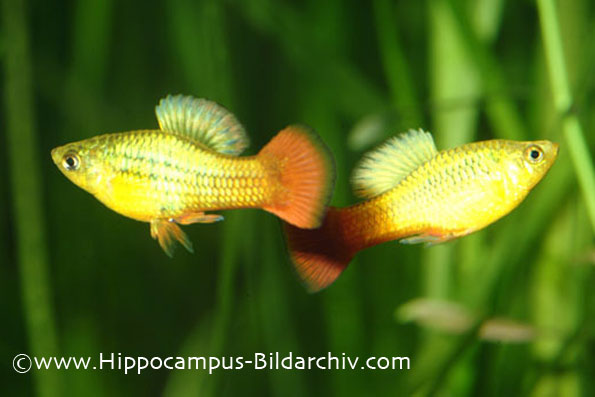
Xiphophorus variatusVariable Platy
Meek, 1904
Max length50mm SL2.0in SLTank60 × 30cm24 × 12inTemp20–26°C68–79°FpH7.0–8.2Another massively popular aquarium fish, with dozens of selectively bred varieties available. Some of these are produced by crossbreeding with X.helleri or X. maculatus. Unfortunately many commercially bred platies are not very hardy due to inbreeding and over-production and are prone to disease and premature death. The wild X. variatus can be distinguished from X. maculatus by its slimmer, more elongated body shape and slightly longer dorsal fin. This last feature has been seized upon by many...