Results for “basin”
Type a name: scientific, common, or one a species used to go by. Or narrow the catalogue with the filters.
Filters
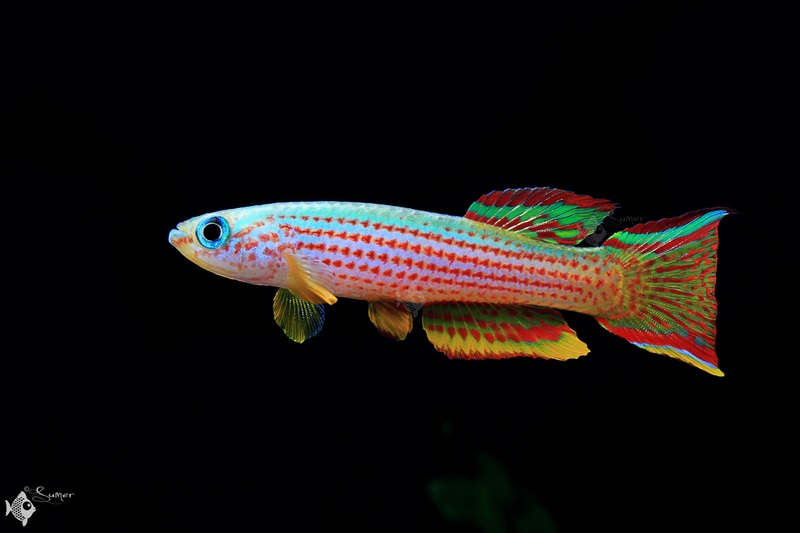
Aphyosemion striatumRed-Striped Lyretail
Boulenger, 1911
Max length50mm SL2.0in SLTank45 × 30cm18 × 12inTemp20–26°C68–79°FpH6.5–7.5Appears restricted to the area between the lower Mitmele River, Equatorial Guinea and the lower Ogooué basin in Gabon, including coastal drainages such as the Mbei, Komo and Gabon watersheds in between. Type locality is 'Abanga River, between first and second rapids, Ogowe River system, Gabon', corresponding to the Abanga River bas...
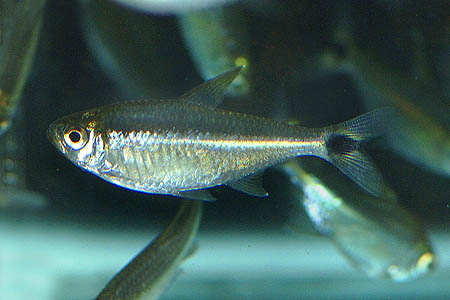
Astyanax kennedyiKennedy's Tetra
Géry, 1964
Max length50mm SL2.0in SLTank80 × 30cm31 × 12inTemp26–29°C79–84°FpH5.5–7.0Endemic to pthe upper Amazon basin in Peru, around the city of Iquitos. Most Astyanax spp. are not popular in the aquarium hobby, though the genus is among the most speciose within the family Characidae. A. kennedyi is no exception; you'll rarely see it offered for sale but may find the occasional specimen mixed among other species in shipments of wild fishes from Peru.
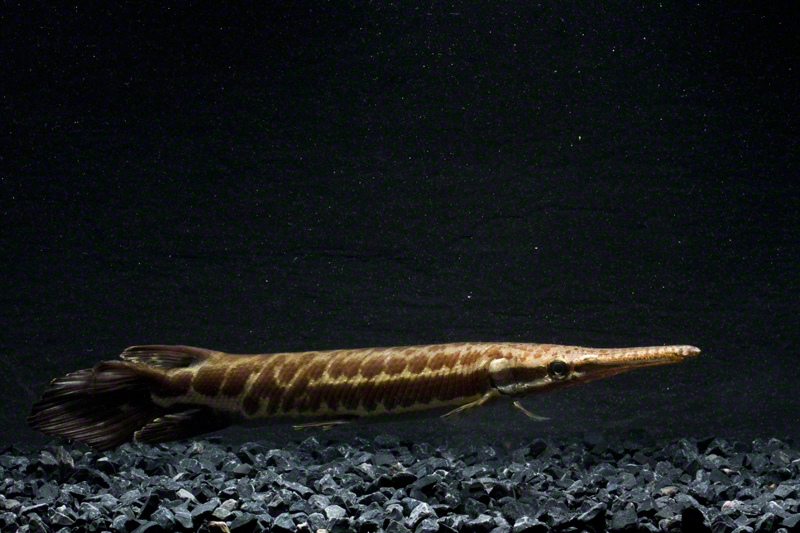
Atractosteus tropicusTropical Gar
Gill, 1863
Max length1250mm SL49in SLTanknot recordedTemp22–28°C72–82°FpH6.0–8.5Found in both Caribbean and Pacific-slope drainage basins in Central America, from southern Mexico through Belize, Guatemala, Honduras and Nicaragua, and into Costa Rica. This species clearly shouldn't be considered a home aquarium subject at all given its eventual size and the fact it can live for several decades.
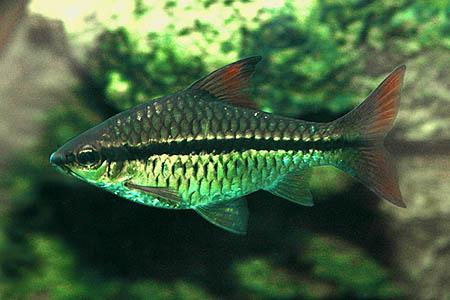
'Barbus' holotaeniaSpotscale Barb
Boulenger, 1904
Max length120mm SL5in SLTank120 × 45cm48 × 18inTemp24–30°C75–86°FpH6.0–7.0This species is native to Central West Africa where it is principally found in the great Ogooué and Congo River systems. It therefore has an extensive range and has been recorded at numerous localities right across the Democratic Republic of Congo (DRC) from the Ituri River in the far east of the country to the Luki River basin in the extreme west. The Congo River appears to represent the southernmost limit of its range as a...
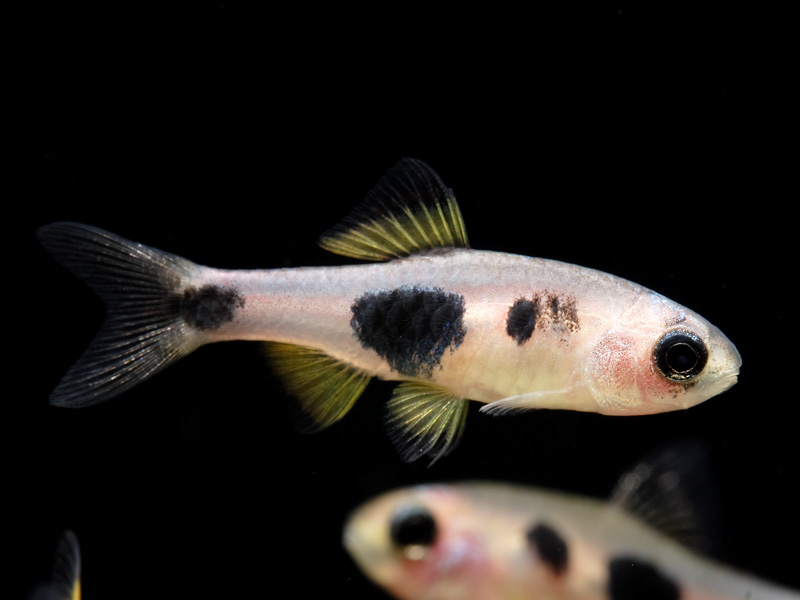
'Barbus' hulstaertiAfrican Butterfly Barb
Poll, 1945
Max length35mm SL1.4in SLTank45 × 30cm18 × 12inTemp17–24°C63–75°FpH5.0–6.5Two closely-related species are also found in the Congo basin and infrequently seen in the trade. 'B.' candens has been collected northeast of the range of 'B.' hulstaerti around the city of Kisangani (formerly Stanleyville) and nearby town of Yangambi. It can be distinguished from 'B.' hulstaerti by its paler body colouration, smaller dark markings on the body and red ventral and anal fins in males. 'B.' papillo is known only from its type locality close to the eastern town of Kindu between the Lualaba and Lomami rivers. It has an elongated central body marking and males possess black dorsal, ventral and anal fins.
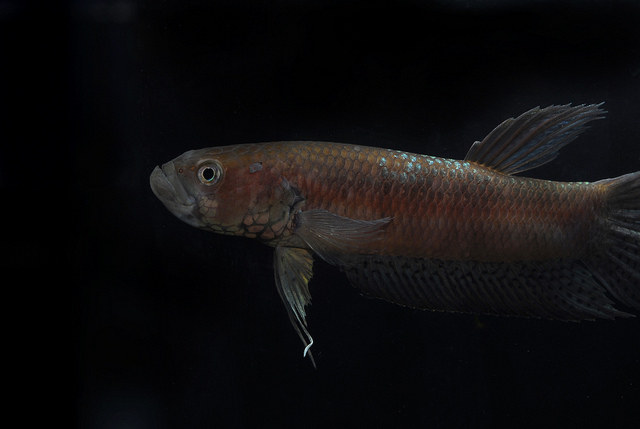
Betta gladiator
Tan & Ng, 2005
Max length90mm SL3.5in SLTank90 × 30cm36 × 12inTemp22–27°C72–81°FpH4.0–6.0Presumed endemic to the geographically-isolated Maliau basin, a roughly circular plateau enclosed by hills in Sabah state, Malaysia, Borneo. The Maliau River is part of the much larger Kinabantangan watershed, Malaysia's second longest river. The type series was collected from heath forest alongside 'Puntius' sealei and Hemibagrus cf. baramensis in acidic water with a pH of 4.2-4.8. Adult individuals were spaced around a metre apa...
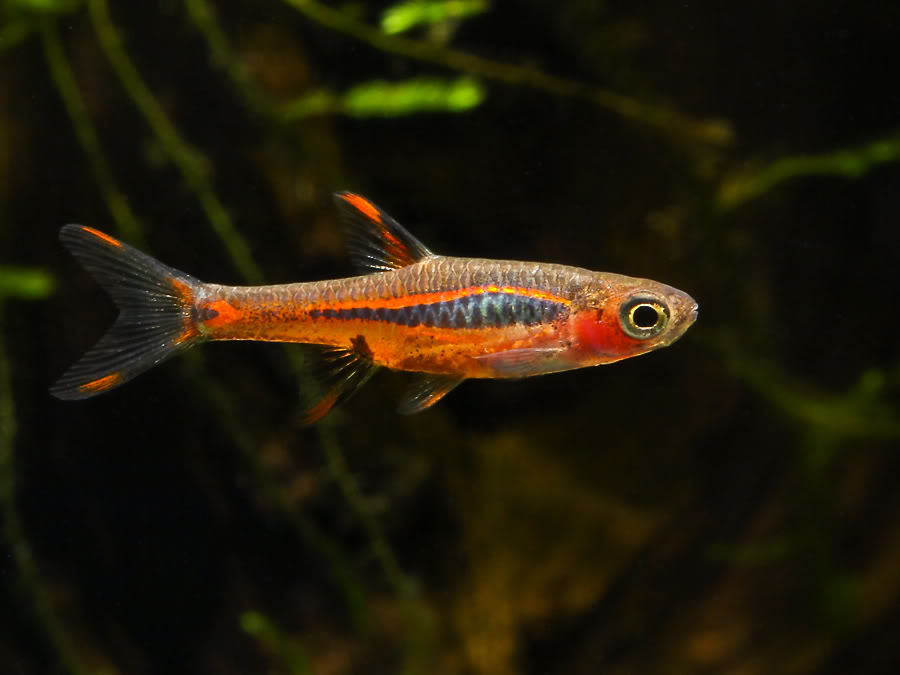
Boraras brigittaeMosquito Rasbora
Vogt, 1978
Max length20mm SL0.8in SLTank45 × 30cm18 × 12inTemp20–28°C68–82°FpH4.0–7.0Appears to be endemic to southwestern Borneo though occurence records are scant. Type locality is 'Bandjarmasin', a port town in the Indonesian province of Kalimantan Selatan (South Kalimantan), and following Kottelat (1991) it's range extends westwards as far as the Jelai Bila river basin, near the town of Sukamara, where it's said to occur sympatrically with the congener B. merah. Boraras was erected in 1993 in order to separa...
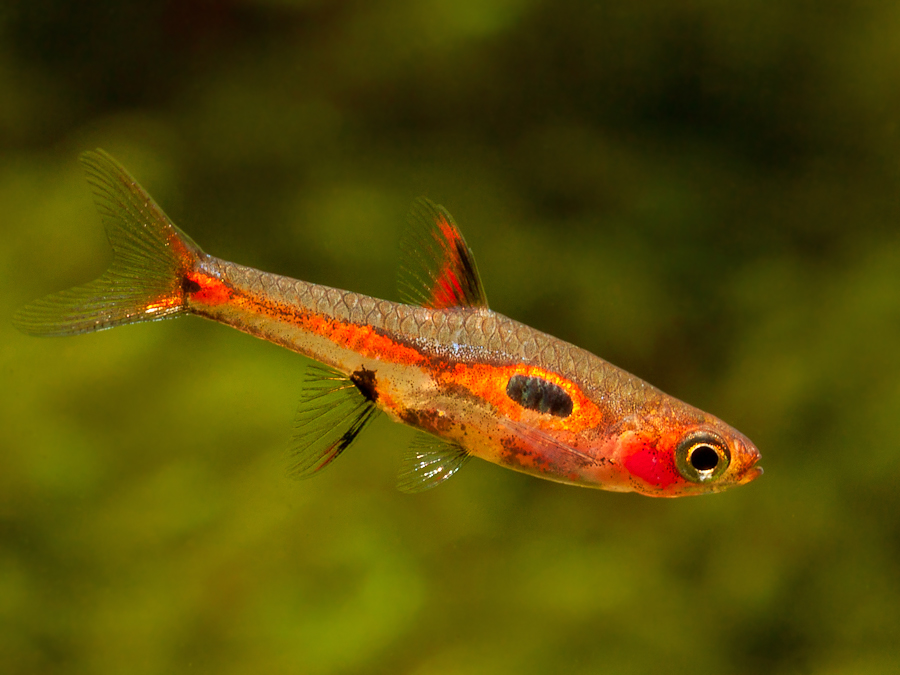
Boraras merah
Kottelat, 1991
Max length20mm SL0.8in SLTank45 × 30cm18 × 12inTemp20–28°C68–82°FpH4.0–6.5Appears endemic to southern Borneo. The type specimens were collected from the Jelai Bila river basin at Nataik Sedawak, presumably a settlement of some kind, near the town of Sukamara in the Indonesian province of Kalimantan Tengah (Central Kalimantan). Its range extends westwards from the Jelai Bila watershed whereas that of the congener B. brigittae, with which it may occur sympatrically there (see 'Notes'), extends east.
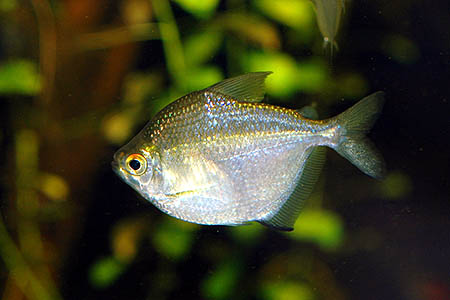
Brachychalcinus orbicularisDiscus Tetra
Valenciennes, 1850
Max length90mm SL3.5in SLTank120 × 30cm48 × 12inTemp20–27°C68–81°FpH5.0–7.5The genus Brachychalcinus currently contains four other species: B. copei (Steindachner 1882) from the rio Madeira and rio Solimões; B. nummus Böhlke 1958 from the Upper Amazon region in Colombia, Ecuador and Peru; B. parnaibae Reis 1989 from the rio Parnaíba basin, and B. retrospina Boulenger 1892 from the Rio Paraguay system. The group is often referred to collectively as 'silver dollar tetras' and tho...
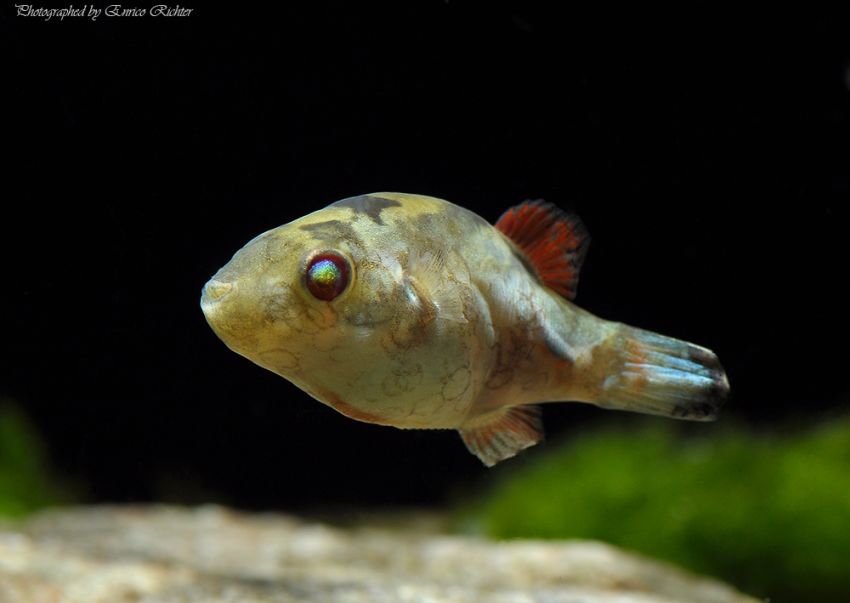
Carinotetraodon lortetiRedeye Puffer
Tirant, 1885
Max length60mm SL2.4in SLTank60 × 30cm24 × 12inTemp20–28°C68–82°FpH5.0–7.5Known from the lower Mekong basin in Thailand, Vietnam, and Cambodia, the Chao Phraya watershed in central Thailand, and may occur in smaller river systems between. Type locality is 'Thu-dâu-môt, Vietnam'.
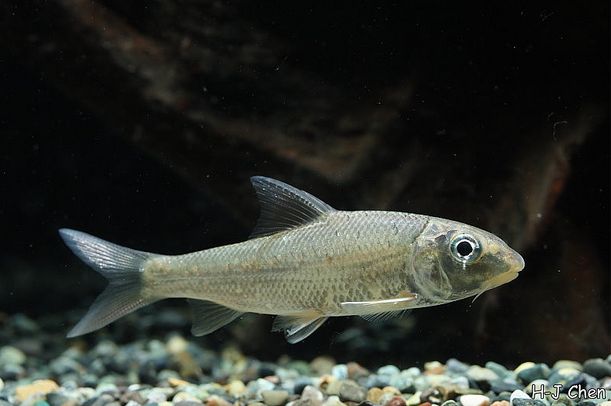
Chagunius chagunio
Hamilton, 1822
Max length450mm SL18in SLTank240 × 90cm96 × 36inTemp20–25°C68–77°FpH6.0–7.5Endemic to the Ganges and Brahmaputra river basins and thus occurs in northern India, Nepal and Bangladesh. Type locality is 'the Yamuna River, and northern rivers of Behar and Bengal'. The distribution of the genus as a whole is interesting because these fish occupy the area that geographically separates Indian and Southeast Asia barbs and it has been theorised that they may represent an evolutionary 'link' species...
Characodon lateralisRainbow Characodon
Günther, 1866
Max length65mm SL2.6in SLTank120 × 30cm48 × 12inTemp18–24°C64–75°FpH6.0–8.0Restricted to a series of small habitats below the waterfall known as 'El Salto' in the upper Río Mezquital basin, Durango state, central Mexico. It was previously considered to occur throughout much of the upper Río Mezquital in both Durango and Coahuila states, but genetic analyses suggest otherwise and have resulted in taxonomic confusion (see 'Notes').
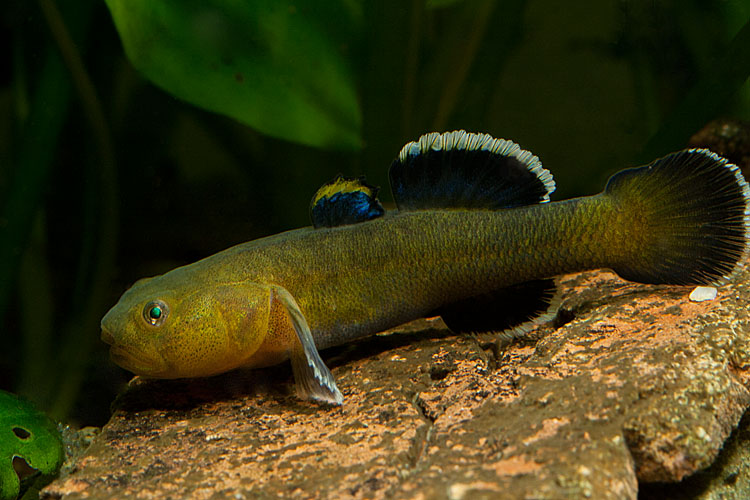
Chlamydogobius eremiusDesert Goby
Zietz, 1896
Max length60mm SL2.4in SLTank45 × 30cm18 × 12inTemp20–28°C68–82°FpH7.0–8.5Lake Eyre is a vast endorheic basin within which lies the lowest point in Australia at some 15 m BMSL. It only fills with water occasionally and when it does so forms the country's largest salt lake. C. eremius does not occur in the lake itself since no fishes are able to survive there, rather it inhabits isolated freshwater springs, flowing artesian bores (wells), and ephemeral waterholes where it tends to be associated with rocks and other submerged cover.
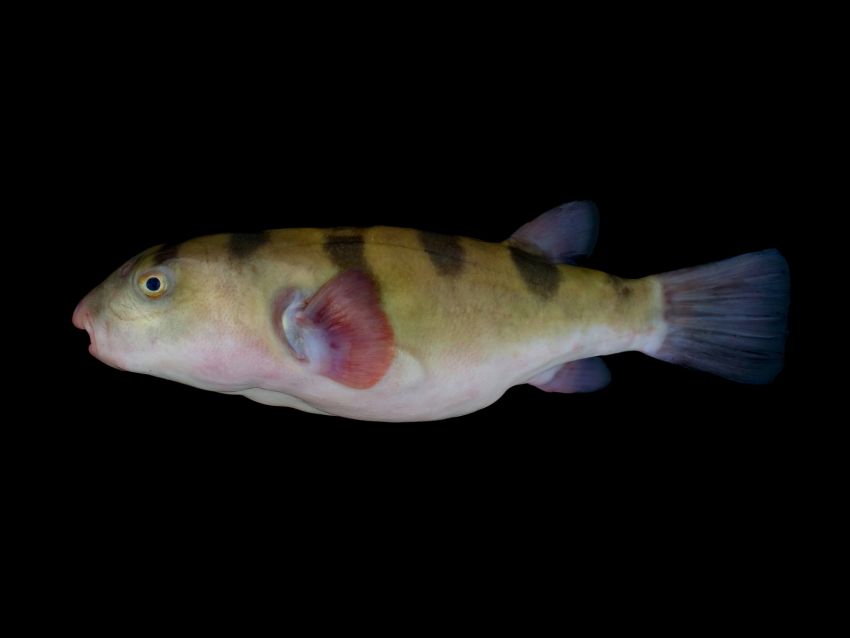
Colomesus psittacusBanded Puffer
Bloch & Schneider, 1801
Max length290mm SL11in SLTank180 × 60cm72 × 24inTemp20–26°C68–79°FpH7.0–9.0Although it does penetrate the lower basins of rivers, particularly the Amazon where it has been collected from the rio Xingu several hundred kilometres from its mouth, this species is predominantly an inhabitant of mangrove swamps, estuaries, and other such saline habitats. It is particularly common in tidal channels, shallow inshore lagoons, and the lower reaches of rivers.
Colossoma macropomumBlack Pacu
authority not recorded
Max length600mm SL24in SLTank300 × 90cm118 × 36inTemp22–28°C72–82°FpH5.5–7.5Known as the tambaqui in its native countries, this is the second largest species of scaled fish found in the Amazon basin. This alone should tell you much of what you need to know about its suitability as an aquarium inhabitant. In reality, it's debatable as to whether the species should be considered an aquarium subject at all. While pacu rarely reach their maximum size in captivity, they're still easily capable of growing to a couple of feet in length. The myth that fish will only g...
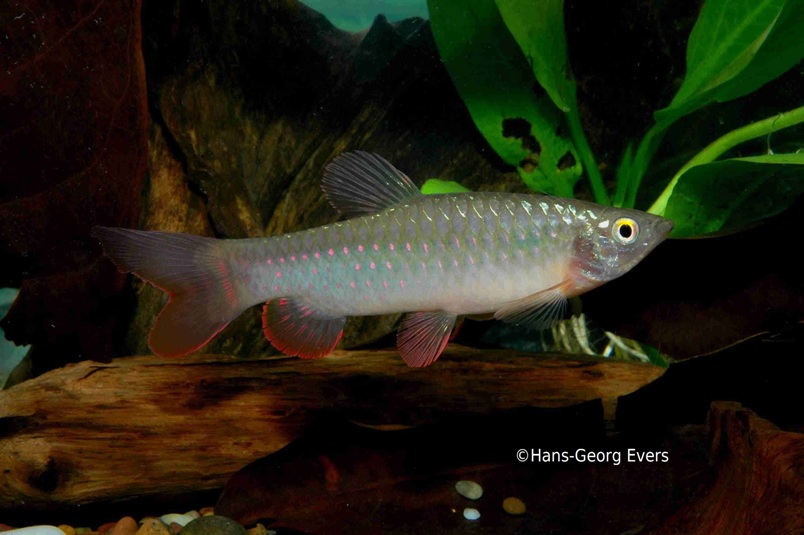
Copeina guttataRed-spotted Tetra
Steindachner, 1876
Max length76mm SL3.0in SLTank120 × 30cm48 × 12inTemp20–28°C68–82°FpH4.0–7.5Known from the middle and upper Amazon river basins in Brazil, Peru, Ecuador and Colombia. Type locality is 'Amazon River at Obidos, Cudajas, and Tabatinga; Rio Negro, Brazil.' It apparently practises an interesting reproductive strategy in which the eggs are deposited in a shallow depression excavated from the substrate and guarded by the male.
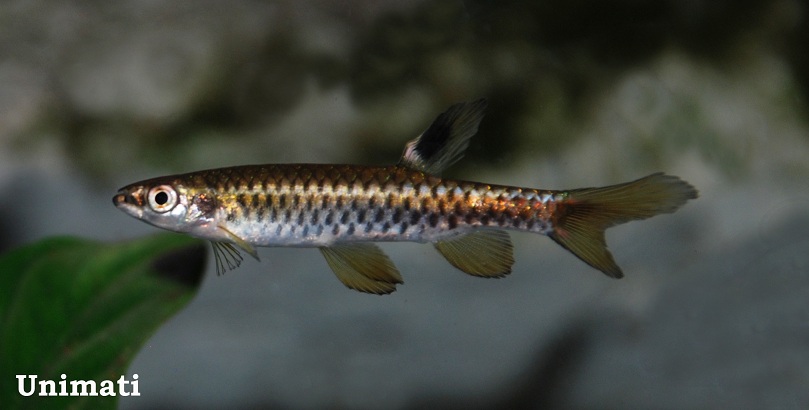
Copella eigenmanni
Regan, 1912
Max length45mm SL1.8in SLTank80 × 30cm31 × 12inTemp20–28°C68–82°FpH4.0–7.0This species does appear in the aquarium trade from time-to-time, often among shipments of other wild-caught fishes from the Orinoco basin. Populations from Colombia were formerly referred to as C. metae until Zarske (2011) synonymised the two when designating a lectoty...
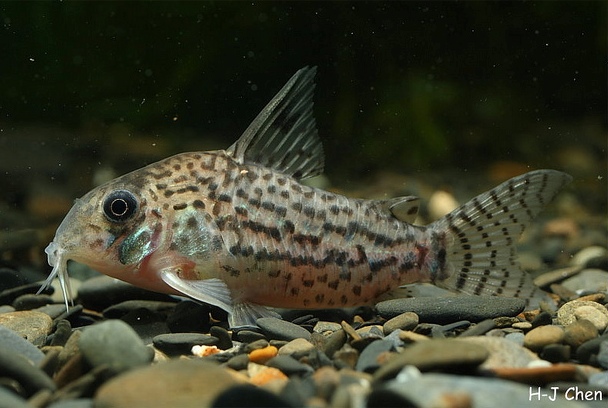
Corydoras acrensisAcre Cory
Nijssen, 1972
Max length55mm SL2.2in SLTanknot recordedTemp21–25°C70–77°FpH6.0–7.5Type locality is 'Furo do Lago São Francisco, 7°40'S, 72°39'W, tributary at left bank of Rio Juruá, Acre State, Brazil', and C. acrensis appears to be endemic to the rio Juruá basin. Unfortunately diagnostic characters cannot be provided since we've been unable to obtain the type description, and little has been written about this species since it was published.
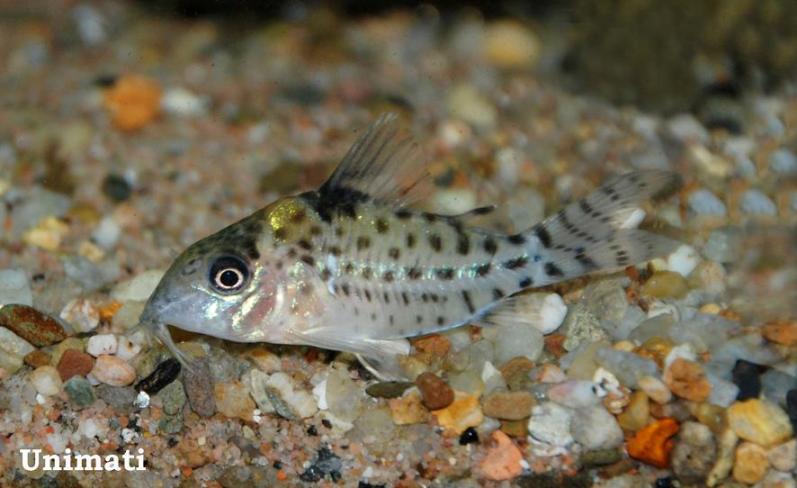
Corydoras ambiacus
Cope, 1872
Max length65mm SL2.6in SLTanknot recordedTemp21–27°C70–81°FpH6.0–8.0Described from the Río Ampiyacu, a small tributary draining into the main Amazon channel in Loreto Department, northeastern Peru, with additional records from the Yavarí (Javari), Napo, Nanay, and lower Ucayali drainage basins. All of these are Amazon tributaries, and C. ambiacus appears to occur in most or all affluents of the main Amazon channel between th...
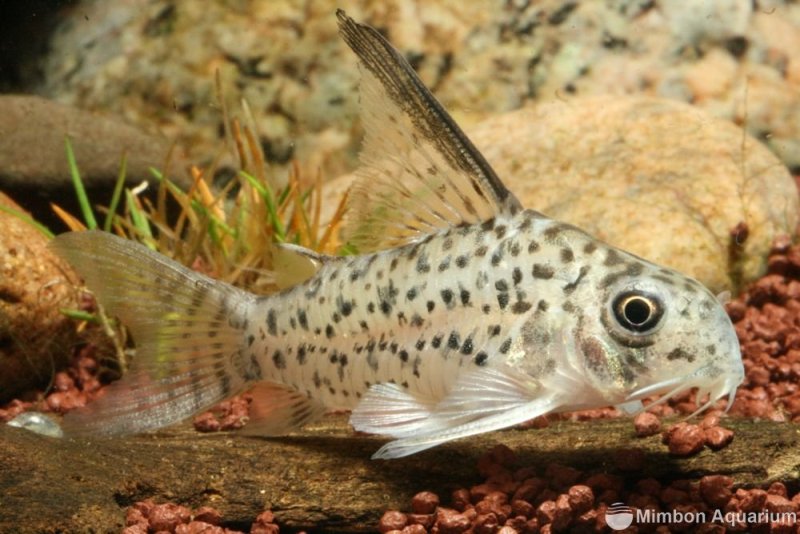
Corydoras armatus
Günther, 1868
Max length65mm SL2.6in SLTanknot recordedTemp22–26°C72–79°FpH6.0–7.5Fish collected in the upper rio Maderia basin in Brazil and Bolivia have been traded under the invented names C. sp. 'dorsalis' and C. sp. 'ogawae' in the past, although are officially-considered conspecific with C. armatus. This appears to warrant investigation since the Río Huallaga in Peru, type locality of C. armatus, and collection localities in the upper Madeira are separated by a straight-line distance of almost 2500 km.