Results for “hybrid”
Type a name: scientific, common, or one a species used to go by. Or narrow the catalogue with the filters.
Filters
Melanochromis cyaneorhabdos
authority not recorded
Max length100mm SL3.9in SLTank90 × 45cm36 × 18inTemp24–28°C75–82°FpH7.6–8.8M. cyaneorhabdos was formerly known as M. "maingano", after a village located on the shore off which it is found. It can be distinguished from the similar M. johanni by the overall blueish colouration of dominant males, as opposed to the more black patterning of johanni. It is sometimes incorrectly sold as "electric blue" johanni. Do not keep it with other Melanochromis species as they may hybridise....
Melanochromis johanni
authority not recorded
Max length120mm SL5in SLTank90 × 45cm36 × 18inTemp23–27°C73–81°FpH7.6–8.8This species can be distinguished from the similar M. cyaneorhabdos by the overall black colouration of dominant males, as opposed to the more blueish patterning of cyaneorhabdos. It is sometimes sold as "electric blue johanni". Do not keep it with other Melanochromis species as they may hybridise....
Melanochromis lepidiadaptes
authority not recorded
Max length120mm SL5in SLTank90 × 45cm36 × 18inTemp24–28°C75–82°FpH7.6–8.8This species was originally sold as M. fuscus and then M. sp. "lepidophage. The name refers to the act of lepidophagy, which is the act of a fish eating the scales of another fish. In nature M. lepidiadaptes apparently lives an opportunistic lifestyle, feeding almost solely on the scales of other species, although interestingly not other mbuna. However in aquaria this behaviour has never been witnessed. Do not keep it with other Melanochromis species as they may hybridise....
Melanotaenia maccullochiDwarf Rainbowfish
authority not recorded
Max length70mm SL2.8in SLTank60 × 30cm24 × 12inTemp20–30°C68–86°FpH5.5–8.0There are a few geographical variants of this species available, which differ in colour, patterning and less commonly, size. These should not be mixed in aquaria, as they may hybridise. The differences are so apparent between some of these forms that they may well turn out to be different species in the future....
Melanotaenia splendida inornataCheckered Rainbowfish
authority not recorded
Max length150mm SL6in SLTank120 × 30cm48 × 12inTemp26–33°C79–91°FpH6.5–8.0There are currently 4 described subspecies of Melanotaenia splendida. The principle differences are generally in colour, pattern and fin counts, although even these vary depending on the locality of the fish. The different forms and subspecies should not be mixed in the aquarium, as they may hybridise. Adult specimens are rarely seen for sale, and it's the much drabber juvenile fish that are almost always offered in dealers tanks. However, exercise some patience (even on a good diet, full c...
Melanotaenia splendida rubrostriataRed-striped Rainbowfish
authority not recorded
Max length125mm SL5in SLTank120 × 30cm48 × 12inTemp24–30°C75–86°FpHnot recordedThere are currently 4 described subspecies of Melanotaenia splendida, of which this species is one of the most colourful. The principle differences are generally in colour, pattern and fin counts, although even these vary depending on the locality of the fish. The different forms and subspecies should not be mixed in the aquarium, as they may hybridise. Adult specimens are rarely seen for sale, and it's the much drabber juvenile fish that are almost always offered in dealers tanks. However,...
Melanotaenia trifasciataBanded Rainbowfish
authority not recorded
Max length150mm SL6in SLTank120 × 30cm48 × 12inTemp24–33°C75–91°FpH6.5–8.0M. trifasciata exhibits a wide variation in colour and patterning depending on locality, and it's very important that the different morphs are not mixed in the aquarium, as they will hybridise freely. These different forms are often distinguished by the addition of the name of collection locality being added to the scientific name of the fish. It's thought that several species may in fact be in evidence here, and a reclassification will probably occur at some point As with many othe...
Neolamprologus helianthusSunflower Lamprologus
authority not recorded
Max length80mm SL3.1in SLTanknot recordedTemp23–27°C73–81°FpH7.5–9.0This stunning species was only described in 1997 and is included in the so-called "Brichardi complex", which also includes N. brichardi, crassus, falcicula, gracilis, pulcher, savoryi and splendens. The species should not be mixed in aquaria as they will hybridise freely. N. helianthus can be distinguished from others in the complex by its overall yellow-orange patterning and v-shaped cheek marking....
Neolamprologus olivaceous
authority not recorded
Max length80mm SL3.1in SLTanknot recordedTemp23–27°C73–81°FpH7.5–9.0This species is included in the so-called "Brichardi complex", which also includes N. brichardi, crassus, falcicula, gracilis, pulcher, savoryi and splendens. These should not be mixed in aquaria, as they will hybridise freely. N. olivaceouscan be distinguished from others in the complex by the two curved markings on the gill cover. It is possible that it is synonymous with N. pulcher, as proposed by Konings (1993)....
Neolamprologus savoryiStriped Brichardi
authority not recorded
Max length80mm SL3.1in SLTanknot recordedTemp23–27°C73–81°FpH7.5–9.0This species is included in the so-called "Brichardi complex", which also includes N. brichardi, crassus, falcicula, gracilis, helianthus, olivaceous, pulcher, and splendens. These should not be mixed in aquaria as they will hybridise freely. N. savoryi can be distinguished from others in the complex by it's distinctive patterning of vertical bars....
Ophthalmotilapia nasuta
authority not recorded
Max length200mm SL8in SLTank150 × 45cm60 × 18inTemp23–27°C73–81°FpH7.5–9.0O. nasuta can be distinguished from other members of the genus primarily by the fleshy proboscis-like growth that extends beyond the upper lip. It exists in several different geographical morphs including "Kachese", "Mpimbwe", "Cape Tembwe" and "Chamba", among others. These should not be mixed in aquaria as they will hybridise freely....
Ophthalmotilapia ventralis
authority not recorded
Max length150mm SL6in SLTank135 × 45cm53 × 18inTemp23–27°C73–81°FpH7.5–9.0This is a truly stunning species that does well in a Tanganyikan community with well-chosen tankmates. It exists in well over 20 colour morphs, too many to list here. Obviously these should not be mixed in aquaria as they will hybridise freely. In nature, it is only the largest dominant males that build nests whilst the subdominant males and females shoal together. The territories of these dominant fish may measure several metres across....
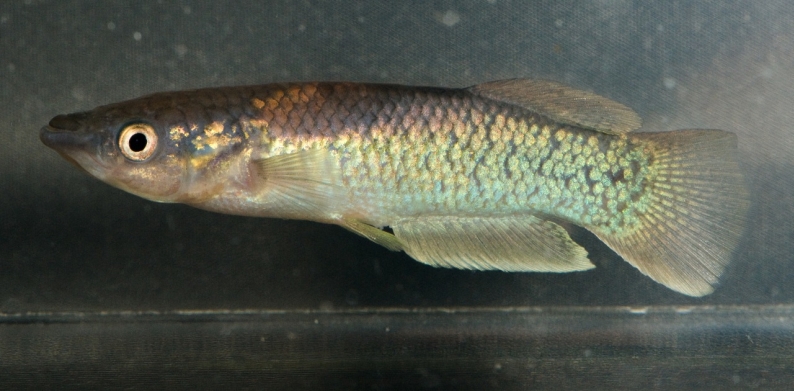
Pachypanchax arnoulti
Loiselle, 2006
Max length80mm SL3.1in SLTank90 × 30cm36 × 12inTemp20–28°C68–82°FpH6.0–7.5P. arnoulti has been in the aquarium hobby for many years but was identified as the congener P. omalonotus prior to its description. It appears in the majority of older aquarium literature under that name and as a result a degree of hybridisation has undoubtedly occurred.
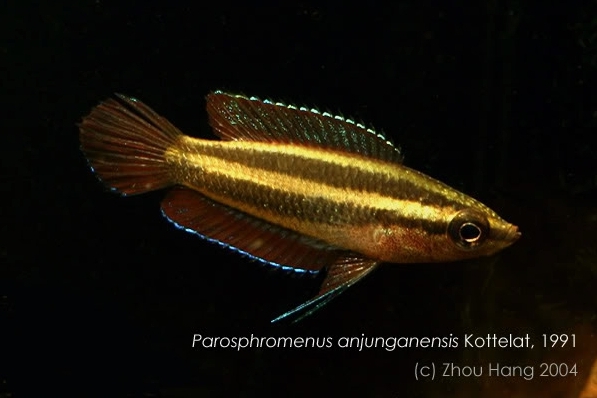
Parosphromenus anjunganensis
Kottelat, 1991
Max length35mm SL1.4in SLTank40 × 20cm16 × 8inTemp22–28°C72–82°FpH3.0–6.5It's care requirements, disposition, and especially conservation status dictate that it should be maintained alone or alongside a group of small, peaceful cyprinids such as Boraras or Sundadanio spp. Likewise, different Parosphromenus spp. should not be kept together since the females of many are very difficult to tell apart and some are undoubtedly capable of hybridising.
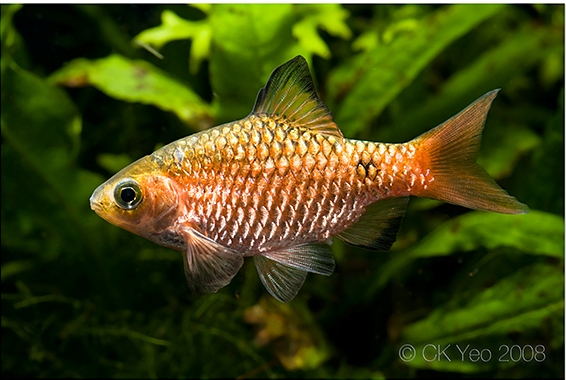
Pethia conchoniusRosy Barb
Hamilton, 1822
Max length100mm SL3.9in SLTank100 × 30cm39 × 12inTemp16–24°C61–75°FpH6.0–8.0Generally considered one of the hardiest small cyprinids available in the aquarium hobby, P. conchonius is an excellent choice for the beginner. Selective breeding has produced various ornamental strains including long-finned, 'veil-tail', 'super red', 'neon', and 'golden' forms. It's also been hybridised with some congeners although the offspring of such experiments are apparently infertile. It was formerly included in th...
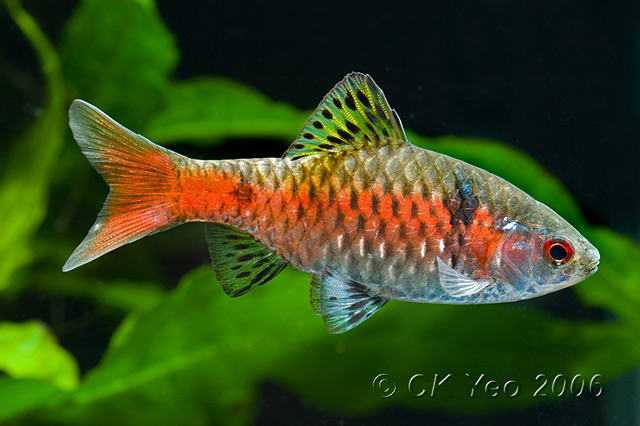
Pethia padamyaOdessa Barb
Kullander & Britz, 2008
Max length46mm SL1.8in SLTank80 × 30cm31 × 12inTemp16–25°C61–77°FpH6.5–8.5This species has been in the aquarium trade since the early 1970s but its precise origin was a mystery until 2003. It first appeared in Ukraine, the common name 'Odessa' being derived from the port city of that name, and when it arrived in western Europe was widely considered a hybrid of similar-looking congeners such as P. conchonius, P. ticto and P. cumingii. It was also hypothesised as a subspecies of P. ticto or P. conchonius, and some suggested the fish to be artificially dyed.
Placidochromis electraDeepwater Hap
authority not recorded
Max length200mm SL8in SLTank120 × 45cm48 × 18inTemp24–28°C75–82°FpH7.6–8.8The common name is derived from the fact that it was previously thought to be found only in much deeper water than we now know it inhabits. In nature, P. electra feeds from the surface of the substrate on invertebrates and other morsels stirred up by the action of digging substrate feeders such as Taeniolethrinops praeorbitalis. It is attracted to the clouds of sediment thrown up by these species. Several colour forms exist and these should not be kept together in aquaria as they may hybridis...
Protomelas sp. steveni "Taiwan reef"
authority not recorded
Max length140mm SL6in SLTank120 × 45cm48 × 18inTemp24–28°C75–82°FpH7.6–8.8Protomelas sp. "steveni taiwan reef" is often sold as a subspecies of P. fenestratus, but is actually thought not to be synonymous and is currently undescribed. It can be distinguished from similar species such as P. fenestratus and P. taeniolatus by the bright redof adult males. None of these related species or morphs should be kept together in aquaria as they may hybridise. Some captive spawns of this species have resulted in albino fry. It is one of the more popular and readily a...
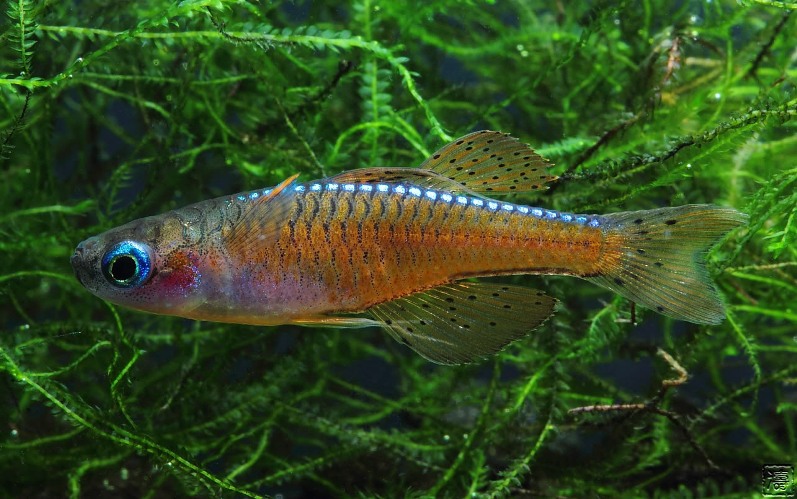
Pseudomugil sp. 'red neon'
authority not recorded
Max length35mm SL1.4in SLTank45 × 30cm18 × 12inTemp18–26°C64–79°FpH6.5–7.5This fish first appeared in the aquarium hobby in 2011 and has been traded under various names including P. sp. cf. paskai, P. sp. 'red orange neon', P. sp. 'neon orange', P. sp. 'Irian' and P. 'iriani'. The majority of fish available tend to be male, presumably due to their brighter colour pattern. It was initially suspected to be a hybrid or sele...
Pseudotropheus elongatusElongate Mbuna
authority not recorded
Max length135mm SL5in SLTank120 × 38cm48 × 15inTemp24–28°C75–82°FpH7.6–8.8Over 30 different forms of this species occur in Lake Malawi. These should not be mixed in the aquarium as they will hybridise freely. P. elongatus differs morphologically from other mbuna, being relatively slender and elongate. In nature females protect territories which contain 'gardens' of algae which they leave to breed before returning once they are holding eggs. Juvenile fish from previous spawns also inhabit the territory, protecting it when the female is away. This species i...