Results for “variant”
Type a name: scientific, common, or one a species used to go by. Or narrow the catalogue with the filters.
Filters
Melanotaenia affinisNew Guinea Rainbowfish
authority not recorded
Max length120mm SL5in SLTank120 × 30cm48 × 12inTemp20–30°C68–86°FpH6.5–8.0M. affinis was one of the first rainbowfish species to be imported for the hobby in any numbers. There are several geographical variants, three of which can be found in the hobby. The "standard" form has a large natural range and is the most commonly encountered. The "Pagwi" form has a very limited distribution, being known only from a tributary of the Sepik River in New Guinea, while the "Bluewater Creek" form has only been collected from a single location close t...
Melanotaenia maccullochiDwarf Rainbowfish
authority not recorded
Max length70mm SL2.8in SLTank60 × 30cm24 × 12inTemp20–30°C68–86°FpH5.5–8.0There are a few geographical variants of this species available, which differ in colour, patterning and less commonly, size. These should not be mixed in aquaria, as they may hybridise. The differences are so apparent between some of these forms that they may well turn out to be different species in the future....
Nanochromis parilus
authority not recorded
Max length80mm SL3.1in SLTanknot recordedTemp22–25°C72–77°FpH6.0–7.0N. parilus is one of the commoner Nanochromis in the hobby as it is more easily collected from its natural waters than most species. It is easily confused with the less often seen N. nudiceps but can be distinguished by the fact that male fish exhibit a barred patterning inn the upper half of the which is not present in nudiceps. Females can be distinguished by the unpatterned lower part of the caudal, which is spotted in nudiceps. There are a couple of geographical variants available. We do ...
Oreochromis mossambicusMozambique Mouthbrooder
authority not recorded
Max length390mm SL15in SLTank210 × 60cm84 × 24inTemp21–27°C70–81°FpH6.2–8.5One of the most invasive fish species in the world, O. mossambicus is one of the species farmed for supermarkets and restaurants across the globe. Several colour varieties have been selectively bred from the natural green fish to make the fish more appealing to consumers and unsurprisingly, it is these more brightly coloured forms which are usually seen in aquaria. Some of these variants are cross breeds with other species of Oreochromis. The destructive effect of O. mossambicus on non-nativ...
Otopharynx lithobatesSulphur-headed Hap
authority not recorded
Max length160mm SL6in SLTank90 × 45cm36 × 18inTemp24–28°C75–82°FpH7.6–8.8O. lithobates is a true rock dweller and is hardly ever seen in open water, even in aquaria. In fact, the scientific name lithobates literally translates as "rock dweller". Breeding males of this species rank among the most stunning of Lake Malawi Haplochromine cichlids. The three characteristic spots on the flanks disappear and are masked by a stunning neon blue patterning. Almost the entireand top of the head turn a deep yellow-orange colour. The most colourful variant is the "...
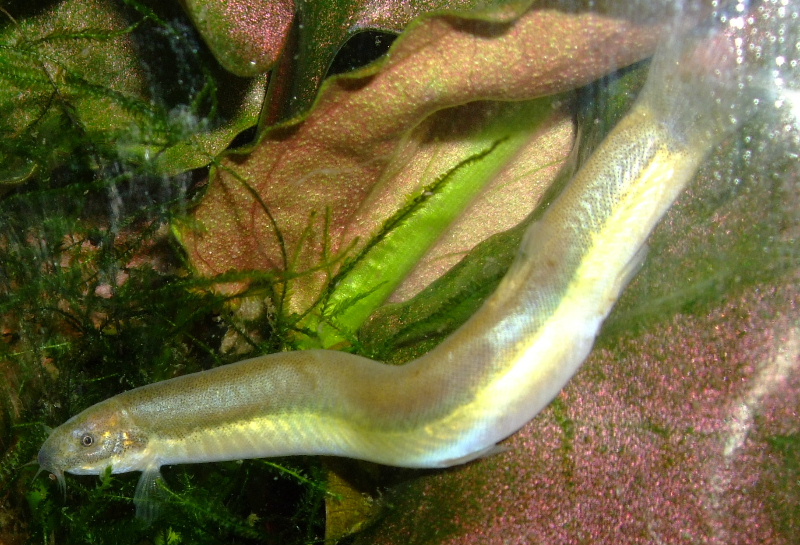
Pangio sp. 'PAN02'
authority not recorded
Max length50mm SL2.0in SLTank60 × 30cm24 × 12inTemp21–26°C70–79°FpH3.5–7.0The fish in our images don't correspond to any of the described members of the genus but can be assigned to the P. oblonga species group with a degree of certainty. It's apparently exported as a contaminant among shipments of a uniformly brown-coloured fish with unpublished genetic analyses suggesting the two might be variants of the same species (J. Bohlen, pers. comm.). Among congeners it may be related to P. alcoides Kottela...
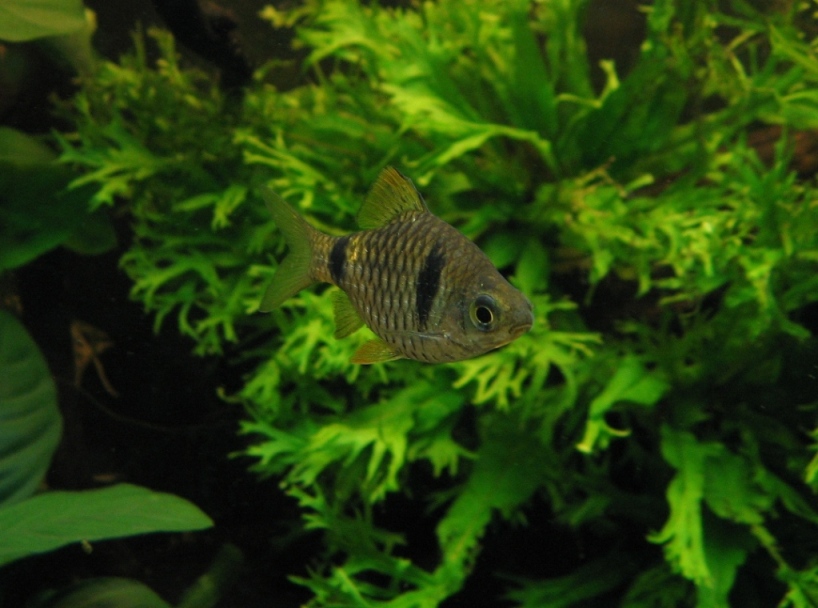
Pethia cumingiiCuming's Barb
Günther, 1868
Max length41mm SL1.6in SLTank60 × 30cm24 × 12inTemp20–27°C68–81°FpH5.5–7.0For many years this species was considered to occur in two colour forms with yellow or red dorsal, anal, and pelvic fins, respectively, but the red-finned variant has now been elevated to full species status as P. reval (Meegaskumbura et al. 2008). The latter is a smaller fish with a maximum SL of 33.6 mm recorded to date. As well as the obvious differences in body size and fin colour P. cumingii can be told apart from P. reval by the following...
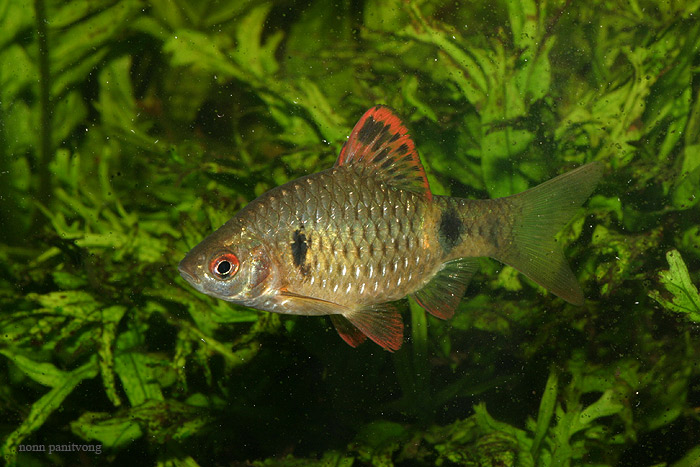
Pethia stoliczkana
Day, 1871
Max length50mm SL2.0in SLTank75 × 30cm30 × 12inTemp18–26°C64–79°FpH6.0–7.5This species is confused with P. ticto in much of the available literature and is sometimes listed as a synonym of it. Although some populations of the two species possess a similar colour pattern (there are reports of a P. ticto variant from the south of West Bengal state in India with a red, black-flecked dorsal-fin, for example) they do not occur in the same waters in nature and can be distinguished by examining the lateral line. This is complete in...
Potamotrygon castexiOtorongo Ray
authority not recorded
Max length600mm SL24in SLTanknot recordedTemp24–28°C75–82°FpHnot recordedIn Brazil P. castexi is currently banned from export, although it can still be legally obtained from other countries. There's a high level of polychromatism (differences in colour and pattern) displayed by this species, and in the hobby some of the colour forms have been given distinguishing names. Below is a list of some of the commoner varieties, along with some defining characteristics: Otorongo Ray (also known as "Jaguar" Ray, P25, P26, P28 or P35): This popular variant has...
Potamotrygon sp. "itaituba"P14
authority not recorded
Max length400mm SL16in SLTank210 × 90cm84 × 36inTemp23–29°C73–84°FpH6.0–7.5This stunning fish is one of the more sought after rays in the hobby. Taxonomically it remains unclear whether it is a geographical variant of P. leopoldi or a distinct species. It has a smaller adult size and both pups (see section above) and adults exhibit different patterning than it's relative. In P. leopoldi the light spotted markings tend to be quite large, spaced out and do not extend to the edge of the disc. In P14 they are typically much smaller, more randomly distributed and prese...
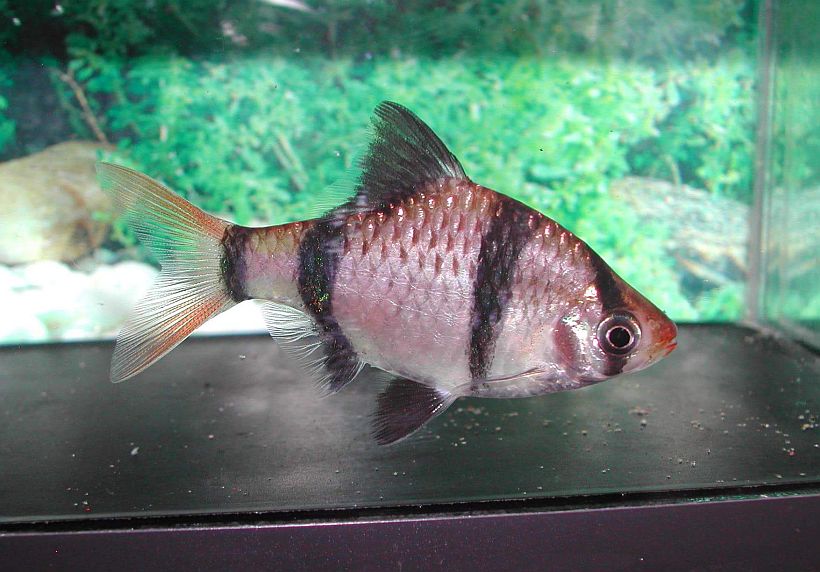
Puntigrus tetrazonaTiger Barb
Bleeker, 1855
Max length60mm SL2.4in SLTank80 × 30cm31 × 12inTemp20–26°C68–79°FpH5.0–8.0P. tetrazona is traditionally considered to be among the most ubiquitous species available in the aquarium trade. Wild examples are rarely traded, however, and there exists ongoing confusion as to the identity of the commercially-produced 'aquarium' tiger barb. A number of selectively-bred, ornamental strains are available. The albino, 'green' (aka 'moss'), and 'golden' (leucistic) variants are particularly pop...
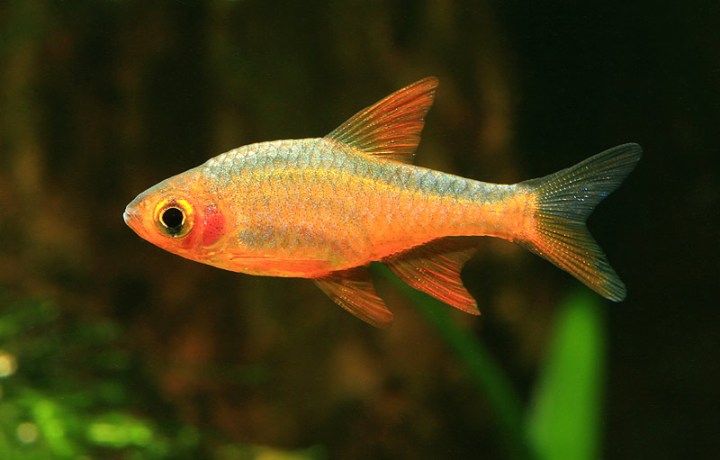
Rasboroides vateriflorisFire Rasbora
Deraniyagala, 1930
Max length40mm SL1.6in SLTank60 × 30cm24 × 12inTemp23–27°C73–81°FpH5.5–7.0These are still regarded as valid by some authorities although it's widely accepted that they represent variants of R. vaterifloris due to a lack of type material hindering conclusive study. Rasboroides nigromarginata (Meinken, 1956) has also been used to refer to a reddish form in which males differ from other populations in possessing dark fin margins, but the name is currently considered synonymous with R. vaterifloris by most sources despite the fish being rediscovered in 2010.
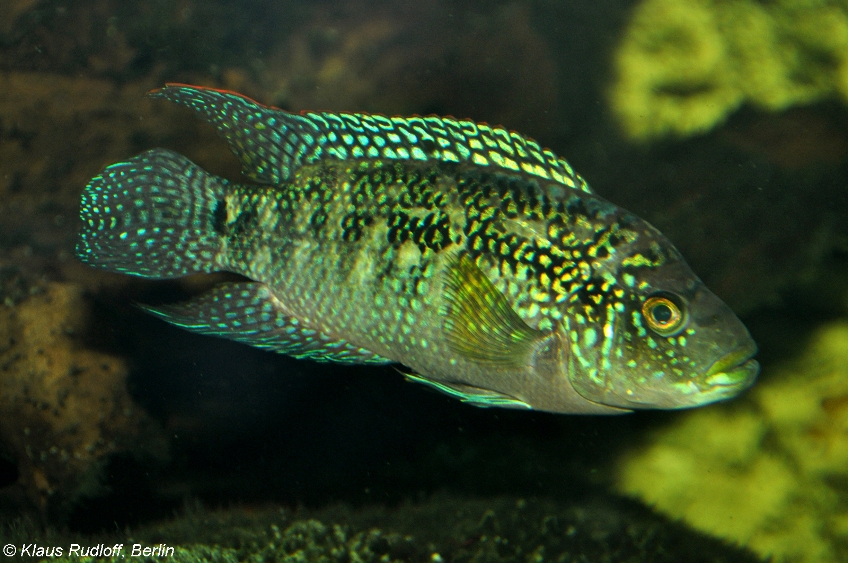
Rocio octofasciataJack Dempsey Cichlid
Regan, 1903
Max length200mm SL8in SLTank120 × 45cm48 × 18inTemp20–30°C68–86°FpH6.5–8.0A bright blue variant normally referred to as 'electric blue Jack Dempsey' or simply 'EBJD' is of unclear origin but it appears to be an ornamental strain fixed from a natural mutation. Care is as per the natural form although the blue fish tend to remain smaller and some reports suggest them to be less aggressive. R. octofasciata has a confusing taxono...
Synodontis notataOne-spot Synodontis
authority not recorded
Max length275mm SL11in SLTank120 × 30cm48 × 12inTemp22–25°C72–77°FpH6.5–7.5Also known as the Domino Synodontis or the One-spot Squeaker, several regional variants of S. notata are known, some of which have 3, 6 or 12 spots and others none at all. Some of these are seen for sale under the invalid name S. ocellata. It is also often imported with similar species such as S. nummifer or S.congica. These are usually then all sold as notata. S. notata is more active during the day than many Syno species and therefore makes a good addition to aquariums with more boisterous...
Wallago leeriiStriped Wallago Catfish
authority not recorded
Max length2032mm SL80in SLTanknot recordedTemp22–26°C72–79°FpH6.0–7.0Wallago are fearsome predatory catfish that are fairly widespread in southeast Asia. There are currently five recognised species, W. attu, W. leerii, W. hexanema, W. maculatus and W. micropogon. The latter was described to science in 2004 by renowned catfish expert Heok Hee Ng and was previously considered to be a geographic variant of W. leerii. All members of the genus possess an enormous mouth full of backward pointing teeth, which are used to rip chunks from their prey. Smaller fish or amphi...