Rocio octofasciata
Jack Dempsey Cichlid
Formerly Heros octofasciatus Regan, 1903 · Archocentrus octofasciatus Regan, 1903 · Cichlasoma octofasciatum Regan, 1903 · Nandopsis octofasciata Regan, 1903 · Cichlasoma hedricki Meek, 1904 · Cichlosoma biocellatum Regan, 1909
Last revised 2013Edit this page
On this page12 sections
Quick factsEdit
Difficulty7 of 8 measures
Rated moderate because it needs a well-established tank and stable water.
- Space
- large tank
- Water
- flexible
- Temp
- flexible
- Diet
- unknown
- Temperament
- peaceful
- Social
- best in a pair
- Compatibility
- choose tankmates carefully
Other demands
Each of these can raise the rating on its own, whatever the measures above say.
- Hardiness
- needs a well-established tank
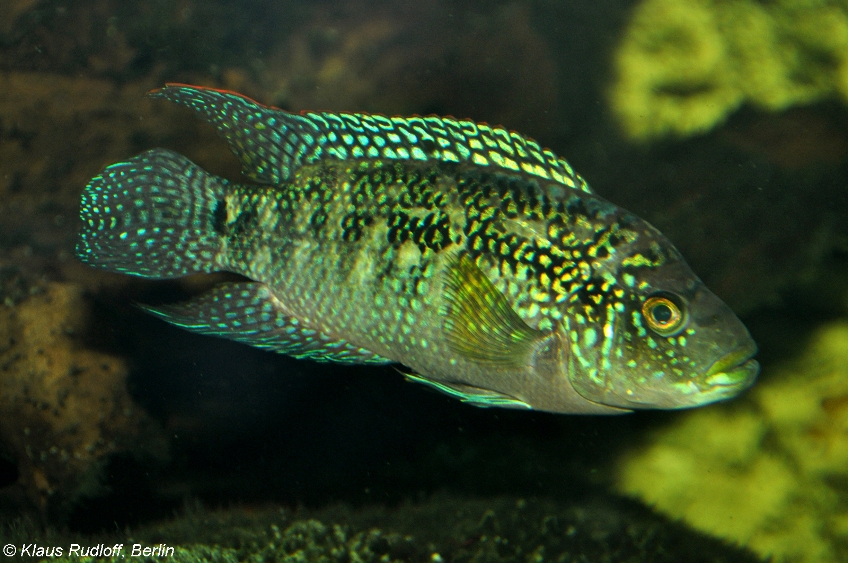
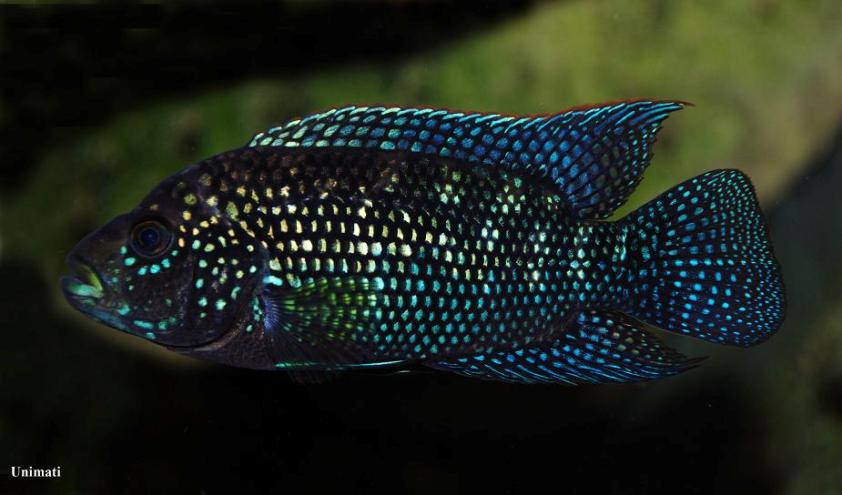
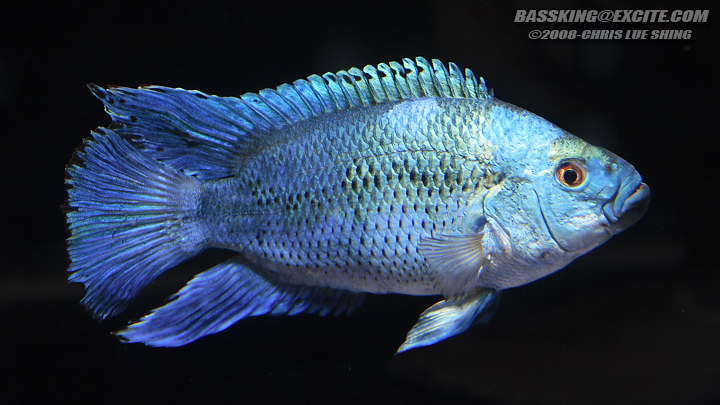
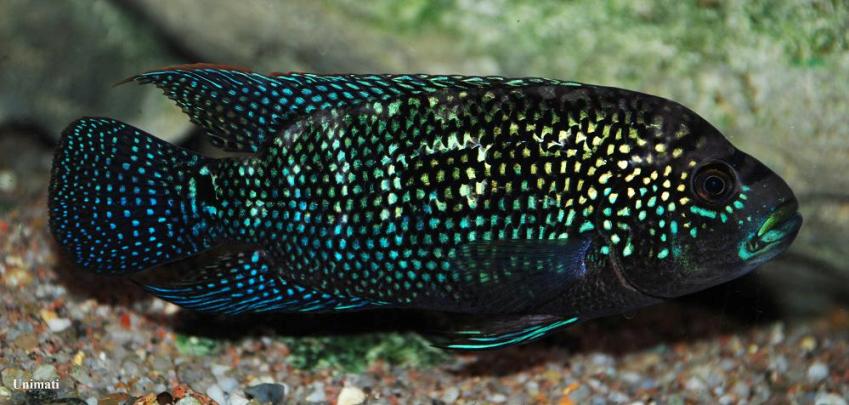
The Jack Dempsey cichlid, Rocio octofasciata, is native to the Atlantic slope of Central America in Mexico, Belize, Guatemala and Honduras. Its name apparently comes from the American heavyweight boxer, for its 'strong facial features' and pugnacious nature. Tankmates must be too large to be viewed as prey. A bright blue strain, the 'electric blue Jack Dempsey', tends to stay smaller and may be less aggressive.
Etymology
EditRocio: named for the author's wife, Rocío, the word 'rocío also meaning 'morning dew', an image evoked by the resplendent spots on cheek and sides of some member species, notably R. gemmata.
octofasciata: from the Latin octo, meaning 'eight', and fasciatus, meaning 'banded', in reference to this species' colour pattern.
Distribution
EditNative to the Atlantic slope of Central America in Mexico, Belize, Guatemala, and Honduras with its known range extending southwards from the Río Actopan in Veracruz state, Mexico to the ríos Motagua, Chamelecón and Ulúa in Cortés and Yoro departments, western Honduras.
Type locality was originally given as 'Mexico' by Regan (1903) but the label on the jar containing the specimens actually reads 'Río de Sarabia (Cosamaloapan, according to the original label), Coatzacoalcos drainage, Veracruz, Mexico' as per Schmitter-Soto (2007a).
Feral populations have become established in several countries including the United States, Russia, Australia and Thailand.
Habitat
Write a noteEditMost often recorded in coastal drainages and slower-moving, lower reaches of rivers but otherwise something of an ecological generalist having been recorded in river channels, man-made canals, drainage ditches, lakes and ponds.
Aquarium size
Write a noteEditAn aquarium with minimum base dimensions of 120 ∗ 45 cm48 ∗ 18 in or equivalent is recommended for a single adult pair.
Maintenance
Write a noteEditIdeally a soft, sandy substrate should be used though it’s not essential, and one or two flattish, water-worn rocks can also be included to provide potential spawning sites.
Additional furnishings are as much a case of personal taste as anything else but the most favoured set-ups tend to feature relatively dim lighting plus some chunks of driftwood and scattered roots or branches.
If you wish to include live plants species which can be grown attached to the décor or float onthe surface constitute the best choices since those rooted into the substrate are likely to be uprooted by the digging behaviour of the fish.
Water quality is of the utmost importance since these cichlids are susceptible to deteriorating water quality and should never be introduced to a biologically immature aquarium.
Water conditions
EditThese recommendations come from this profile’s own figures. They contain affiliate links, so we may earn a commission.
Diet
Write a noteEditWild specimens are likely omnivorous but with a preference for aquatic invertebrates and suchlike.
In the aquarium it does best when offered a varied diet comprising sinking dried foods, frozen Daphnia, mosquito larvae, chironomid larvae (bloodworm), and prawn/shrimp, for, example.
Home-made foods using a mixture of natural ingredients bound with gelatin are very useful since they can be tailored to contain fresh fruit, vegetables, Spirulina and meatier ingredients.
Behaviour and compatibility
Write a noteEditCan be kept in a well-chosen community arrangement alongside tankmates that are too large to be viewed as prey although a very large tank will be needed should you wish to keep it with other cichlids.
Young specimens can be maintained together but usually begin to display aggressive behaviour towards one another as they become sexually mature.
If a pair forms they are usually peaceful towards one another but hostile to other conspecifics and similarly-shaped fishes.
Reproduction
Write a noteEditBiparental substrate spawner.
Notes
EditJack Dempsey (1895-1983) was an American heavyweight boxer, world champion for much of the 1920s and a cultural icon of the time, thus his name was apparently used for R. octofasciata due to its 'strong facial features' and pugnacious nature.
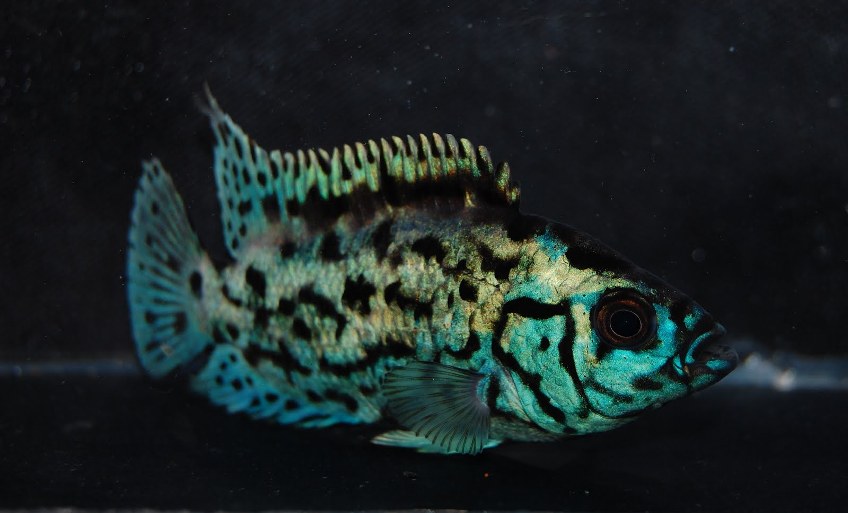
A bright blue variant normally referred to as 'electric blue Jack Dempsey' or simply 'EBJD' is of unclear origin but it appears to be an ornamental strain fixed from a natural mutation.
Care is as per the natural form although the blue fish tend to remain smaller and some reports suggest them to be less aggressive.
R. octofasciata has a confusing taxonomic history and its generic placement is still questioned by some authors.
It's been referred to Heros, Archocentrus, Cichlasoma, Nandopsis and 'Cichlasoma' in the past before eventually being placed in the new genus Rocio in 2007.
Rocio currently contain three species with R. ocotal endemic to Laguna Ocotal, an isolated, highland water body in the Lacantún-Usumacinta drainage, Chiapas state, Mexico, and R. gemmata known only from a handful of cenotes and small inland lakes in northern Quintana Roo state, eastern Yucatán Peninsula, Mexico.
R. octofasciata is told apart from these congeners by the following combination of characters: pelvic fins almost always reaching anal-fin origin; distally one scale row between longest dorsal-fin rays; dentary pores always 4; total gill-rakers on first arch 9–12; lateral blotch squarish; no pored scales on caudal-fin, other than one or two on extended lateral line; abdomen not reddish in life; maxilla reaching only a horizontal line from inferiormost rim of orbit, rather than a vertical line from anteriormost rim of orbit; orbital diameter 21–25% of head length and less than 80% of snout length; cheek-scale rows modally 6 (4-7); scales from vent to interpelvic scale 10–13; dorsal and anal fins usually bearing filaments; spots on side of body smaller than scales and aligned in ca. 15 regular series.
The genus Rocio is diagnosed by the following combination of characters: caudal-fin rounded or (sub)truncate; outer teeth on upper jaw gradually increasing in size anteriorly with symphysial teeth abruptly larger; frenum present in lower lip or absent; total gill-rakers on first arch 7–15; pharyngeal plate about as wide as long, or wider; lateral stripe extending from snout to a blotch on mid-body; eight bars on sides; ocellated spot on caudal-fin, dorsal to lateral line; lower jaw usually extending beyond upper jaw.
References
- Regan, C. T. (1903). Descriptions de poissons nouveaux faisant partie de la collection du Musée d'Histoire Naturelle de Genève. Revue Suisse de Zoologie 11(2), 413-418
- Pashkov, A. N. and D. D. Zvorykin (2009). Some Morphoecological Specific Features of Cichlasomine Rocio octofasciata (Perciformes, Cichlidae) from the Population in Lake Staraya Kuban. Journal of Ichthyology 49(5, 383-389
- Matamoros, W. A., J. F. Schaefer and B. R. Kreiser (2009). Annotated checklist of the freshwater fishes of continental and insular Honduras. Zootaxa 2307, 1-38
- Schmitter-Soto, J. J. (2007). A systematic revision of the genus Archocentrus (Perciformes: Cichlidae), with the description of two new genera and six new species. Zootaxa 1603, 1-76
- Schmitter-Soto, J. J. (2007). Phylogeny of species formerly assigned to the genus Archocentrus (Perciformes: Cichlidae). Zootaxa 1618, 1-50
Species images · 6
These photographs are used with each photographer's permission.
Send a photograph