Results for “várzea”
Type a name: scientific, common, or one a species used to go by. Or narrow the catalogue with the filters.
Filters
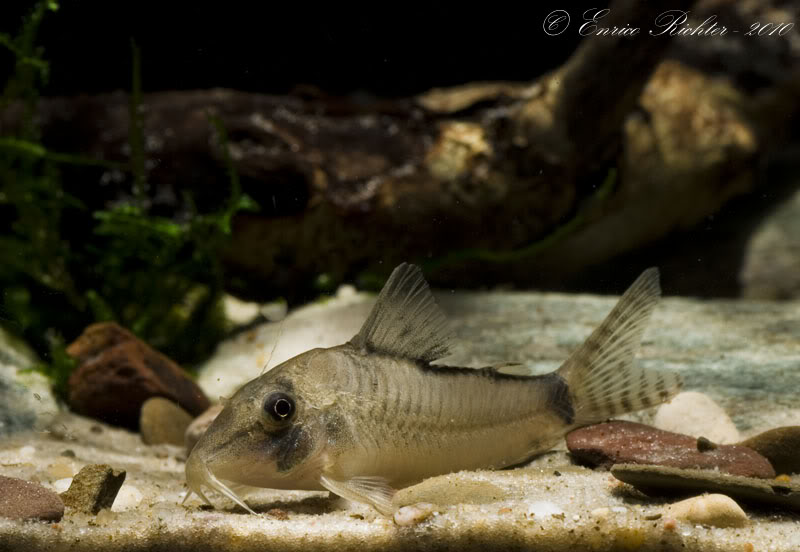
Corydoras simulatus
Weitzman & Nijssen, 1970
Max length70mm SL2.8in SLTanknot recordedTemp20–25°C68–77°FpH6.0–7.0This species can be identified from similar-looking congeners by possession of a pair of small rictal barbels. Its colour pattern can vary considerably depending on collection locality, with some forms having been misidentified as other species in the past. Those possessing a dark marking on the sides of the body are sometimes referred to as Corydoras sp. 'olga'.
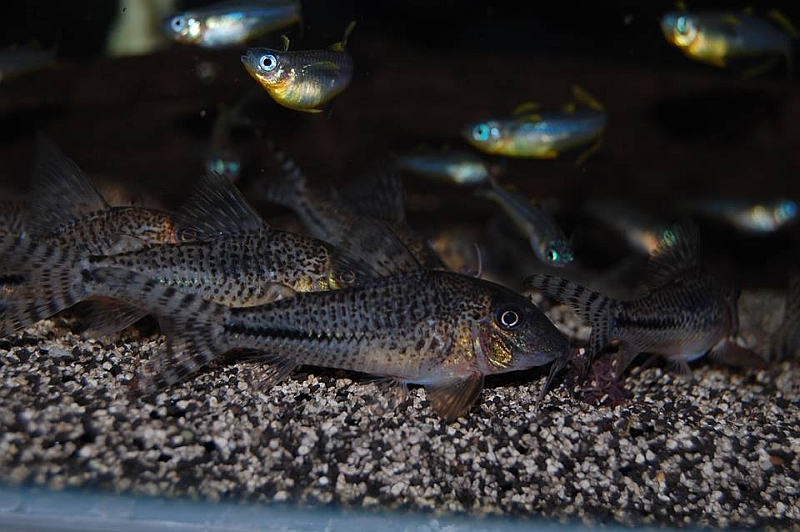
Corydoras sp.C115
authority not recorded
Max length70mm SL2.8in SLTanknot recordedTemp22–28°C72–82°FpH6.0–7.0This unidentified species was originally traded under the C-numbers C115 and C116 but these two are now thought to represent the same species, while fish collected from Manú National Park and sold as C. sp. 'Manu 1 long nose', C. sp. 'Manu 4', C. sp. 'Manu 7', and C. sp. 'Manu 8' may represent this species as well. It's highly variable in terms of colour patter...
Crenicichla compressicepsCompressiceps Dwarf Pike Cichlid
authority not recorded
Max length76mm SL3.0in SLTank90 × 38cm36 × 15inTemp24–27°C75–81°FpH5.0–6.8Crenicichla compressiceps are an excellent little fish. They are small, but they swim a great deal (and can be incredibly quick) so require larger aquaria than other, similar sized fish. In the wild, Compressiceps are insect feeders. They will wait quietly then quickly sweep down and prey on any nearby insects. They have good vision in the night and will often feed in the dark. Be careful when choosing tankmates, though as previously mentioned it may be mandatory to include some fish to e...
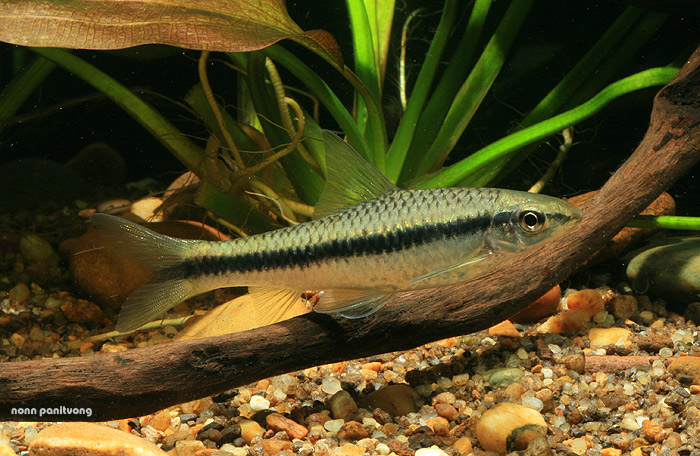
Crossocheilus atrilimesSiamese Algae Eater
Kottelat, 2000
Max length75mm SL3.0in SLTank120 × 30cm48 × 12inTemp20–26°C68–79°FpH6.0–7.5This species is among a handful of near-identical congeners that are traded as 'Siamese algae-eater' (often abbreviated to 'SAE'), 'Siamese flying fox' and 'Crossocheilus siamensis'. The latter name is not valid, however, and is a synonym of Epalzeorhynchos siamensis which is itself a synonym of Crossocheilus oblongus, a species described from Java. C. oblongus is currently accepted to...
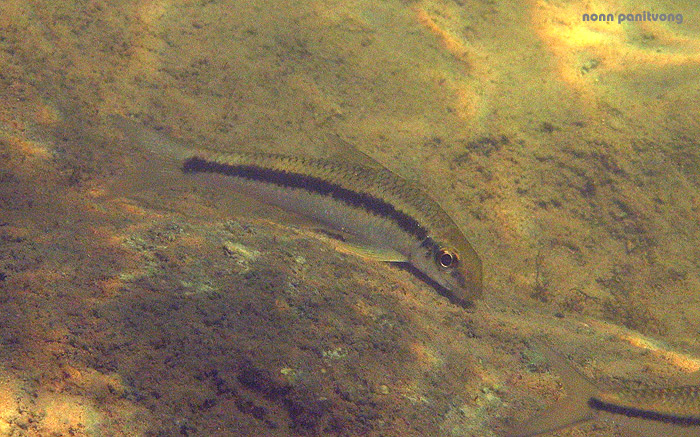
Crossocheilus burmanicus
Hora, 1936
Max length120mm SL5in SLTank150 × 45cm60 × 18inTemp20–26°C68–79°FpHnot recordedWe've been unable to obtain a diagnosis for this species to date but it can at least be distinguished from those congeners traded as 'Crossocheilus siamensis' (an invalid name synonymous with C. oblongus, which is itself of questionable identity), 'Siamese algae eater', or 'SAE' by the fact that the dark lateral stripe does not extend into the caudal-fin. Members of Crossocheilus are characterised by...
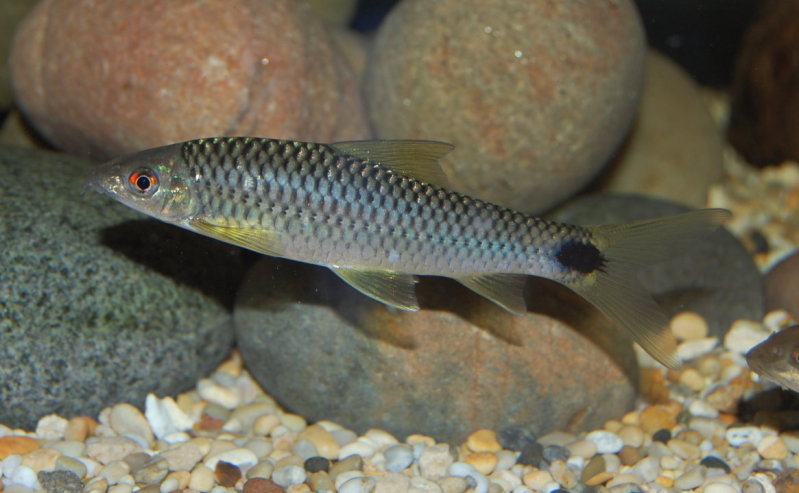
Crossocheilus reticulatus
Fowler, 1934
Max length170mm SL7in SLTank180 × 45cm72 × 18inTemp16–24°C61–75°FpH6.0–7.5While some laterally-striped members of the genus look very similar to one another the combination of silvery body, dark-edged scales and dark caudal peduncle blotch set C. reticulatus uniquely apart. The names Crossocheilus tchangi, Epalzeorhynchos coatesi and E. stigmaeus are all now considered synonyms of the species but were erected because the fish vary, most often in minor aspects of patt...
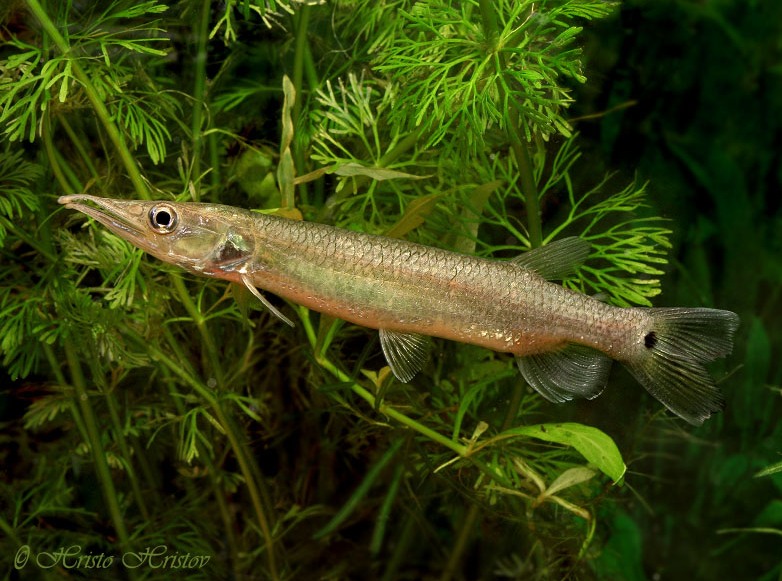
Ctenolucius hujetaGar 'Characin'
Valenciennes, 1850
Max length250mm SL10in SLTank180 × 60cm72 × 24inTemp22–28°C72–82°FpH5.0–7.5C. hujeta is traded under various names including 'slant-nosed gar', 'hujeta gar', 'rocket gar' and 'freshwater barracuda' but it and other members of the family Ctenoluciidae have traditionally been referred to as 'pike characids'. They're all predatory fishes native to South America, included in the order Characiformes and currently spread across two genera; Ctenolucius with two species and Boulengerella with five. The two genera are ...
Ctenopoma murieiOcellated Bushfish
authority not recorded
Max length75mm SL3.0in SLTank60 × 30cm24 × 12inTemp24–28°C75–82°FpH6.0–7.5One of the smallest species in the genus, it is rarely seen in the trade. A pity, as its diminutive size makes for an ideal aquarium subject. Like others in the suborder Anabantoidei, the species possesses an accessory breathing organ known as the labyrinth organ. So-called due to its maze-like structure, this organ allows the fish to breathe atmospheric air to a certain extent. It is formed by a modification of the first gill arch, and consists of many highly vascularised, folded flaps of sk...
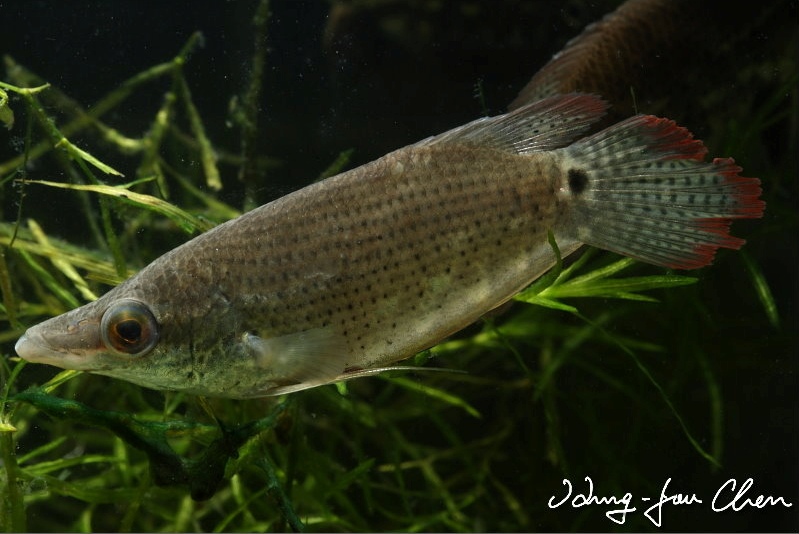
Ctenops nobilisFrail Gourami
McClelland, 1845
Max length100mm SL3.9in SLTank120 × 30cm48 × 12inTemp15–25°C59–77°FpH5.0–7.5This species is also referred to by the alternative vernacular name of 'noble gourami' and is currently the only recognised member of the genus Ctenops. It is usually regarded as being very difficult to keep whereas in reality it is quite adaptable once acclimatised but appears to react poorly to the export and shipping process meaning it is often seen on sale in poor condition and susceptible to or already infested with secondary health issues such as Oödinium, to which it appear...
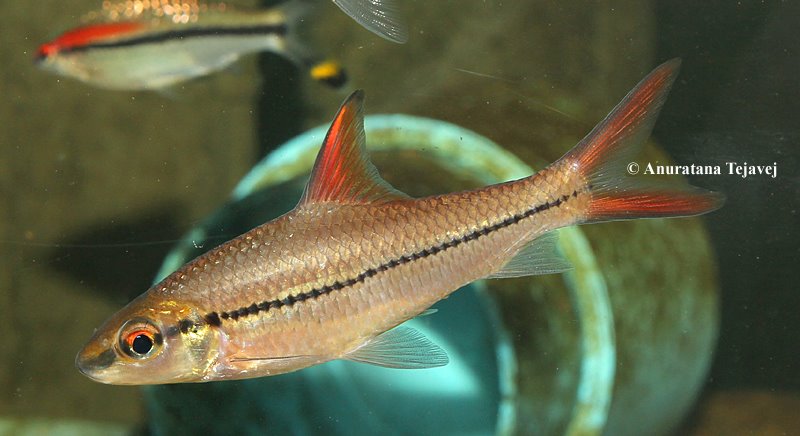
Cyclocheilichthys janthochir
Bleeker, 1854
Max length200mm SL8in SLTank180 × 45cm72 × 18inTemp22–27°C72–81°FpH4.0–7.0In the exceptionally diverse Danau Sentarum lake system of the upper Kapuas River basin, West Kalimantan, sympatric species include Scleropages formosus, Barbonymus gonionotus, B. schwanenfeldii, Crossocheilus nigriloba, Cyclocheilichthys apogon, C. repasson, Epalzeorhynchos kalopterus, Labiobarbus ocellatus , Leptobarbus hoevenii, Luciosoma spilopleura plus various representatives of Barbodes, Rasbora and Osteochilus.
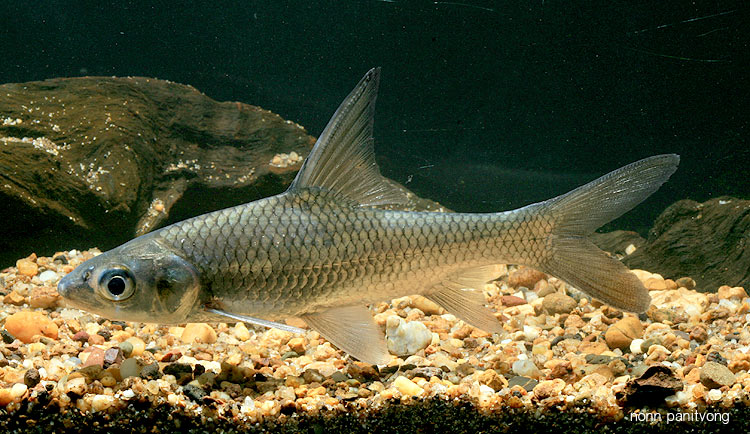
Cyclocheilos enoplos
Bleeker, 1849
Max length750mm SL30in SLTanknot recordedTemp20–26°C68–79°FpH6.0–8.0In the Mekong, it has been observed to migrate upstream from Phnom Penh to Khone Falls between November and February, returning downstream between May and August. The downstream migration ends in the Mekong delta area in Vietnam, where the fish remain until the floods reach their peak in October and November. These lower Mekong migrations mostly comprise juveniles and sub-adults, whereas above Khone Falls...
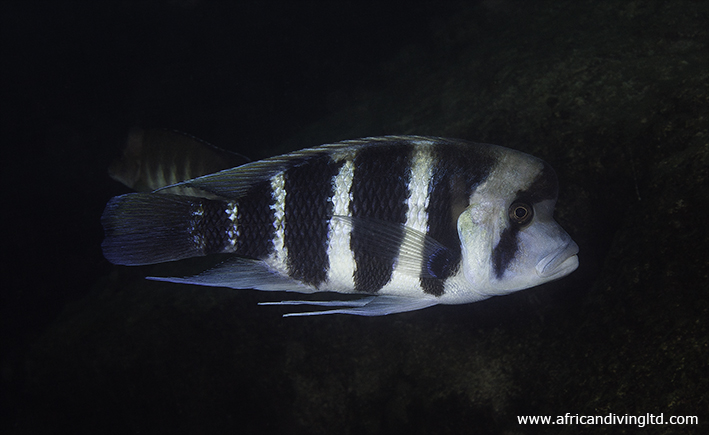
Cyphotilapia frontosaHumphead Cichlid
Boulenger, 1906
Max length255mm SL10in SLTank240 × 60cm96 × 24inTemp23–27°C73–81°FpH8.0–9.0Populations of C. frontosa from different localities are often labelled as such in order to maintain accuracy and preserve pure bloodlines. The majority possess 6 vertical bands on the body with the exception of the form from Kigoma on the eastern side of the lake, which has 7. Forms referred to as 'Blue Zaire' are sometimes misidentified as C. frontosa but are representative of its congener C. gibberosa.
Cyprichromis microlepidotusSmallscale Cyprichromis
authority not recorded
Max length110mm SL4in SLTank120 × 45cm48 × 18inTemp24–27°C75–81°FpH7.8–9.0Quite a rarity in the hobby, but when available it is much sought after by enthusiasts. It can be found living in huge mixed species groups with other Cyprichromis species and the similar Paracyprichromis. There are a few geographical variants known, each of which has both a yellow and blue tailed form. Individual populations can also contain males with different colour and patterning, a phenomenon known as polychromatism. The different forms should never be mixed in the aquarium, as they will i...
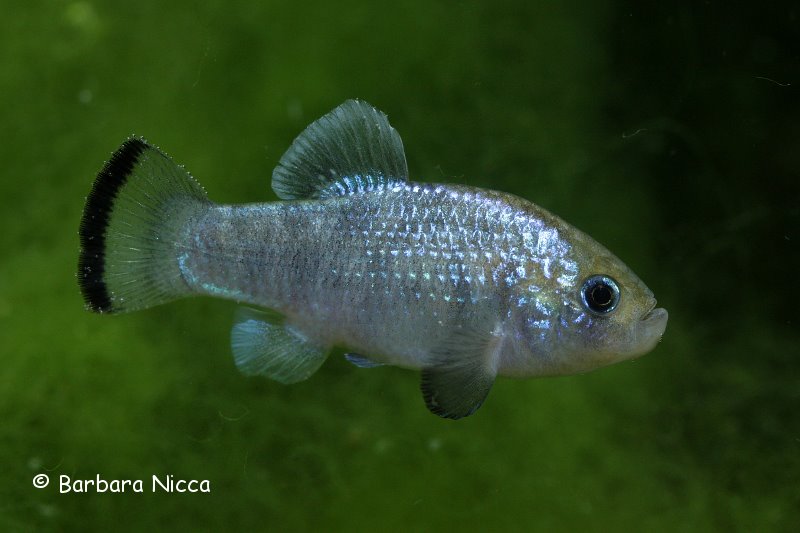
Cyprinodon alvareziPotosí Pupfish
Miller, 1976
Max length60mm SL2.4in SLTank60 × 30cm24 × 12inTemp17–26°C63–79°FpH7.0–8.0The type locality originally consisted of a single spring-fed pond located in an endorheic basin known as 'La Hediondilla' at the foot of the 'Cerro Potosí' mountain and around 1880 m AMSL. It had been modified to make it larger via an earth and rock dam, and below the pond were several distributaries running for a distance of 1-1.5 km.
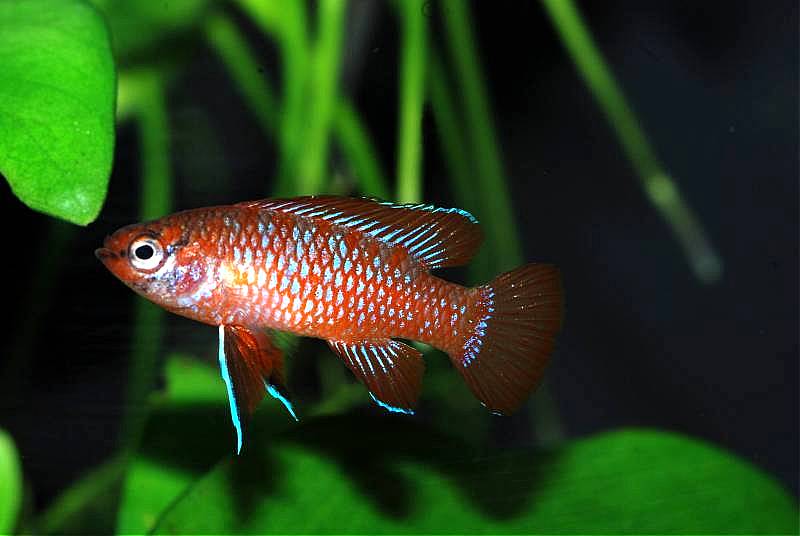
Dario darioScarlet Badis
Hamilton, 1822
Max length20mm SL0.8in SLTank45 × 30cm18 × 12inTemp18–26°C64–79°FpH6.5–8.5This species is among the more well-known badids in the aquarium hobby, and is a popular choice for 'nano' aquaria since it is among the smallest percoid fishes known. It is easily told apart from congeners since it is the only species in which males possess a series of seven iridescent blue vertical bars on the flanks.
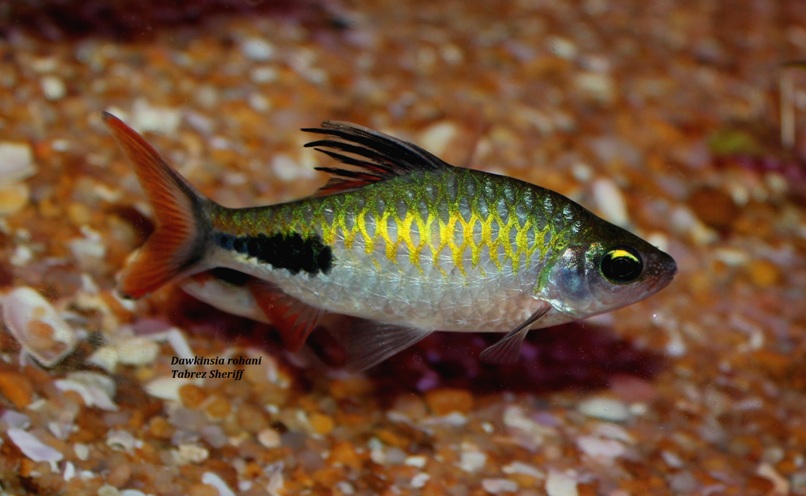
Dawkinsia rohani
Rema Devi, Indra & Knight, 2010
Max length95mm SL3.7in SLTank120 × 45cm48 × 18inTemp19–25°C66–77°FpH6.0–7.5Known only from Kanyakumari District, Tamil Nadu state, at the southern tip of the Indian peninsula. Type locality is the Kodayar River drainage and it's also been collected in the Paralayar and Pamburivaikal river systems. No precise data is available but it's certainly a pelagic, riverine species with habitats likely to vary depending on locality and time o...
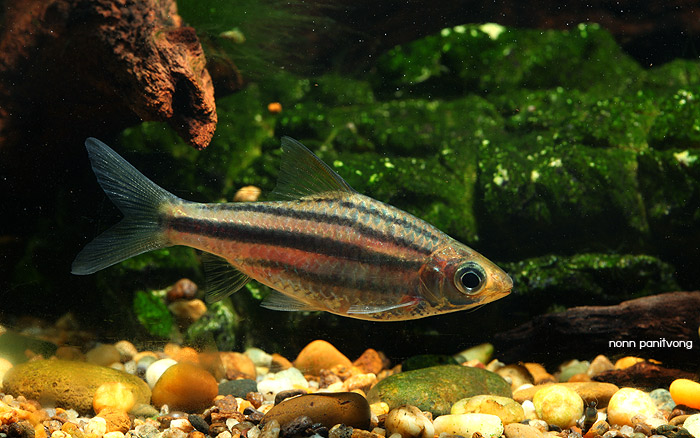
Desmopuntius johorensisStriped Barb
Duncker, 1904
Max length100mm SL3.9in SLTank120 × 45cm48 × 18inTemp20–25°C68–77°FpH5.0–7.0D. johorensis can be distinguished by the following combination of characters: 5-6 dark, lateral stripes on body in specimens larger than 40 mm; stripes immediately above and below the central stripe (stripes '+1' and '-1', respectively) located on scale rows +2 and -2, not touching dorsal and ventral midlines (except in some small specimens from Peninsular Malaysia); stripes broad, typically between 0.5-1 scale rows deep...
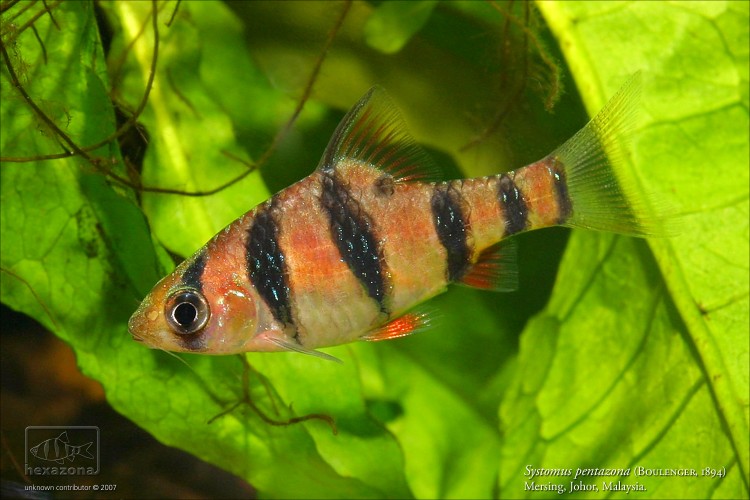
Desmopuntius pentazonaFive-banded Barb
Boulenger, 1894
Max length55mm SL2.2in SLTank80 × 30cm31 × 12inTemp21–26°C70–79°FpH4.0–7.0This species is rare in the aquarium trade with the majority of fish available under the name or the vernacular 'pentazona barb' being the closely-related D. hexazona. The two are almost identical in terms of both appearance and meristics but can be separated by the fact that D. pentazona possesses a small dark marking at the posterior base of the dorsal-fin which is absent in D. hexazona.
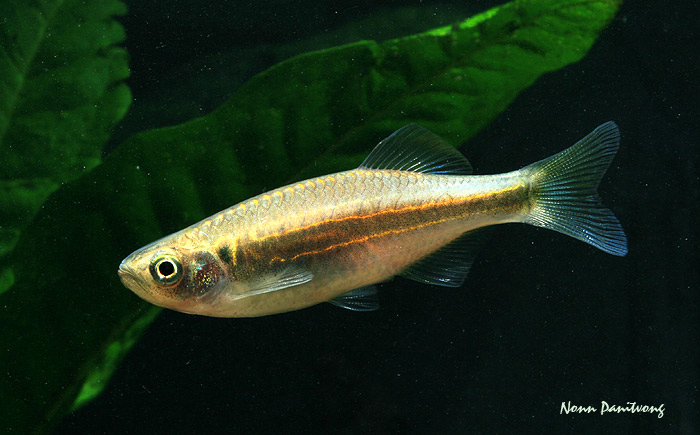
Devario acrostomus
Fang & Kottelat, 1999
Max length80mm SL3.1in SLTank120 × 45cm48 × 18inTemp23–26°C73–79°FpH6.0–7.0The type series was collected during the dry season from localities with varying gradient both within the Nam Leuk mainstream and smaller tributaries. In the tributaries the fish were found congregating in pools some of which were isolated on steep slopes. All habitats above Tad Leuk falls were characterised by clear to very clear water under forest cover while below the falls they were dominated by exposed basalt slabs with some underground water channels.
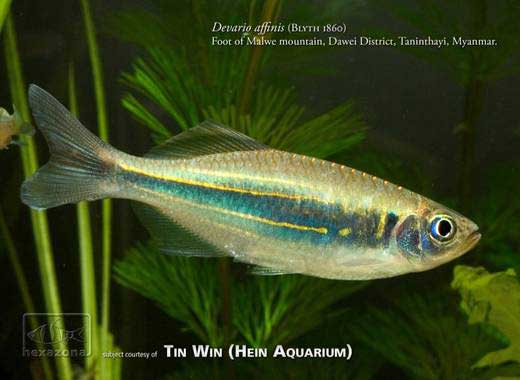
Devario affinis
Blyth, 1860
Max length80mm SL3.1in SLTank120 × 45cm48 × 18inTemp20–26°C68–79°FpHnot recordedType locality is 'Tenasserim, Myanmar' which at time of description was used to refer to the portion of Myanmar lying to the south and east of the Ayeyarwaddy/Irrawaddy river delta, including present-day Kayah, Kayin, and Mon states, Bago Division, and possibly the southern Tanintharyi Region. Blyth's description paper covered fishes collected from the Sittaung River (plus a few Gangetic species) in what is currently Bago Division, but we've been unable to locate any modern records of D. affinis fro...