Results for “bar”
Type a name: scientific, common, or one a species used to go by. Or narrow the catalogue with the filters.
Filters
Hemigrammus barrigonaeBarrigona Tetra
authority not recorded
Matched on the common name Barrigona Tetra
Max length40mm SL1.6in SLTank60 × 38cm24 × 15inTemp22–26°C72–79°FpH5.5–7.0Not a common species in the hobby, although it does occasionally show up as a contaminant among imports of more popular species. Like all Hemigrammus, the taxonomic status of this species is currently Incertae Sedis, meaning uncertain. The genus is currently used as something of a catch-all for over 70 species of small characin. Most experts agree that a full revision is required, with the likely outcome that many species will be placed into new or different genera....
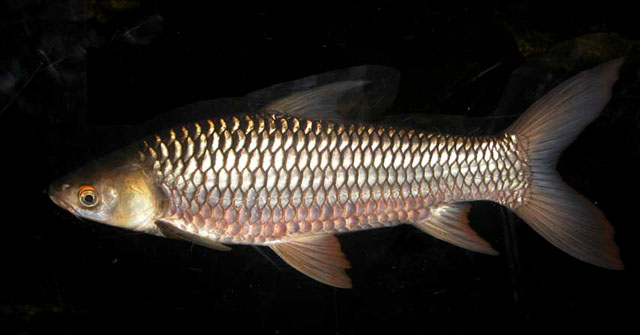
Leptobarbus hoeveniiMad Barb
Bleeker, 1851
Matched on Barbus hoevenii, a name it was formerly known by
Max length1000mm SL39in SLTanknot recordedTemp20–26°C68–79°FpH6.0–8.0Apparently native to Peninsular Malaysia plus the Greater Sunda Islands of Borneo, Sumatra, and Java. Reports of this species from the Mekong, Chao Phraya, and other rivers in Indochina refer to the congener L. rubripinna (see 'Notes'). Type locality is 'Indonesia: Borneo: Kalimantan Selatan: Banjarmasin'.
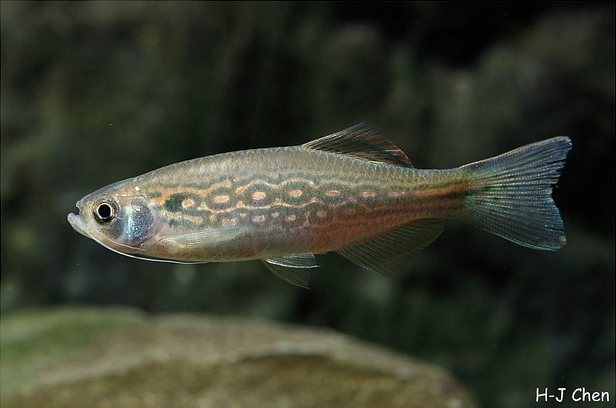
Danio dangilaMoustached Danio
Hamilton, 1822
Max length130mm SL5in SLTank120 × 45cm48 × 18inTemp16–24°C61–75°FpH6.5–7.5In the Barak River drainage, which flows through the north-east Indian states of Nagaland and Assam before bifurcating at the Bangladesh border, symaptric species include Barilius bakeri, B. barna, B. bendelisis, B. dogarsinghi, Laubuca laubuca, Esomus danricus, Devario aequipinnatus, D. annandalei, D. devario, Rasbora daniconius, R. rasbora,...
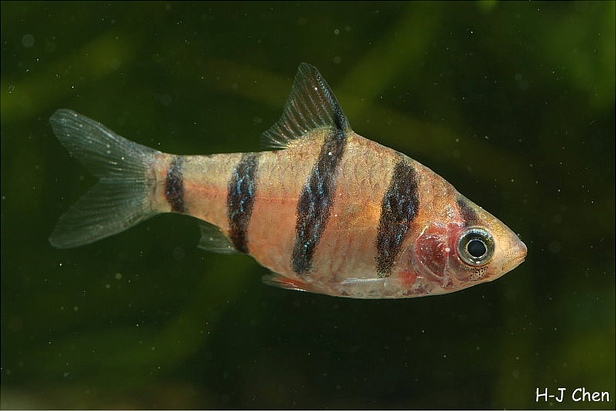
Desmopuntius hexazona'Pentazona' Barb
Weber & de Beaufort, 1912
Matched on Barbus hexazona, a name it was formerly known by
Max length55mm SL2.2in SLTank80 × 30cm31 × 12inTemp20–26°C68–79°FpH4.0–7.0Native to parts of southern Borneo, eastern Sumatra, Singapore, and the Malay Peninsula. In Singapore it's considered highly-endangered and is now restricted to the Central Catchment nature reserve. Type locality is 'Tuluk and Gunung Sahilan, Sumatra, Indonesia' which appears to correspond to localities within the Kampar River drainage of which the former is now known as Teluk Meranti and is o...
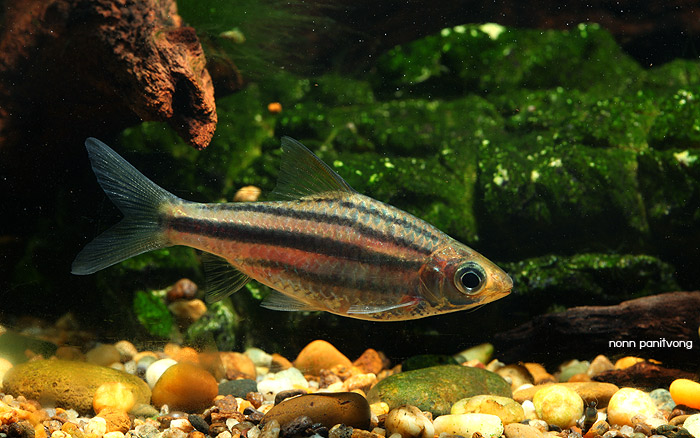
Desmopuntius johorensisStriped Barb
Duncker, 1904
Matched on Barbus tetrazona johorensis, a name it was formerly known by
Max length100mm SL3.9in SLTank120 × 45cm48 × 18inTemp20–25°C68–77°FpH5.0–7.0D. johorensis can be distinguished by the following combination of characters: 5-6 dark, lateral stripes on body in specimens larger than 40 mm; stripes immediately above and below the central stripe (stripes '+1' and '-1', respectively) located on scale rows +2 and -2, not touching dorsal and ventral midlines (except in some small specimens from Peninsular Malaysia); stripes broad, typically between 0.5-1 scale rows deep...
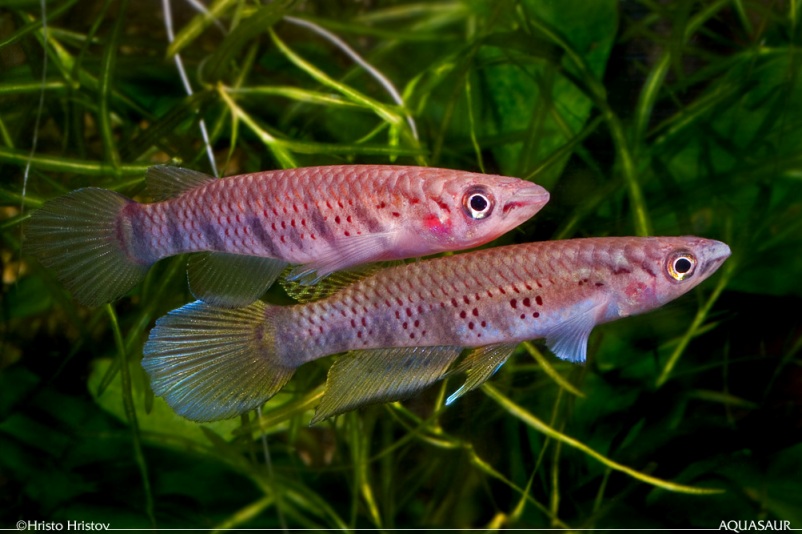
Epiplatys sexfasciatusSix-barred Panchax
Gill, 1862
Matched on Epiplatys sexfasciatus baroi, a name it was formerly known by
Max length70mm SL2.8in SLTank80 × 30cm31 × 12inTemp20–27°C68–81°FpH5.0–7.0Distributed throughout coastal regions north and westwards from Gabon through Equatorial Guinea, Cameroon, Nigeria, Benin and Togo as far as Ghana although some consider it restricted to northwestern Gabon and Equatorial Guinea with the remaining populations representing various subspecies (see 'Notes'). Type locality is 'Gaboon River', which presumably refe...
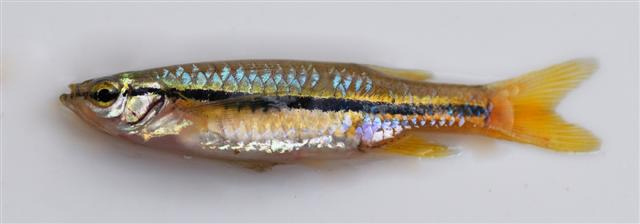
Esomus danricaFlying Barb
Hamilton, 1822
Matched on Cyprinus barbiger, a name it was formerly known by
Max length70mm SL2.8in SLTank120 × 30cm48 × 12inTemp20–26°C68–79°FpH6.0–8.0Found in various types of habitat but shows a marked preference for shallow, slow-moving and standing waters such as rice paddies and other temporally-inundated environments with dense aquatic vegetation.
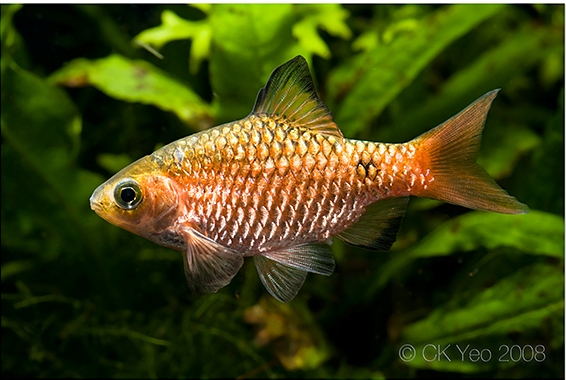
Pethia conchoniusRosy Barb
Hamilton, 1822
Matched on Barbus conchonius, a name it was formerly known by
Max length100mm SL3.9in SLTank100 × 30cm39 × 12inTemp16–24°C61–75°FpH6.0–8.0Generally considered one of the hardiest small cyprinids available in the aquarium hobby, P. conchonius is an excellent choice for the beginner. Selective breeding has produced various ornamental strains including long-finned, 'veil-tail', 'super red', 'neon', and 'golden' forms. It's also been hybridised with some congeners although the offspring of such experiments are apparently infertile. It was formerly included in th...
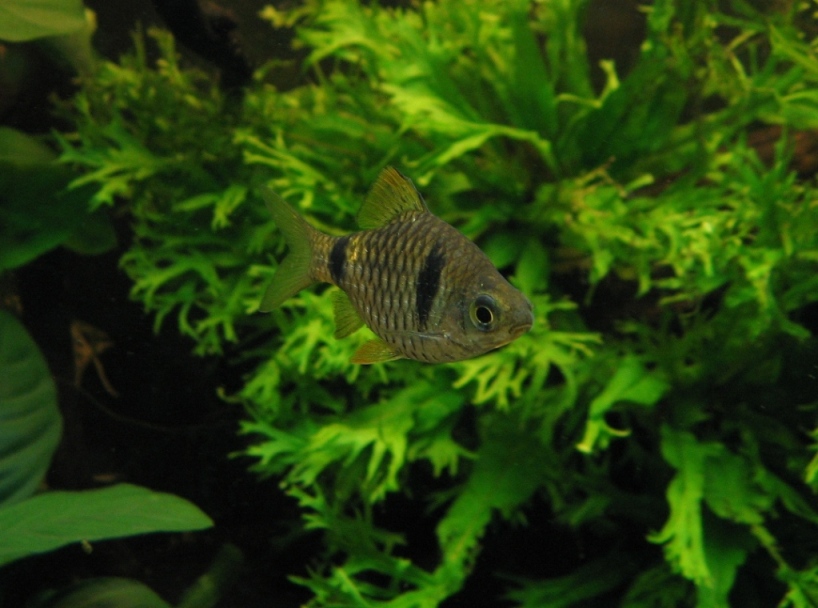
Pethia cumingiiCuming's Barb
Günther, 1868
Matched on Barbus cumingii, a name it was formerly known by
Max length41mm SL1.6in SLTank60 × 30cm24 × 12inTemp20–27°C68–81°FpH5.5–7.0For many years this species was considered to occur in two colour forms with yellow or red dorsal, anal, and pelvic fins, respectively, but the red-finned variant has now been elevated to full species status as P. reval (Meegaskumbura et al. 2008). The latter is a smaller fish with a maximum SL of 33.6 mm recorded to date. As well as the obvious differences in body size and fin colour P. cumingii can be told apart from P. reval by the following...
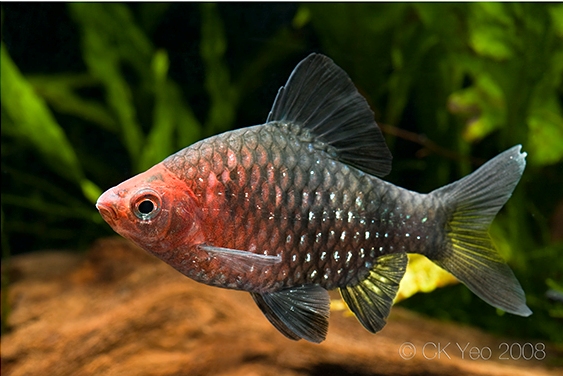
Pethia nigrofasciataBlack Ruby Barb
Günther, 1868
Matched on Barbus nigrofasciatus, a name it was formerly known by
Max length55mm SL2.2in SLTank80 × 30cm31 × 12inTemp20–27°C68–81°FpH5.5–7.5Little sun is able to penetrate the forest floor so aquatic habitats are shaded and water temperature may be relatively cool, while conductivity and hardness are generally low and pH slightly acid. Macrophytes are uncommon though there may be dense, marginal vegetation, sometimes overhanging the full width of the stream, the roots of which may penetrate the banks underwater. Typical substrates are sandy but covered by a layer of leaf litter with fallen twigs and branches.
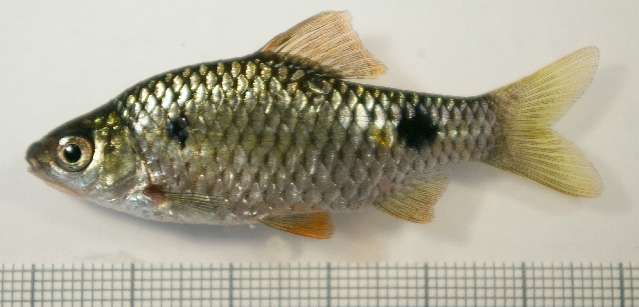
Pethia tictoTicto Barb
Hamilton, 1822
Matched on Barbus ticto, a name it was formerly known by
Max length65mm SL2.6in SLTank80 × 30cm31 × 12inTemp18–25°C64–77°FpH6.0–7.5Apparently most abundant in shallow streams and minor tributaries, sometimes at relatively high altitudes, and apparently shows a preference for substrates of mud or silt. Given the extent of its range it would seem sensible to assume that it inhabits various habitat-types which also vary in water depth, flow, and turbidity depending on the time of year.
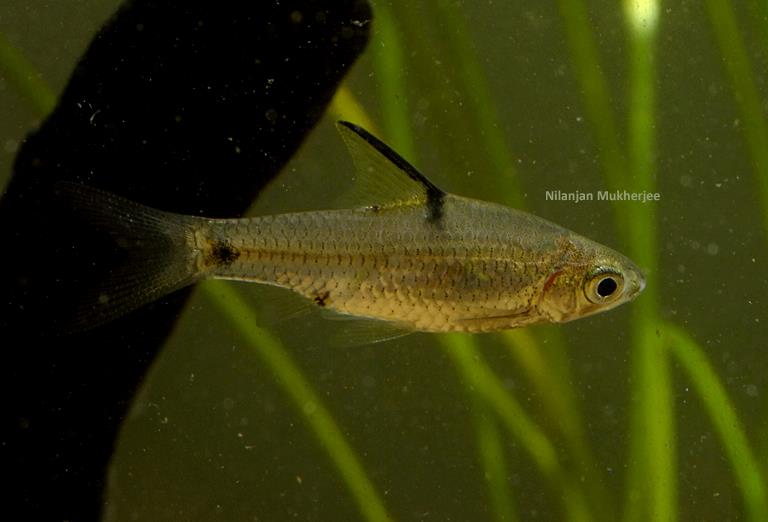
'Puntius' guganioGlass Barb
Hamilton, 1822
Matched on Barbus carletoni, a name it was formerly known by
Max length65mm SL2.6in SLTank75 × 30cm30 × 12inTemp18–26°C64–79°FpH6.0–7.5Probably a micropredator feeding on small insects, worms, crustaceans and other zooplankton in nature. In the aquarium it should accept dried foods of a suitable size but should not be fed these exclusively. Daily meals of small live and frozen fare such as Daphnia, Artemia, Moina, etc., along with good quality flakes and granules will result in the best colouration and encourage the fish to come into breeding condition.
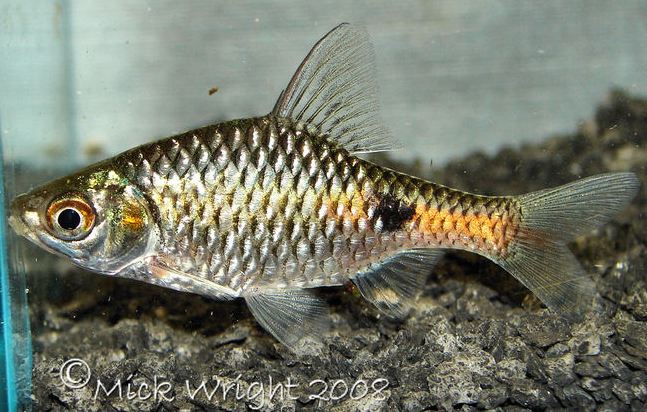
Puntius terioOnespot Barb
Hamilton, 1822
Matched on Barbus terio, a name it was formerly known by
Max length90mm SL3.5in SLTank80 × 30cm31 × 12inTemp18–26°C64–79°FpH6.5–7.5This species is uncommon in the aquarium trade which is a little surprising given its huge natural range. Different populations can vary in colour pattern to an extent though all share the defining aspects given by Hamilton, comprising a diffuse yellow-golden marking on the operculum plus a dark spot on the caudal peduncle. The latter is usually surrounded by a variably-sized golden-yellow margin, and the dorsal-fin often contains irregular dark spots and streaks, these sometimes forming a longitudinal band.
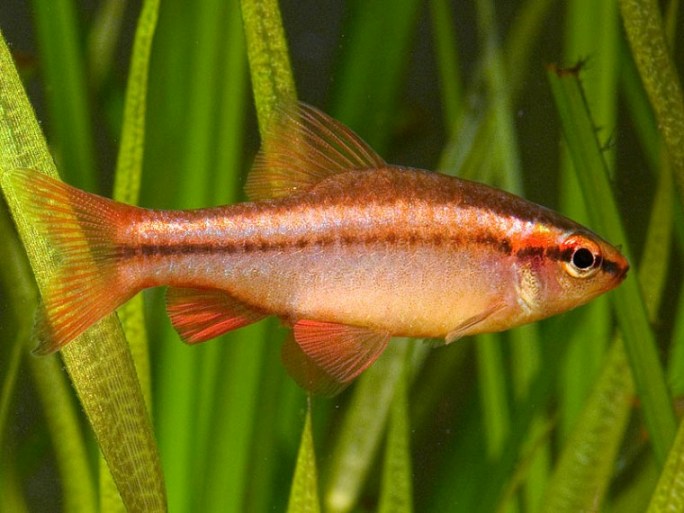
Puntius titteyaCherry Barb
Deraniyagala, 1929
Matched on Barbus titteya, a name it was formerly known by
Max length50mm SL2.0in SLTank60 × 30cm24 × 12inTemp20–27°C68–81°FpH6.0–8.0As of 2006 only 4.6% of the old forest was left with the remainder existing only in small, highly-fragmented patches, most covering areas less than 10 km², of which some are now officially-protected reserves. Kottawa Forest is one of these and comprises just 15-20 hectares of wet, evergreen jungle, though the combined Kottawa-Kombala forest covers around 1600 ha. A number of minor, pristine streams...
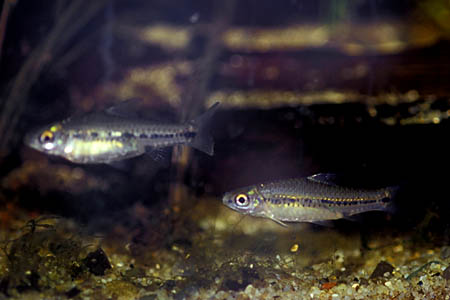
'Barbus' sublineatus
Daget, 1954
Max length100mm SL3.9in SLTank120 × 30cm48 × 12inTemp22–27°C72–81°FpH6.0–7.0The genus Barbus is in something of a confused state classification-wise. While there exist almost 340 putative species the vast majority of them do not appear to be closely-related to the genus Barbus sensu stricto. Berrebi et al. (1996) proposed that only the European, Southwest Asian and North African representatives should be included in Barbus (around 20 species) and that 'all species of Barbus sen...
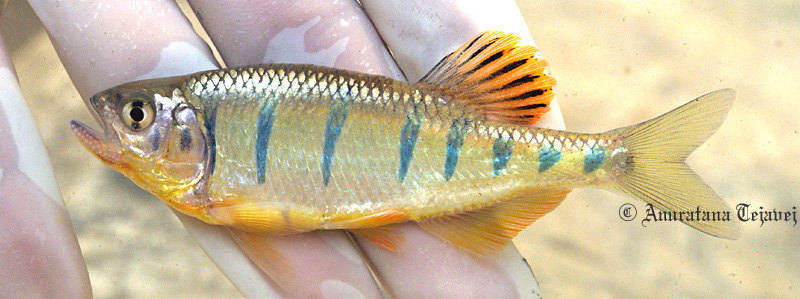
Opsarius pulchellus
Smith, 1931
Matched on Barilius pulchellus, a name it was formerly known by
Max length110mm SL4in SLTank120 × 45cm48 × 18inTemp18–26°C64–79°FpH6.0–7.5This species is traded for aquaria under various names including 'butterfly barb', 'mackerel barb', 'green-barred danio', and 'royal opsarius'. It can be told apart from other memb...
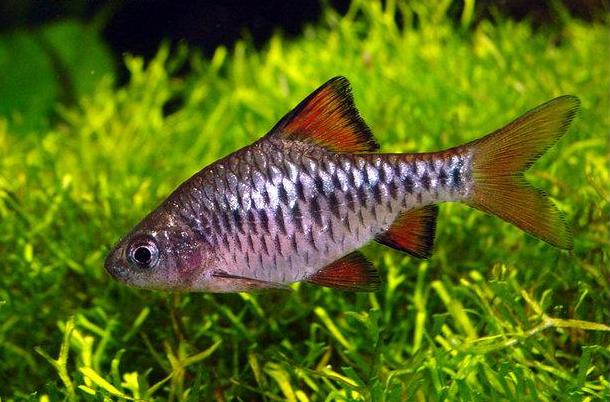
Oliotius oligolepisCheckered Barb
Bleeker, 1853
Matched on the common name Checkered Barb
Max length45mm SL1.8in SLTank75 × 30cm30 × 12inTemp18–25°C64–77°FpH5.5–7.5This species is also traded as 'checker barb', 'checkerboard barb', or 'island barb', and is among the most ubiquitous species available in the aquarium trade. It is farmed commercially in enormous numbers with wild examples rarely, if ever, available. It was formerly included in the polyphyletic catch-all genus Puntius which contained over 100 species, but this situation has been largely resolved since the turn of the century.
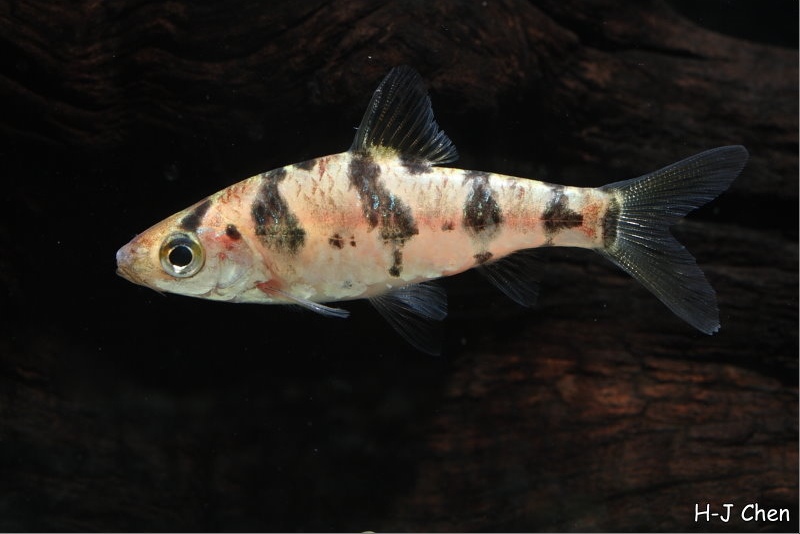
Desmopuntius foerschi
Kottelat, 1982
Matched on Barbus foerschi, a name it was formerly known by
Max length55mm SL2.2in SLTank80 × 30cm31 × 12inTemp20–28°C68–82°FpH5.0–7.0D. foerschi is sometimes traded as 'boomerang barb' or 'Foersch's fire barb' and is included in a group of closely-related, similar-looking fishes which were moved into the new genus Desmopuntius by Kottelat (2013). It can be told apart from other vertically-striped congeners by possession of additional dark blotches between the second, third and fourth vertical bars and a further marking at the posterior base o...
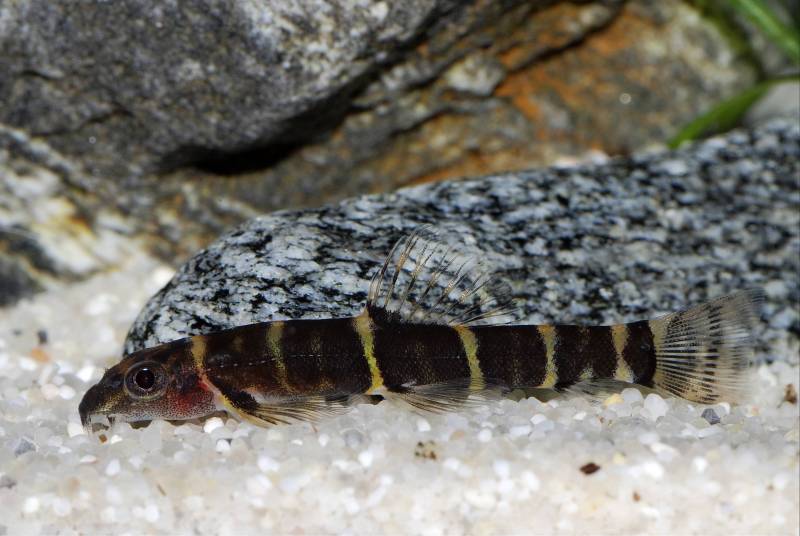
Barbucca diabolica
Roberts, 1989
Max length50mm SL2.0in SLTank60 × 30cm24 × 12inTemp20–25°C68–77°FpH5.5–7.5Barbucca spp. are uncommon in the aquarium trade but available periodically. There exist several undescribed species and it's possible that more than one has been exported, although to date only B. diabolica is officially recognised. Most of the fish we've seen possess red eyes (when viewed at certain angles), unique tuberculation and six dark body stripes as mentioned in Roberts' description although there are exceptio...
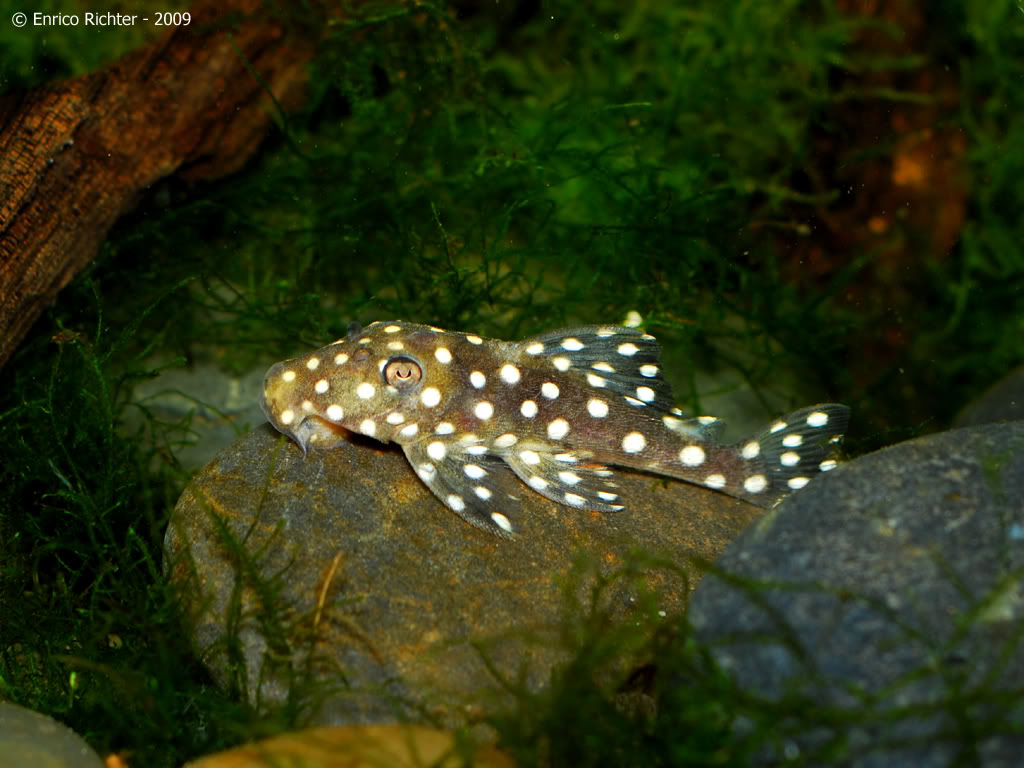
Baryancistrus sp. L142Big White Spot Pleco
authority not recorded
Max length250mm SL10in SLTank120 × 45cm48 × 18inTemp27–32°C81–90°FpH6.0–7.5The genus Baryancistrus can be distinguished from all other loricariids by possession of an enlarged membrane located posteriorly to the last branched dorsal-fin ray. This membrane may or may not reach the supporting structure of the adipose fin and in this way members can be told apart from the genera Oligancistrus, Parancistrus, and Spectracanthicus, in which the dorsal and adipose fins are completely connected, and Hemiancistrus...