Opsarius pulchellus
Formerly Barilius pulchellus Smith, 1931 · Barilius buddhae Fowler, 1934 · Barilius pellegrini Fang, 1938 · Paradaniops macropterus Nguyen & Doan, 1967 · Daniops nammuensis Nguyen & Doan, 1969
Last revised 2026Edit this page
On this page13 sections
Quick factsEdit
Difficulty6 of 8 measures
- Space
- large tank
- Water
- flexible
- Temp
- flexible
- Diet
- unknown
- Temperament
- unknown
- Social
- needs to be in a group
- Compatibility
- choose tankmates carefully
Other demands
Each of these can raise the rating on its own, whatever the measures above say.
- Hardiness
- needs a well-established tank
Before you buy
Needs a tight-fitting lid as this species is known to jump
A tightly-fitting cover is also essential as Opsarius spp.
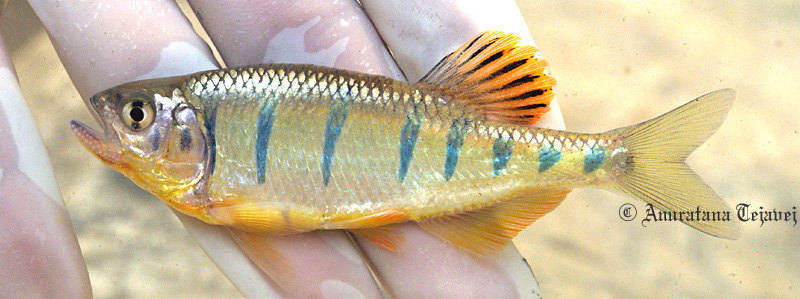
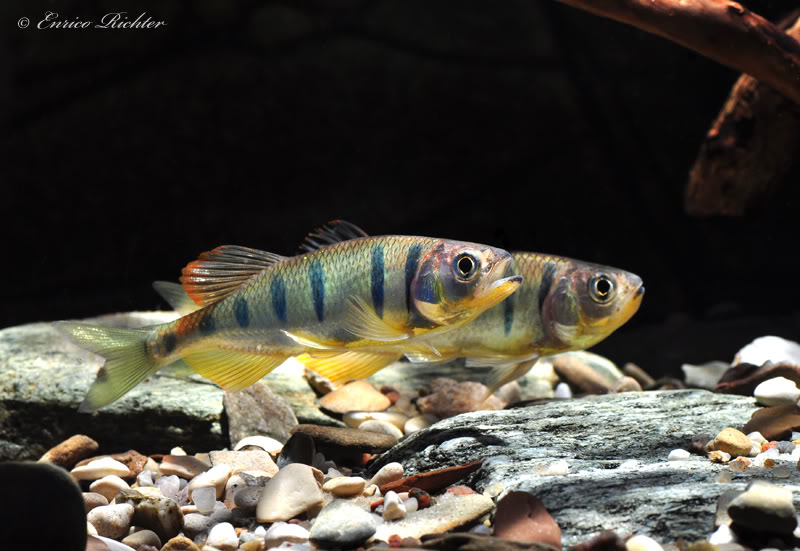
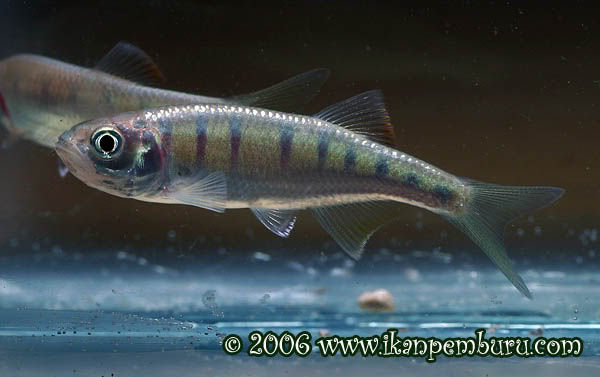
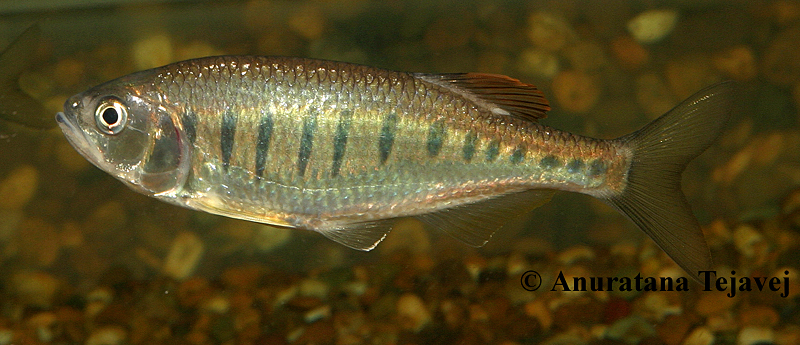
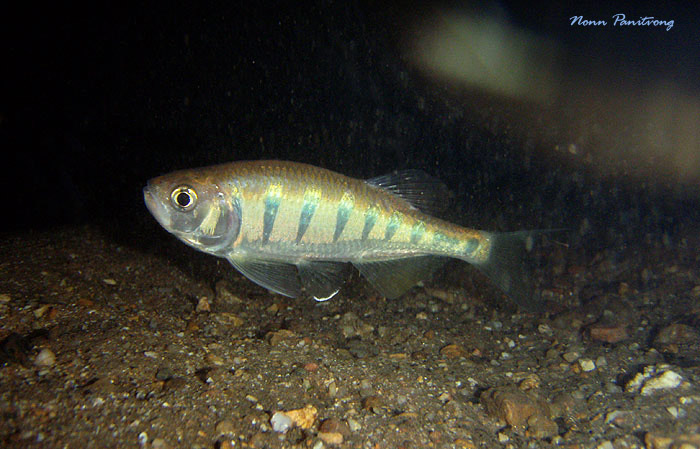
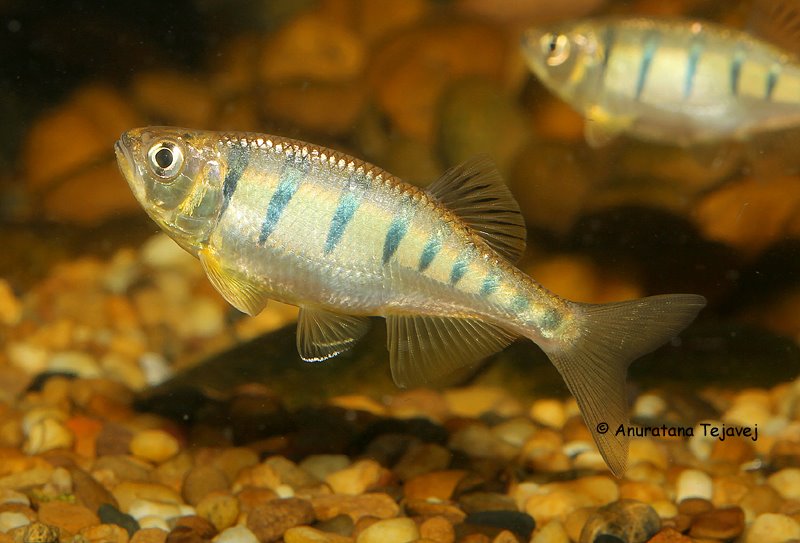
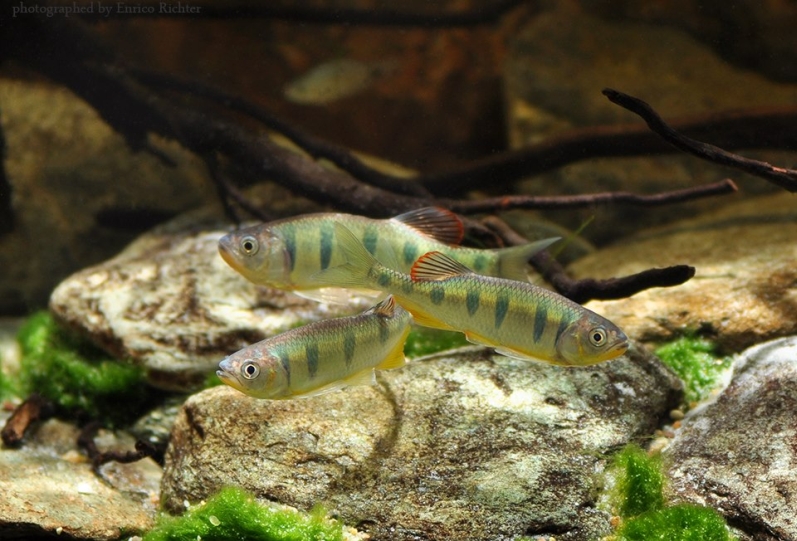
Traded as 'butterfly barb' or 'mackerel barb', Opsarius pulchellus is a cyprinid from the Chao Phraya and mid-to-lower Mekong basins. It occurs in Thailand, Laos, Cambodia and Vietnam, typically in submontane headwaters and fast-flowing minor rivers and streams. Also sold as 'royal opsarius', it carries 7-10 elongate vertical bars on each flank, and like its congeners is too fast and vigorous a feeder for the general community.
Etymology
EditOpsarius: apparently from an Ancient Greek word meaning 'small fish'.
pulchellus: a diminutive of the Latin pulchellus, meaning 'beautiful'.
Distribution
EditOccurs throughout the Chao Phraya river system in central and western Thailand, and the mid-to-lower Mekong basins in Thailand, Laos, Cambodia, and Vietnam with a handful of reports from the upper Mekong in Yunnan province, China.
Type locality is 'Mekang River at Pang Chao, northern Thailand' which is not a misspelling of 'Mekong' but a stream draining the Doi Inthanon (formerly Doi Angka), Thailand's highest mountain, in Chiang Mai province, northern Thailand.
Habitat
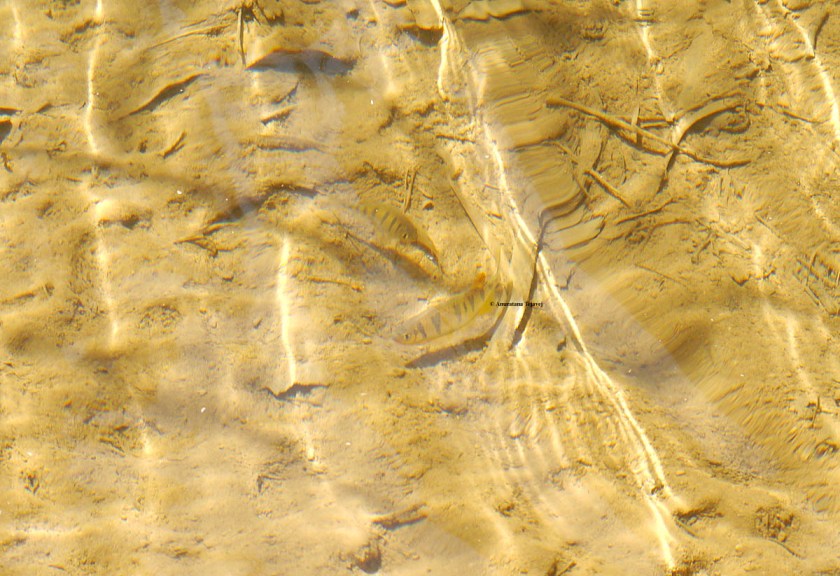
Write a noteEditTypically inhabits submontane headwaters and similar well-oxygenated, low-to-medium gradient, moderate to fast-flowing minor rivers and streams with substrates of gravel, cobbles, larger boulders and exposed bedrock.
It is also found, albeit less frequently, in fast-flowing stretches of larger river channels.
Aquarium size
Write a noteEditRequires a large aquarium with minimum surface area of 120 ∗ 45 cm48 ∗ 18 in or equivalent.
Maintenance
Write a noteEditThe aquarium should ideally be designed to resemble a flowing stream or river with a substrate of variably-sized rocks, sand, fine gravel, and some larger water-worn boulders. This can be further furnished with driftwood roots and branches if you wish but be sure to leave plenty of open swimming space.
While the majority of aquatic plants will fail to thrive in such surroundings hardy genera such as Microsorum, Bolbitis, or Anubias spp. can be grown attached to the décor.
This species is intolerant to the accumulation of organic wastes and requires spotless water at all times in order to thrive. It also does best if there is a high proportion of dissolved oxygen and moderate degree of water movement meaning external filters, powerheads, airstones, etc., should be employed as necessary.
As stable water conditions are obligatory for its well-being this fish should never be added to biologically-immature aquaria, and weekly water changes of 30-50% aquarium volume should be considered mandatory. A tightly-fitting cover is also essential as Opsarius spp. are prodigious jumpers.
Water conditions
EditThese recommendations come from this profile’s own figures. They contain affiliate links, so we may earn a commission.
Diet
Write a noteEditOpsarius spp. are predominantly surface-feeders preying on aquatic and terrestrial insects in nature, with some small fishes and benthic invertebrates probably taken as well.
In the aquarium good quality dried products can be offered but should be supplemented with regular meals of live and frozen fare such as chironomid larvae (bloodworm), Artemia, chopped earthworms, etc. Drosophila fruit flies and small crickets are also suitable provided they are gut-loaded prior to use.
Behaviour and compatibility
Write a noteEditUnsuitable for the general community due to its environmental requirements, and likely to outcompete or intimidate slow-moving and less bold species at meal times since it is an extremely fast swimmer and vigorous feeder. Much smaller fishes should also be omitted as they may be predated upon.
The best tankmates are similarly-sized, robust, pelagic cyprinids such as Dawkinsia, Barilius or larger Devario and Rasbora spp. while bottom-dwellers could consist of Garra, Crossocheilus, Botia and Schistura spp., for example. Many characids and loricariid catfishes should also work well, but be sure to perform thorough research before purchase.
Although gregarious by nature this is a shoaling rather than schooling species which develops a distinct pecking order and therefore should always be maintained in a group of five or more individuals. If only two or three are purchased the subdominant fish may be bullied incessantly whereas solitary specimens may become aggressive towards similar-looking species
Sexual dimorphism
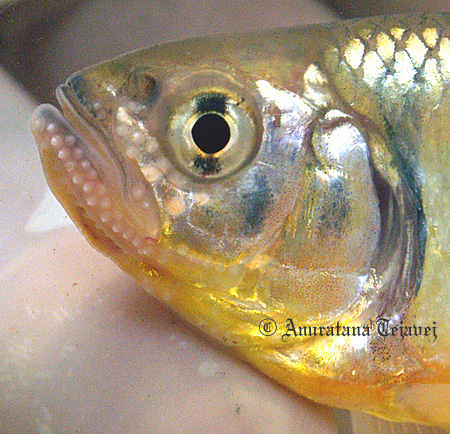
Write a noteEditMature males develop extended pectoral, dorsal, and anal fins and nuptial individuals possess visible breeding tubercules on the head and body, plus bright yellow-orange pigmentation in the lower portion of the body.
Adult females are less-brightly-coloured, tend to grow a little larger and are thicker-bodied than males, especially when gravid.
Reproduction
Write a noteEditUnreported.
Notes
EditThis species is traded for aquaria under various names including 'butterfly barb', 'mackerel barb', 'green-barred danio', or 'royal opsarius'.
It can be told apart from other members of the genus by the following combination of characters: 37-43 lateral line scales; 21-25 predorsal scales; 7-10 elongate vertical bars on each flank, becoming more circular in the posterior portion of the body.
The generic placement of species currently referred to Opsarius has been open to question since Howes (1980) concluded that the Barilius grouping, within which they were included at the time, was not monophyletic and identified two separate lineages. The first group contained B. barila, the type species, plus B. bendelisis, B. radiolatus, B. vagra, and B. shacra, while the second included all other species, and initially these were referred to the subdivisions 'group i' and 'group ii' within Barilius itself.
The composition of these groups is confusing since in a later work Howes (1983) included B. evezardi and B. modestus in 'group i' whilst omitting B. bendelisis, B. radiolatus, and B. shacra without explicitly stating why.
Rainboth (1991) assigned the members of Howe's 'group ii' to the revalidated generic name Opsarius based on the fact it was the oldest available with 'group i' species retaining the name Barilius due to the presence of the type species.
This system has been followed by some subsequent authors, e.g., Tang et al. (2010) and Collins et al. (2012) but not gain wider usage until Kottelat (2013), who included all former Barilius from Southeast Asia in Opsarius.
References
- Collins R. A., K. F. Armstrong, R. Meier, Y. Yi, S. D. J. Brown, R. H. Cruickshank, S. Keeling, and C. Johnston (2012). Barcoding and border biosecurity: identifying cyprinid fishes in the aquarium trade. PLoS ONE 7(1), e28381
- Tang, K. L., M. K. Agnew, W. J. Chen., M. V. Hirt, T. Sado, L. M. Schneider, J. Freyhof, Z. Sulaiman, E. Swartz, C. Vidthayanon, M. Miya, K. Saitoh, A. M. Simons, R. M. Wood and R. L. Mayden (2010). Systematics of the subfamily Danioninae (Teleostei: Cypriniformes: Cyprinidae). Molecular Phylogenetics and Evolution 57(1), 189-214
- Liao, T-Y, S. O. Kullander, and F. Fang (2011). Phylogenetic position of rasborin cyprinids and monophyly of major lineages among the Danioninae, based on morphological characters (Cypriniformes: Cyprinidae). Journal of Zoological Systematics and Evolutionary Research 49(3), 224-232
- Howes, G. J. (1980). The anatomy, phylogeny and classification of bariliine cyprinid fishes. Bulletin of the British Museum (Natural History) : Zoology series 37(3), 129-198
- Nath, P., D. Dam, and A. Kumar (2010). A New Fish Species of the Genus Barilius (Cyprinidae: Rasborinae) from River Siang, D'Ering Memorial Wildlife Sanctuary, Arunachal Pradesh, India. Records of the Zoological Survey of India 110(3), 19-33doi.org/10.26515/rzsi/v110/i3/2010/158930
- Smith, H. M. (1931). Descriptions of new genera and species of Siamese fishes. Proceedings of the United States National Museum 79(2873), 1-48
- Kottelat, M. (1998). Fishes of the Nam Theun and Xe Bangfai basins, Laos, with diagnoses of twenty-two new species (Teleostei: Cyprinidae, Balitoridae, Cobitidae, Coiidae and Odontobutidae). Ichthyological Exploration of Freshwaters 9(1), 1-128
- Kottelat, M. (2001). Fishes of Laos. WHT Publications, Colombo, 1-198
- Kottelat, M. (2013). The fishes of the inland waters of southeast Asia: a catalogue and core bibiography of the fishes known to occur in freshwaters, mangroves and estuaries. The Raffles Bulletin of Zoology Supplement 27, 1-663
Species images · 9
These photographs are used with each photographer's permission.
Send a photograph