Results for “base”
Type a name: scientific, common, or one a species used to go by. Or narrow the catalogue with the filters.
Filters
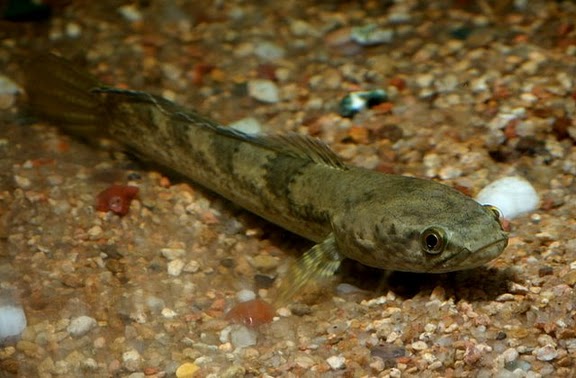
Channa sp. 'five stripe'
authority not recorded
Max lengthnot recordedTank90 × 30cm36 × 12inTemp15–28°C59–82°FpH6.0–8.0Based on its colour pattern and limited details regarding its natural habitat this species may be adapted to dwelling between and under rocks. Alipurduar lies in the moist tropical region of floodplains and foothills of the eastern Himalayas commonly referred to as the Dooars or Duars, traditionally considered the gateway to Bhutan.
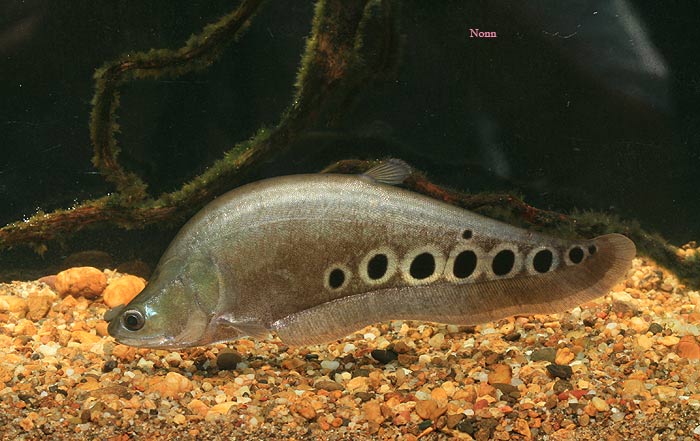
Chitala ornataClown Featherback
Gray, 1831
Max length1000mm SL39in SLTanknot recordedTemp20–28°C68–82°FpH6.0–8.0This species is also referred to as 'clown knifefish' in the aquarium trade. It arguably has no place in the ornamental hobby given its adult size and specialised requirements but remains inexplicably popular and an albino form has even been line-bred for the purpose. It can be distinguished from all congeners by presence of one or more rows of large ocellated spots above the base of the anal-fin, but...
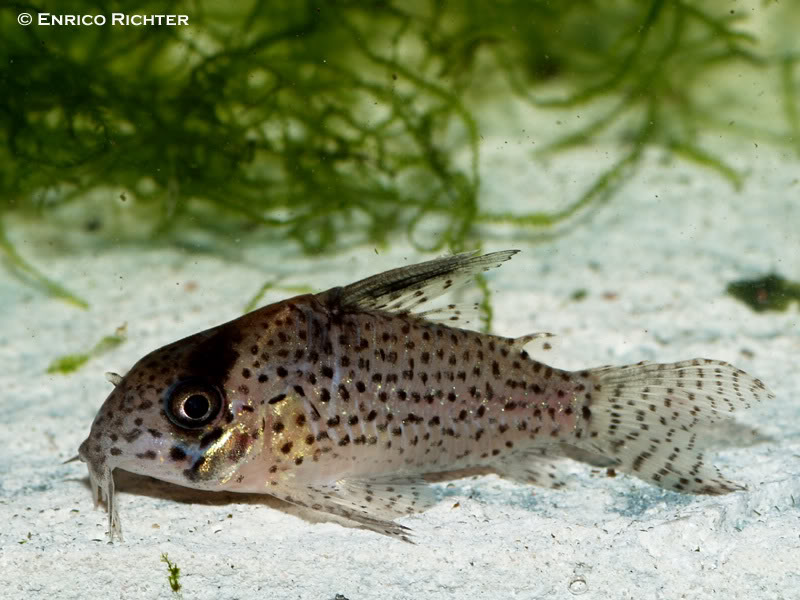
Corydoras kaneiC026
Grant, 1998
Max length50mm SL2.0in SLTank90 × 30cm36 × 12inTemp20–26°C68–79°FpH5.5–7.5Prior to description C. kanei was assigned the 'C' numbers C026 and C046. Among congeners it is most easily-confused with, and sometimes traded as, C. atropersonatus, but can be identified by presence (vs. absence in C. atropersonatus) of dark markings in the anal and caudal fins, presence of numerous, smaller (vs. fewer, larger) dark spots on the body, and an overall darker (vs. paler) base colouration.
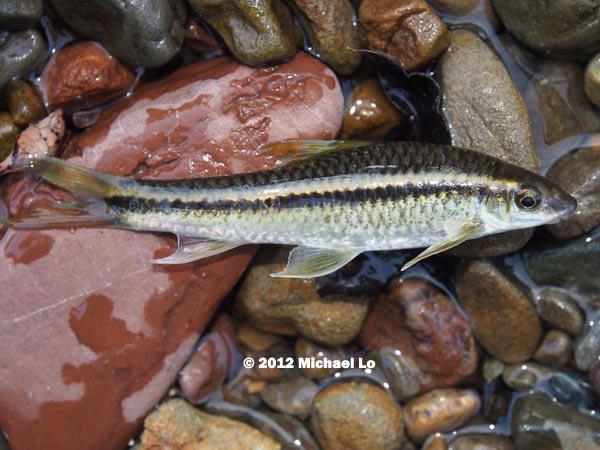
Crossocheilus cobitis
Bleeker, 1854
Max length52mm SL2.0in SLTank100 × 30cm39 × 12inTemp20–26°C68–79°FpHnot recordedGiven its wide natural range it seems logical that this species is or has been available in the aquarium trade, although its correct name may never have been applied. It is told apart from congeners by the following combination of characters: two pairs of barbels; a continuous midlateral stripe from the tip of the snout to the base of the caudal-fin, with a conspicuous small blotch at the posterior extremity, faintly marked on the caudal-fin; a faint mark between the anus and the anal-fin origin in juveniles; a narrow mouth.
Crossocheilus elegans
Kottelat & Tan, 2011
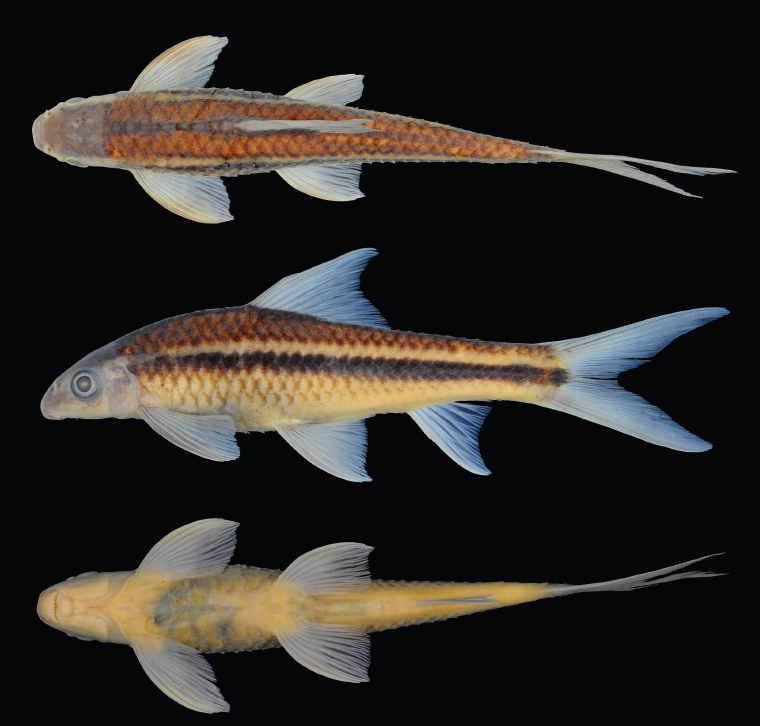
Max length110mm SL4in SLTank150 × 45cm60 × 18inTemp20–25.5°C68–78°FpHnot recordedThis species can be most easily distinguished from other members of the genus by its colour pattern which consists of a blackish midlateral stripe extending from the tip of the gill opening to the middle of the caudal-fin base, which is separated from the dark brown dorsum by a pale yellowish brown stripe. This differs from the pattern seen in other Crossocheilus species with a black midlateral stripe in which the the dorsum is olive brown and much paler than the midlateral stripe, there is no yellow stripe between the dorsum and the black stripe, and the black stripe extends to the tip of the snout.
Cyclocheilichthys armatus
Valenciennes, 1842
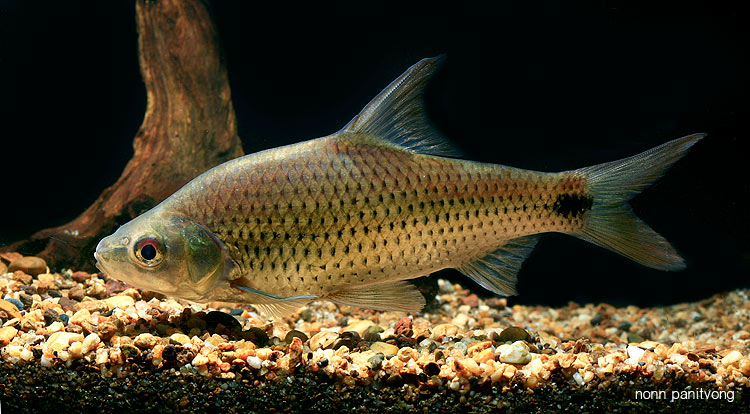
Max length230mm SL9in SLTank180 × 60cm72 × 24inTemp20–26°C68–79°FpH6.0–8.0It can be distinguished from congeners by possessing one or two pairs of barbels, a black blotch at the base of the caudal-fin, and rows of dark spots along the lateral scale rows. Members of Cyclocheilichthys are characterised by possessing a serrated dorsal fin spine, 9 branched pelvic fin rays, a conical snout, small, subterminal...
Cyclocheilichthys repasson
Bleeker, 1853
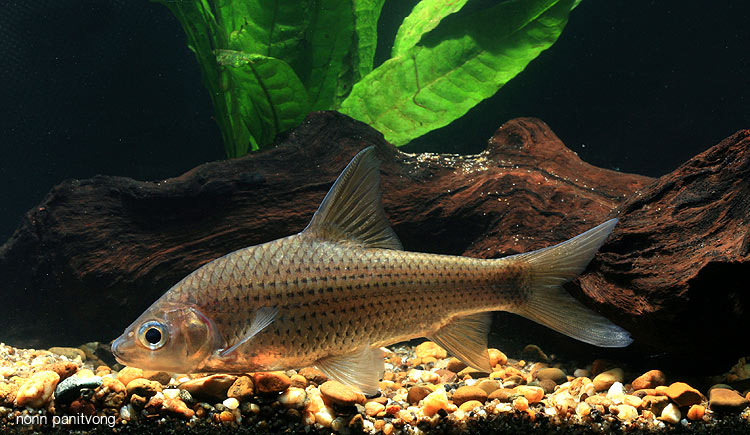
Max length280mm SL11in SLTank180 × 45cm72 × 18inTemp20–26°C68–79°FpH5.0–8.0An ideal resident of the larger, well-furnished community set-up though it might upset slow-moving or timid companions simply by its size. There are plenty of suitable tankmates including many cyprinids, loaches, cichlids, catfish and characins, but as always when selecting a compatible community of fish proper research is essential. A community based around one of its native countries or river basins...
Desmopuntius foerschi
Kottelat, 1982
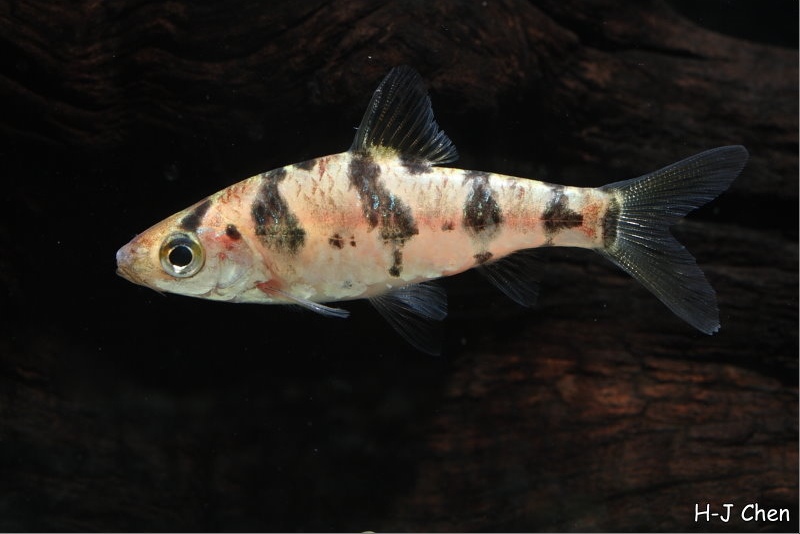
Max length55mm SL2.2in SLTank80 × 30cm31 × 12inTemp20–28°C68–82°FpH5.0–7.0D. foerschi is sometimes traded as 'boomerang barb' or 'Foersch's fire barb' and is included in a group of closely-related, similar-looking fishes which were moved into the new genus Desmopuntius by Kottelat (2013). It can be told apart from other vertically-striped congeners by possession of additional dark blotches between the second, third and fourth vertical bars and a further marking at the posterior base o...
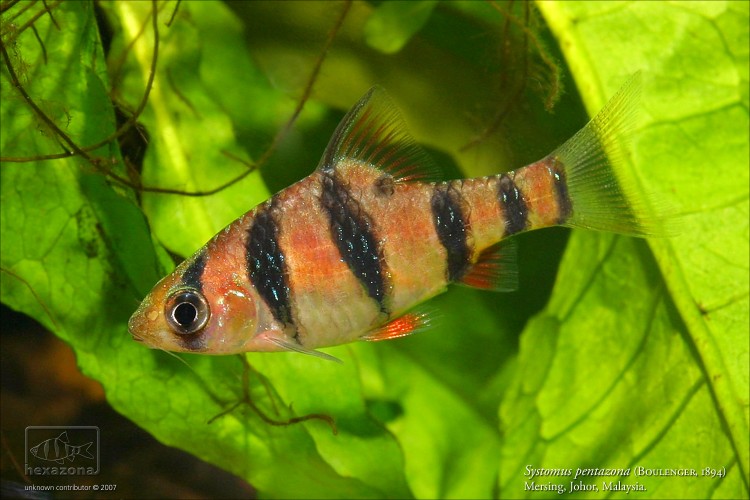
Desmopuntius pentazonaFive-banded Barb
Boulenger, 1894
Max length55mm SL2.2in SLTank80 × 30cm31 × 12inTemp21–26°C70–79°FpH4.0–7.0This species is rare in the aquarium trade with the majority of fish available under the name or the vernacular 'pentazona barb' being the closely-related D. hexazona. The two are almost identical in terms of both appearance and meristics but can be separated by the fact that D. pentazona possesses a small dark marking at the posterior base of the dorsal-fin which is absent in D. hexazona.
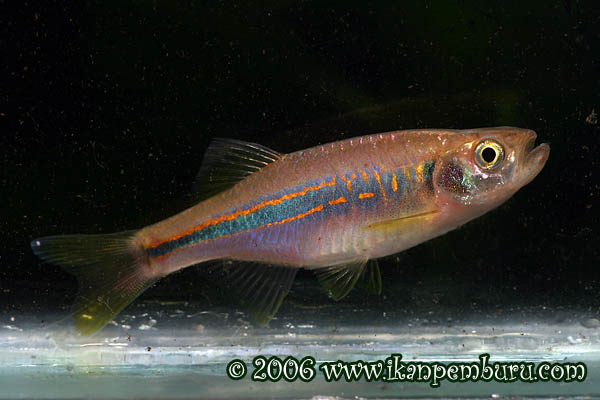
Devario laoensis
Pellegrin & Fang, 1940
Max length65mm SL2.6in SLTank90 × 30cm36 × 12inTemp23–26°C73–79°FpH6.0–7.5It can be further distinguished from other species in the genus by colour pattern consisting of a dark, horizontal P stripe originating around mid-body, where it's relatively faint, this becoming thicker and darker in the posterior portion of the body and terminating at the base of the caudal-fin. Among congeners it's most similar to D. chrysotaeniatus but that species lacks the infraorbital process, has three rows of pharyngeal teeth and the P stripe extends to the end of the caudal-fin rays.
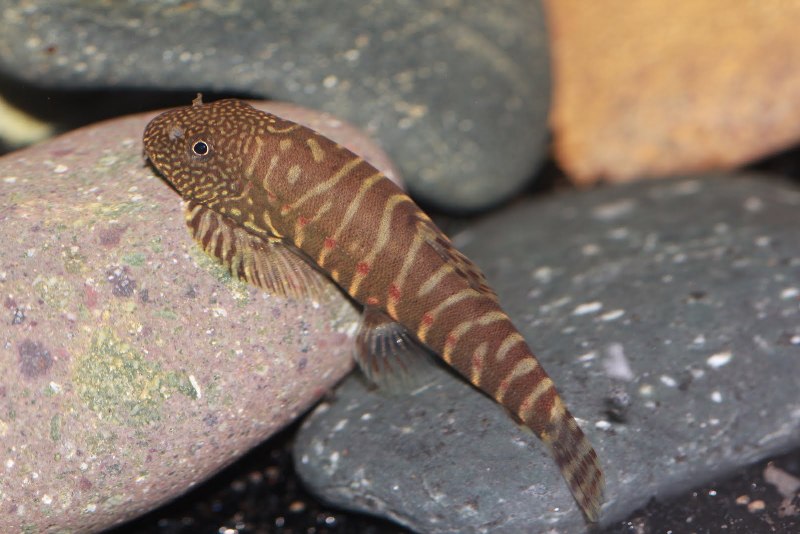
Erromyzon sp. 'ER02'
authority not recorded
Max length50mm SL2.0in SLTank60 × 30cm24 × 12inTemp18–24°C64–75°FpH6.5–8.0This fish remains in need of identification, and we've chosen to list unidentified members of the genus using an 'ER' numbering system in the absence of definitive information. It's quite easy to distinguish from congeners since it's the only species known to possess a colour pattern comprising a dark base colour and series of thin, paler vertical bars on the body and similarly-coloured spots on the head.
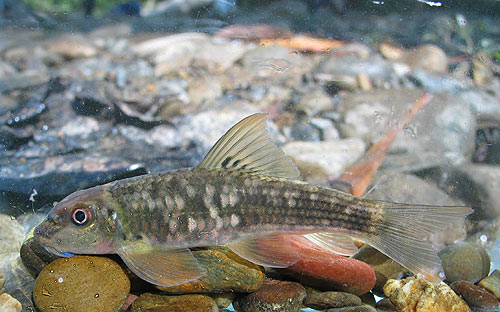
Garra notata
Blyth, 1860
Max length120mm SL5in SLTanknot recordedTempnot recordedpHnot recordedG. notata is one of a number of congeners to lack both a transverse groove and a proboscis on the snout. It also possesses 33-34 lateral line scales and a series of dark spots at the base of the dorsal-fin rays, and lacks scales on the lower portion of the body and abdomen. The genus Garra is a particularly enigmatic grouping with new taxa...
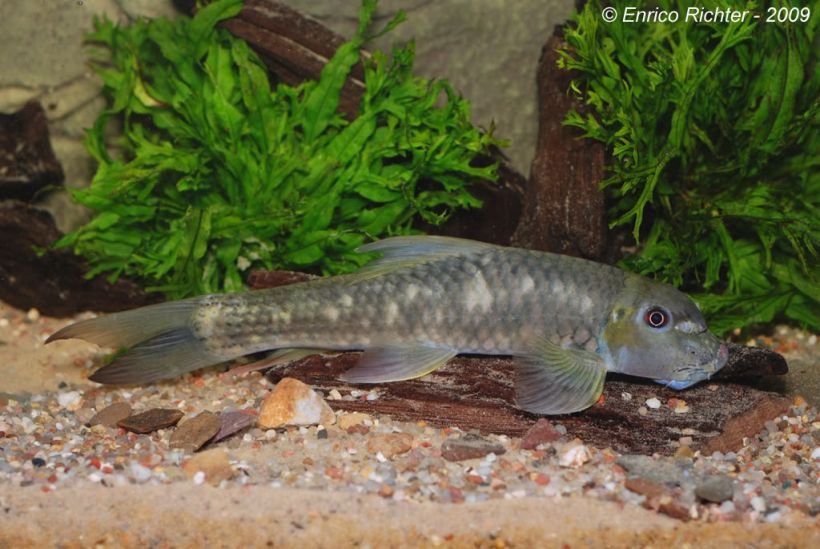
Garra salweenica
Hora & Mukerji, 1934
Max length175mm SL7in SLTanknot recordedTempnot recordedpHnot recordedG. salweenica can be distinguished from other congeners inhabiting the Salween watershed by the following combinatuion of characters: body brownish; presence of a trilobed proboscis on the snout; snout blunt; a series of black spots at the base of the central dorsal-fin rays; presence of longitudinal stripes on the posterior portion of the body; a dark marking at the tip of the upper (and lower in some specimens) caudal-fin lobe; body depth 22.4-25.3 % SL.
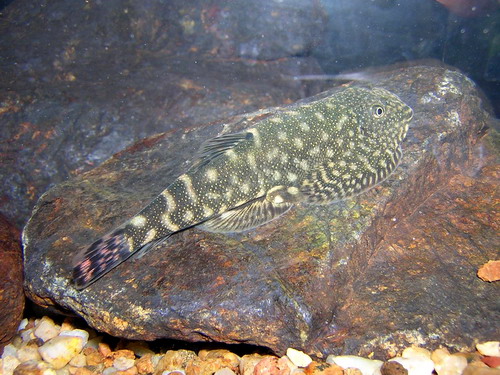
Gastromyzon sp. 'SK01'
authority not recorded
Max length50mm SL2.0in SLTank60 × 30cm24 × 12inTemp20–24°C68–75°FpH6.5–8.0This undescribed species has probably not been seen in the aquarium trade yet but is occasionally maintained private collectors. The 'SK' numbering system used here refers to 'South Kalimantan', home to several unidentified members of the genus. Gastromyzon spp. are placed into various 'species groups' (artificial assemblages of species which may or may not be monophyletic) for ease of reference, and based on colour and patterning G. sp. 'SK01' appears similar to members of the G. ridens group which also includes G. crenastus, G. stellatus and G. zebrinus.
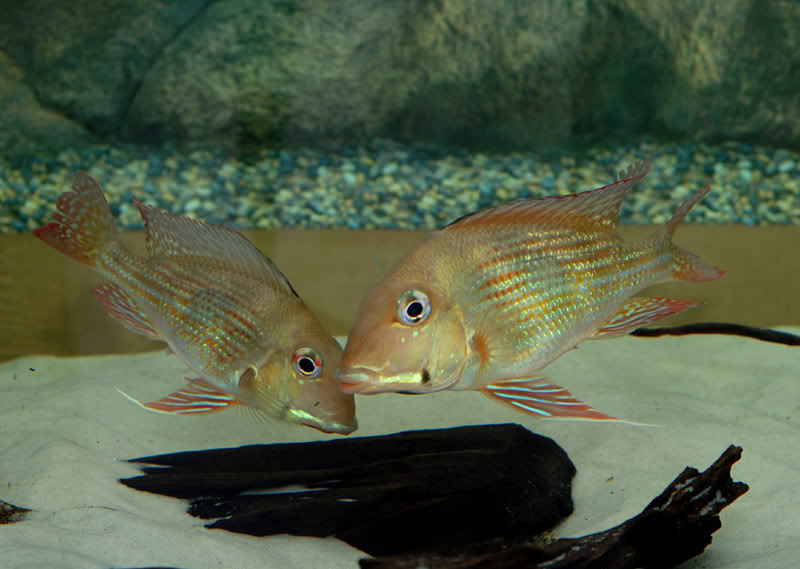
Geophagus brachybranchus
Kullander & Nijssen, 1989
Max length200mm SL8in SLTank180 × 60cm72 × 24inTemp26–30°C79–86°FpH5.0–7.0This species is generally rare in the aquarium hobby though oddly appears to be one of the commoner species in Australia where it's often referred to by the vernacular name 'black-throated eartheater'. It's a member of the nominal G. surinamensis 'group' of closely-related species within the genus and can be identified by a combination of characters including: presence of dark preopercular markings; no vertical bars on the flanks even when stressed/preserved; base of filaments on the first gill arch mostly covered by a flap of skin; exposed part of bra...
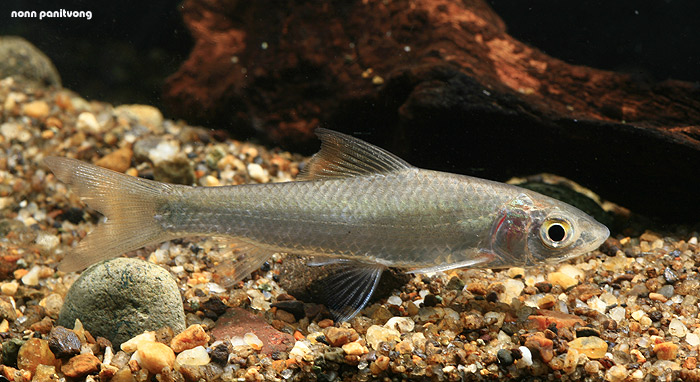
Gymnostomus lobatus
Smith, 1945
Max length150mm SL6in SLTanknot recordedTempnot recordedpHnot recordedG. lobatus can be distinguished from congeners by the following combination of characters: possession of 32-33 + 2-3 lateral line scales; 5½ scale rows between lateral line and base of dorsal-fin; body relatively slender, depth fits 3.7-4.0 times in SL; snout often projecting strongly; body plain silver in colour.
Hemiancistrus sp.Blue Phantom Plec
authority not recorded
Max length180mm SL7in SLTank120 × 30cm48 × 12inTemp22–25°C72–77°FpH6.0–7.0This stunning species must surely rank among the most attractive Loricariids available in the hobby. There are several colour forms available, depending on collection locality. These vary in base colour and in the number, size and positioning of the spots on the body. The true identity of this fish is shrouded in confusion. It may or may not be Hemiancistrus subviridis, also known as the green phantom plec (L200), which it resembles very closely in morphology. The two are also found in diffe...
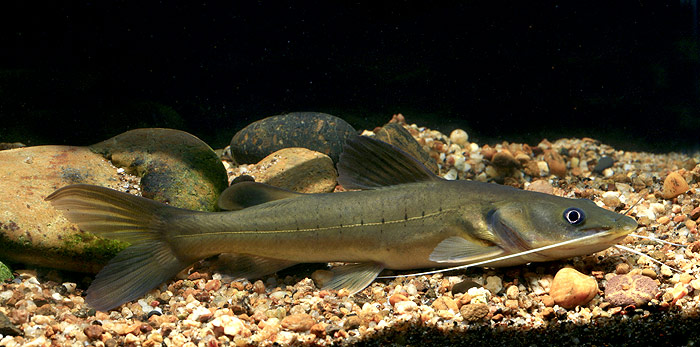
Hemibagrus peguensis
Boulenger, 1894
Max length286mm SL11in SLTanknot recordedTempnot recordedpHnot recordedMembers of this assemblage can be told apart from other congeners by possession of 44–46 vertebrae, an adipose-fin with a relatively short base (< 20 % SL), a colour pattern comprising either distinct black spots arranged in vertical columns or irregular black vertical lines running along the flanks, and normally a reddish or orangish caudal-fin in life.
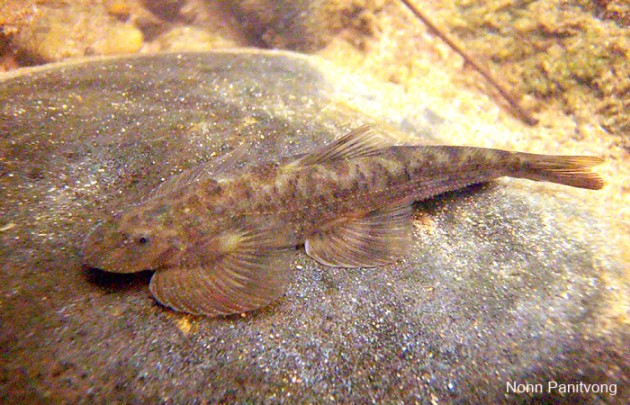
Hemimyzon nanensis
Doi & Kottelat, 1998
Max length57mm SL2.2in SLTank90 × 30cm36 × 12inTemp16–22°C61–72°FpH6.0–8.0Most importantly the water must be clean and well-oxygenated so we suggest the use of an over-sized filter as a minimum requirement. Turnover should ideally be 10-15 times per hour so additional powerheads, airstones, etc. should also be employed as necessary. Base substr...
Heteropneustes fossilisLiver Catfish
authority not recorded
Max length300mm SL12in SLTank120 × 45cm48 × 18inTemp21–25°C70–77°FpH6.0–8.0Also known as the stinging or fossil catfish, H. fossilis is not recommended to the inexperienced due to its venomous nature. The venom is contained in sacs at the base of the pectoral spines. A sting from one of these is very painful indeed, in some very rare cases fatal. It goes without saying that extreme care must be exercised when performing tank maintenance, or if you need to move the fish for any reason. If stung, the wound should be immersed in water as hot as you can stand, as this will...