Heteropneustes fossilis
Liver Catfish
Last revised 2012Edit this page
On this page11 sections
Quick factsEdit
Difficulty6 of 8 measures
- Space
- large tank
- Water
- flexible
- Temp
- needs a steady temperature
- Diet
- unknown
- Temperament
- peaceful
- Social
- needs to be in a group
- Compatibility
- unknown
Other demands
Each of these can raise the rating on its own, whatever the measures above say.
- Hardiness
- hardy
Before you buy
Needs a tight-fitting lid as this species is known to jump
It therefore can and probably will escape given the opportunity.
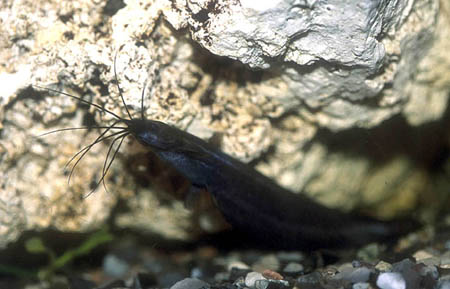
The liver catfish, Heteropneustes fossilis, is a catfish from Iran, Pakistan, India, Nepal, Sri Lanka, Bangladesh, Myanmar and the Andaman Islands. Also known as the stinging or fossil catfish, it carries venom sacs at the base of the pectoral spines and its sting is very painful, so it is not recommended for the inexperienced. Exceptionally hardy and long-lived, it can breathe atmospheric air to a certain extent and survives in sluggish, oxygen-deficient swamps and ditches.
Distribution
EditIts natural range is quite large and covers parts of Iran, Pakistan, India, Nepal, Sri Lanka, Bangladesh, Myanmar and the Andaman Islands.
Habitat
Write a noteEditMost often found in sluggish and sometimes oxygen deficient swamps, ditches and ponds. It's also known to enter rivers and has occasionally been recorded in brackish waters.
Aquarium size
Write a noteEditOne of these would need a tank measuring at least 120 ∗ 45 ∗ 45 cm48 ∗ 18 ∗ 18 in - ~243 litres~64 US gal.
Maintenance
Write a noteEditDoes best in a dimly-lit tank with plenty of hidng places, as well as some open areas for swimming. This can be furnished with smooth rocks, driftwood, lengths of plastic piping etc. Make sure the tank has a very securely-fitting cover, as in nature it is known to actively cross small areas of dry land to find new waters. It therefore can and probably will escape given the opportunity. Filtration should be strong and efficient as it produces a lot of waste.
Water conditions
EditTemperature: 21 – 25 °C70 – 77 °F
pH: 6.0-8.0
Hardness: 5-30°H
These recommendations come from this profile’s own figures. They contain affiliate links, so we may earn a commission.
Diet
Write a noteEditNot difficult to feed. It will take most sinking dried, live and frozen foods. Try to ensure it receives a good proportion of meaty fare such as earthworms, bloodworm, chopped prawns and similar. Once settled, many specimens will come to the surface to feed.
Behaviour and compatibility
Write a noteEditWhile smaller tankmates will undoubtedly be eaten, it's quite peaceful with similarly-sized or larger, active species. Ideal choices are those that inhabit different areas of the tank, such as bigger characins or cyprinids. Other benthic or slow-moving fish present more of a problem, as they may be harassed by its nocturnal activity. Somewhat surprisingly, it's a gregarious fish that's best kept in a small group.
Sexual dimorphism
Write a noteEditMature females tend to be rounder-bodied than males.
Reproduction
Write a noteEditHas been bred in captivity but few details are available. Apparently, it's a substrate-spawner that lays its eggs in a pre-excavated pit. Both parents assume responsibility for guarding and tending to the brood, and continue to care for the fry for some time once they hatch. In some of its native countries, it is bred in large numbers for food on commercial farms, both by natural methods and artifically via the use of hormones.
Notes
EditAlso known as the stinging or fossil catfish, H. fossilis is not recommended to the inexperienced due to its venomous nature. The venom is contained in sacs at the base of the pectoral spines. A sting from one of these is very painful indeed, in some very rare cases fatal. It goes without saying that extreme care must be exercised when performing tank maintenance, or if you need to move the fish for any reason. If stung, the wound should be immersed in water as hot as you can stand, as this will help to denature the proteins in the venom. Medical advice should also be sought.
It's an exceptionally hardy and long-lived species, and can easily survive for 20 years or more when cared for properly. It can breathe atmospheric air to a certain extent, allowing it to survive in some fairly hostile conditions. The swim bladder is modified into an elongated air sac, connected to the gill chamber to assist in this. It also secretes a mucous that helps to slow down the drying out of the skin, and can seal its gills completely. These adaptations mean it can leave the water for short periods of time and move to new areas.
There is some confusion regarding the members of the genus Heteropneustes. While there are currently 4 recognised species, the validity of at least one of these (H. microps) is questionable. Whilst some state the species are distinct, others argue that the only distinguishing characteristics are geography and a feature of the anal fin that may in fact be down to injury rather than genetics.
The species was only moved into the family Clariidae in 2003.
Species images · 2
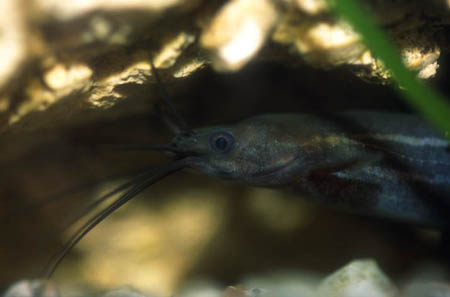
These photographs are used with each photographer's permission.
Send a photographProfile completeness19 of 24
79% complete
Also missing: a recorded distribution, taxonomic authority, etymology.
Community
Questions about Heteropneustes fossilis?
Ask on Discord