Results for “lateral line”
Type a name: scientific, common, or one a species used to go by. Or narrow the catalogue with the filters.
Filters
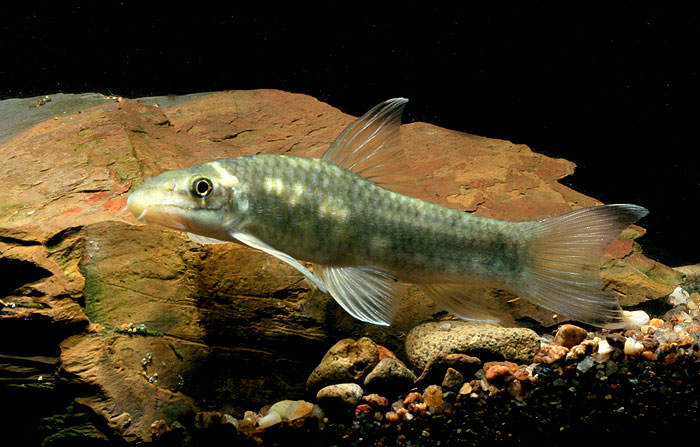
Garra rakhinica
Kullander & Fang, 2004
Max length60mm SL2.4in SLTanknot recordedTempnot recordedpHnot recordedG. rakhinica can be distinguished from other members of the genus by the following combination of characters: rostral furrow shallow and snout tip smoothly rounded; rostral lobe present, proboscis absent; scaled predorsal region, chest, and abdomen; two pairs of barbels; 28 lateral line scales; 16 circumpeduncular scale rows; colour pattern almost uniform greyish on body and caudal-fin; a dark spot immediately posterior to the upper extremity of the...
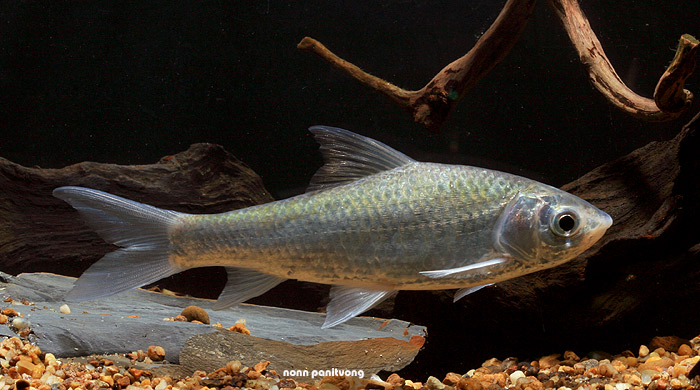
Gymnostomus siamensisSiamese Mud Carp
Sauvage, 1881
Max length150mm SL6in SLTanknot recordedTempnot recordedpHnot recordedG. siamensis can be distinguished from congeners by the following combination of characters: possession of 5½ lateral line scales; body relatively deep, depth fits 3.2-3.4 times in SL; head large and broad, width fits 5.5-6.7 times in SL; snout not or only weakly projecting; body plain silver in colour with no dark marking on caudal peduncle.
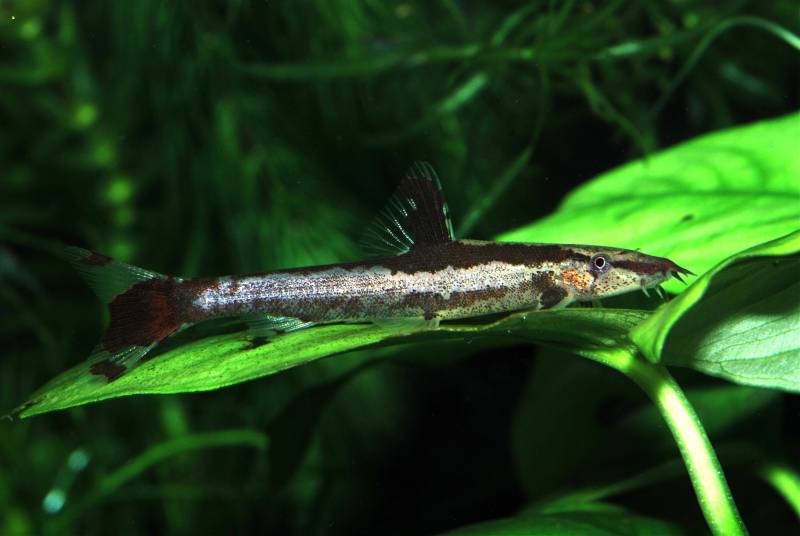
Homaloptera bilineata
Blyth, 1860
Max length100mm SL3.9in SLTank120 × 30cm48 × 12inTemp20–25.5°C68–78°FpH6.0–7.5This rarely-traded species is a member of the H. ocellata 'group' of closely-related congeners, an assemblage which currently comprises H. ocellata, H. bilineata, H. confuzona, H. orthogoniata, H. ogilviei and H. parclitella. Following Tan and Ng (2005) these share possession of a colour pattern with reddish tints and dark brown head markings, elongate head, slightly compressed body, 61-77 lateral line scales and dorsal-fin origin placed in advance of pelvic-fin origin.
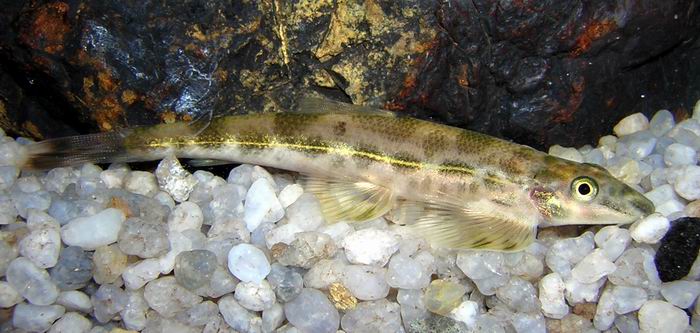
Homalopteroides stephensoni
Hora, 1932
Max length65mm SL2.6in SLTank60 × 30cm24 × 12inTemp20–25.5°C68–78°FpH6.0–7.5Tan (2009) redescribed H. stephensoni and it possesses the following unique character set: sub-inferior mouth with thin barbels; five principle, 12-13 secondary pectoral fin rays (usually 12); scaleless belly; pattern of keeled scales on anterior, dorsal portion of body consisting of a single central keel in the posterior third of each scale; 43-50 lateral line...
Horadandia atukorali
Deraniyagala, 1943
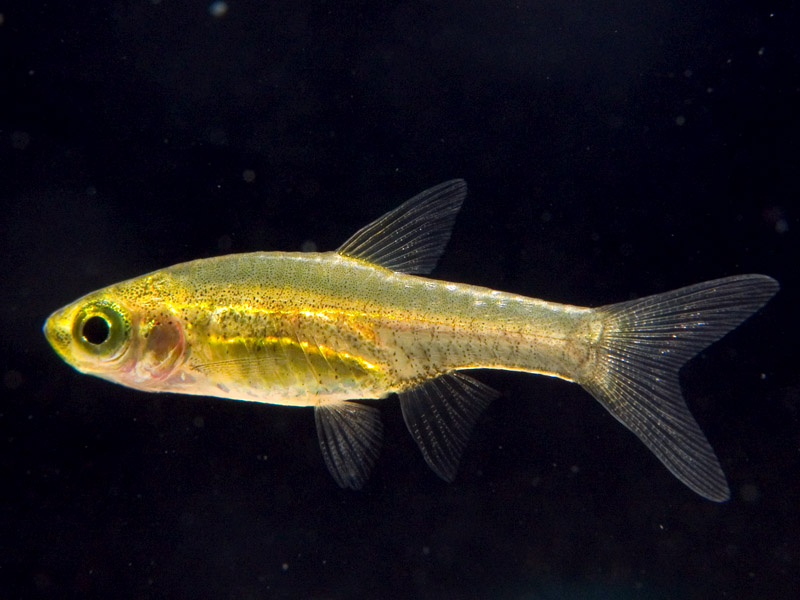
Max length30mm SL1.2in SLTank45 × 30cm18 × 12inTemp20–26°C68–79°FpH5.5–7.5The genus is monotypic and distinguished from other cyprinid taxa by a combination of a moderately compressed, elongated body with two rows of teeth on the lower pharyngeal (throat) bone and lacking barbles, visible lateral line and a symphyseal knob on the lower jaw (Talwar & Jhingran, 1991). Its small adult size evolved via a process known as miniaturisation characterised by sexually mature adults with a significantly reduced size of less than 20 mm SL. Among bony fishes cyprinids are one of the few groups in which this phenomenon occurs repeatedly...
'Inlecypris' shanensis
Hora, 1928
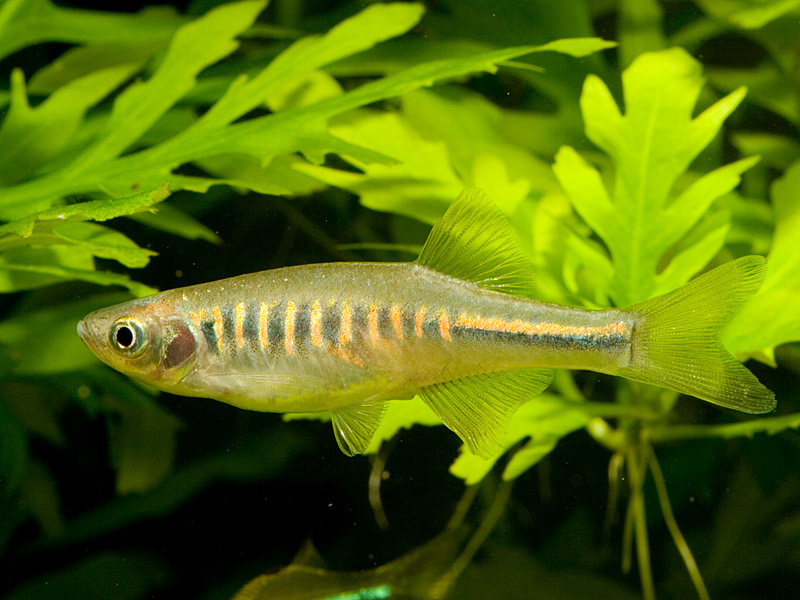
Max length60mm SL2.4in SLTank80 × 30cm31 × 12inTemp18–26°C64–79°FpH6.0–8.0This species is sometimes referred to as 'Hora danio' or Salween danio'. It is distinguished from similar-looking species by a combination of characters as follows: lateral line complete or incomplete with 22-33 pored scales; absence of infraorbital process; 7 branched dorsal-fin rays; usually 10 or 11 branched anal-fin rays; barbels absent or rudimentary; flank markings comprising a series of narrow vertical bars on the anterior portion of each flank, fol...
Luciosoma bleekeri
Steindachner, 1878
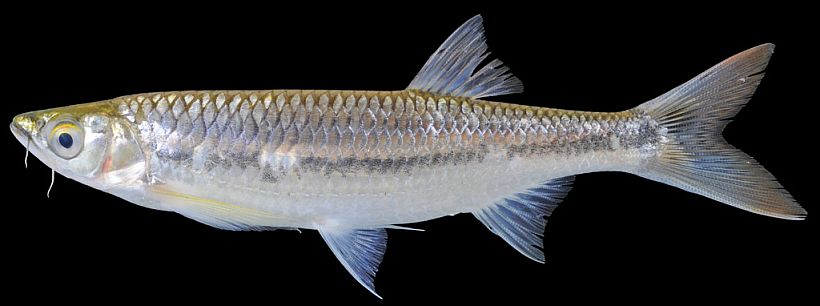
Max length210mm SL8in SLTank240 × 60cm96 × 24inTemp20–26°C68–79°FpH6.0–8.0L. bleekeri is most-easily distinguished from the congener L. setigerum, with which it is frequently confused, by absence (vs. presence) of a series of black spots on the lateral line scales.
Micronemacheilus cruciatus
Rendahl, 1944
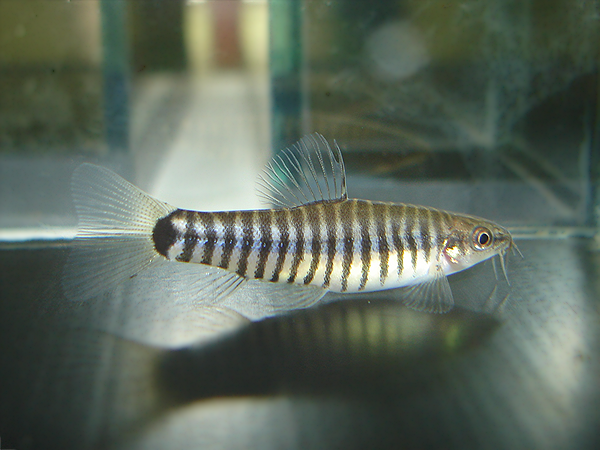
Max length40mm SL1.6in SLTank60 × 30cm24 × 12inTemp22–27°C72–81°FpH6.0–7.5This species is traded under various names including 'Vietnamese multi-banded zebra loach', 'hovering zebra loach', 'Laos pygmy multi-stripe loach', and 'banded dwarf loach'. It can be distinguished from related species by the following combination of characters: body with distinct vertical bars; 8 branched dorsal-fin rays; 3-10 pored lateral line scales; one pair of large papillae in median portion of upper lip; two pairs of large papillae in median portion of lower lip; lower posterior edge of opercle with 3-4 prominent indentations.
Mogurnda adspersaSouthern Purple Spotted Gudgeon
authority not recorded
Max length140mm SL6in SLTank120 × 30cm48 × 12inTemp16–24°C61–75°FpH7.0–7.5This species is considered endangered across its native range, but has recently begun to appear in the hobby a little more often as a result of commercial farming. It's still by no means common though. Superficially it looks very similar to the much commoner Northern purple spotted gudgeon (Mogurnda mogurnda), but can be distinguished by the presence of only 30-36 scales along its lateral line, (as opposed to 37-48 in M. mogurnda), and a higher degree of red spotting in the second dorsal fi...
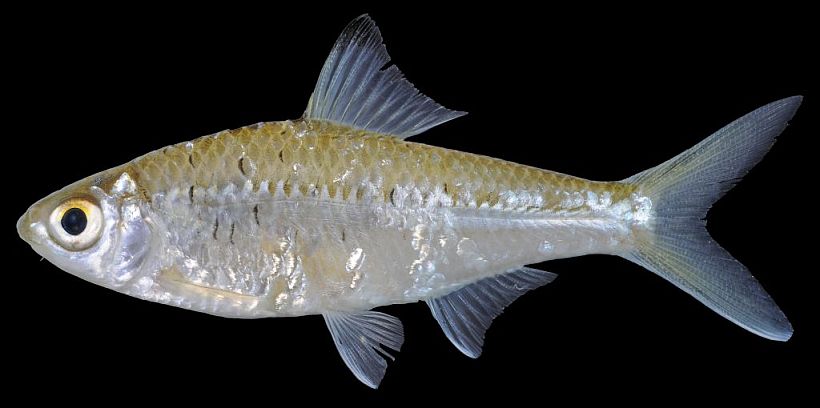
Mystacoleucus lepturus
Huang, 1979
Max length95mm SL3.7in SLTanknot recordedTempnot recordedpHnot recordedThis species can be distinguished from congeners by the following combination of characters: body relatively slender, depth fitting 3.4-3.8 times in SL; 32-33 + 2 lateral line scales; 14 circumpeduncular scale rows; presence of a single pair of barbels; black distal margin on dorsal-fin; numerous body scales with dark, crescent-shaped markings.
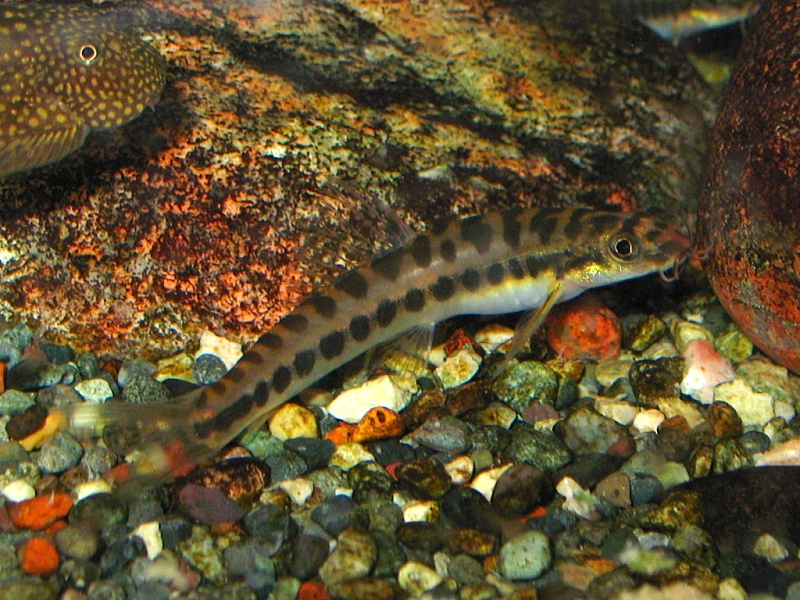
Nemacheilus masyaeArrow Loach
Smith, 1933
Max length70mm SL2.8in SLTank60 × 30cm24 × 12inTemp23–26°C73–79°FpH6.0–7.5This species was originally named Nemacheilus masyae but following ICZN rules the spelling was later corrected to N. masyai because it's named after a man. It can be distinguished from the majority of congeners by body patterning comprising 14-18 short, dark vertical bars on each flank, 12-17 saddle-like markings running along the dorsal surface, a dark spot on the caudal peduncle at the termination of the lateral line and a dark blotch in the lower half of the first few dorsal-fin rays.
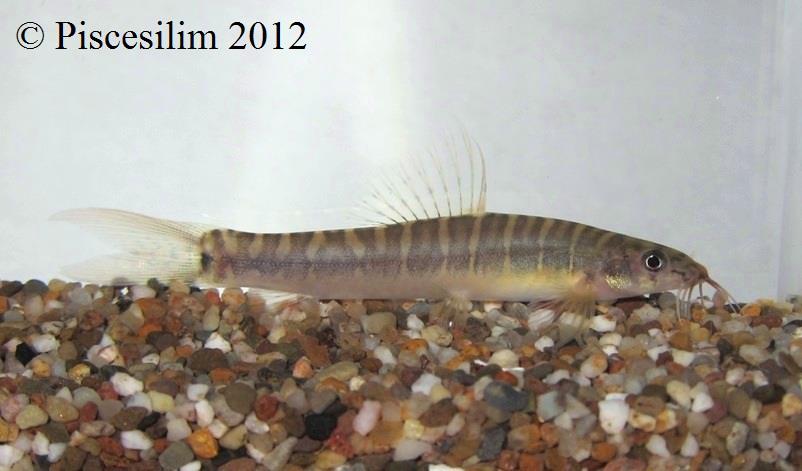
Nemacheilus selangoricus
Duncker, 1904
Max length60mm SL2.4in SLTank60 × 30cm24 × 12inTemp20–25°C68–77°FpH5.0–7.5N. selangoricus is most similar to N. spiniferus since it possesses acuminate scales above and below the lateral line on the caudal peduncle, a feature not shared with any other congener. It can however be distinguished by the following characters: presence of 8-12 very regular dark bars on flanks (vs. 10-13 irregularly-shaped bars in N. spiniferus), 3-5 times...
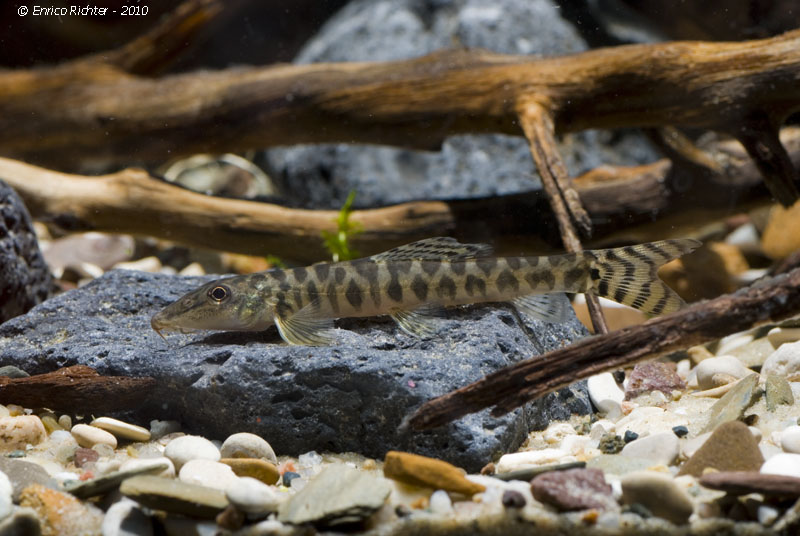
Nemachilichthys rueppelli
Sykes, 1839
Max length85mm SL3.3in SLTank90 × 30cm36 × 12inTemp20–25°C68–77°FpH7.0–7.5This species is frequently misidentified as Nemachilichthys rueppelli (Sykes, 1839) but that species was described from close to Pune in Maharashtra state, well over 500 km north of Shimoga. Further, in his description of N. rueppeli Sykes states that the body colour is 'greenish yellow' and 'the lateral line marked with short dark bars'. Narayan Rao described the colour pattern of...
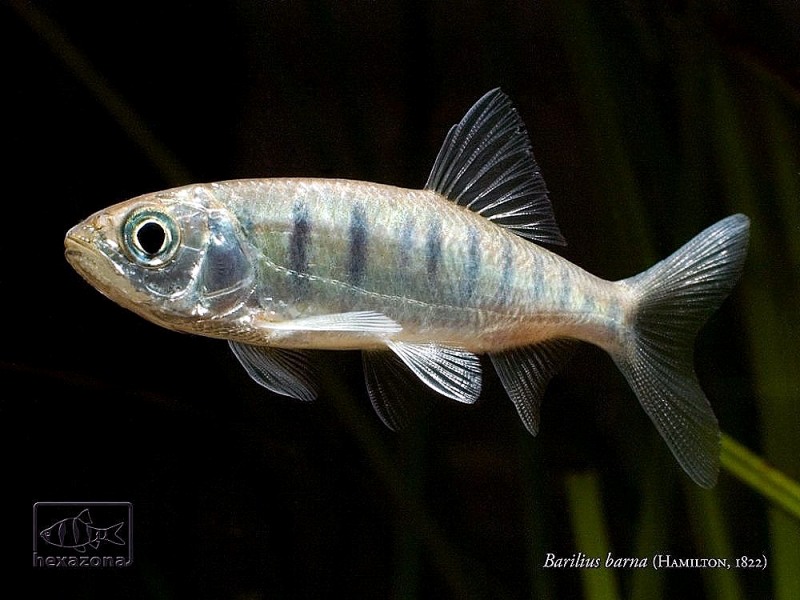
Opsarius barna
Hamilton, 1822
Max length130mm SL5in SLTank150 × 60cm60 × 24inTemp16–24°C61–75°FpH6.0–8.0This species occasionally appears in the ornamental trade, usually as 'striped hill trout' or 'banded hill trout'. It can be distinguished from congeners by the following combination of characters: lateral line complete with 40-42 scales; barbels absent; 10-13 anal-fin rays; body with 9-11 dark blue vertical bars; last dorsal-fin ray extending to caudal-fin base.
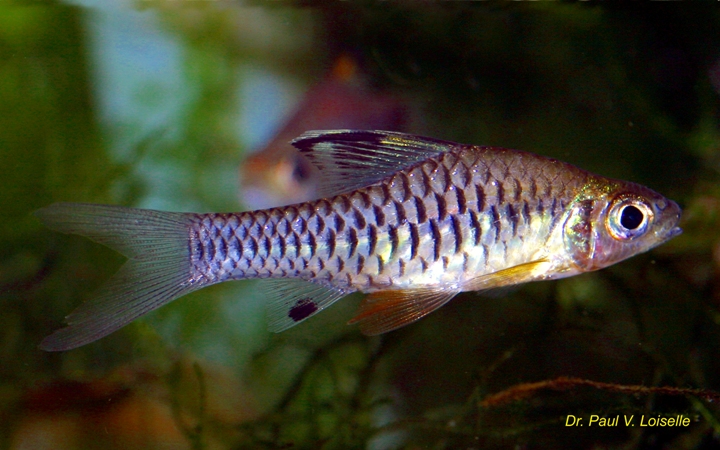
Oreichthys cosuatis
Hamilton, 1822
Max length43mm SL1.7in SLTank60 × 30cm24 × 12inTemp24–28°C75–82°FpH6.5–7.5An assortment of undescribed Oreichthys spp. from India, Myanmar and Thailand are currently traded as O. cosuatis. It can be distinguished from other described members of the genus by lacking a black blotch on the caudal peduncle, plus the following combination of characters: 2-3 perforated scales in lateral line; ½6½ between pelvic-fin origin and dorsal midline; presence of dark stripe in centre of anal-fin, forming a triangular blotch in adult individuals; dorsal-fin with whitish tip and broad, black, subdistal margin in the upper portion of the fin; 11-13 rows...
Oxydoras nigerRipsaw Catfish
authority not recorded
Max length900mm SL35in SLTank240 × 60cm96 × 24inTempnot recordedpH6.0–7.0Previously referred to a Pseudodoras niger, the Ripsaw Cat is a fish only for the experienced fishkeeper due to its large adult size. Although a visually stunning fish, realistically, it is best suited to public aquaria. Much more peaceful than its common name suggests, which it gets from the spines that run down the lateral line of the fish. This fish is becoming more readily available to the hobby and prices are also falling, meaning that many fishkeepers are being tempted into buying a fis...
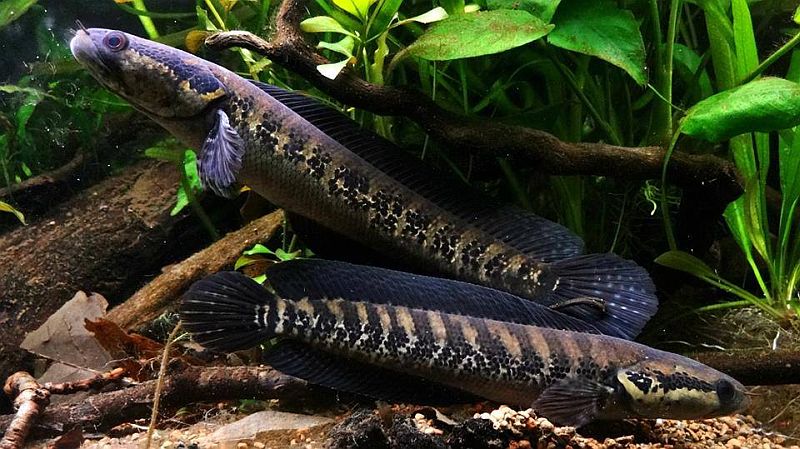
Parachanna africana
Steindachner, 1879
Max length300mm SL12in SLTank120 × 60cm48 × 24inTemp20–25°C68–77°FpH5.0–7.5Following Bonou and Teugels (1985), P. africana can be distinguished from congeners by the following combination of characters: colour pattern unique, comprising a series of 8-11 dark, chevron-shaped markings extending along the body posterior to the pectoral fins; 19-24 scales in the transverse series; lateral line complete with 73-83 pored scales; 45-48 dorsal-fin rays 45-48; 32-35 anal-fin rays.
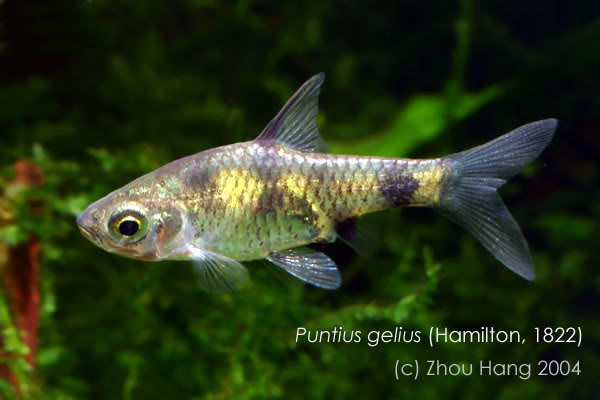
Pethia aurea
Knight, 2013
Max length25mm SL1.0in SLTank45 × 30cm18 × 12inTemp18–24°C64–75°FpH6.0–7.0This species was considered to be a phenotype of the similar-looking P. gelius prior to its description. Following Knight (2013) it is included a group of closely-related species alongside P. gelius and P. canius, the trio being distinguished from other members of the genus Pethia by the following combination of characters: lateral line incomplete with 3-4 por...
Pethia phutunioDwarf Barb
Hamilton, 1822
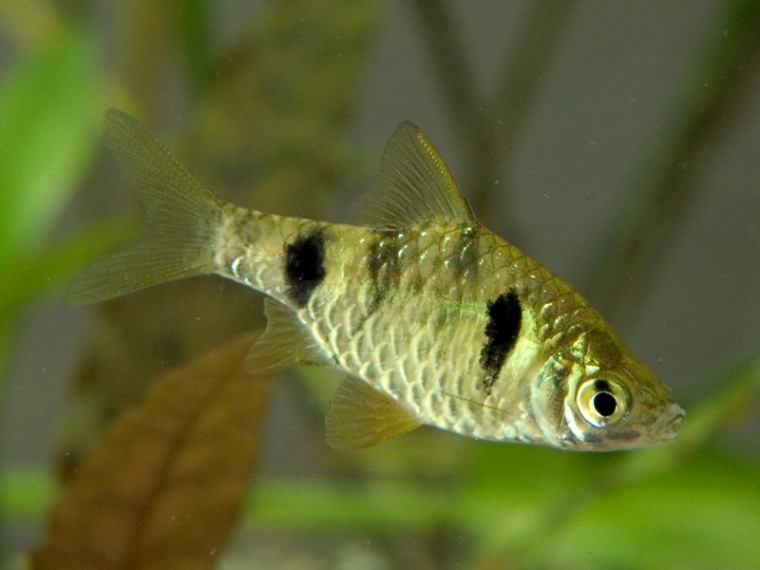
Max length30mm SL1.2in SLTank60 × 30cm24 × 12inTemp21–26°C70–79°FpH6.0–7.0In P. phutonio the flank markings comprise two black, vertically-orientated blotches, one posterior to the operculum and the other on the caudal peduncle, and within the P. conchonius group this patterning is shared with P. bandula, P. cumingii, P. didi, P. meingangbii, P. padamya, and P. tiantian. It can be told apart from these by the following combination of characters: smaller adult size of 25 - 30 mm vs. at least 35 - 40 mm; minute maxillary barbels; incomplete lateral line with ab...
Pethia stoliczkana
Day, 1871
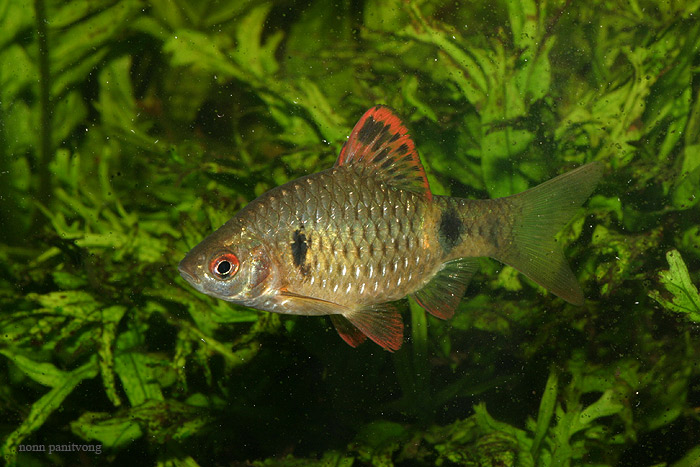
Max length50mm SL2.0in SLTank75 × 30cm30 × 12inTemp18–26°C64–79°FpH6.0–7.5This species is confused with P. ticto in much of the available literature and is sometimes listed as a synonym of it. Although some populations of the two species possess a similar colour pattern (there are reports of a P. ticto variant from the south of West Bengal state in India with a red, black-flecked dorsal-fin, for example) they do not occur in the same waters in nature and can be distinguished by examining the lateral line. This is complete in...