Mystacoleucus lepturus
Last revised 2017Edit this page
On this page6 sections
Quick factsEdit
Difficulty3 of 8 measures
- Space
- medium tank
- Water
- unknown
- Temp
- unknown
- Diet
- unknown
- Temperament
- unknown
- Social
- needs to be in a group
- Compatibility
- fine with others
Other demands
Each of these can raise the rating on its own, whatever the measures above say.
- Hardiness
- unknown
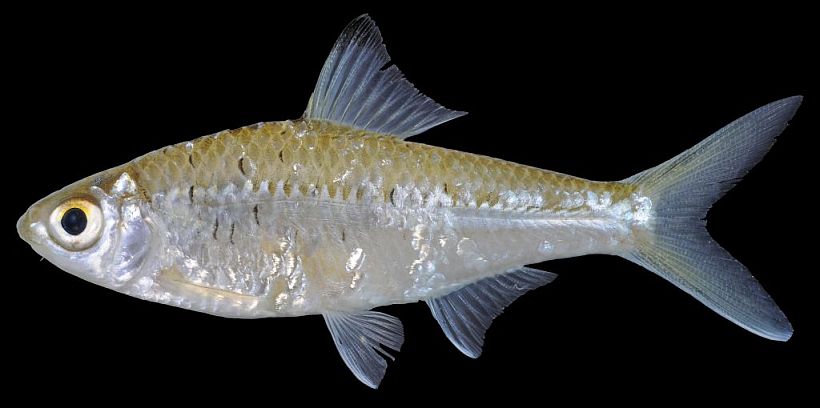
Mystacoleucus lepturus is a riverine cyprinid known only from the upper Mekong basin in southern China, Laos and Thailand. It favours clear, well-oxygenated running water over sand or gravel. The body is relatively slender, with a black margin on the dorsal fin and many crescent-marked scales. Records from Vietnam and Hainan Island refer to other species. Like all Mystacoleucus it has a forward-pointing predorsal spine that can snag in a net.
Etymology
EditMystacoleucus: from the Ancient Greek μύσταξ (mústaks), meaning 'upper lip, moustache', and the generic name Leuciscina, which is not currently in use.
lepturus: from the Ancient Greek λεπτός (leptós), meaning 'slender, thin', and οὐρά (ourá), meaning ‘tail’, presumably in reference to this species' relatively slender caudal peduncle.
Distribution
EditKnown only from the upper Mekong River basin in southern China (where the river is known as Lancang Jiang), Laos, and Thailand. Records from Vietnam and Hainan Island are incorrect and refer to other species.
Type locality is 'Tributary of Lancang Jiang, Mengna (Mengla) Xian, Xishuangbanna, Yunnan Province, China'.
Habitat
Write a noteEditNotes
EditThis species can be distinguished from congeners by the following combination of characters: body relatively slender, depth fitting 3.4-3.8 times in SL; 32-33 + 2 lateral line scales; 14 circumpeduncular scale rows; presence of a single pair of barbels; black distal margin on dorsal-fin; numerous body scales with dark, crescent-shaped markings.
All Mystacoleucus species possess a procumbent predorsal spine orientated towards the head, though it can be difficult to spot with the naked eye. This can become entangled in an aquarium net so care must be taken when handling the fish.
The trait is shared by members of Tor, Spinibarbus and Paraspinibarbus although there exists no strong evidence to suggest that these genera form a monophyletic lineage and it is likely that they developed the spine independantly of one another. Mystacoleucus spp. can be further identified by the presence of 6-10 branched anal-fin rays and 24-39 lateral line scales.
References
- Kottelat, M. (2013). The fishes of the inland waters of southeast Asia: a catalogue and core bibiography of the fishes known to occur in freshwaters, mangroves and estuaries. The Raffles Bulletin of Zoology Supplement 27, 1-663
- Kottelat, M. (2001). Fishes of Laos. WHT Publications, Colombo, 1-198
- Kottelat, M. (2000). Notes on taxonomy, nomenclature and distribution of some fishes of Laos. Journal of South Asian Natural History 5(1), 83-90
- Huang, S.-Y. (1979). Notes on fishes of the genus Mystacoleucus from southern Yunnan, China, with description of a new species. Acta Zootaxonomica Sinica 4(4), 419-421
Species images · 3
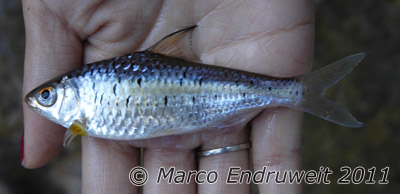
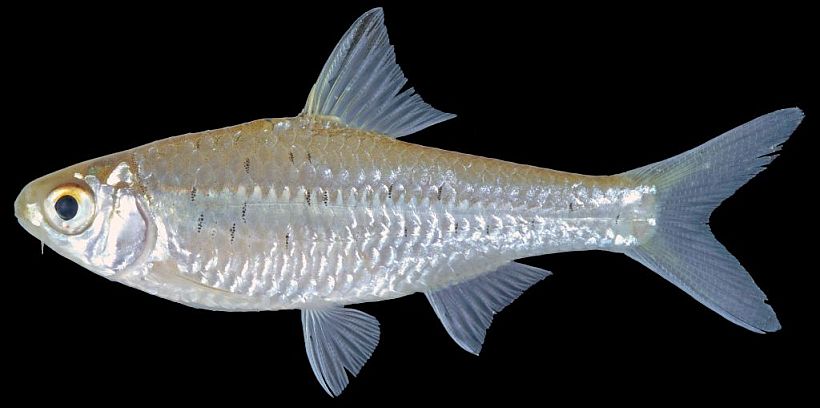
These photographs are used with each photographer's permission.
Send a photographDistribution
Profile completeness12 of 24
Community
Questions about Mystacoleucus lepturus?
Ask on Discord