Results for “spot”
Type a name: scientific, common, or one a species used to go by. Or narrow the catalogue with the filters.
Filters
Metynnis maculatusSpotted Metynnis
Kner, 1858
Matched on the common name Spotted Metynnis
Max length148mm SL6in SLTank180 × 45cm72 × 18inTemp20–28°C68–82°FpH5.0–7.5Metynnis maculatus
Mystus bimaculatusTwo Spot Mystus
authority not recorded
Matched on the common name Two Spot Mystus
Max length65mm SL2.6in SLTank45 × 30cm18 × 12inTemp23–30°C73–86°FpH4.0–6.5A delightful little species that deserves greater popularity in the hobby. All attempts at captive breeding should be encouraged, as its natural habitat is in danger of destruction by human activity.
Pimelodus maculatusSpotted Pim
authority not recorded
Matched on the common name Spotted Pim
Max length180mm SL7in SLTank120 × 60cm48 × 24inTemp20–24°C68–75°FpH6.4–7.4There are currently 32 genera and over 80 species included in the family Pimelodidae (including Pimelodus), making it the second largest and one of the most diverse amongst catfish. Most experts agree however, that a full systematic revision of the family is needed, as little information about the phylogenetic (evolutionary relatedness) relationships between the various genera exists. Taxonomy information at the species level is also basic at best. It's therefore likely that at least some o...
Potamotrygon falkneriLarge Spot Stingray
authority not recorded
Matched on the common name Large Spot Stingray
Max length470mm SL19in SLTank180 × 60cm72 × 24inTemp23.9–28.9°C75–84°FpH6.0–7.5P. falkneri is arguably among the most beautiful Potamotrygonids seen in the hobby. It's not imported with any great degree of regularity, and is usually expensive when available. There are currently three genera in the family Potamotrygonidae, all of which hail from South America. Paratrygon and Plesiotrygon are both monotypic genera (contain only a single described species) and are rarely seen in the hobby. The vast majority of imported rays belong to the biggest genus, Potamotrygon. T...
Pseudanos trimaculatusThree-spot Headstander
authority not recorded
Matched on the common name Three-spot Headstander
Max length125mm SL5in SLTanknot recordedTemp23–27°C73–81°FpH6.0–7.5This species was formerly known as Anostomus trimaculatus and this name is still used in much of the available literature. It is now invalid, however. The genus Pseudanos contains 3 other known species, P. gracilis, P. irinae and the recently described P. winterbottomi. Care for these species is as for P. trimaculatus....
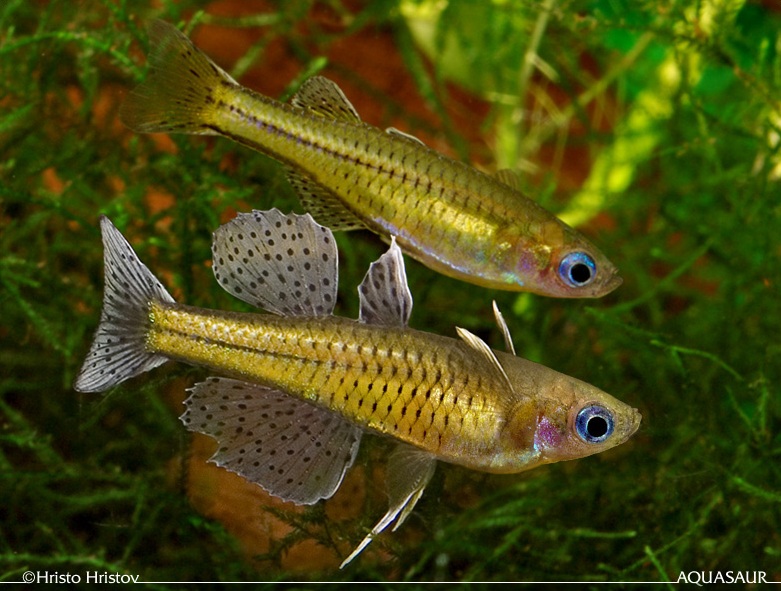
Pseudomugil gertrudaeSpotted Blue-eye
Weber, 1911
Matched on the common name Spotted Blue-eye
Max length38mm SL1.5in SLTank45 × 30cm18 × 12inTemp21–28°C70–82°FpH4.5–7.5Described from 'Rivulet in sago forest at Ngaiguli, Terangan, Aru Island, Aru Islands, Maluku, Indonesia', corresponding to the island now normally referred to as 'Trangan' in the Aru Islands group, eastern Indonesia. The islands are located in the Arafura Sea, with western New Guinea to the north and the Arnhem Land Region of Australia's Northern Territory to the south, and though they lie within Maluku province of eastern Indonesia, are part of the Australian continent in a geological sense.
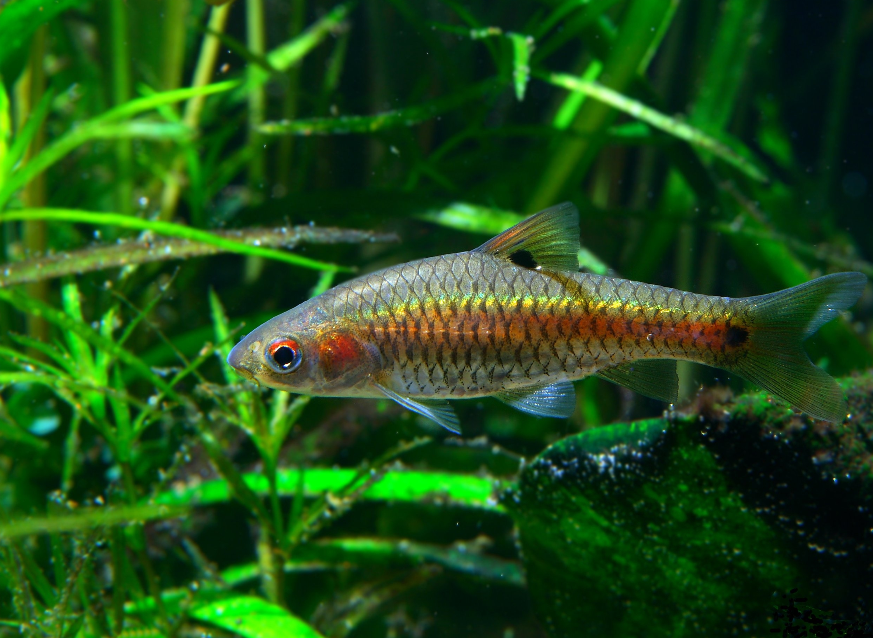
Puntius bimaculatusTwo-spotted Barb
Bleeker, 1863
Matched on the common name Two-spotted Barb
Max length50mm SL2.0in SLTank60 × 30cm24 × 12inTemp18–24°C64–75°FpH6.0–7.5Generally very peaceful making it an ideal resident of the well-researched community tank. As it places no special demands in terms of water chemistry it can be combined with many of the most popular fish in the hobby including other small cyprinids as well as tetras, livebearers, rainbowfishes, anabantoids, catfishes and loaches. It's a schooling species by nature, and at least 6-10 specimens should be purchased. Maintaining it in such...
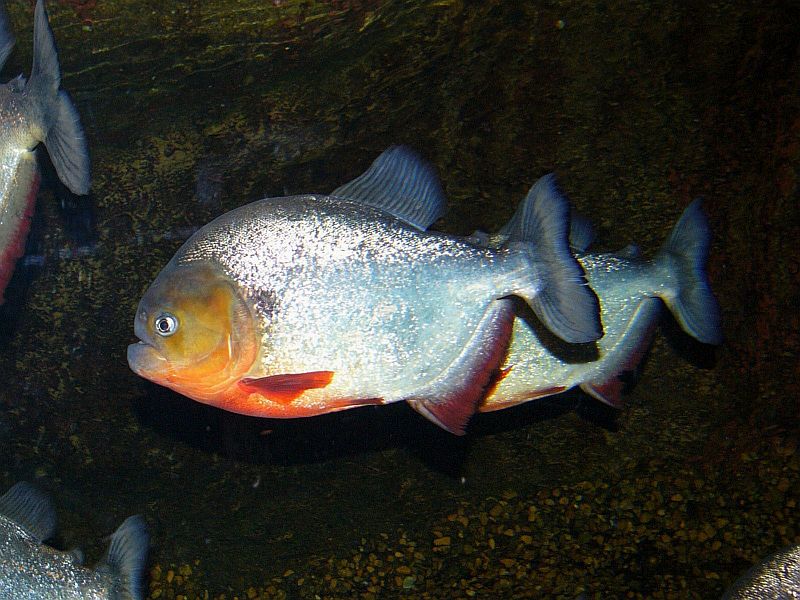
Pygocentrus caribaBlack Spot Piranha
Humboldt, 1821
Matched on the common name Black Spot Piranha
Max length350mm SL14in SLTank240 × 90cm96 × 36inTemp20–28°C68–82°FpH4.0–7.0Has been recorded from major river channels, smaller tributaries, and floodplain lakes, many of which comprise acidic, mineral-poor blackwater environments with brownish, tannin-stained water, although it has been observed to inhabit clear waters as well. Many of its habitats lie within the Venezuelan and Colombian llanos, a vast, highly biodiverse system of tropical savannah grasslands, seasonally-flooded plains and forests covering an area measuring almost 600,000 square kilo...
Synodontis acanthomiasBlack-spotted Synodontis
authority not recorded
Matched on the common name Black-spotted Synodontis
Max length300mm SL12in SLTank120 × 60cm48 × 24inTemp22–24°C72–75°FpH6.5–8.0This is one of the species of Synodontis seen less frequently in the trade and it ranks alongside S. schall as one of the more aggressive members of the genus. It is very hardy however and makes a good tankmate for large aggressive cichlid species. One unique characteristic of S. acanthomias is that the humeral process (the bony extension just above the pectoral fins) is long and tapered with a curved end....
Tetraodon nigroviridisGreen Spotted Puffer
authority not recorded
Matched on the common name Green Spotted Puffer
Max length170mm SL7in SLTank120 × 30cm48 × 12inTemp24–28°C75–82°FpH7.5–8.5Puffer fish are so called as they have the ability to inflate their elastic stomachs with water or air. This is usually a response to some kind of threat, although in the aquarium many specimens appear to inflate themselves for no apparent reason. The fish becomes 2 or 3 times it's normal size, which makes the fish both big enough to scare away many potential predators, and difficult to swallow. Many parts of the body of puffers contain the deadly neurotoxin tetrodoxin. This is the same ...
Tropheus duboisiWhite-Spotted Cichlid
authority not recorded
Matched on the common name White-Spotted Cichlid
Max length120mm SL5in SLTanknot recordedTemp23–27°C73–81°FpH8.0–9.5Like others in the genus, Tropheus duboisi is something of an enigma in the aquarium hobby and despite it's popularity, is not a good species for the beginner. There has been much arguement and discussion about how best to maintain it in the aquarium, and some of these debates still rage on. We have provided the generally accepted method of keeping the fish, but in reality what works for one aquarist may not for another. One aspect which is always true, is that water quality is of the utmos...
Vieja bifasciataRed-spotted Cichlid
authority not recorded
Matched on the common name Red-spotted Cichlid
Max length300mm SL12in SLTanknot recordedTemp27–29°C81–84°FpH7.0–8.5Vieja bifasciata are often confused for vieja synspilum but can be told apart as bifasciata have two prominent horizontal lines running between their eyes (hence the name). They are a very colourful fish and respond to their owner's presence - usually looking for food! Bifasciata are not particularly demanding in terms of water parameters and easy to keep, especially if suitable tankmates can be found. It is sometimes the case that a pair of fish that will not live together in a tank on ...
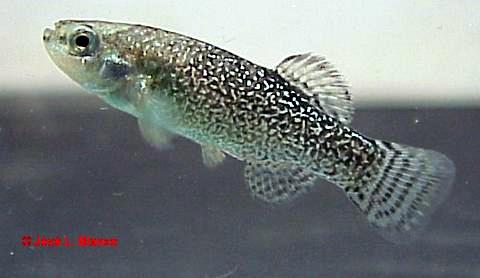
Apricaphanius saourensisSahara Toothcarp
Blanco, Hrbek & Doadrio, 2006
Max length45mm SL1.8in SLTank120 × 30cm48 × 12inTemp2–30°C36–86°FpH7.5–9.0All Algerian Aphanius populations were considered to be representative of A. iberus until this species was described in 2006. It differs both morphologically and genetically from A. iberusand A. baeticus, probably diverging about 5.3 million years ago during the opening of the Straits of Gibraltar. It is most easily distinguished by the distinct mottled body patterning which in males of the other two species forms distinct vertical bars and in females dark spot-like markings. A. iberusis now k...
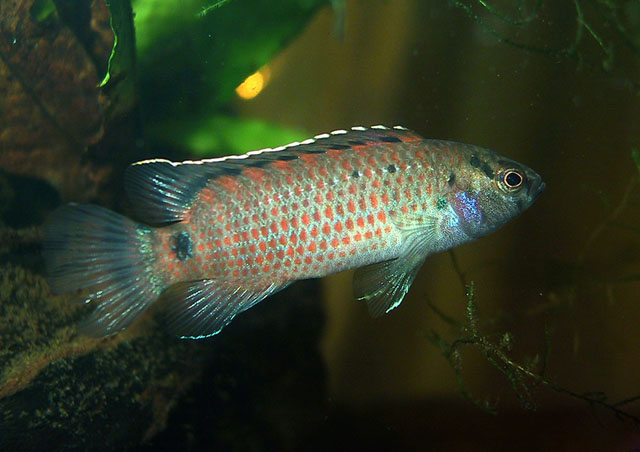
Badis khwae
Kullander & Britz, 2002
Max length60mm SL2.4in SLTank60 × 30cm24 × 12inTemp22–26°C72–79°FpH6.5–7.5Like most badids this species is poorly documented and has yet to find significant popularity in the aquarium hobby, though given its restricted natural distribution it is unlikely ever to be available in large numbers. Within the genus it is most easily confused with B. ruber and B. siamensis but both these species have rows of dark spot-like markings on the flanks which are lacking in B. khwae. The three also differ in the shape of the dark marking on the caudal peduncle; in B. ruber it is rel...
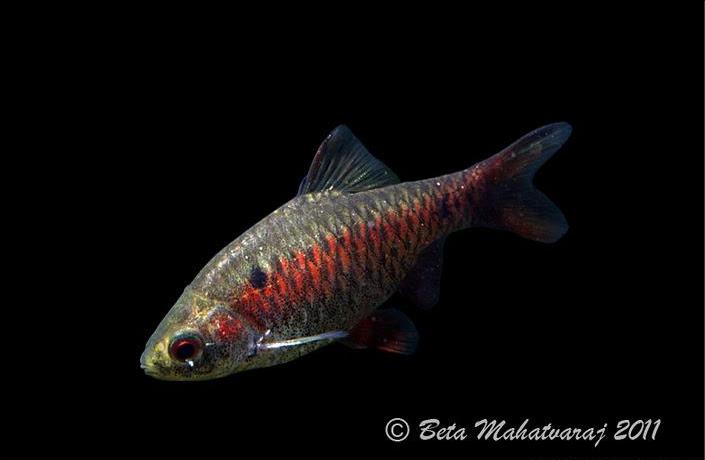
Pethia manipurensis
Menon, Rema Devi & Vishwanath, 2000
Max length62mm SL2.4in SLTank80 × 30cm31 × 12inTemp18–25°C64–77°FpH5.5–7.5Within this assemblage P. manipurensis is most similar to 'P.' meingangbii and P. padamya by virtue of the fact that males in all three possess orange-red pigmentation on the flanks and caudal-fin. It can be told apart most easily by the fact it possesses a relatively small, spot-like humeral marking, vs. a vertically-elongated, relatively large humeral marking in both the other species.
Rasbora elegansElegant Rasbora
authority not recorded
Max length200mm SL8in SLTank120 × 45cm48 × 18inTemp22–25°C72–77°FpHnot recordedThis species is not especially popular in the hobby and is only infrequently seen on sale. It is clearly distinguishable from similar-looking members of the genus by lacking a dark stripe along the lateral line. Instead it possesses two spot-like markings on each flank, one below theorigin and lateral line and another at the caudal peduncle. The intensity of these can vary depending on the collection locality of the fish and they can be quite faint in some forms. There is also a third, smaller m...
Rasbora kalochromaClown Rasbora
authority not recorded
Max length100mm SL3.9in SLTank120 × 45cm48 × 18inTemp23–28°C73–82°FpHnot recordedR. kalochroma exhibits variable patterning across its range according to locality with some forms possessing a line of spot-like markings connecting the two dark blotches on the flanks and others more intense body colouration. Juveniles are sometimes confused with Boraras maculatus and adults with the similarly-patterened R. elegans although the latter is easy to identify by its overall silver, as opposed to pinkish/reddish, colouration. The only congener for which it may be genuinely mistake...
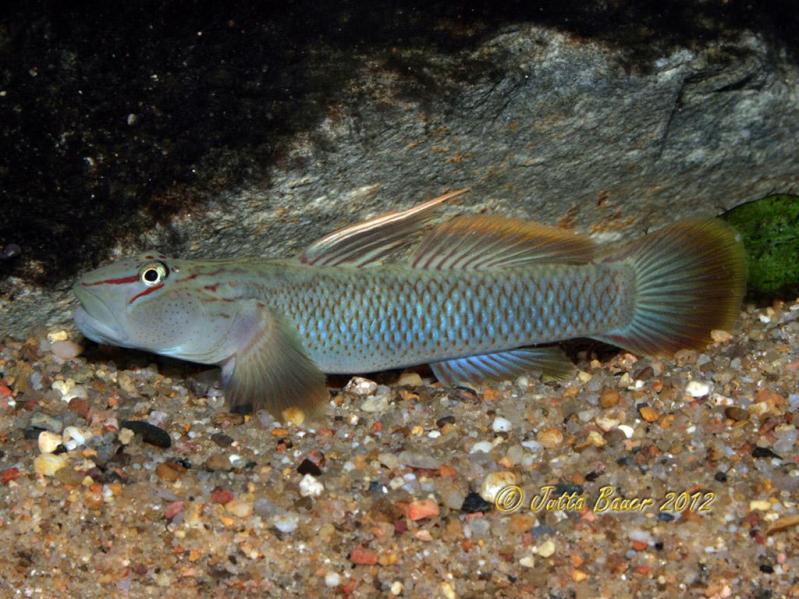
Rhinogobius nantaiensis
Aonuma & Chen, 1996
Max length55mm SL2.2in SLTank60 × 30cm24 × 12inTemp18–28°C64–82°FpH6.0–8.0This fish is normally imported alongside the congener R. candidianus and is actually the commoner of the two in the aquarium trade. It looks very similar to R. candidianus but does not grow as large and possesses a more rounded snout. Most specimens also have spot-like markings on the sides of the head which has led to them being identified as R. nantaiensis, but the fish do no...
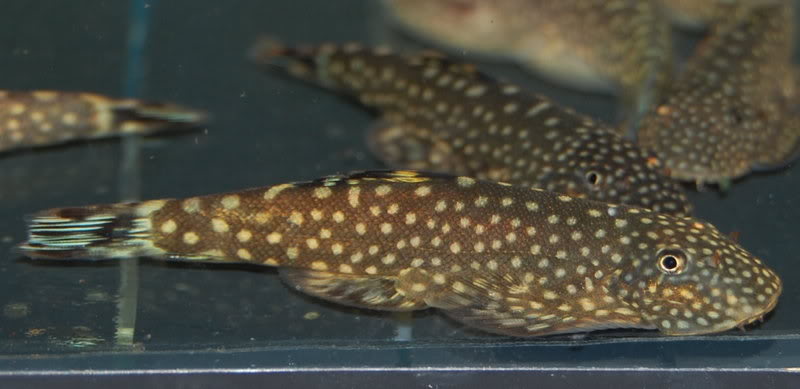
Gastromyzon scitulus
Tan & Leh, 2006
Max length45mm SL1.8in SLTank75 × 30cm30 × 12inTemp20–24°C68–75°FpH6.0–7.5It can be distinguished from congeners by the following combination of characters: gill slit angular; presence of subopercular groove, running continuous to origin of pectoral-fin; body black with numerous, small, evenly-spaced light brown spots; head dorsum black with numerous cream spots; pectoral and pelvic fins with cream spots; caudal-fin with iridescen...
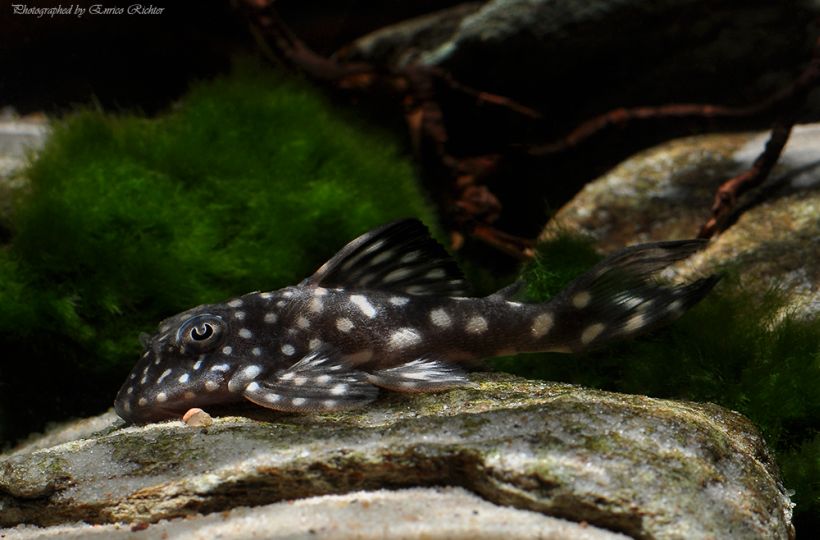
Hypancistrus inspectorL102
Armbruster, 2002
Max length160mm SL6in SLTank120 × 45cm48 × 18inTemp22–30°C72–86°FpH5.0–7.5H. inspector can be told apart from other described species in the genus by the following combination of characters: colour pattern comprising brown to black base with large whitish to yellow spots; adpressed dorsal-fin not reaching the adipose-fin spine; spots on head much smaller than on rest of body; spots in the upper caudal-fin lobe combining to form bands in adults; 24 plates in the mid-ventral series.