Results for “dorsal”
Type a name: scientific, common, or one a species used to go by. Or narrow the catalogue with the filters.
Filters
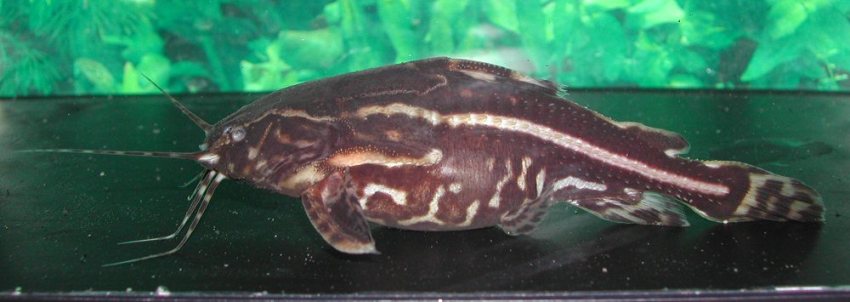
Acanthodoras cataphractusChocolate Talking Catfish
Linnaeus, 1758
Max length115mm SL5in SLTank120 × 30cm48 × 12inTemp22–26°C72–79°FpH6.0–7.5This species, which may also be referred to by the alternative vernacular names 'spiny catfish', 'painted talking catfish' or 'chocolate raphael', isn't particularly common in the trade and most often exported only as bycatch among shipments of Platydoras armatulus. It appears very similar to the congener A. spinosissimus with the most useful external distinguishing character being the presence of pale blotches on the dorsal surface, between the dorsal and caud...
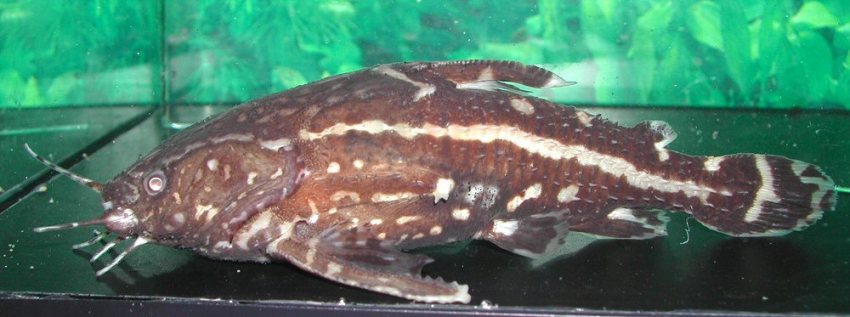
Acanthodoras spinosissimusChocolate Talking Catfish
Eigenmann & Eigenmann, 1888
Max length137mm SL5in SLTank120 × 30cm48 × 12inTemp22–26°C72–79°FpH6.0–7.5This species, which may also be referred to by the alternative vernacular names 'spiny catfish', 'painted talking catfish' or 'chocolate raphael', isn't particularly common in the trade and most often exported only as bycatch among shipments of Platydoras armatulus. It appears very similar to A. cataphractus with the most useful external distinguishing character being the presence of pale blotches on the dorsal surface, between the dorsal and caudal fins, in....
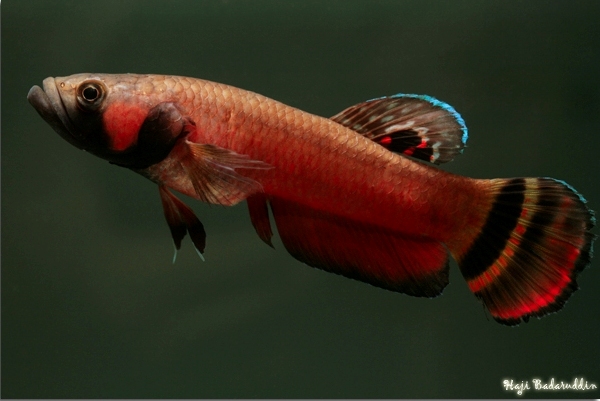
Betta macrostomaBrunei Beauty
Regan, 1910
Max length100mm SL3.9in SLTank80 × 30cm31 × 12inTemp20–25°C68–77°FpH4.0–6.0B. macrostoma is included in the Betta unimaculata complex of closely-related species within the genus, of which members share the following set of characters: body long and slender with depth at dorsal fin origin 18-25 % SL; head large and blunt with width 19-24 % SL; long maxilla and lower lip with distance from tip of lower jaw to posterior end of maxilla 27-54 % HL; caudal-fin rounded in shape, occasionally with elongated median rays; pelvic-fin short and filamentous; dorsal and anal fins relatively pointed.
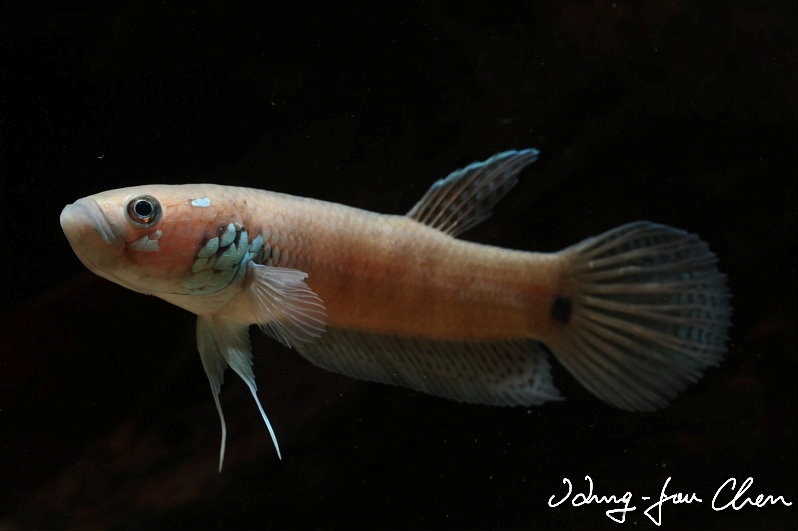
Betta ocellata
de Beaufort, 1933
Max length90mm SL3.5in SLTank80 × 30cm31 × 12inTemp21–25°C70–77°FpH5.5–7.5This species is included in the Betta unimaculata complex of closely-related species within the genus, of which members share the following set of characters: body long and slender with depth at dorsal fin origin 18-25 % SL; head large and blunt with width 19-24 % SL; long maxilla and lower lip with distance from tip of lower jaw to posterior end of maxilla 27-54 % HL; caudal-fin rounded in shape, occasionally with elongated median rays; pelvic-fin short and filamentous; dorsal and anal fins relatively pointed.
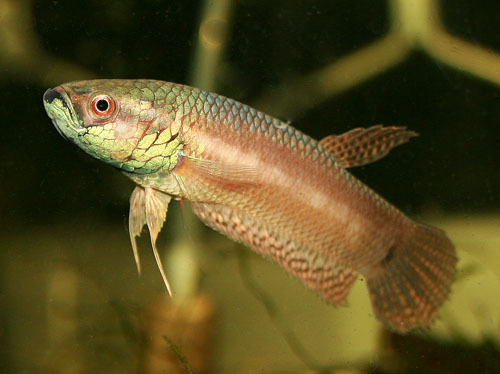
Betta pallifina
Tan & Ng, 2005
Max length90mm SL3.5in SLTanknot recordedTemp22–27°C72–81°FpH5.5–7.5This species is included in the Betta unimaculata complex of closely-related species within the genus, of which members share the following set of characters: body long and slender with depth at dorsal fin origin 18-25 % SL; head large and blunt with width 19-24 % SL; long maxilla and lower lip with distance from tip of lower jaw to posterior end of maxilla 27-54 % HL; caudal-fin rounded in shape, occasionally with elongated median rays; pelvic-fin short and filamentous; dorsal and anal fins relatively pointed.
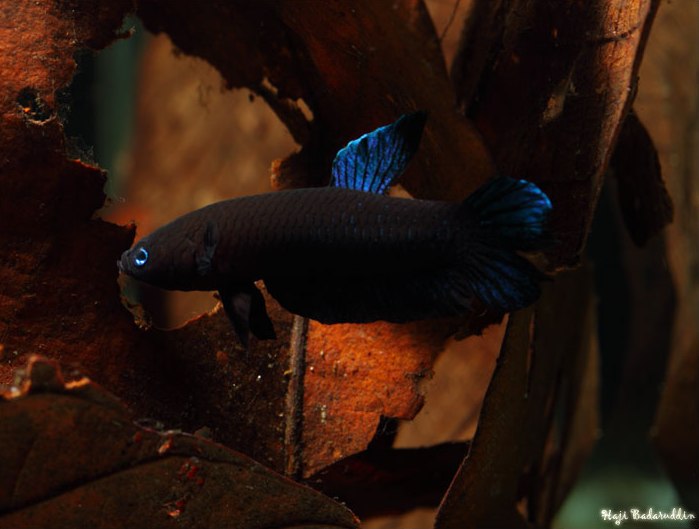
Betta persephone
Schaller, 1986
Max length35mm SL1.4in SLTank45 × 30cm18 × 12inTemp22–28°C72–82°FpH4.0–6.0B. persephone can be told apart from other members of the group by the following characters: no lateral blotch; body blackish; dorsal surface of head posterior to eye sloping gently; no parallel vertical iridescent gold opercle bars; pelvic-fin falcate with white filamentous tip, remainder black to reddish; median fins covered diffusely with light green iridescence; dorsal fin-rays 9; anal-fin rays 24-27; subdorsal scales 6-7; lateral scales 27-29; predorsal scales 17-18.
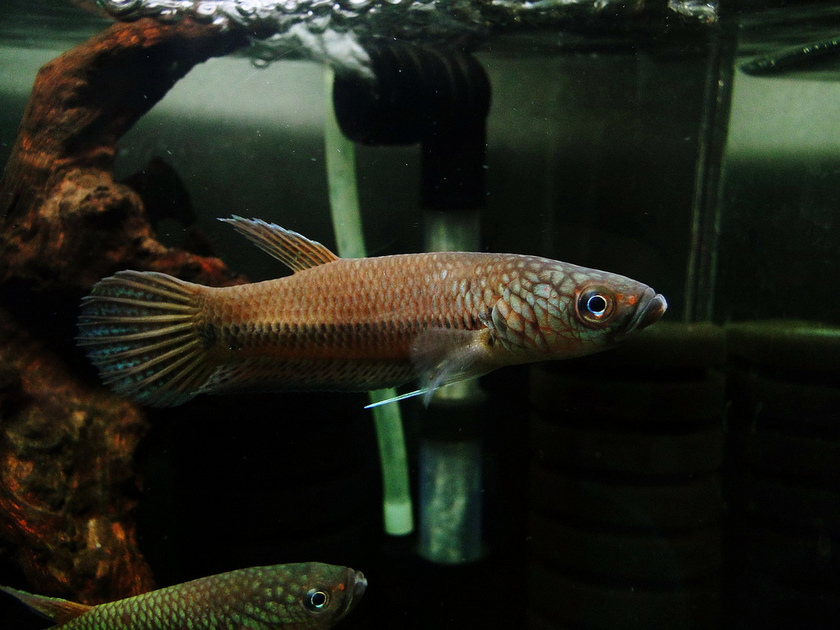
Betta sp. 'Antuta/Bulungan'
authority not recorded
Max length100mm SL3.9in SLTank80 × 30cm31 × 12inTemp21–27°C70–81°FpH5.5–7.5This hypothetically-undescribed species appears to be a member of the Betta unimaculata complex of closely-related species within the genus, of which members share the following set of characters: body long and slender with depth at dorsal fin origin 18-25 % SL; head large and blunt with width 19-24 % SL; long maxilla and lower lip with distance from tip of lower jaw to posterior end of maxilla 27-54 % HL; caudal-fin rounded in shape, occasionally with elongated median rays; pelvic-fin short and filamentous; dorsal and anal fins relatively pointed.
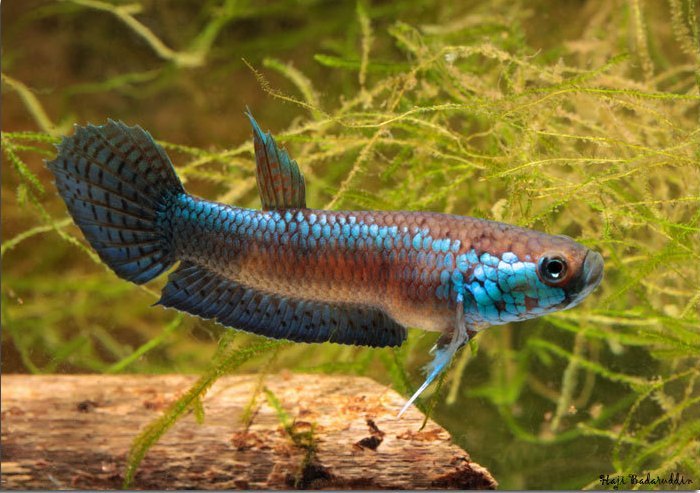
Betta unimaculata
Popta, 1905
Max length115mm SL5in SLTank80 × 30cm31 × 12inTemp21–26°C70–79°FpH5.0–7.5This species is included in the Betta unimaculata complex of closely-related species within the genus, of which members share the following set of characters: body long and slender with depth at dorsal fin origin 18-25 % SL; head large and blunt with width 19-24 % SL; long maxilla and lower lip with distance from tip of lower jaw to posterior end of maxilla 27-54 % HL; caudal-fin rounded in shape, occasionally with elongated median rays; pelvic-fin short and filamentous; dorsal and anal fins relatively pointed.
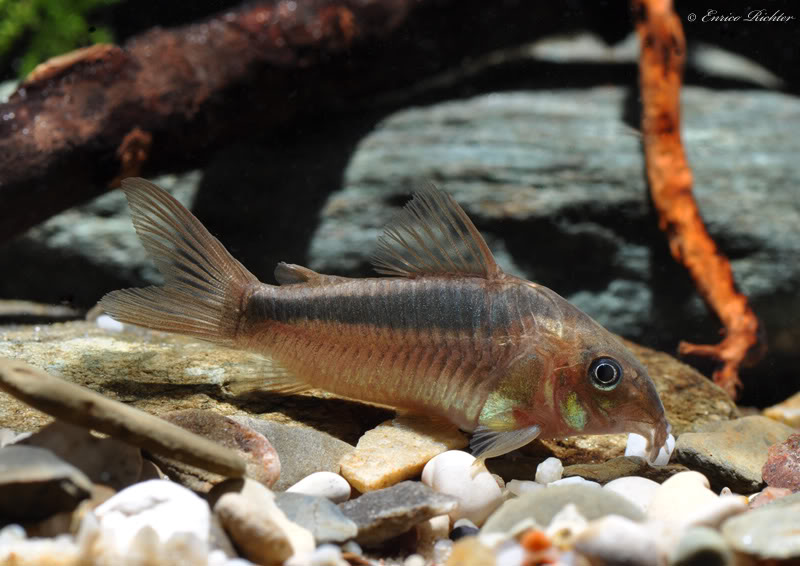
Corydoras rabautiRusty Cory
La Monte, 1941
Max length65mm SL2.6in SLTank90 × 30cm36 × 12inTemp20–27°C68–81°FpH5.5–7.2The broad dark stripe in the dorsal portion of the body extends into the ventral portion on the caudal peduncle, and this character can be used to distinguish it from the very similar-looking C. zygatus, with which it is often confused. In C. zygatus the dark stripe does not extend ventrally on the caudal peduncle and is present only on the dorsal part.
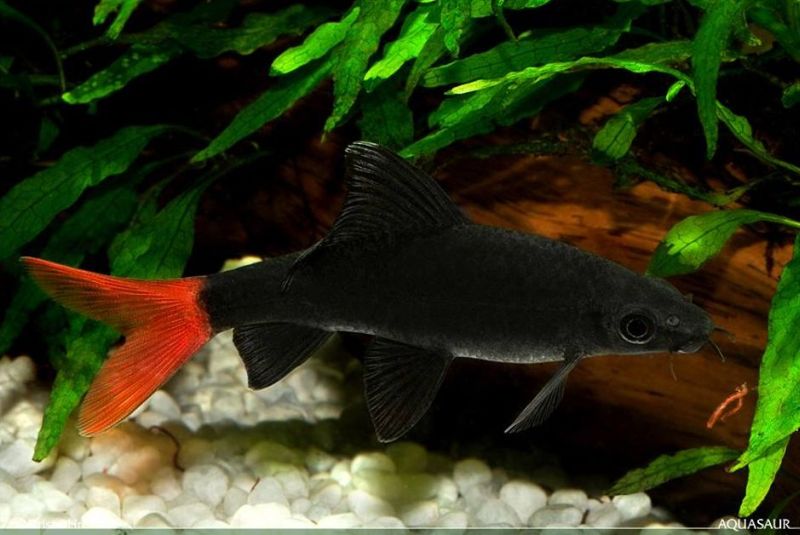
Epalzeorhynchos bicolorRed-Tailed Black Shark
Smith, 1931
Max length125mm SL5in SLTank120 × 45cm48 × 18inTemp20–26°C68–79°FpH6.0–8.0Most members of Epalzeorhynchos were formerly regarded as Labeo spp. and are thus referred to as such in older literature. According to Rainboth (1996) they're characterised by absence of a dorsal spine, possession of 10-13 branched dorsal fin rays, a thin membrane connecting the upper and lower lips and rigid, freely moveable rostral lobes. Epalzeorhynchos itself has undergone some quite recent changes with a handful of species hav...
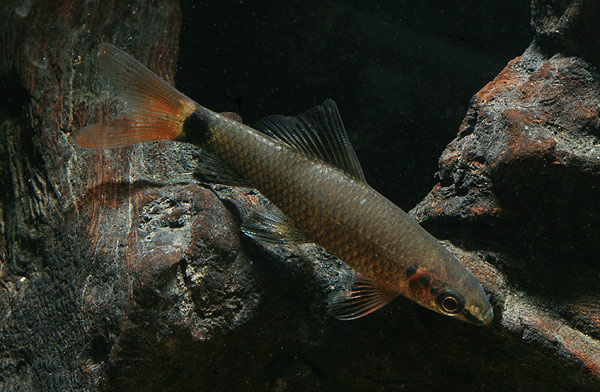
Epalzeorhynchos munense
Smith, 1934
Max length120mm SL5in SLTank120 × 45cm48 × 18inTemp20–26°C68–79°FpH6.5–7.5This species does not appear to be in the aquarium hobby at time of writing though it may have been in the past, when exports of wild Epalzeorhynchos spp. still took place. Most members of the genus were formerly regarded as Labeo spp. and are thus referred to as such in older literature. According to Rainboth (1996) they're characterised by absence of a dorsal spine, possession of 10-13 branched dorsal fin rays, a thin membrane...
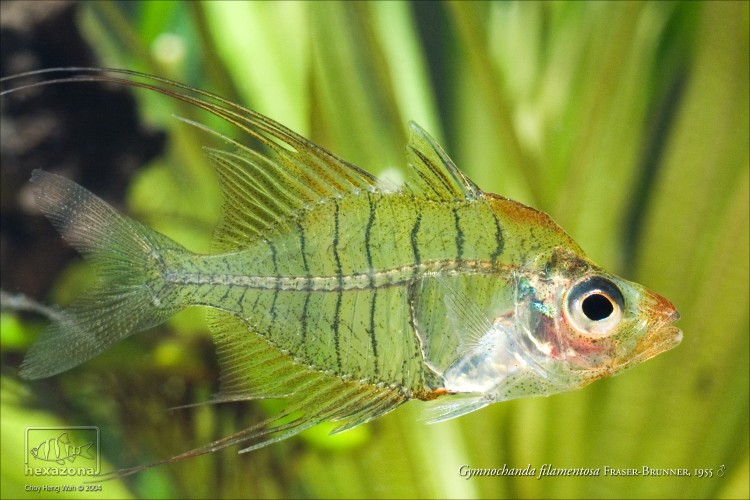
Gymnochanda filamentosa
Fraser-Brunner, 1955
Max length32mm SL1.3in SLTank60 × 30cm24 × 12inTemp20–28°C68–82°FpH4.0–6.0G. filamentosa has appeared in the ornamental trade but is evidently delicate and therefore recommended only to experienced aquarists. It can be told apart from congeners by the following combination of characters: possession of filamentous dorsal and anal-fin rays in males; body transparent to translucent yellowish-brown colour in life; absence of a highly-extended second anal-fin spine; absence of carmine-red pigmentation in the dorsal, anal an...
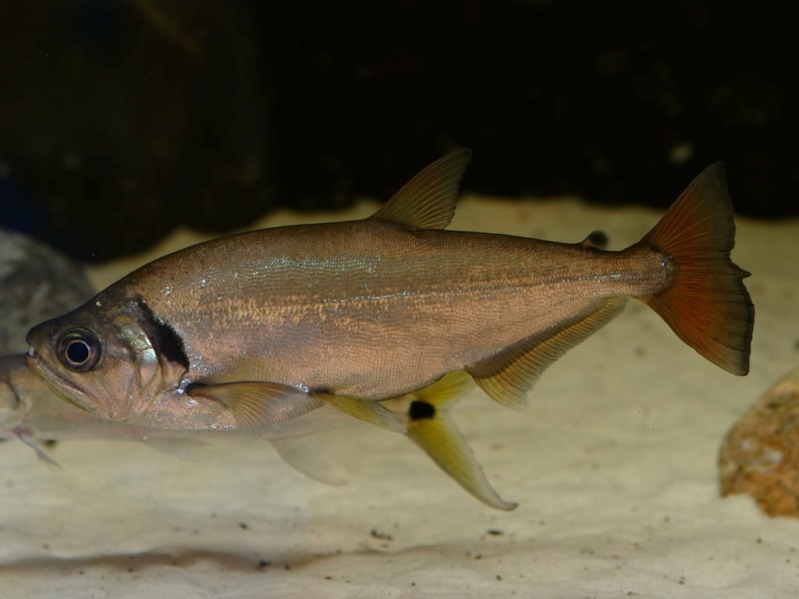
Hydrolycus tatauaia
Toledo-Piza, Menezes & Santos, 1999
Max length455mm SL18in SLTanknot recordedTemp24–28°C75–82°FpH6.0–8.0Vernacular names in Brazil include 'Cachorra' or 'Pirandirá', although these are also applied to congeners. It can be told apart from all congeners by the following combination of characters: head and body silvery with dark dorsal surface; an elongate dark blotch posterior to the opercle; dorsal, caudal and anal-fin rays reddish to orange proximally with some individual variation in intensity and tonality; adipose fin dark, with diffuse black pigmentation.
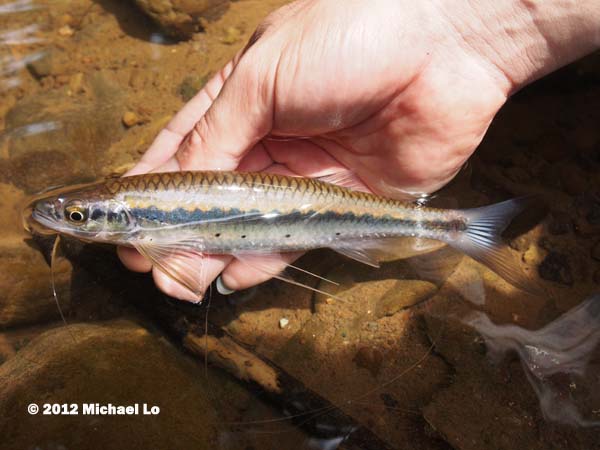
Luciosoma pellegrinii
Popta, 1905
Max length170mm SL7in SLTanknot recordedTempnot recordedpHnot recordedThe five species which currently comprise Luciosoma can be distinguished by elements of colour pattern. Popta described the colour pattern of L. pellegrinii as follows: body colour olive dorsally, with dark-edged scales, yellow ventrally; a lateral series of dark spots on the flank forming a midlateral band which extends onto the opercle but not the head; 4-8 blackish-brown, distinctly-separate spots on the lateral line; fins yellow; dorsal and anal fins with a blackish-brown band; anterior half of some pectoral-fin rays blackish-brown...
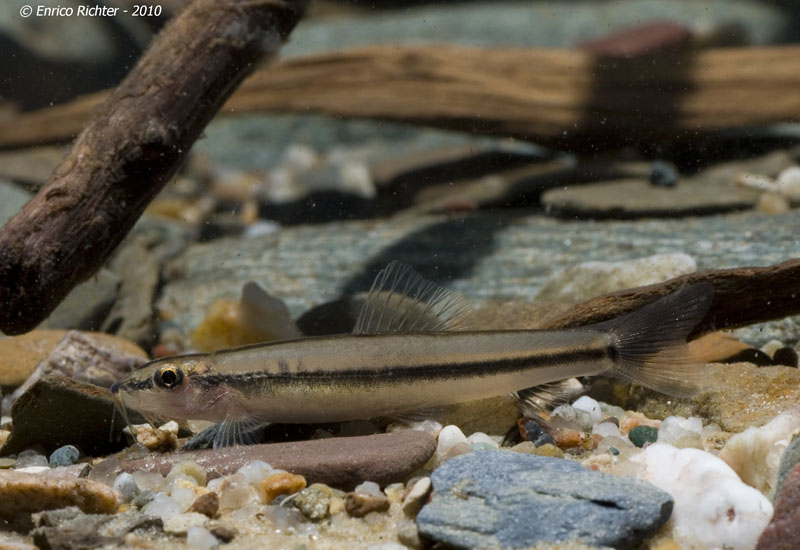
Nemacheilus binotatus
Smith, 1933
Max length45mm SL1.8in SLTank60 × 30cm24 × 12inTemp23–26°C73–79°FpH6.0–7.5N. binotatus is distinguished from similar-looking congeners such as N. longistriatus and N. ornatus by its unique body patterning consisting very simply of two dark stripes, one running along the dorsal surface and the other from the tip of the snout, through the eye and along the flank. There are usually 1-3 small, vertically-orientated spots extending above the lateral stripe between the pectoral-fin and dorsal fins. These are su...
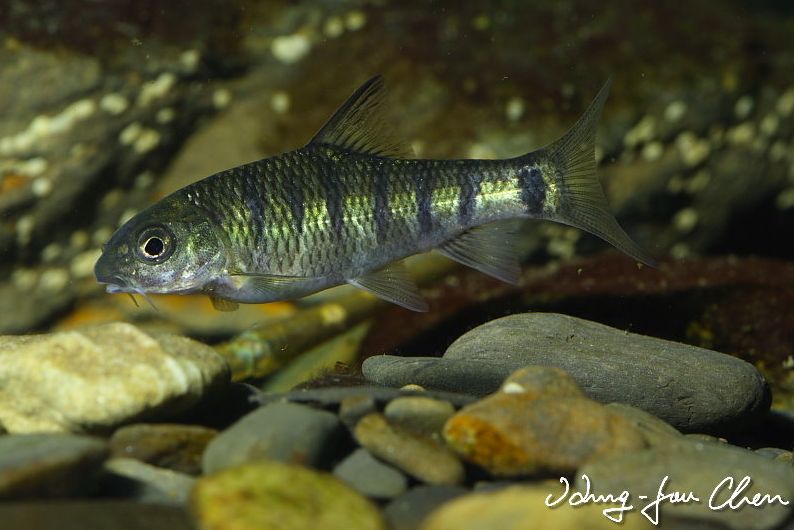
Acrossocheilus paradoxusTaiwan Banded Barb
Günther, 1868
Max length200mm SL8in SLTank180 × 45cm72 × 18inTemp15–25°C59–77°FpH6.0–8.0The genus Acrossocheilus is restricted to southern China, northern Vietnam and northern Laos. It can be distinguished from related genera by the following combination of characters: rostral fold present; lips fleshy and continuous around corners of mouth; lower lip with a median interruption; mouth inferior; horny sheath on lower jaw; two pairs of barbels; last simple ray of dorsal fin osseous with a serrated or smooth posterior margin.
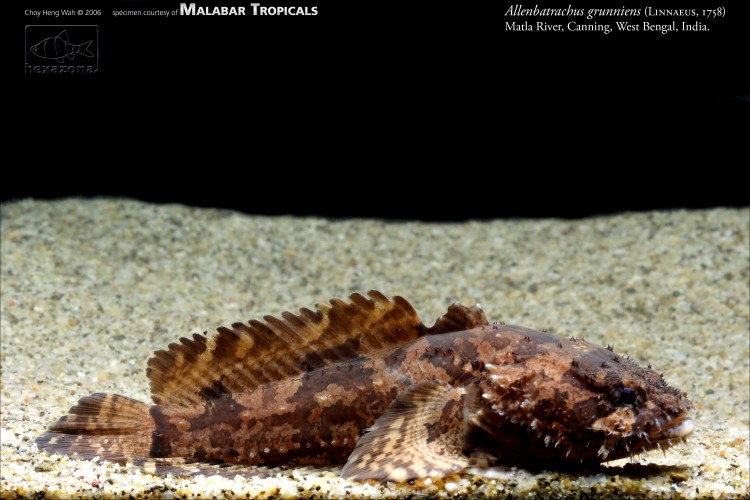
Allenbatrachus grunniensFreshwater Toadfish
Linnaeus, 1758
Max length300mm SL12in SLTanknot recordedTemp23–28°C73–82°FpH7.5–9.0This species is relatively common in the aquarium hobby but contrary to popular belief is not venomous in any way. Its dorsal and opercular spines can pierce the skin, however, meaning extreme caution is necessary when netting it or performing aquarium maintenance. The genus Allenbatrachus was erected in 1997 to accom...
Apistogramma alacrinaRedspot Dwarf Cichlid
Kullander, 2004
Max length♂ 55 · ♀ 37mm SL♂ 2.2 · ♀ 1.5in SLTank45 × 30cm18 × 12inTemp23–29°C73–84°FpH4.0–7.0This species differs from all other described members of the genus by the presence of dark blotches at the dorsal and ventral base of the pectoral fins. Three very similar-looking fishes have been assigned the codes A106, A107 and A108 under the DATZ system and are also known in the aquarium hobby as A. sp. 'rotpunkt' (this form has been in the hobby for decades with its precise origin unclear), A. sp. 'rotpunkt Orteguazas' (the paratype form of A. alacrina) and A. sp. 'rotpunkt Guayas', respectively. It remains to be seen whether they're conspecific with A. alacrina or not since they exhibit some differences in colour pattern and morphology.
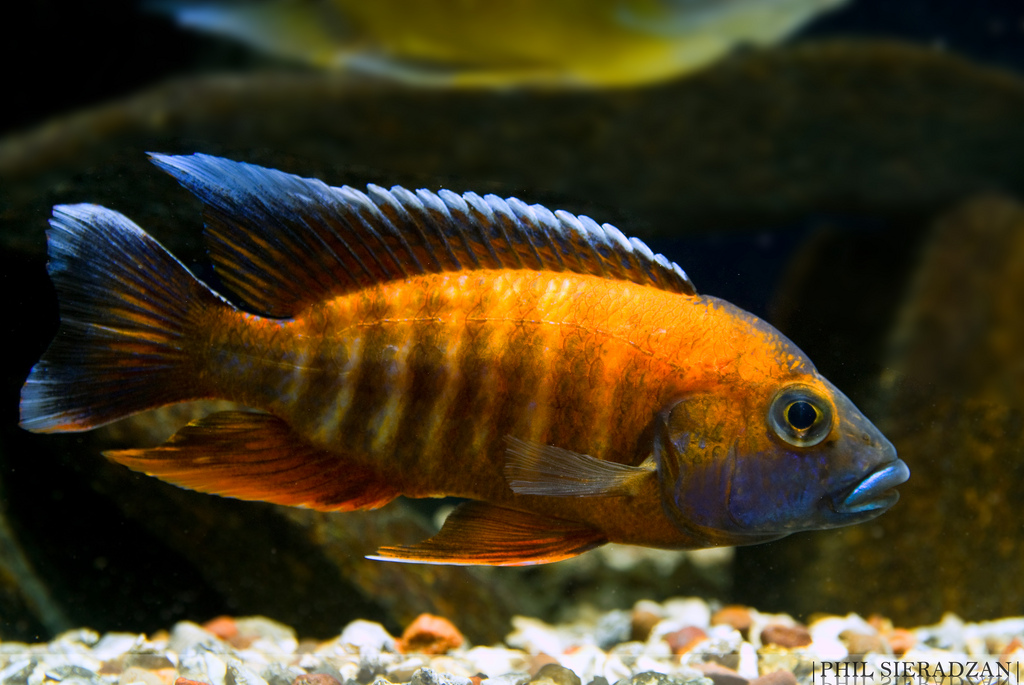
Aulonocara jacobfreibergiMalawi Butterfly
Johnson, 1974
Max length170mm SL7in SLTank120 × 60cm48 × 24inTemp25–29°C77–84°FpH7.5–9.0This was one of the first Aulonocara spp. to enter the hobby and its popularity has endured. It's known by several other vernacular names including 'Freiberg's peacock', 'fairy cichlid' and 'African butterfly' as well as the erroneous 'scientific' names Trematocranus trevori, T. jacobfreigbergi and T. regina. A naturally-occurring, yellowish form from Undu reef, Tanzania is often referred to as 'lemon jake'. It can be told apart from most other members of the genus by the broad, pale distal margins in the dorsal, anal and caudal fins, more deeply-forked caudal fin and larger adult size.
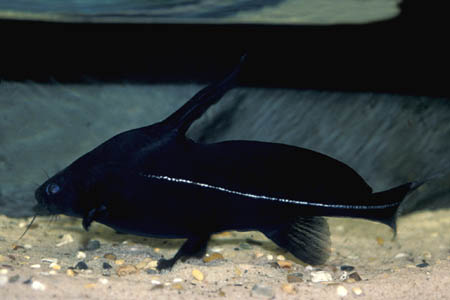
Bagrichthys macracanthusBlack Lancer
Bleeker, 1854
Max length230mm SL9in SLTank120 × 45cm48 × 18inTemp24–28°C75–82°FpH5.5–7.0The vernacular name 'lancer' is derived from the extended dorsal spine possessed by several members of the genus, which currently contains 7 species. Among them B. macracanthus is most similar to B. majusculus and B. vaillantii but can be told apart from the former by possession of shorter pectoral spines (13.3 - 16.2% SL vs. 15.8 - 20.7%), shorter adipose fin (46.0 - 58.0% SL vs. 38.8 - 45.8%), less deep caudal peduncle (7.1 - 7.5% SL vs. 5.6-7.0%) and larger adult size. From B. vaillantii it di...