Acrossocheilus paradoxus
Taiwan Banded Barb · Taiwan Bänderbärbling
Formerly Barbus paradoxus Günther, 1868 · Gymnostomus formosanus Regan, 1908 · Lissocholichthys matsudai Oshima, 1920 · Acrossocheilus invirgatus Oshima, 1920
Last revised 2026Edit this page
On this page10 sections
Quick factsEdit
Difficulty6 of 8 measures
- Space
- very large tank
- Water
- flexible
- Temp
- flexible
- Diet
- unknown
- Temperament
- unknown
- Social
- needs to be in a group
- Compatibility
- fine with others
Other demands
Each of these can raise the rating on its own, whatever the measures above say.
- Hardiness
- needs a well-established tank
- Needs a very large tank
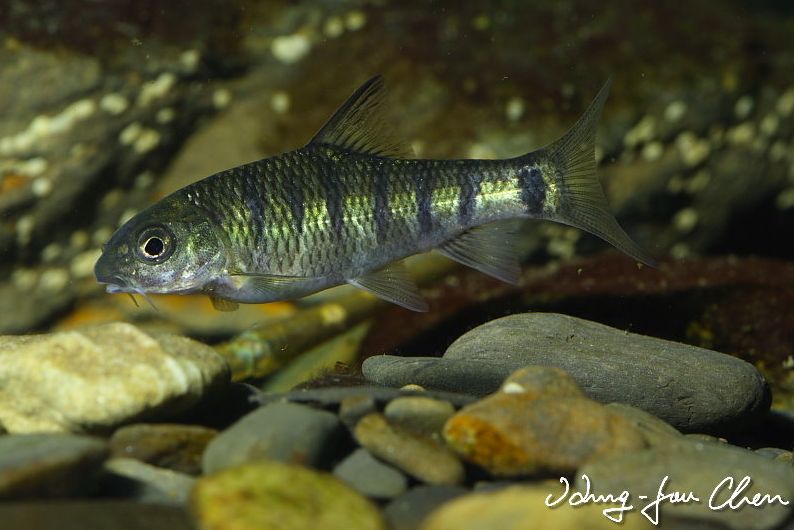
The Taiwan banded barb, Acrossocheilus paradoxus, is a cyprinid native to Taiwan, where it occurs throughout western and northeastern river drainages. It inhabits subtropical streams and small to medium rivers at medium to relatively high altitudes, and in the aquarium needs spotless, well-oxygenated water with moderate flow. Growing to around 200 mm SL, it needs a tank of at least 180 x 45 cm.
Etymology
EditAcrossocheilus: from the Greek a- (Gr. ἀ-), meaning 'without', krossós (Gr. κροσσός), meaning 'fringe, tassel', and cheílos (Gr. χείλος), meaning 'lip', in reference to the smooth upper lip in members of this genus.
paradoxus: Latin term meaning 'strange, contrary to expectation', in reference to a “very singular variation” in the type series because one individual had a “considerably produced” snout compared with the others.
Distribution
EditHabitat
Write a noteEditInhabits subtropical streams and small-to-medium sized rivers at medium to relatively high altitudes.
Aquarium size
Write a noteEditAn aquarium with base dimensions of 180 ∗ 45 cm72 ∗ 18 in or equivalent should be the smallest considered for long-term maintenance.
Maintenance
Write a noteEditLikely to prefer a set-up designed to resemble a flowing river with a substrate of variably-sized rocks and gravel and some large water-worn boulders. This can be further furnished with driftwood roots and branches arranged to form some shaded spots.
While the vast majority of plant species will fail to thrive in such surroundings hardy types such as Microsorum, Bolbitis or Anubias can be grown attached to the décor and bright lighting will promote the growth of aufwuchs upon which the fish will graze.
Like many fishes that naturally inhabit running water it is intolerant to the accumulation of organic wastes and requires spotless conditions in order to thrive, meaning weekly water changes of 30-50% tank volume should be considered routine. Though torrent-like conditions are unnecessary it also does best if there is a high level of dissolved oxygen and moderate water movement.
Since it doesn't cope well with fluctuating water conditions try to acclimatise it to the aquarium over a couple of hours if possible, and it should never be introduced to a biologically immature system.
Water conditions
EditThese recommendations come from this profile’s own figures. They contain affiliate links, so we may earn a commission.
Diet
Write a noteEditNotes
EditThe genus Acrossocheilus is restricted to southern China, Taiwan, northern Vietnam and northern Laos. It can be distinguished from related genera by the following combination of characters: rostral fold present; lips fleshy and continuous around corners of mouth; lower lip with a median interruption; mouth inferior; horny sheath on lower jaw; two pairs of barbels; last simple ray of dorsal fin osseous with a serrated or smooth posterior margin.
Members of the genus are characterised by possessing a particular number of dark vertical bar on each flank, and A. paradoxus belongs to a group of species with five or six such bars, each of which is two scales in width. Congeners sharing this pattern include A. fasciatus, A. hemispinus (in juveniles only), A. jishouensis, A. kreyenbergii, A. parallens, A. spinifer, A. wenchowensis, and A. wuyiensis.
The nominal species A. labiatus is currently considered synonymous with A. paradoxus according to some sources although this appears to be in question.
References
- Ho, H.-C. and K.-T. Shao (2011). Annotated checklist and type catalog of fish genera and species described from Taiwan. Zootaxa 2957, 1-74
- Günther, A. (1868). Catalogue of the Physostomi, containing the families Heteropygii, Cyprinidae, Gonorhynchidae, Hyodontidae, Osteoglossidae, Clupeidae,... [thru]... Halosauridae, in the collection of the British Museum. Catalogue of the fishes in the British Museum v. 7, i-xx + 1-512
- Lan, Z.-J., B.-P. Chan and J. Zhao (2014). Acrossocheilus multistriatus, a new species of barbine fish (Teleostei: Cyprinidae) from the Zhujiang River basin, south China. Zoological Systematics 39(3), 433-441
- Chen, I-S, and Y-C Chang (2005). A Photographic Guide to the Inland-water Fishes of Taiwan: Vol. 1 Cypriniformes. The Sueichan Press, i-xx + 1-284
- Yuan, L.-Y., Z.-Q. Wu and E. Zhang (2006). Acrossocheilus spinifer, a new species of barred cyprinid from south China (Pisces: Teleostei). Journal of Fish Biology 68 (Supplement B), 163-173
Species images · 3
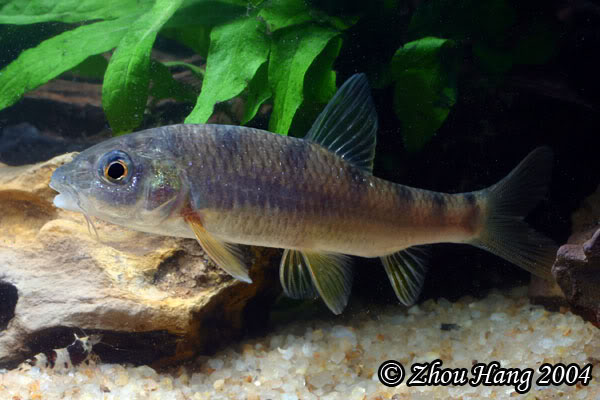
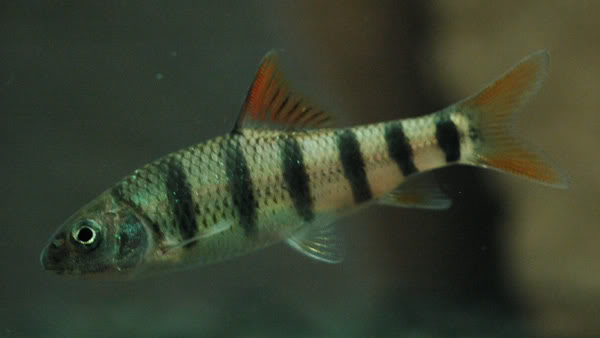
These photographs are used with each photographer's permission.
Send a photographDistribution
Profile completeness19 of 24
79% complete
Also missing: water condition notes, behaviour and compatibility, sexual dimorphism, reproduction.
Community
Questions about Acrossocheilus paradoxus?
Ask on Discord