Results for “spot”
Type a name: scientific, common, or one a species used to go by. Or narrow the catalogue with the filters.
Filters
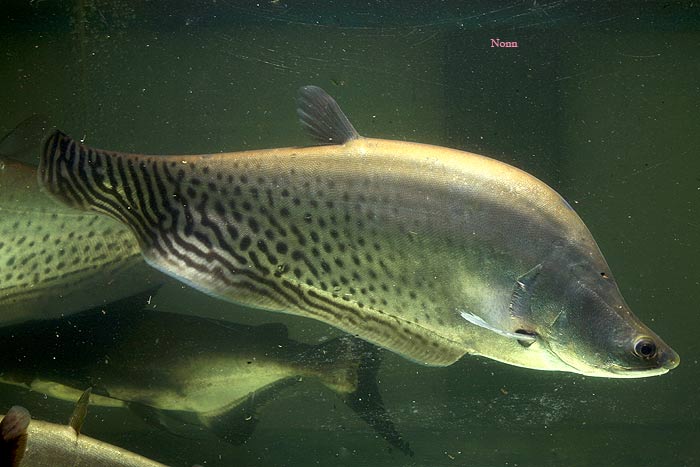
Chitala blanciRoyal Featherback
d'Aubenton, 1965
Max length1200mm SL47in SLTanknot recordedTemp20–28°C68–82°FpH6.0–8.0This species is also referred to as 'royal knifefish' in the aquarium trade but arguably has no place in the ornamental hobby given its adult size and specialised requirements. It can be distinguished from congeners by presence of many small, dark spots on the anterior portion of the body which merge to form oblique, irregular stripes extending onto the anal and caudal fins posteriorly.
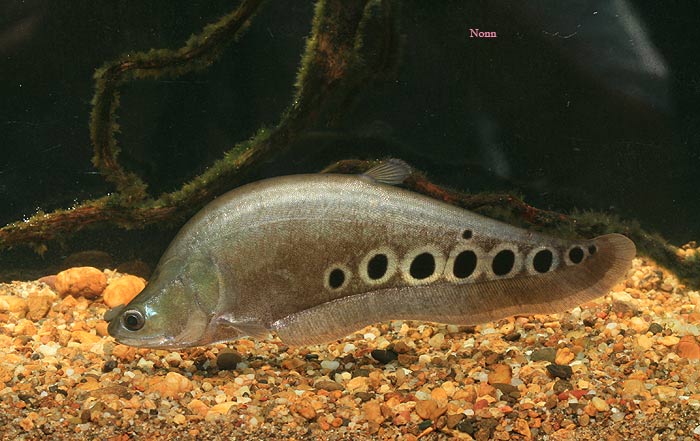
Chitala ornataClown Featherback
Gray, 1831
Max length1000mm SL39in SLTanknot recordedTemp20–28°C68–82°FpH6.0–8.0This species is also referred to as 'clown knifefish' in the aquarium trade. It arguably has no place in the ornamental hobby given its adult size and specialised requirements but remains inexplicably popular and an albino form has even been line-bred for the purpose. It can be distinguished from all congeners by presence of one or more rows of large ocellated spots above the base of the anal-fin, but...
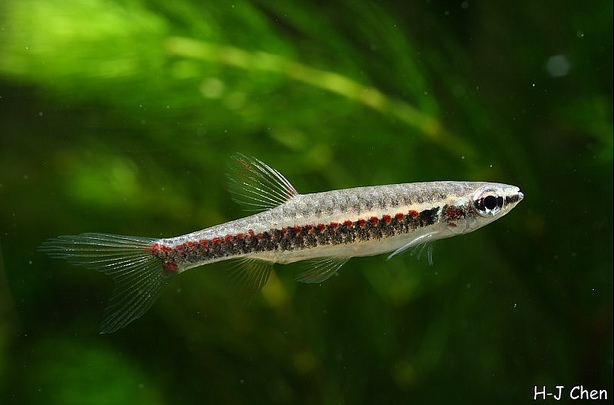
Copella nattereri
Steindachner, 1876
Max length45mm SL1.8in SLTank60 × 30cm24 × 12inTemp20–28°C68–82°FpH4.0–7.0This species is sometimes traded as C. sp. 'red line', 'spotted tetra' or as its congener C. nigrofasciata. In the past it's name was also widely applied to the fish now identified as C. callolepis and C. meinkeni, and this misidentification continues to an extent although the two are easily-distinguished by the fact that C. nattereri is the only one of the three possessing a dark lateral stripe on each side of the body.
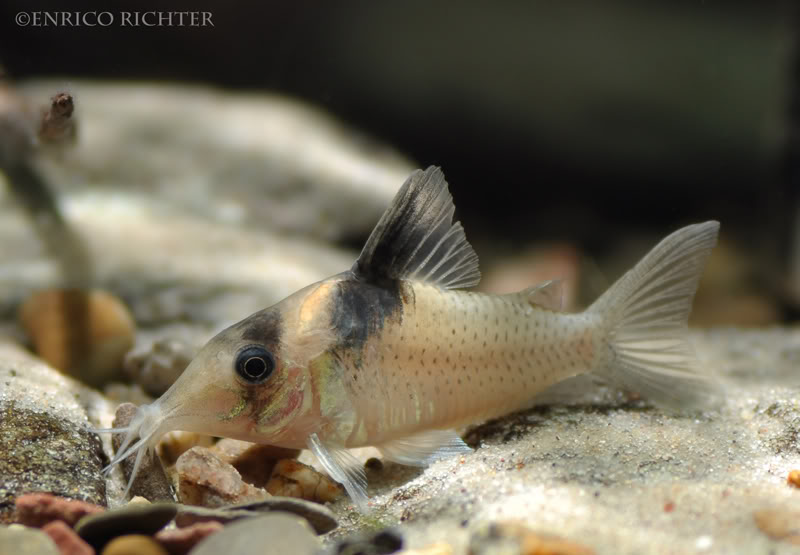
Corydoras amandajanea
Sands, 1995
Max length65mm SL2.6in SLTanknot recordedTemp23–27°C73–81°FpH6.0–7.5C. amandajanea is rare in the aquarium trade and appears to be variable in colour pattern to an extent, with some individuals posssessing relatively larger dark spots on the body, for example. Unfortunately diagnostic characters cannot be provided since we've been unable to obtain the type description, and little has been written about this species since it was published.
Corydoras atropersonatusFairy Cory
Weitzman & Nijssen, 1970
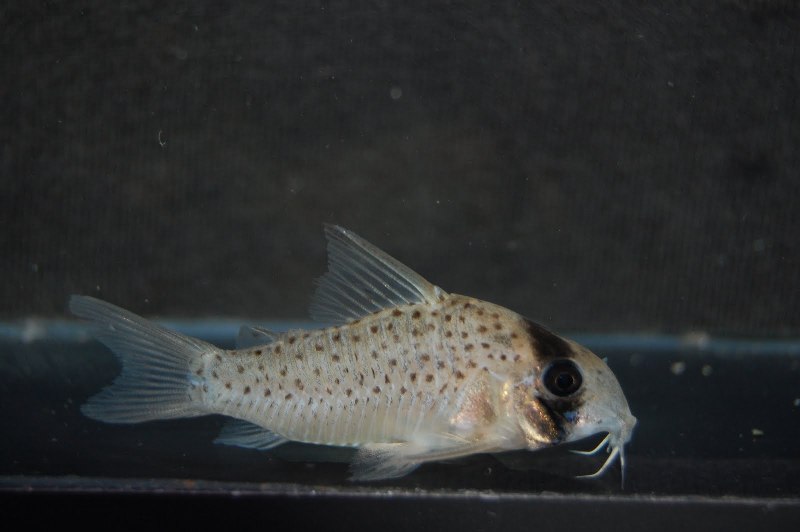
Max length50mm SL2.0in SLTanknot recordedTemp21–27°C70–81°FpH5.0–7.0This species is sometimes confused any of several similar-looking fishes such as C. sychri or C. sp. C097. While the former is a more elongate fish with a longer snout and quite easy to identify, C097 resembles C. atropersonatus more closely, despite being traded as C. sychri 'longnose'. Its snout is longer than that of C. atropersonatus but shorter than that of C. sychri, and the dark spots on the body tend to be more well-defined and spaced out than in the other two.
Corydoras caudimaculatusTailspot Cory
Rössel, 1961
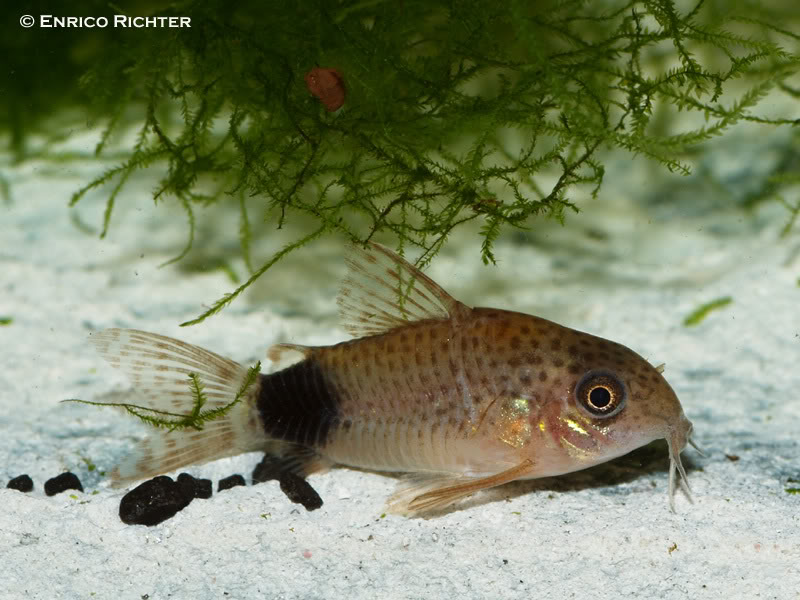
Max length50mm SL2.0in SLTanknot recordedTemp20–26°C68–79°FpH6.0–7.0C. caudimaculatus may be confused with the congener C. similis but can be told apart by possession of a well-defined, blackish spot on the caudal peduncle vs. a 'smudged' bluish marking. C. guapore also has a comparable colour pattern but possesses a distinctly rounded snout and tends to swim above the substrate.
Corydoras kaneiC026
Grant, 1998
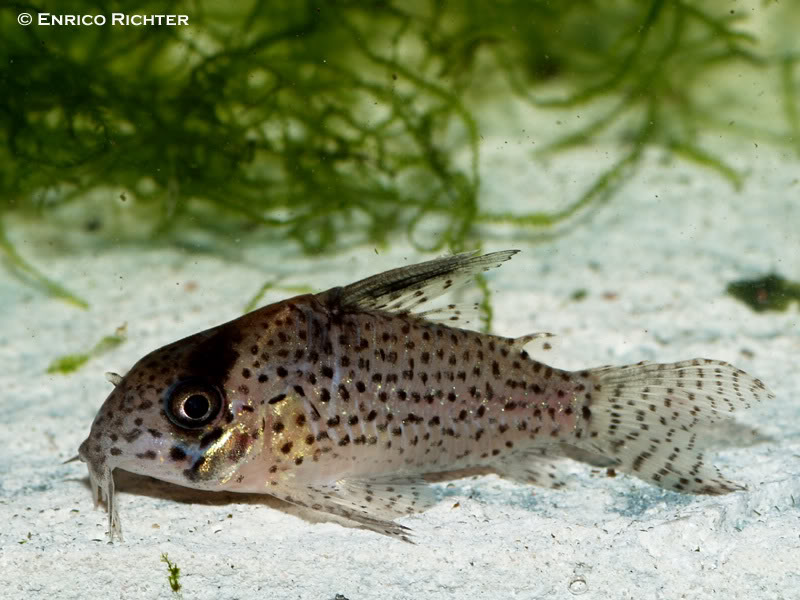
Max length50mm SL2.0in SLTank90 × 30cm36 × 12inTemp20–26°C68–79°FpH5.5–7.5Prior to description C. kanei was assigned the 'C' numbers C026 and C046. Among congeners it is most easily-confused with, and sometimes traded as, C. atropersonatus, but can be identified by presence (vs. absence in C. atropersonatus) of dark markings in the anal and caudal fins, presence of numerous, smaller (vs. fewer, larger) dark spots on the body, and an overall darker (vs. paler) base colouration.
Cyclocheilichthys armatus
Valenciennes, 1842
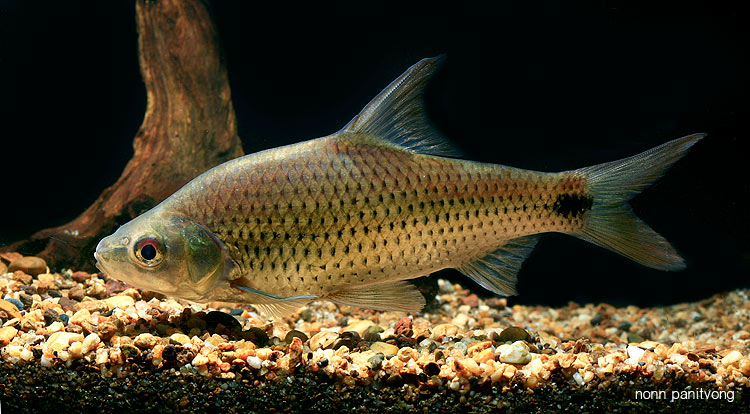
Max length230mm SL9in SLTank180 × 60cm72 × 24inTemp20–26°C68–79°FpH6.0–8.0It can be distinguished from congeners by possessing one or two pairs of barbels, a black blotch at the base of the caudal-fin, and rows of dark spots along the lateral scale rows. Members of Cyclocheilichthys are characterised by possessing a serrated dorsal fin spine, 9 branched pelvic fin rays, a conical snout, small, subterminal...
Dianema longibarbisPorthole Catfish
authority not recorded
Max length100mm SL3.9in SLTank90 × 38cm36 × 15inTemp24–28°C75–82°FpH5.5–7.5So named because of the row of spots running along the lateral line, the porthole cat is a good community species. Newly imported fish tend to be a little delicate and are susceptible to disease. This is at least in part because all specimens sold for the trade are wild caught. Once acclimatised, it usually proves very hardy and can be exceptionally long-lived for a fish of this size, having the potential to survive for over 10 years....
Dimidiochromis compressicepsMalawi Eye-Biter
authority not recorded
Max length250mm SL10in SLTank150 × 38cm60 × 15inTemp23–28°C73–82°FpH7.5–8.8D. compressiceps is an ambush predator in nature, its laterally compressed shape and head-down hunting position allowing it to remain hidden among Vallisneria beds and making it tricky to spot in open water. It has a dark stripe running from the snout along the back to the tail which serves to provide further camouflage. Despite its common name, it does not prey solely on the eyes of other species, preferring to hunt small fish (particularly juvenile Copadichromis sp.). It swallows these tai...
Ectodus descampsiiDescamp's Strange-Tooth Cichlid
authority not recorded
Max length104mm SL4in SLTank90 × 30cm36 × 12inTemp24–27°C75–81°FpH7.5–9.0A rare species in the hobby, there is also another, as yet undescribed fish sometimes imported as E. descampsii but this is thought to be a distinct species. This one is currently known as Ectodus sp. "north", as it's found further up the lake than E. decampsii. It can be distinguished by its smaller adult size and the fact that the black spot on the dorsal is found towards the front whereas in E. descampsii it's found in the middle of the fin. Confusingly, E. sp. "north...
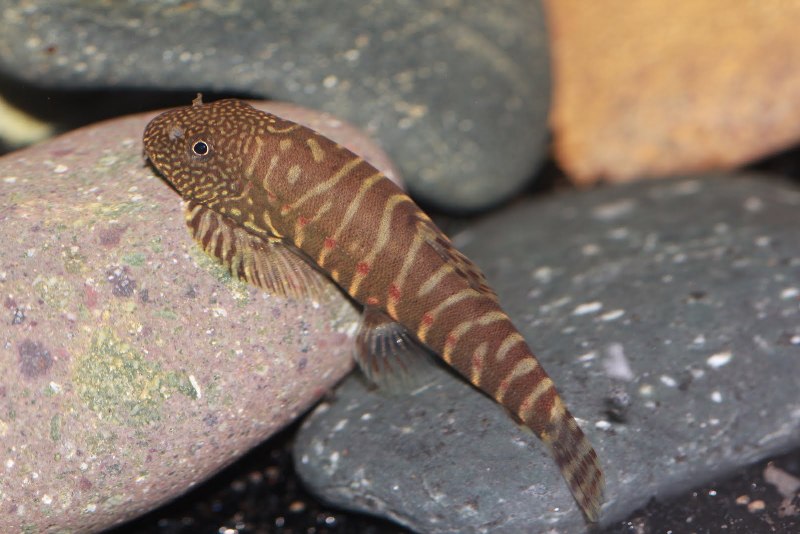
Erromyzon sp. 'ER02'
authority not recorded
Max length50mm SL2.0in SLTank60 × 30cm24 × 12inTemp18–24°C64–75°FpH6.5–8.0This fish remains in need of identification, and we've chosen to list unidentified members of the genus using an 'ER' numbering system in the absence of definitive information. It's quite easy to distinguish from congeners since it's the only species known to possess a colour pattern comprising a dark base colour and series of thin, paler vertical bars on the body and similarly-coloured spots on the head.
Gambusia affinisWestern Mosquitofish
authority not recorded
Max length40mm SL1.6in SLTanknot recordedTemp18–27°C64–81°FpH6.0–8.0For many years G. affinis was thought to be the same species as the Eastern Mosquitofish, G. holbrooki, but has since been given distinct species status. They can be distinguished by several means. In G. holbrooki the leading ray of the males' gonopodium has a serrated edge, theusually has 7 rays and males also generally have a higher degree of dark spotting on the body than G. affinis males. Male G. affinis also lack the serrated leading ray of the gonopodium and this species usually has o...
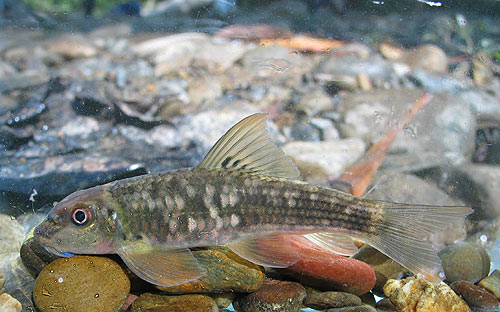
Garra notata
Blyth, 1860
Max length120mm SL5in SLTanknot recordedTempnot recordedpHnot recordedG. notata is one of a number of congeners to lack both a transverse groove and a proboscis on the snout. It also possesses 33-34 lateral line scales and a series of dark spots at the base of the dorsal-fin rays, and lacks scales on the lower portion of the body and abdomen. The genus Garra is a particularly enigmatic grouping with new taxa...
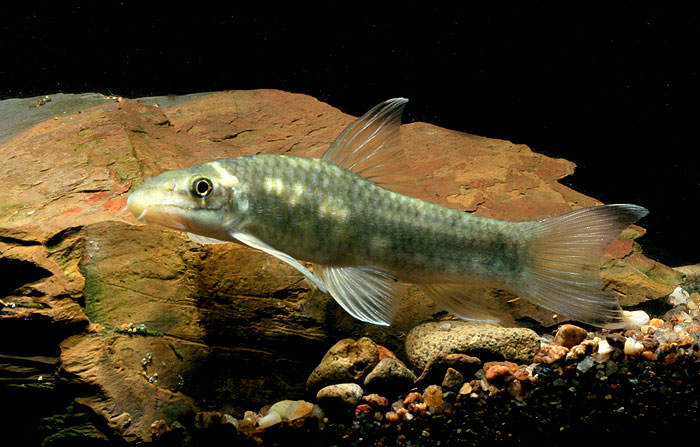
Garra rakhinica
Kullander & Fang, 2004
Max length60mm SL2.4in SLTanknot recordedTempnot recordedpHnot recordedG. rakhinica can be distinguished from other members of the genus by the following combination of characters: rostral furrow shallow and snout tip smoothly rounded; rostral lobe present, proboscis absent; scaled predorsal region, chest, and abdomen; two pairs of barbels; 28 lateral line scales; 16 circumpeduncular scale rows; colour pattern almost uniform greyish on body and caudal-fin; a dark spot immediately posterior to the upper extremity of the...
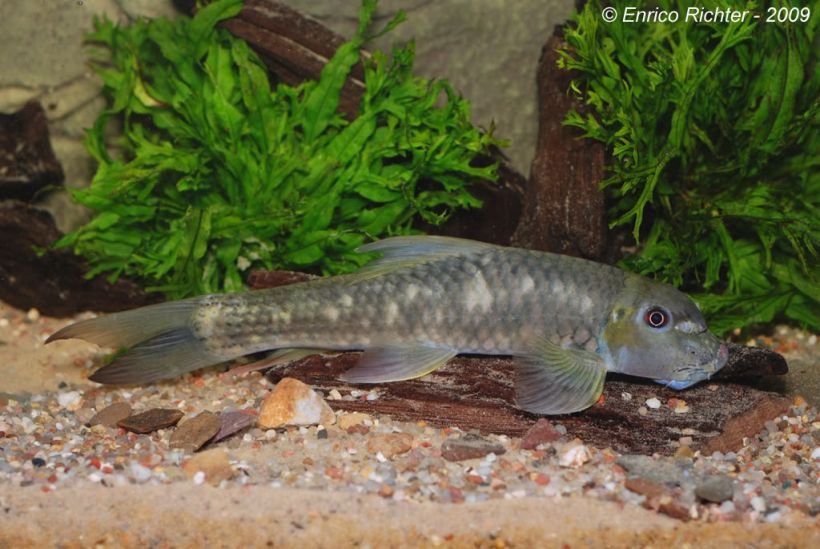
Garra salweenica
Hora & Mukerji, 1934
Max length175mm SL7in SLTanknot recordedTempnot recordedpHnot recordedG. salweenica can be distinguished from other congeners inhabiting the Salween watershed by the following combinatuion of characters: body brownish; presence of a trilobed proboscis on the snout; snout blunt; a series of black spots at the base of the central dorsal-fin rays; presence of longitudinal stripes on the posterior portion of the body; a dark marking at the tip of the upper (and lower in some specimens) caudal-fin lobe; body depth 22.4-25.3 % SL.
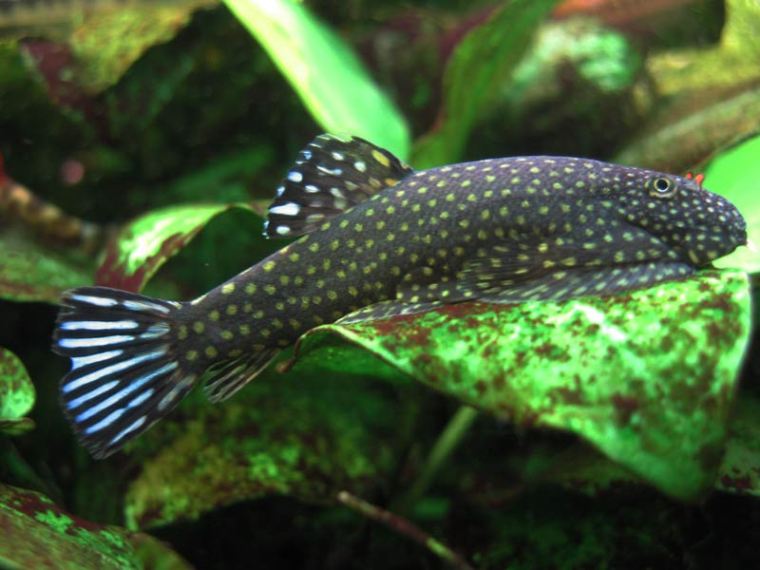
Gastromyzon ctenocephalus
Roberts, 1982
Max length40mm SL1.6in SLTank60 × 30cm24 × 12inTemp20–24°C68–75°FpH6.0–7.5One of the more commonly-traded members of the genus and often found in mixed shipments which may contain other Gastromyzon spp. or related fishes like Beaufortia kweichowensis, these often labelled collectively as 'Borneo sucker', 'Hong Kong pleco', 'butterfly loach', etc. It's sometimes misidentified as G. punctulatus, a species not currently traded which possesses yellow finnage and a lighter-coloured, less-intensely spotted body.
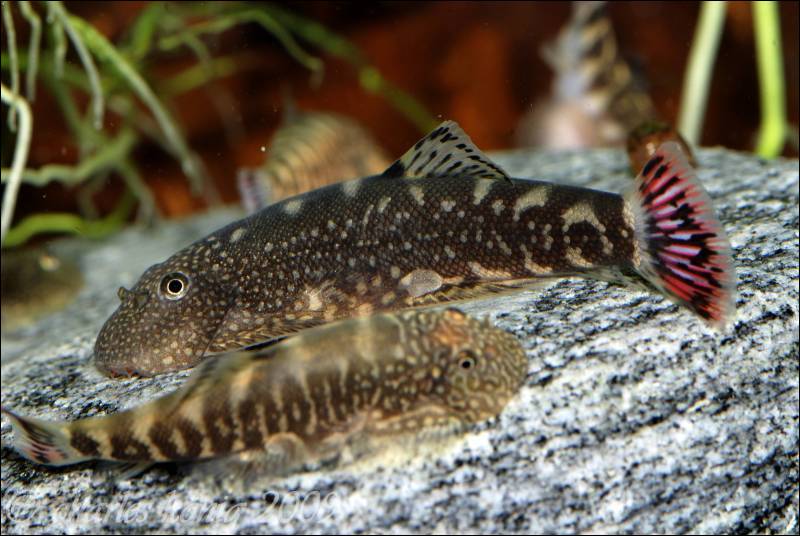
Gastromyzon ocellatus
Tan & Ng, 2004
Max length45mm SL1.8in SLTank60 × 30cm24 × 12inTemp20–24°C68–75°FpH6.0–7.5Some individuals do appear very similar to G. farragus, with noticeable spotting on the head, but can usually still be told apart by examining the caudal-fin which tends to contain only a single thick, dark vertical bar in G. farragus whereas in G. ocellatus there are more often two bars, one thick, one thinner. Intermediate forms do exist though meaning identification is sometimes tricky.
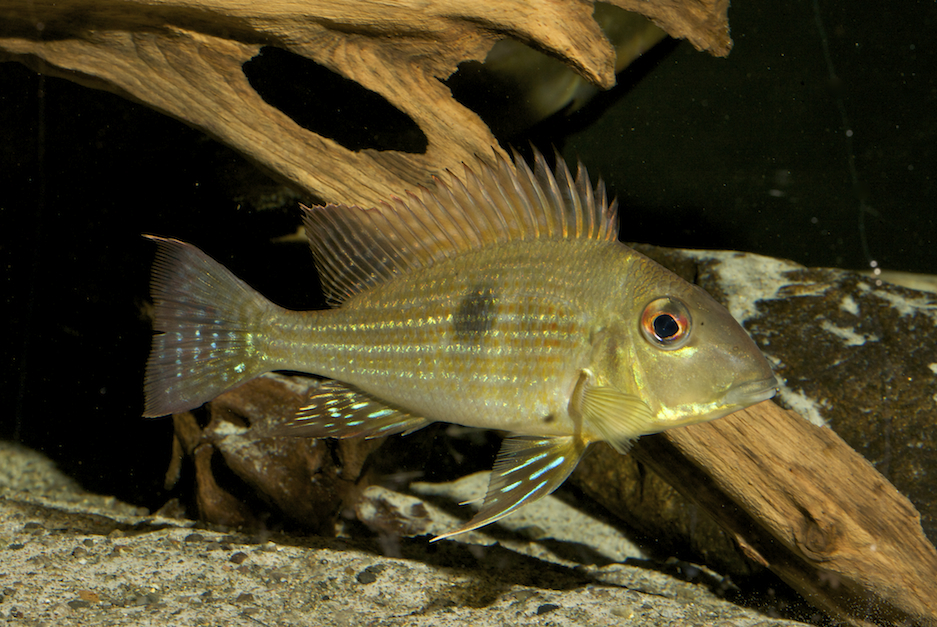
Geophagus brokopondo
Kullander & Nijssen, 1989
Max length150mm SL6in SLTank150 × 60cm60 × 24inTemp25–33°C77–91°FpH5.0–7.0This species is very rarely-traded since collections of fishes for commercial purposes aren't common in Suriname. It's a member of the nominal G. surinamensis 'group' of closely-related species within the genus and can be identified by a combination of characters including: no dark preopercular marking; six vertical/parallel bars on each flank (normally visible only when the fish are stressed, spawning or preserved); dark, squarish lateral spot positioned within the third vertical bar; sixth (posterior) bar elongate an...
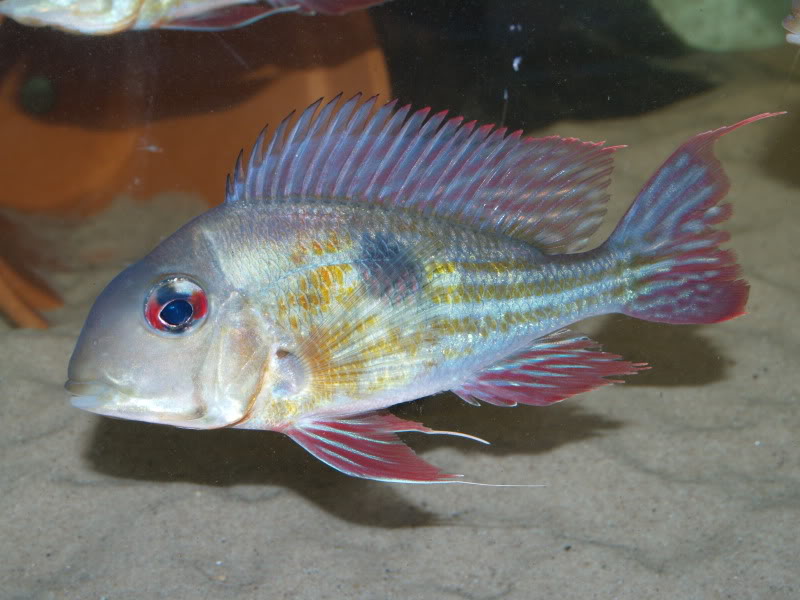
Geophagus proximus
Castelnau, 1855
Max length225mm SL9in SLTank180 × 60cm72 × 24inTemp24–32°C75–90°FpH4.0–7.0This species is rare in the hobby though it's name is often attached to shipments of other Geophagus species. It's a member of the nominal G. surinamensis 'group' of closely-related species within the genus and can be identified by a combination of characters including: possession of dark preopercular marking; no vertical bars on the flanks; relatively large, roughly oblong-shaped dark midlateral marking; caudal fin brownish with 3-5 light stripes on upper lobe and less well-defined stripes or mottled pattern of light spots with narrow dark interspaces on lower lobe.