Ectodus descampsii
Descamp's Strange-Tooth Cichlid
Last revised 2026Edit this page
On this page11 sections
Quick factsEdit
Difficulty4 of 8 measures
- Space
- large tank
- Water
- flexible
- Temp
- needs a steady temperature
- Diet
- unknown
- Temperament
- unknown
- Social
- needs to be in a group
- Compatibility
- unknown
Other demands
Each of these can raise the rating on its own, whatever the measures above say.
- Hardiness
- unknown
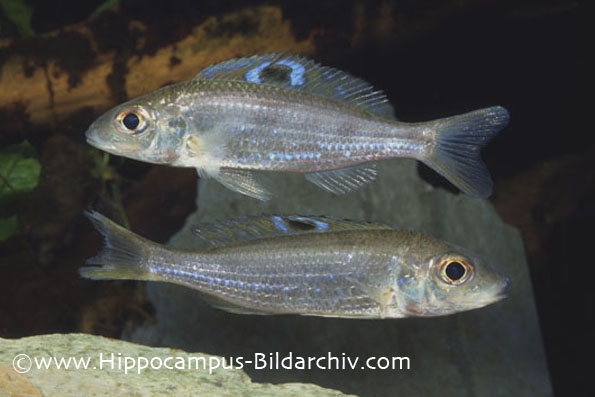
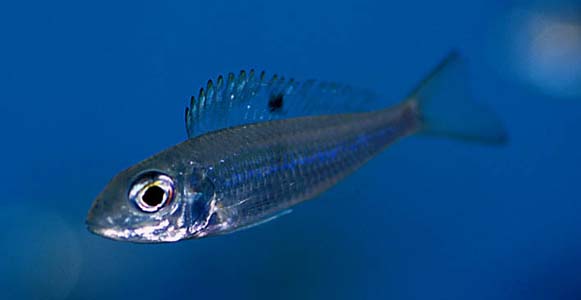
Descamp's strange-tooth cichlid, Ectodus descampsii, is a shy cichlid endemic to Lake Tanganyika, between Moliro and Utinta Bay. It inhabits open water over sand and is gregarious, so a group of at least eight is recommended. An undescribed fish, Ectodus sp. 'north', is sometimes imported under this name and has a smaller adult size and a black dorsal spot towards the front of the fin (in the middle in E. descampsii).
Distribution
EditEndemic to Lake Tanganyika, between Moliro and Utinta Bay.
Habitat
Write a noteEditIt inhabits open waters over sandy substrates.
Aquarium size
Write a noteEdit90 ∗ 30 ∗ 30 cm36 ∗ 12 ∗ 12 in - ~81 litres~21 US gal.
Maintenance
Write a noteEditThe aquarium should contain piles of rocks arranged to form caves with large areas of open water between them. A sandy substrate is best. This species does not damage vegetation so plants can be used but are not essential, likewise driftwood pieces. Select hard water-tolerant species such as Anubias or Vallisneria.
Water conditions
EditTemperature: 24 – 27 °C75 – 81 °F
pH: 7.5-9.0
Hardness: 10-25°H
These recommendations come from this profile’s own figures. They contain affiliate links, so we may earn a commission.
Diet
Write a noteEditWill accept most foods offered but live and frozen varieties should form the bulk of the diet.
Behaviour and compatibility
Write a noteEditThe species is quite shy by nature, and aggressive or boisterous tankmates such as Mbuna should be avoided. Good choices include Julidochromis, Neolamprologus, Cyprichromis and Tanganyikan Synodontis catfish. It's important to keep a group of at least eight of these, as it's gregarious by nature and may become withdrawn without the security of conspecifics.
Sexual dimorphism
Write a noteEditUnknown. The male's dorsal spot is larger than that of the female according to some sources.
Reproduction
Write a noteEditUnrecorded in aquaria although it is likely possible. Little information about its natural spawning behaviour exists. It's known to be a polygamous maternal mouthbrooder that spawns in depressions in the substrate which are dug by the male. If you want to breed this fish using a similar approach as with other substrate-spawning Malawi cichlids is probably a good place to start.
Notes
EditA rare species in the hobby, there is also another, as yet undescribed fish sometimes imported as E. descampsii but this is thought to be a distinct species. This one is currently known as Ectodus sp. "north", as it's found further up the lake than E. descampsii. It can be distinguished by its smaller adult size and the fact that the black spot on the dorsal is found towards the front whereas in E. descampsii it's found in the middle of the fin. Confusingly, E. sp. "north" was until recently thought to be the true descampsii whereas the southern population was referred to as Ectodus d. "ndole".
Verne (2001) found that the holotype of E. descampsii was actually the same as the southern population, and the names have now been changed accordingly.
Species images · 2
These photographs are used with each photographer's permission.
Send a photographDistribution
Profile completeness19 of 24
79% complete
Also missing: taxonomic authority, etymology.
Community
Questions about Ectodus descampsii?
Ask on Discord