Results for “species”
Type a name: scientific, common, or one a species used to go by. Or narrow the catalogue with the filters.
Filters
Serrasalmus elongatusPike Piranha
authority not recorded
Max length300mm SL12in SLTank120 × 60cm48 × 24inTemp24–28°C75–82°FpHnot recordedS. elongatus is known as "Caribe Pinche" in its native countries and is a rare find in the trade, tending to be quite expensive as a result. Individuals seem to vary in personality. While some are particularly fearless and will actively chase and attempt to bite hands or fingers placed in or up against the aquarium, others will always appear to be shy and nervous. The streamlined body form that gives rise to the species name is unique among serrasalmids, and has probably developed as a...
Serrasalmus geryiGéry's Pirambeba
authority not recorded
Max length181mm SL7in SLTank120 × 60cm48 × 24inTemp22–29°C72–84°FpHnot recordedS. geryi is sometimes sold as the "violet-line piranha" in reference to the unusal purple stripe that runs from the base of the lower jaw over the top of the body. It makes a stunning aquarium fish as it also possesses highly reflective scales, deep orange/red eyes and a compressed, high-bodied shape. Far from widespread in nature or the hobby, it tends to be pricey and highly sought-after when available. There are currently 24 described species of Serrasalmus, many of which look s...
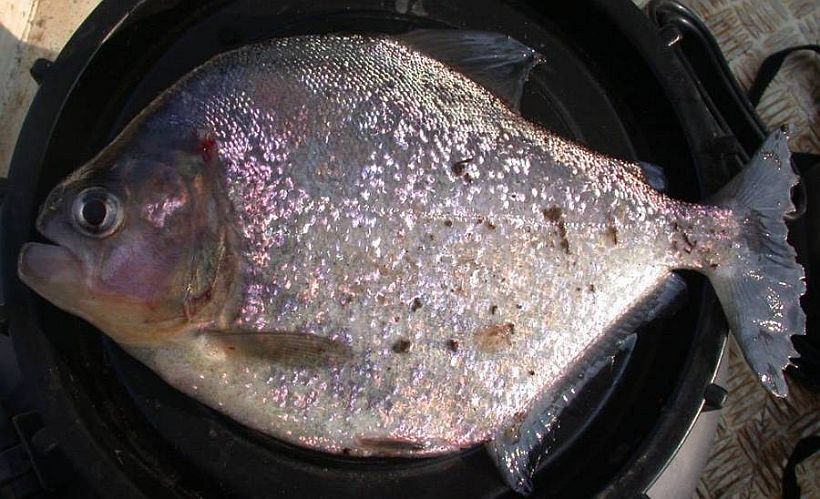
Serrasalmus gouldingiGoulding's Piranha
Fink & Machado-Allison, 1992
Max length280mm SL11in SLTank150 × 60cm60 × 24inTemp24–28°C75–82°FpH4.0–7.0This species occasionally appears in the ornamental trade where it is sometimes referred to as 'blue tiger piranha' Following Fink and Macaht can be distinguished from other members of the genus by the following combination of characters: body shape deep and rhomboid; head robust, snout blunt; eye large; mouth moderate, jaw projecting; 1-3 ontogeneticlly var...
Serrasalmus maculatusMac
authority not recorded
Max length210mm SL8in SLTank120 × 45cm48 × 18inTemp21.1–30°C70–86°FpHnot recordedS. maculatus is one of the better choices for aquarists new to this group of fishes. It grows to a manageable size, is relatively hardy, attractive and usually quite inexpensive. It's sometimes referred to by the alternative vernacular names "gold piranha" or "golden mac" in the hobby. There are in excess of 30 described species of Serrasalmus many of which appear superficially similar and have confusing taxonomic histories. S. maculatus and S. spilopleura have often ...
Serrasalmus sancheziSanchez's Piranha
authority not recorded
Max length114mm SL4in SLTank120 × 30cm48 × 12inTemp24–28°C75–82°FpHnot recordedThere are currently 24 described species of Serrasalmus, many of which look superficially similar. S. sanchezi has frequently been confused with S. spilopleura in the past, and is sometimes still sold as "Spilo cf" or "Ruby-red Spilo". It actually appears to be more closely related to S. rhombeus or S. irritans than S. spilopleura. The characteristic red throat has also led to it being confused with S. medinai and even the red-bellied piranha Pygocentrus nattereri on occasion...
Serrasalmus serrulatus
authority not recorded
Max length190mm SL7in SLTank120 × 45cm48 × 18inTemp24–28°C75–82°FpHnot recordedThere are currently 24 described species of Serrasalmus, many of which look superficially similar. S. serrulatus occupies a particularly confusing taxonomic position and is very tricky to identify positively. According to scientific literature it is very close in appearance to several congeners, most notably S. eigenmanni, S. hollandi, S. humeralis and S. nalseni. The separation of these is largely based on geographical range and it's possible that some of them may turn out to be synonymous...
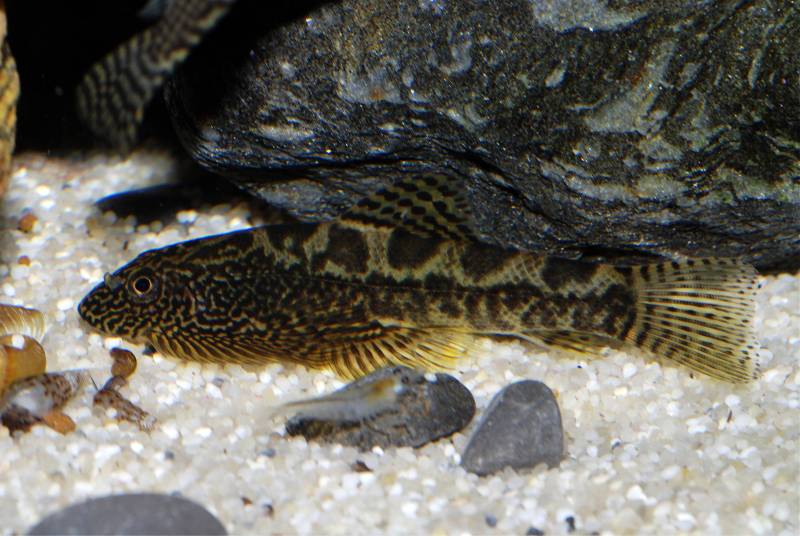
Sewellia sp. 'SEW03'
authority not recorded
Max length60mm SL2.4in SLTank75 × 30cm30 × 12inTemp20–24°C68–75°FpH6.0–7.5This fish first became available in early 2009 and was initially identified as S. breviventralis (Freyhof and Serov, 2000). However it cannot be that species because there is no discernible gap between pelvic and anal fins, which also discounts the possibility of it being S. elongata (Roberts, 1998). It therefore remains unidentified and is often imported in mixed batches with S. sp. 'SEW02', which it also resembles closely.
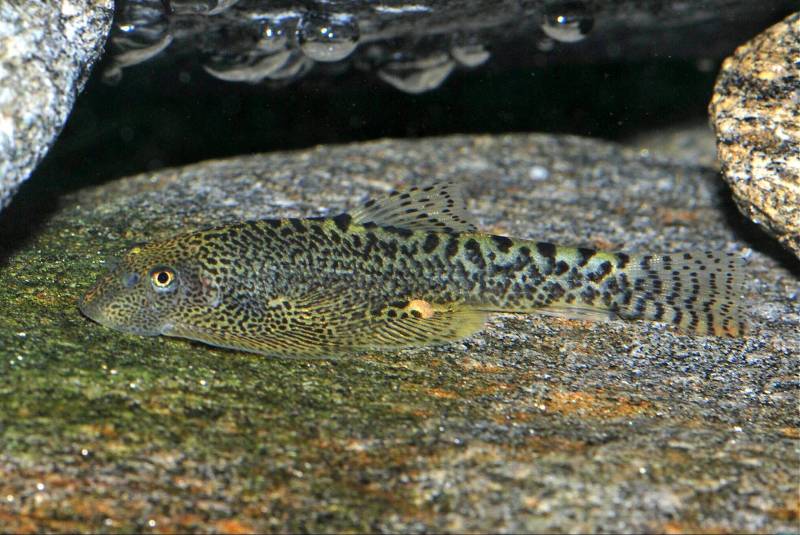
Sewellia sp. 'SEW04'
authority not recorded
Max length60mm SL2.4in SLTank75 × 30cm30 × 12inTemp20–24°C68–75°FpH6.0–7.5This fish has thus far only been imported among shipments of S. sp. 'SEW02' and S. sp. 'SEW03'. It doesn't appear to correspond to any known member of the genus and may be undescribed. Prior to the mid-1990s S. lineolata was the only species in the genus but an upturn in surveys of fresh water fauna in Vietnam and Laos has resulted in the discovery of various new taxa, several of which remain undescribed.
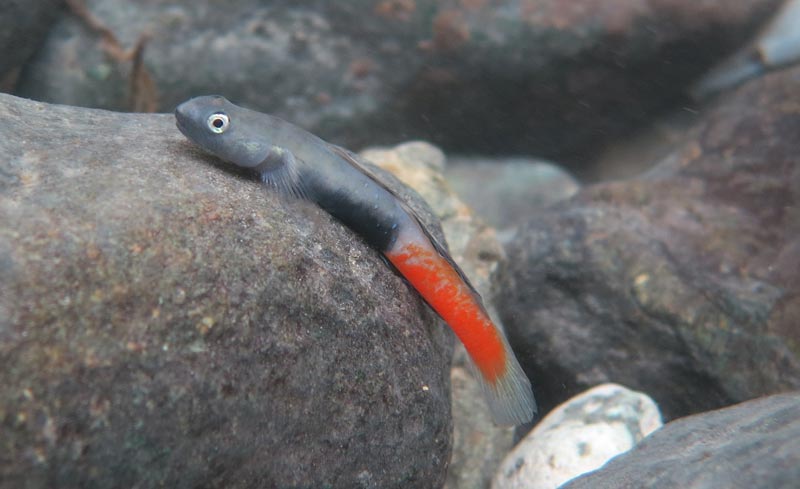
Sicyopus cebuensis
Chen & Shao, 1998
Max length45mm SL1.8in SLTank60 × 30cm24 × 12inTemp22–28°C72–82°FpH6.5–7.5This species is not in the aquarium trade though is maintained by a few private collectors. It can be distinguished from all other members of the genus by the following combination of characters: first dorsal-fin withfirst dorsal-fin elongate in males; anterior portion of body with loosely-arranged ctenoid scales; head, entire nape to first dorsal-fin base, pectoral base, and belly naked; male colour pattern comprising creamy-yellow anterior portion of body with dark blotch at midbody and bright orange/red in postero...
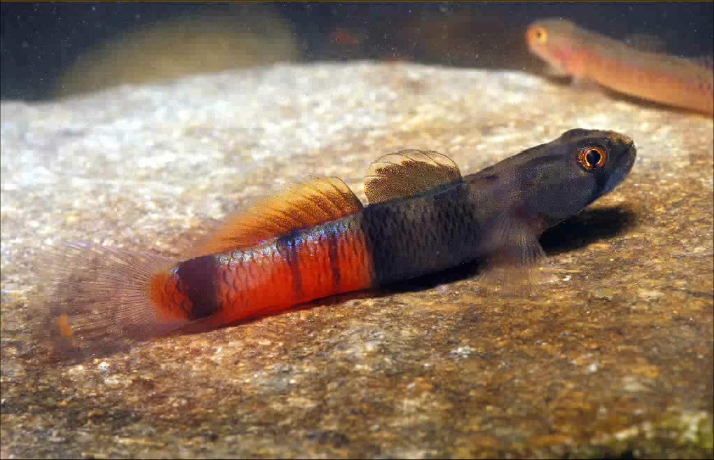
Sicyopus zosterophorus
Bleeker, 1856
Max length45mm SL1.8in SLTank60 × 30cm24 × 12inTemp22–26°C72–79°FpH6.0–7.5Type locality is given as 'Boleling, northern Bali, Indonesia' which appears to correspond to modern-day Buleleng, but this species is currently understood to have a patchy but wide distribution with a range stretching westwards from the Marquesas Islands (French Polynesia), throughout much of Vanuatu, New Caledonia, the Solomon Islands, Papua New Guinea, Palau, Fiji, Indonesia, the Philippines, Japan, Taiwan, and most recently, southern mainland China...
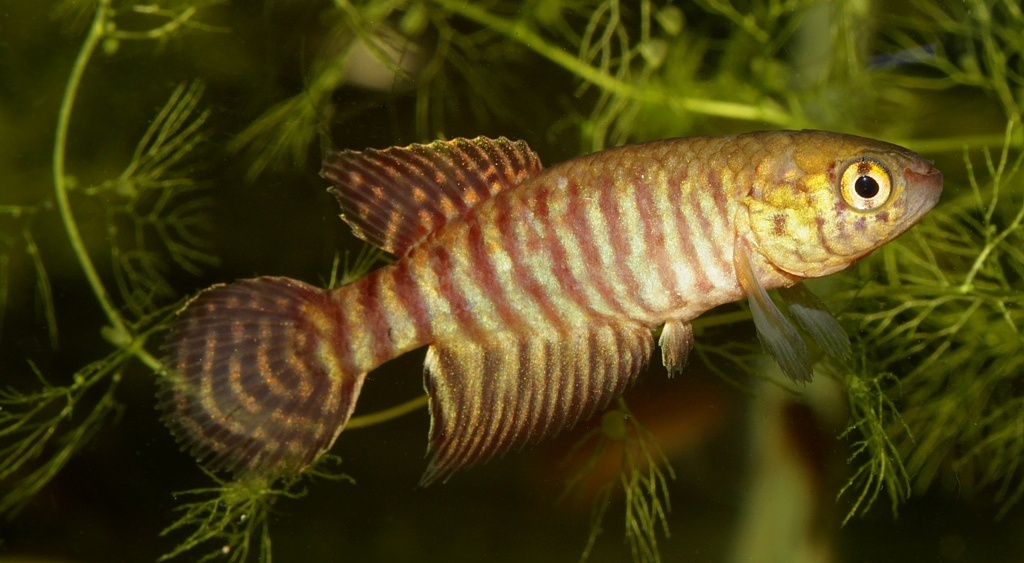
Simpsonichthys myersi
de Carvalho, 1971
Max length40mm SL1.6in SLTank45 × 30cm18 × 12inTemp20–27°C68–81°FpH5.5–7.0This species has a somewhat confusing taxonomic history and it remains unclear whether it is conspecific with S. izecksohni (Da Cruz, 1983) or not. The latter is considered to represent a synonym of S. myersi by Costa (2007), but the majority of authors do not follow the conclusions of that study (see below) and continue to view both as valid.
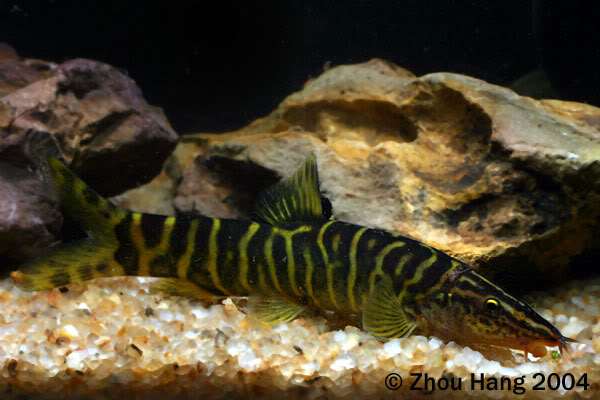
Sinibotia pulchraGolden Zebra Loach
Wu, 1939
Max length110mm SL4in SLTank120 × 30cm48 × 12inTemp20–25.5°C68–78°FpH6.5–8.0This species is also sold under the vernacular names 'golden Chinese loach' and '12-banded Chinese loach'. Along with S. robusta it's the most commonly-traded member of the genus, and the two are often imported in mixed batches, presumably because they occur and are thus collected together in nature. Like most congeners it has a highly flexible, sinuous body which makes it very interesting to observe. S. pulchra can be differentiated from...
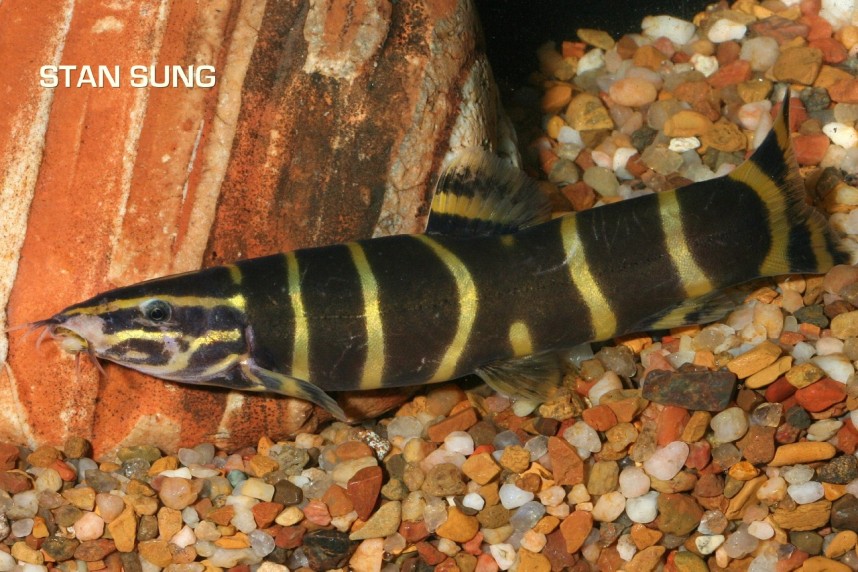
Sinibotia reevesae
Chang, 1944
Max length95mm SL3.7in SLTank120 × 30cm48 × 12inTemp20–25.5°C68–78°FpH6.5–8.0This species not often seen in the aquarium trade and is apparently rare in its natural waters, with the occasional individual imported as bycatch in shipments of S. pulchra or S. robusta, or by private collectors. Like others in the genus it has a highly flexible, sinuous body which makes it very interesting to observe. It's told apart from congeners by the following combination of chara...
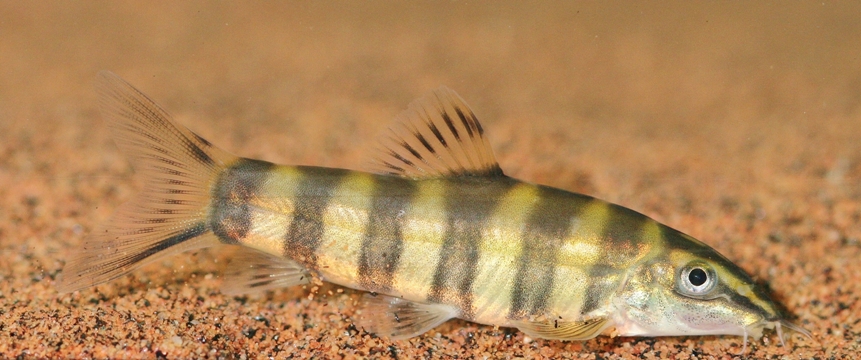
Sinibotia robustaKansu Loach
Wu, 1939
Max length100mm SL3.9in SLTank120 × 30cm48 × 12inTemp20–25.5°C68–78°FpH6.5–8.0This species is also sold under the vernacular names 'golden Chinese loach' and '12-banded Chinese loach'. Along with S. pulchra it's the most commonly-traded member of the genus, and the two are often imported in mixed batches, presumably because they occur and are thus collected together in nature.
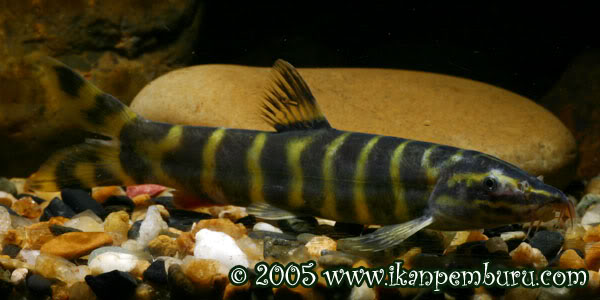
Sinibotia superciliaris
Günther, 1892
Max length110mm SL4in SLTank120 × 30cm48 × 12inTemp20–25.5°C68–78°FpH6.5–8.0This species is rarely-seen in the trade due to a relative lack of commercial exports from the middle Yangtze basin. It looks very similar to S. pulchra but can be told apart by the fact it lacks irregular, brownish markings and spots on the side of the head (vs. present in S. pulchra), and like most congeners it has a highly flexible, sinuous body which makes it very interesting to observe.
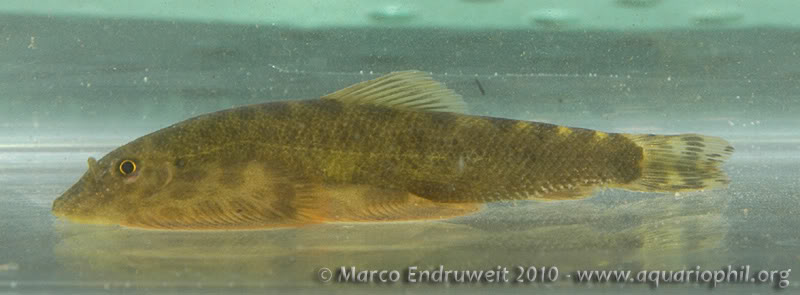
Sinogastromyzon tonkinensis
Pellegrin & Chevey, 1935
Max length65mm SL2.6in SLTank75 × 30cm30 × 12inTemp15–22°C59–72°FpH7.0–9.0At the type locality of the congener S. lixianjiangensis sympatric species included Balitora kwangsiensis, Glyptothorax quadriocellatus, Garra orientalis, Hemibagrus pluriradtus, Poropuntius huangchieni, Pseudecheneis paviei,...
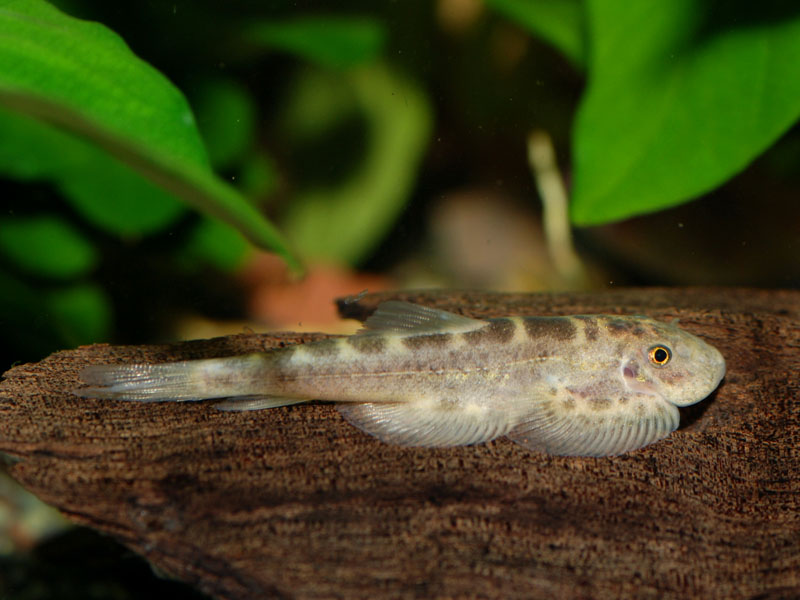
Sinogastromyzon wui
Fang, 1930
Max length110mm SL4in SLTank75 × 30cm30 × 12inTemp20–24°C68–75°FpH6.5–8.0This species is probably the most common member of the genus in the aquarium trade but still not often exported in numbers. Instead it's more often found in mixed shipments of other wild-collected fishes from southern China, particularly Beaufortia or Pseudogastromyzon spp. It may appear superficially simi...
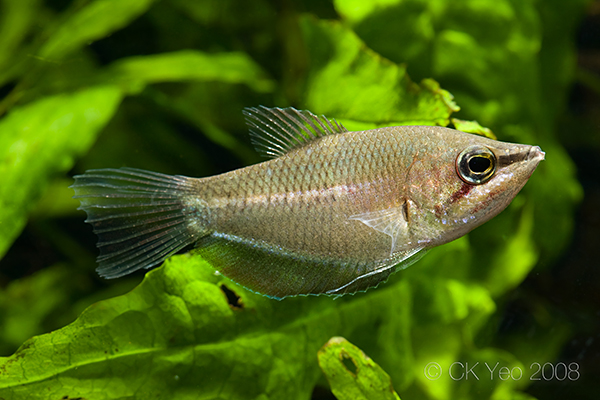
Sphaerichthys acrostomaGiant Chocolate Gourami
Vierke, 1979
Max length70mm SL2.8in SLTank80 × 30cm31 × 12inTemp21–25°C70–77°FpH3.5–6.5This species is traded under several names of which others include 'sharp-nosed gourami', 'moonlight chocolate gourami', 'black-lined chocolate gourami' and 'black-tailed chocolate gourami', though it's far from common in the hobby. Its unique colour pattern makes it difficult to confuse with any of the three other members of the genus even in the absence of meristic data.
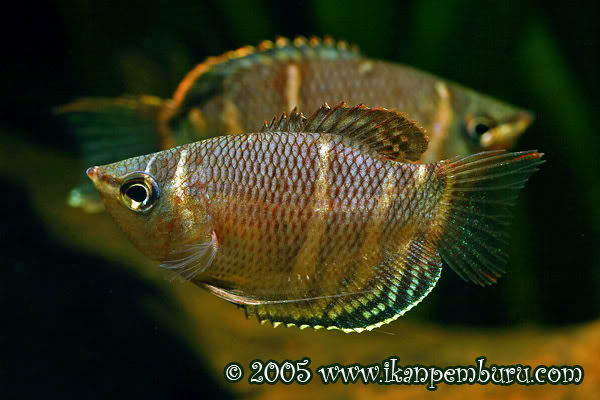
Sphaerichthys osphromenoidesChocolate Gourami
Canestrini, 1860
Max length50mm SL2.0in SLTank60 × 30cm24 × 12inTemp26–31°C79–88°FpH4.0–6.5The genus Sphaerichthys currently comprises four species with S. osphromenoides by far the best known in the hobby. It's easily distinguishable from the congeners S. vaillanti and S. acrostoma since both exhibit a notably more elongate head and body profile, reverse sexual dimorphism (i.e. females are the more colourful/strongly-patterened), and are paternal mouthbrooders.
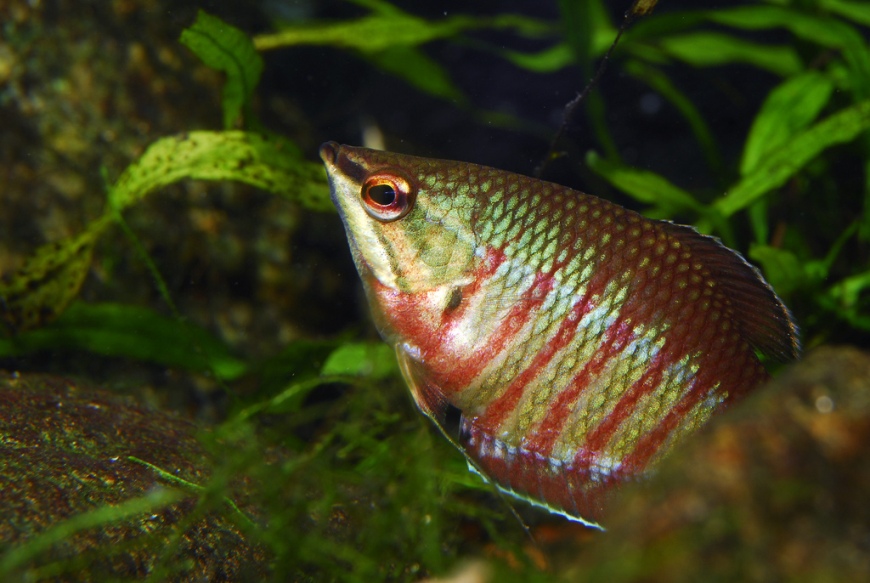
Sphaerichthys vaillantiVaillant's Chocolate Gourami
Pellegrin, 1930
Max length55mm SL2.2in SLTank60 × 30cm24 × 12inTemp21–25°C70–77°FpH3.5–6.5This species is traded under several names of which others include 'Samurai gourami' and 'Samurai Zebra Chocolate Gourami'. Though the former of these is arguably the most common, these names are potentially misleading since the fish is neither especially combative nor from Japan. Its unique colour pattern makes it difficult to confuse with any of the three other members of the genus even in the abse...