Results for “dorsal-fin”
Type a name: scientific, common, or one a species used to go by. Or narrow the catalogue with the filters.
Filters
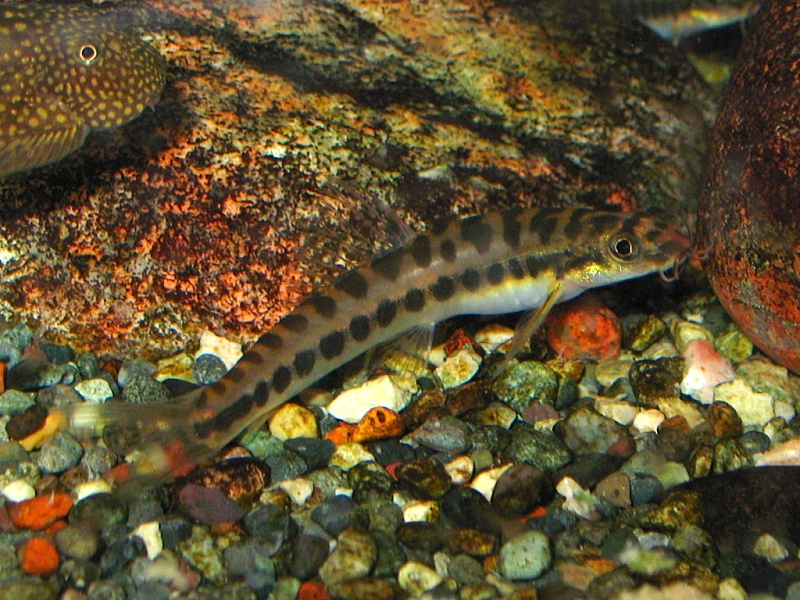
Nemacheilus masyaeArrow Loach
Smith, 1933
Max length70mm SL2.8in SLTank60 × 30cm24 × 12inTemp23–26°C73–79°FpH6.0–7.5This species was originally named Nemacheilus masyae but following ICZN rules the spelling was later corrected to N. masyai because it's named after a man. It can be distinguished from the majority of congeners by body patterning comprising 14-18 short, dark vertical bars on each flank, 12-17 saddle-like markings running along the dorsal surface, a dark spot on the caudal peduncle at the termination of the lateral line and a dark blotch in the lower half of the first few dorsal-fin rays.
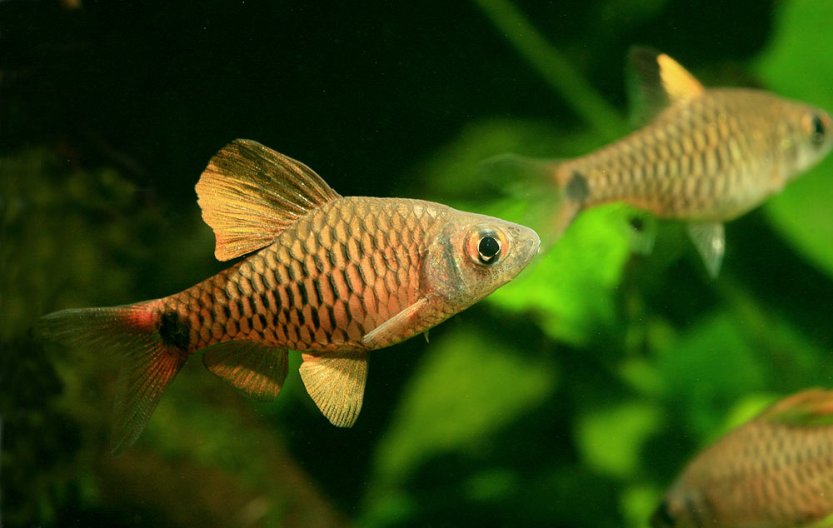
Oreichthys sp. 'Myanmar Redfin'
authority not recorded
Max length40mm SL1.6in SLTank60 × 30cm24 × 12inTemp24–28°C75–82°FpH6.5–7.5This fish is one of several sometimes imported and sold as Oreichthys cosuatis or O. parvus which has led to considerable confusion. It appears to be an undescribed species and can be most easily identified by the absence of a dark marking in the dorsal-fin of adult males (vs. presence in O. cosuatis and O. parvus) and possession of a large, well-defined black blotch on the caudal peduncle ( vs. absent in O. cosuatis, smaller and less well-defined in O. parvus).
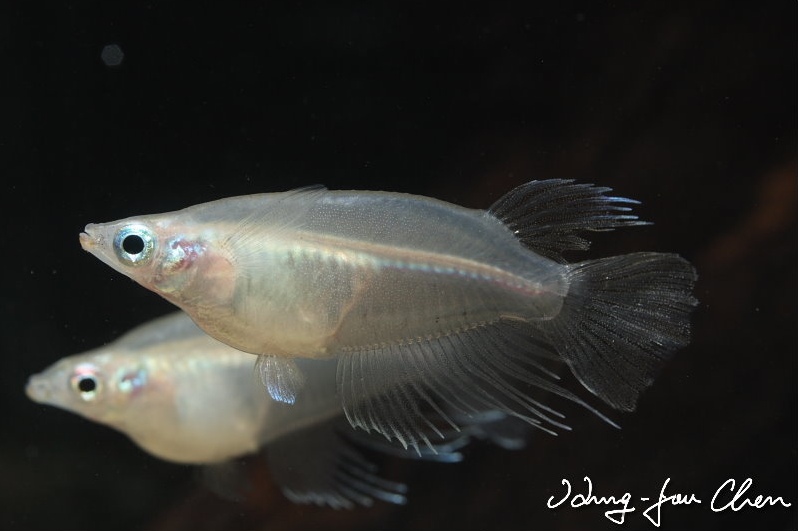
Oryzias dancenaIndian Ricefish
Hamilton, 1822
Max length35mm SL1.4in SLTank45 × 30cm18 × 12inTemp23–27°C73–81°FpH6.5–8.5This species continues to be mislabelled as O. melastigma, a name currently considered invalid by the majority of recent workers, or O. javanicus, a valid but distinct taxon. Roberts (1998) demonstrated that MClelland's description of Aplocheilus melastigmus, later renamed O. melastigma, does not correspond with any known Oryzias species from the Indian subcontinent or Myanmar since it's said to have a dark spot in the dorsal-fin and an excessively slim body, among other anomalies.
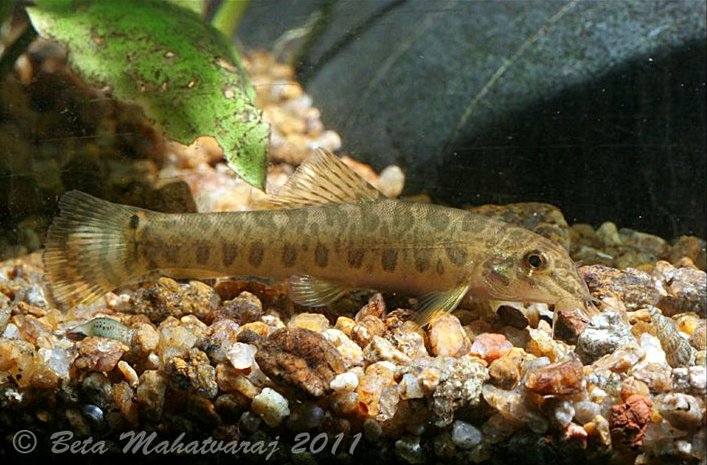
Paracanthocobitis mooreh
Sykes, 1839
Max length75mm SL3.0in SLTank75 × 30cm30 × 12inTemp20–26°C68–79°FpH6.0–7.5This species is still considered a member of the genus Nemacheilus by some sources, but it was reclassified and placed in Acanthocobitis by Grant (2008). Acanthocobitis sinuata, generally considered a junior synonym of A. mooreh (Kottelat, 2012b), also appears distinct and differs in geographical distribution plus number of dorsal-fin rays (2-3/9-10 in A. mooreh vs. 2/8-9 in A. sinuata) and some aspects of colour pattern.
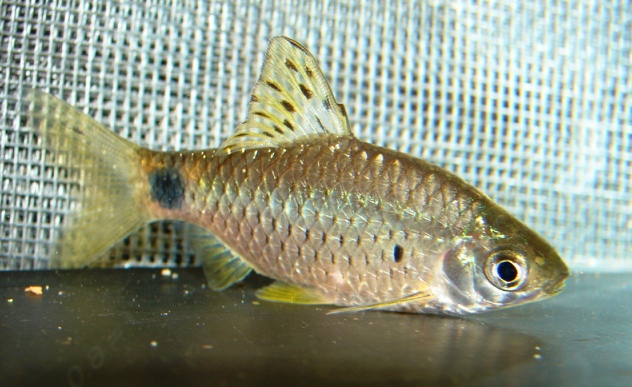
Pethia punctata
Day, 1865
Max length55mm SL2.2in SLTank75 × 30cm30 × 12inTemp21–26°C70–79°FpH6.0–7.5This species is poorly-known in the aquarium hobby and has a confusing taxonomic history having been considered both synonymous with or a subspecies of the congener P. ticto in the past. It can be distinguished from other members of the genus by the following combination of characters: lateral line complete with 27 scales (following Day); body with two dark blotches; anterior spot one scale row below lateral line; dorsal-fin with rows of spots.
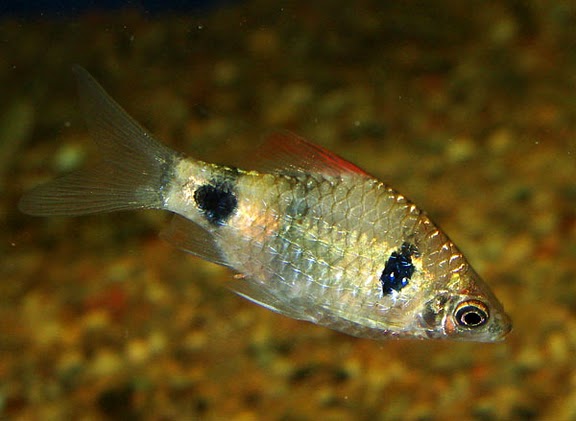
Pethia setnaiNarayan Barb
Chhapgar & Sane, 1992
Max length65mm SL2.6in SLTank90 × 30cm36 × 12inTemp20–26°C68–79°FpH6.0–7.5This species is widely referred to and traded as the congener 'Puntius' narayani (Hora, 1937). The precise identity of the latter is in doubt, however, plus P. setnai possesses a serrated dorsal-fin spine whereas 'P.' It was formerly included in the Puntius conchonius 'group' of closely-related species alongside P. ater, P. bandula, P. conchonius, P. cumingii, P. erythromycter,...
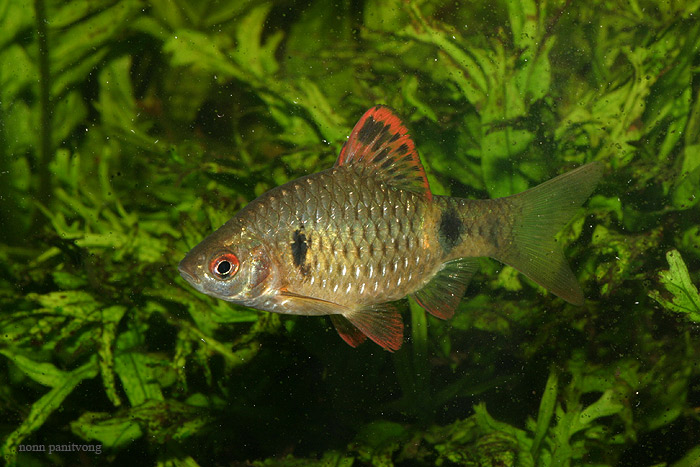
Pethia stoliczkana
Day, 1871
Max length50mm SL2.0in SLTank75 × 30cm30 × 12inTemp18–26°C64–79°FpH6.0–7.5This species is confused with P. ticto in much of the available literature and is sometimes listed as a synonym of it. Although some populations of the two species possess a similar colour pattern (there are reports of a P. ticto variant from the south of West Bengal state in India with a red, black-flecked dorsal-fin, for example) they do not occur in the same waters in nature and can be distinguished by examining the lateral line. This is complete in...
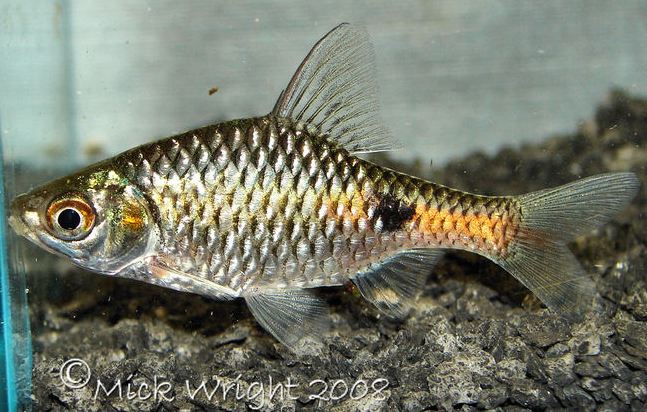
Puntius terioOnespot Barb
Hamilton, 1822
Max length90mm SL3.5in SLTank80 × 30cm31 × 12inTemp18–26°C64–79°FpH6.5–7.5This species is uncommon in the aquarium trade which is a little surprising given its huge natural range. Different populations can vary in colour pattern to an extent though all share the defining aspects given by Hamilton, comprising a diffuse yellow-golden marking on the operculum plus a dark spot on the caudal peduncle. The latter is usually surrounded by a variably-sized golden-yellow margin, and the dorsal-fin often contains irregular dark spots and streaks, these sometimes forming a longitudinal band.
Puntius vittatusGreenstripe Barb
Day, 1865
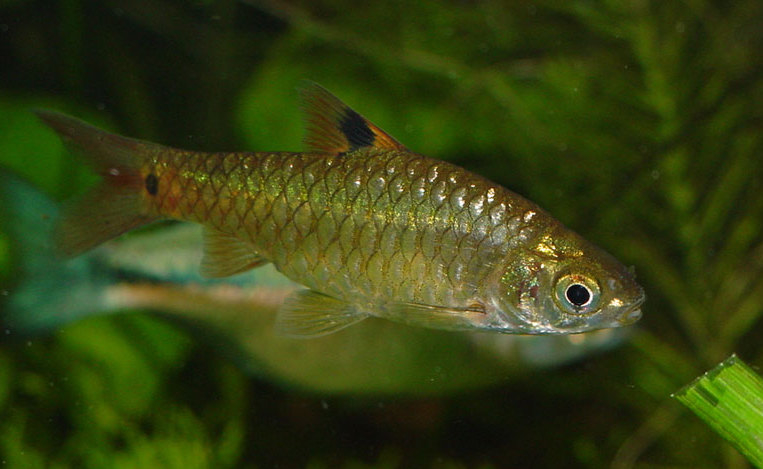
Max length45mm SL1.8in SLTank75 × 30cm30 × 12inTemp18–26°C64–79°FpH6.0–7.5It can be told apart from similar-looking congeners such as P. crescentus and P. muzaffarpurensis by the following combination of characters: barbels absent; lateral line incomplete with up to 5 pored scales; 20-22 lateral line scales; 8 predorsal scales; dorsal-fin with a vertically-orientated black streak and a black tip with orange markings; a dark spot at the base of the caudal peduncle.
Satanoperca pappaterraPantanal Eartheater
Heckel, 1840
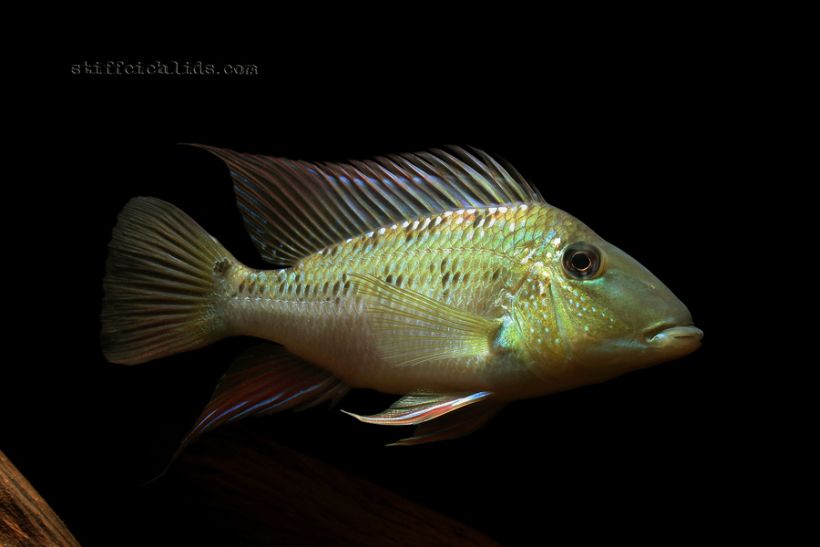
Max length200mm SL8in SLTank210 × 60cm84 × 24inTemp20–28°C68–82°FpH5.5–7.5S. pappaterra is relatively rare in the ornamental trade and much sought after by enthusiasts. It is easily distinguished from all known congeners by presence of a series of prominent black blotches beneath the dorsal-fin, plus a well-defined dark band extending along the side of the body. In recent genetic analyses its genetic distinctness was strongly supported, with S. jurupari and S. leucosticta its closest relatives.
Schistura disparizona
Zhou & Kottelat, 2005
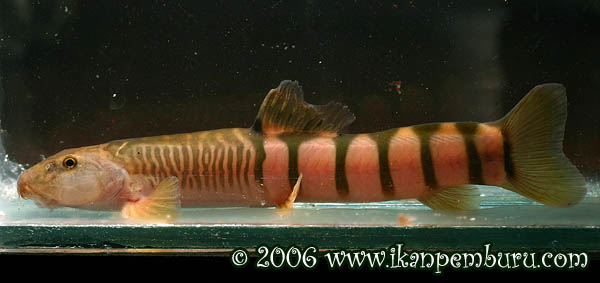
Max length96mm SL3.8in SLTank120 × 30cm48 × 12inTemp18–25°C64–77°FpH6.0–8.0Can be told apart from congeners by its colour pattern which consists of 8-11 closely-set, narrow dark bars in the anterior part of the body and 5 wider bars in the posterior part. It also possesses prominent dorsal and ventral adipose crests on the caudal peduncle and 9½ branched dorsal-fin rays.
Syncrossus helodesBanded Tiger Loach
Sauvage, 1876
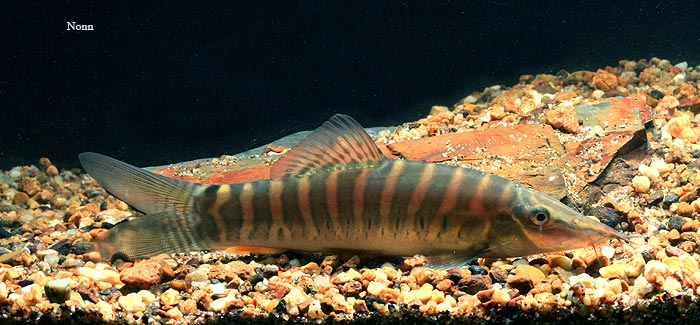
Max length300mm SL12in SLTank180 × 45cm72 × 18inTemp24–30°C75–86°FpH6.0–7.5This species is sometimes confused with S. hymenophysa, native to the Greater Sunda Islands and Peninsular Malaysia, but differs in several ways, the most immediately identifiable of which are possession of small, irregular, dark markings in the lower half of the body and lack of a dark spot in the dorsal-fin. It also has 10-12 vertical body bars...
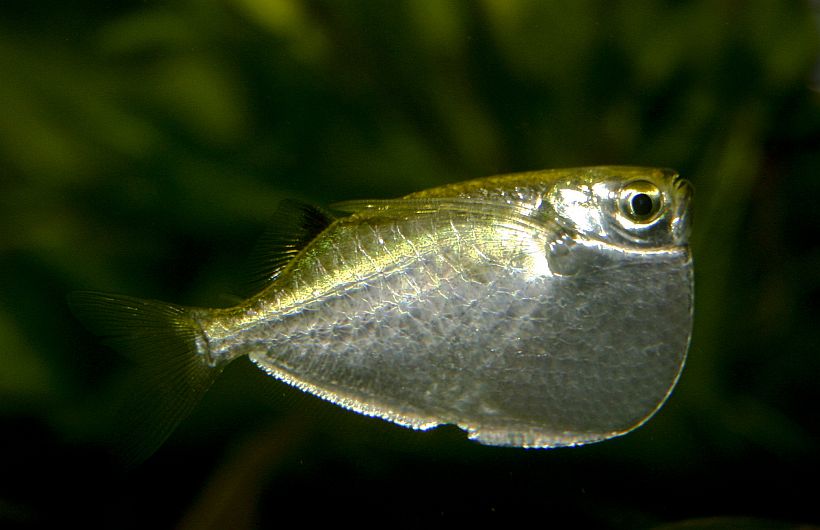
Thoracocharax stellatusSpotfin Hatchetfish
Kner, 1858
Max length70mm SL2.8in SLTank120 × 45cm48 × 18inTemp20–28°C68–82°FpH5.0–7.5T. stellatus is superficially similar to its only congener T. securis, but can immediately be identified by the presence (vs. absence) of a prominent dark spot in the dorsal-fin. It is sometimes traded as 'platinum hatchetfish'. The genus Thoracocharax was originally erected by Fowler in 1906 as a subgenus of Gasteropelecus, but was elevated to generic status by Weitzman (1960).
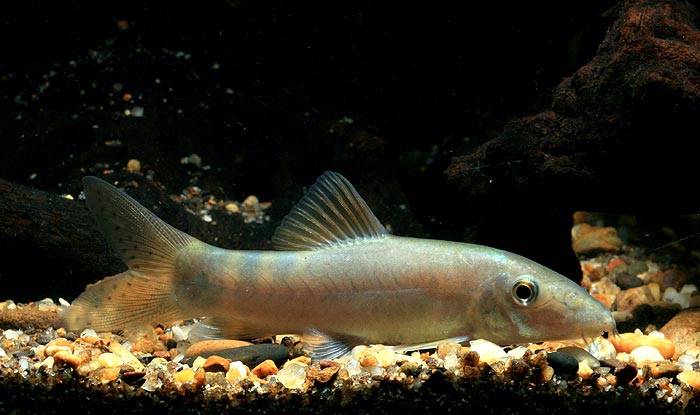
Yasuhikotakia caudipunctataSpeckle-tailed Loach
Taki & Doi, 1995
Max length100mm SL3.9in SLTank120 × 30cm48 × 12inTemp23–30°C73–86°FpH6.0–7.5This specie is relatively rare in the aquarium trade and much sought after by enthusiasts as a result. It looks relatively similar to Y. splendida but can be told apart from it, and indeed all other members of the genus, by the following combination of characters: possession of 8 branched dorsal-fin rays; 32-33 vertebrae; one or two small, brownish, vertically-orientated markings on the dorsal part of the body posterior to the dorsal fi...
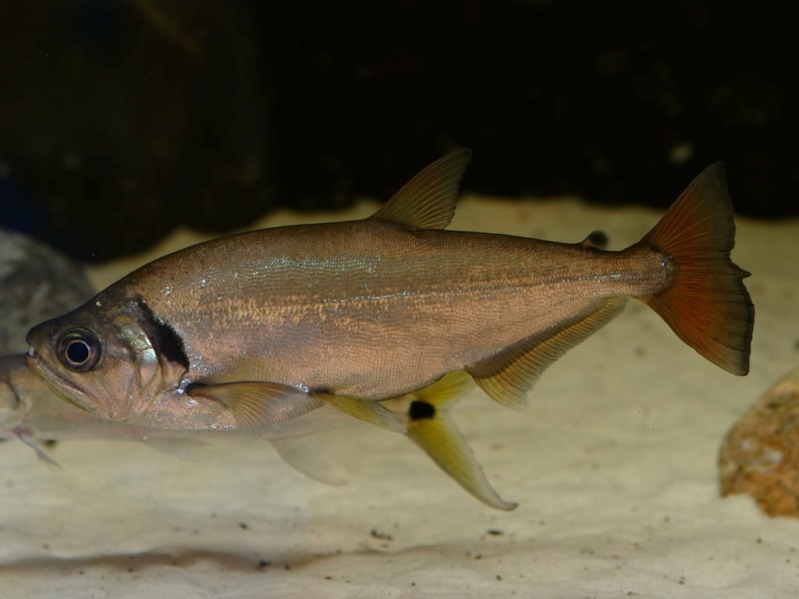
Hydrolycus tatauaia
Toledo-Piza, Menezes & Santos, 1999
Max length455mm SL18in SLTanknot recordedTemp24–28°C75–82°FpH6.0–8.0Vernacular names in Brazil include 'Cachorra' or 'Pirandirá', although these are also applied to congeners. It can be told apart from all congeners by the following combination of characters: head and body silvery with dark dorsal surface; an elongate dark blotch posterior to the opercle; dorsal, caudal and anal-fin rays reddish to orange proximally with some individual variation in intensity and tonality; adipose fin dark, with diffuse black pigmentation.
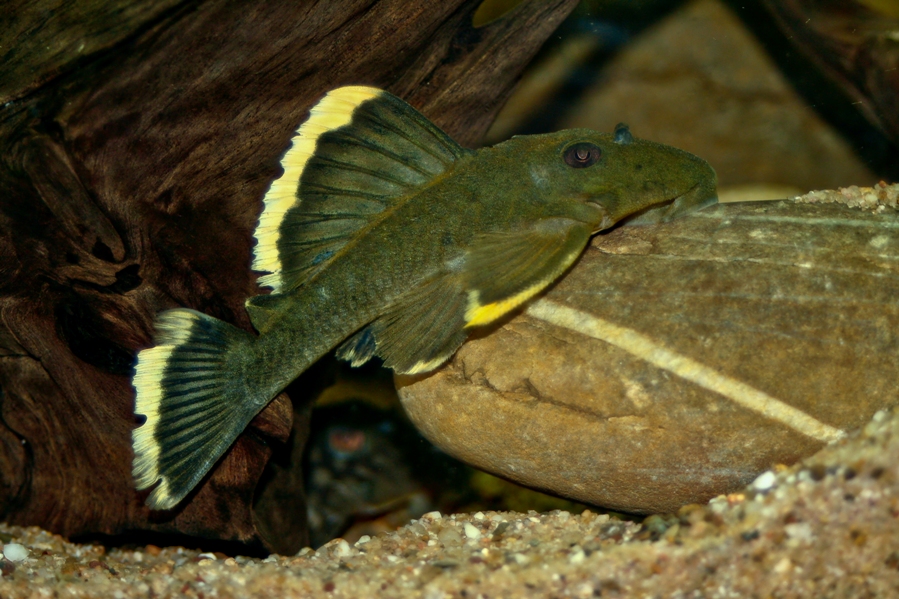
Baryancistrus chrysolomusMango Pleco
Rapp Py-Daniel, Zuanon & Ribeiro de Oliveira, 2011
Max length219mm SL9in SLTank120 × 45cm48 × 18inTemp27–32°C81–90°FpH6.0–7.5Prior to description this species was traded under the DATZ code L047 or the alternative vernacular name 'magnum pleco'. It can be distinguished from congeners by a combination of the following characters: presence of a broad, light-coloured (usually yellowish) distal band on the dorsal and caudal fins throughout life, slightly reduced in adults. The only other member of the genus to possess such bands is B. xanthellus but in that species they are reduced to small markings at the fin tips in adults, and the body is covered in pale, normally yellowish, spots.
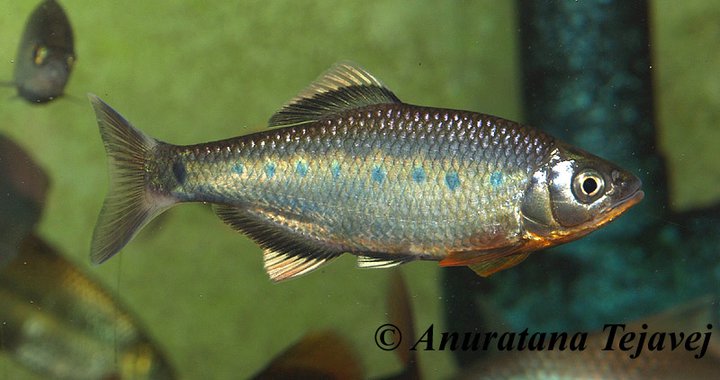
Barilius bakeri
Day, 1865
Max length130mm SL5in SLTank150 × 60cm60 × 24inTemp18–26°C64–79°FpH6.0–7.5This species is traded under several names including 'royal danio', 'blue-spotted hill trout', and 'blue-dotted mirror fish'. It can be distinguished from congeners by possessing a single row of bluish-green spots along the length of the body, white margins on the dorsal and anal fins, 37-38+1 lateral line scales, and fleshy rudi...
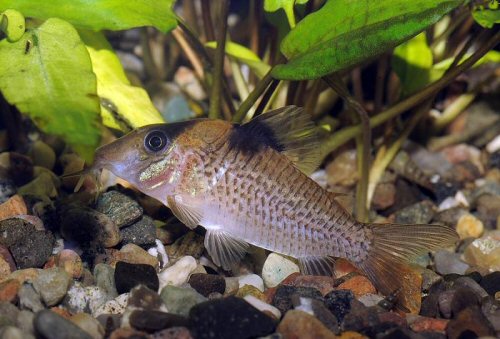
Corydoras ephippiferSaddle Cory
Nijssen, 1972
Max length60mm SL2.4in SLTanknot recordedTemp20–25°C68–77°FpH6.0–7.5This species appears superficially similar to a number of congeners including C. ambiacus, C. agassizii, C. brevirostris, C. delphax, and C. melanistius. Among these C. ephippifer seems to be unique in that all fins except the dorsal are transparent and lack markings.
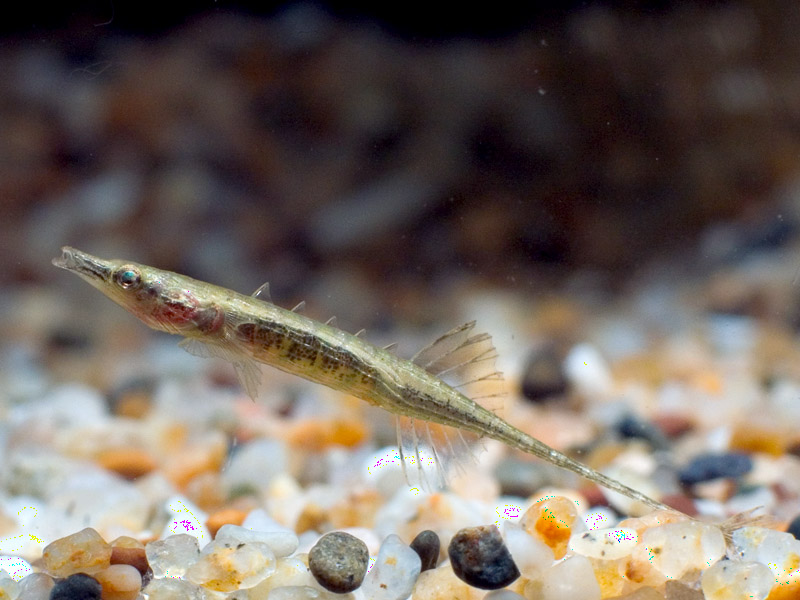
Indostomus paradoxusArmoured Stickleback
Prashad & Mukerji, 1929
Max length30mm SL1.2in SLTank40 × 20cm16 × 8inTemp22–27°C72–81°FpH6.5–7.5This species is rare in the aquarium hobby though its name is often misapplied to the closely-related I. crocodilus. It can be told apart from congeners by the following characters: dorsal and anal fins without dark markings, with a light brown bar in breeding males; ventral surface light brown; throat white, occasionally with a few brown spots; ridges of head bones weakly serrated or not serrated, depending on the bone. The family Indostomidae currently contains just a single genus with three species of which I. paradoxus is the type. It was raised alongside both family...
Julidochromis dickfeldiBrown Julie
authority not recorded
Max length80mm SL3.1in SLTank75 × 30cm30 × 12inTemp23–27°C73–81°FpH8.0–9.2Julidochromis are commonly known as "Julies" in the hobby. As with other Julies, large water changes should be avoided as this can cause mated pairs to turn on one another. There is some speculation as to whether this species has been placed in the correct genus. It has a different shape to other Julidochromis, having a pointed snout. It also exhibits different patterning, with blue edging to the dorsal and anal fins, and the horizontal stripes are very dark in colour. Furthermore i...