Results for “caudal”
Type a name: scientific, common, or one a species used to go by. Or narrow the catalogue with the filters.
Filters
Pantodon buchholziAfrican Butterfly Fish
authority not recorded
Max length120mm SL5in SLTank90 × 30cm36 × 12inTemp23–30°C73–86°FpH6.0–7.5The common name of this surface-dwelling species is derived from it's appearance when viewed from above, the large pectoral fins giving it the appearance of a butterfly. In reality, these fins serve a dual purpose. They help to camouflage the fish, making it look like a dead leaf floating on the surface, and along with the caudal fin, power the incredible jumps that it is capable of making. The fish jumps from the water to catch flying insects or to escape potential predators and it can mak...
Papyrocranus aferArowana Knifefish
authority not recorded
Max length800mm SL31in SLTank210 × 90cm84 × 36inTemp24–28°C75–82°FpH6.5–7.5Like other members of the family Notopteridae this species differs from Gymnotiform knifefish in that its anal and caudal fins are fused together into one long, undulating fin running along the underside of the fish. There is only one other species in the genus. P. congoensis is a smaller, plain brown coloured fish found only in the Democratic Republic of Congo and is very rare in the hobby. P. afer is also infrequently imported and is one of the rarer knifefish species in the hobby. It can dev...
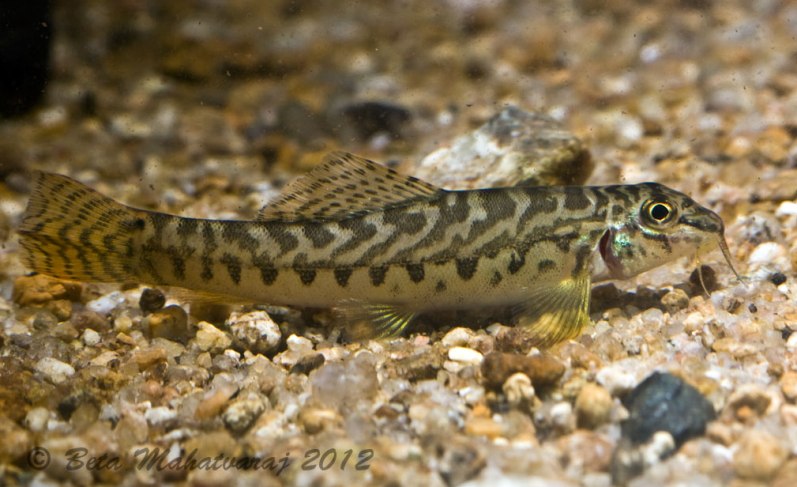
Paracanthocobitis botiaZipper Loach
Hamilton, 1822
Max length152mm SL6in SLTank75 × 30cm30 × 12inTemp21–26°C70–79°FpH6.0–7.5Traded under various names including 'mottled', 'eyepot', 'sand' and 'striped' loach. It's perhaps one of the better choices for those new to keeping nemacheilids being relatively hardy, peaceful and exhibiting some quirky behavioural traits. The characteristic ocellus, a dark marking at the top of the caudal peduncle that resembles an eye, is thought to have some function in predator distraction and is normally more intense in younger specimens.
Pareutropius buffeiThree Striped African Glass Catfish
authority not recorded
Max length80mm SL3.1in SLTank75 × 30cm30 × 12inTemp24–28°C75–82°FpH6.0–7.5Formerly known as Eutropiellus buffei, this midwater swimming, diurnal catfish is very often sold as "Debauwi catfish". Pareutropius debauwi is a closely related species which is, in fact, seldom imported. Adults of the two species can be distinguished by several characteristics. In buffei there are three lateral stripes along the body, whilst debauwi possesses only one. Buffei also has black spots in the upper and lower parts of the caudal fin, and the fin itself has rounded lobes. Th...
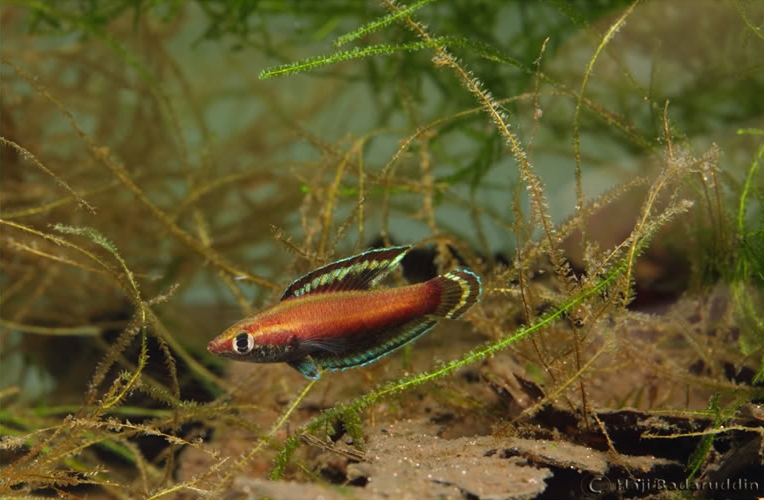
Parosphromenus nagyi
Schaller, 1985
Max length35mm SL1.4in SLTank40 × 20cm16 × 8inTemp22–28°C72–82°FpH3.0–6.5In males the dorsal, anal and caudal have a black subdistal band bordered on either side by bluish iridescent bands, with the inner one significantly thicker. The pelvic fins are iridescent emerald green with a dark blotch at the base and a subdistal dark spot, while the pectoral fins are hyaline.
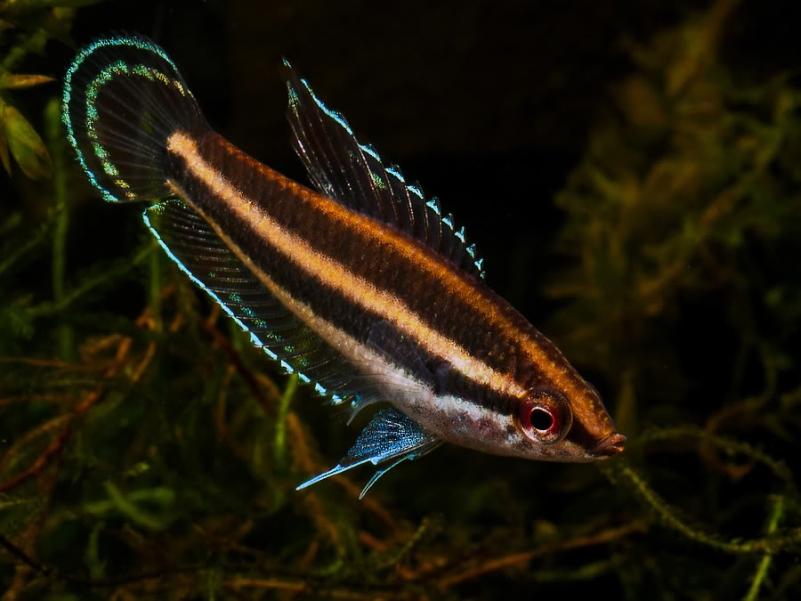
Parosphromenus sp. 'Sentang'
authority not recorded
Max length35mm SL1.4in SLTank40 × 20cm16 × 8inTemp22–28°C72–82°FpH3.0–6.5This fish has been widely available in the aquarium trade in recent years and is sometime referred to by the invented name P. 'sintangensis'. It displays a close resemblance to P. bintan and another unidentified fish known to aquarists as P. sp. 'blue line' although the inner bluish bands in the dorsal, anal and caudal fins are perhaps a little narrower in P. sp. 'Sentang' than the other two.
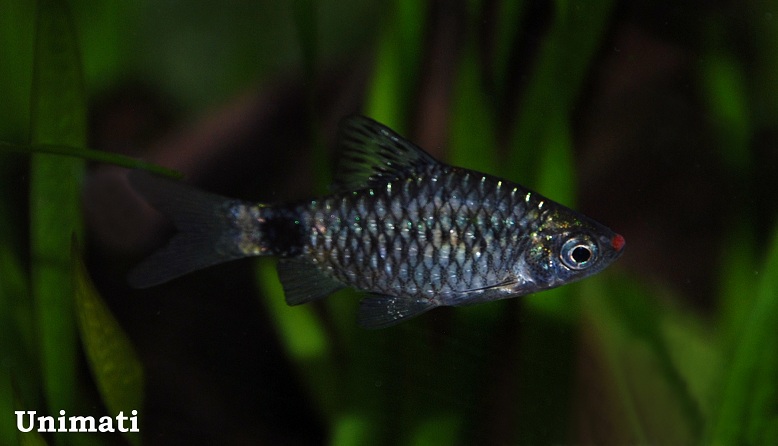
Pethia erythromycterLipstick Barb
Kullander, 2008
Max length35mm SL1.4in SLTank90 × 30cm36 × 12inTemp18–24°C64–75°FpH7.0–7.5This species first appeared in the aquarium hobby in 2006 and is sometimes traded under the name 'Tulip barb'. It was officially described by Kullander in early 2008 in a paper describing five new Puntius species from Kachin, all of which are superficially similar in possession of a dark band or blotch on the caudal peduncle. P. erythromycter can be distinguished b...
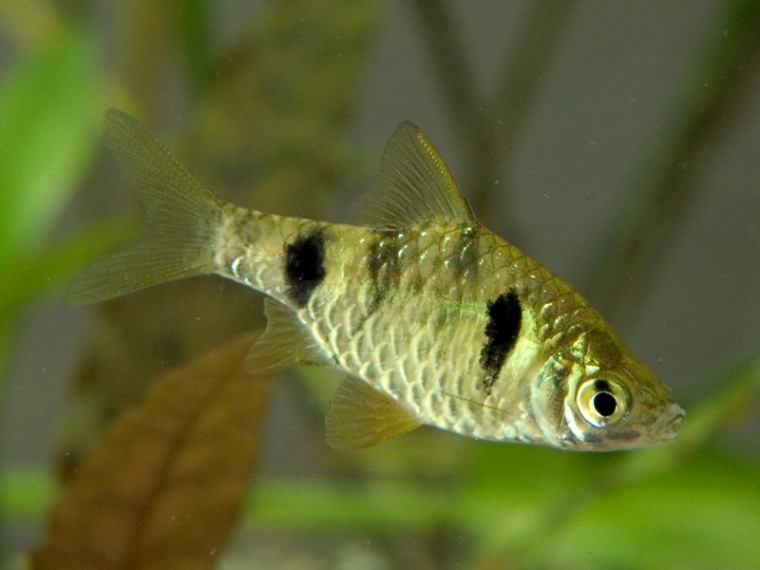
Pethia phutunioDwarf Barb
Hamilton, 1822
Max length30mm SL1.2in SLTank60 × 30cm24 × 12inTemp21–26°C70–79°FpH6.0–7.0In P. phutonio the flank markings comprise two black, vertically-orientated blotches, one posterior to the operculum and the other on the caudal peduncle, and within the P. conchonius group this patterning is shared with P. bandula, P. cumingii, P. didi, P. meingangbii, P. padamya, and P. tiantian. It can be told apart from these by the following combination of characters: smaller adult size of 25 - 30 mm vs. at least 35 - 40 mm; minute maxillary barbels; incomplete lateral line with ab...
Prionobrama filigeraGlass Bloodfin Tetra
authority not recorded
Max length60mm SL2.4in SLTank60 × 38cm24 × 15inTemp23–27°C73–81°FpH6.0–7.5The genus Prionobrama currently contains only one other valid species, P. paraguayensis. It is very similar in appearance to P. filigera, but lacks any red pigmentation in the caudal fin. It's probably never been imported for the hobby, although it may show up as occasional bycatch amongst shipments of more popular species. P. filigera can be easily distinguished from the "other" bloodfin tetra, Aphyocharax anisitsi by its more elongate body shape and the fact that it exhibits...
Pseudogastromyzon laticeps
authority not recorded
Max length67mm SL2.6in SLTank75 × 30cm30 × 12inTempnot recordedpH6.0–7.5It appears that this species has not yet appeared in the western hobby, probably because commercial fish collections don't normally take place in its native waters although the goby Rhinogobius zhoui has been available occasionally. We're unable to provide details of distinguishing characters since no diagnostic key to the genus exists in English at time of writing, but based on the images available it does appear to possess reddish dorsal and caudal fins. The specimens pictured were i...
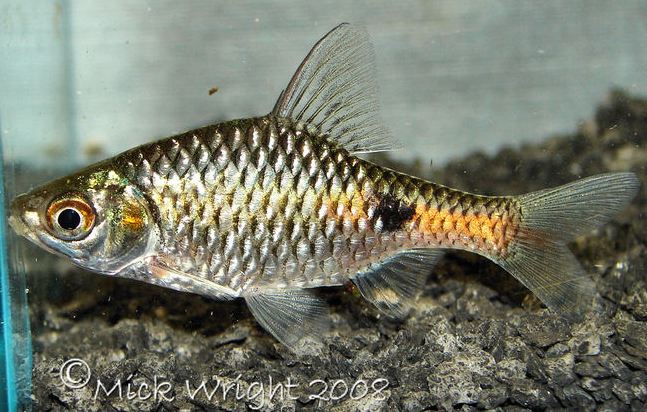
Puntius terioOnespot Barb
Hamilton, 1822
Max length90mm SL3.5in SLTank80 × 30cm31 × 12inTemp18–26°C64–79°FpH6.5–7.5This species is uncommon in the aquarium trade which is a little surprising given its huge natural range. Different populations can vary in colour pattern to an extent though all share the defining aspects given by Hamilton, comprising a diffuse yellow-golden marking on the operculum plus a dark spot on the caudal peduncle. The latter is usually surrounded by a variably-sized golden-yellow margin, and the dorsal-fin often contains irregular dark spots and streaks, these sometimes forming a longitudinal band.
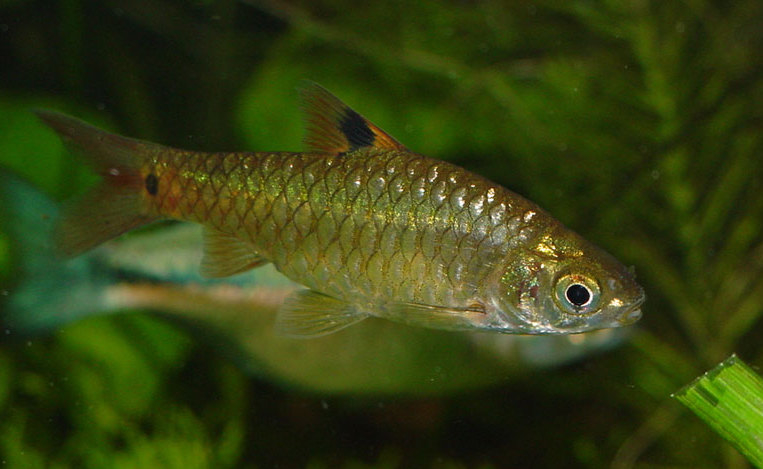
Puntius vittatusGreenstripe Barb
Day, 1865
Max length45mm SL1.8in SLTank75 × 30cm30 × 12inTemp18–26°C64–79°FpH6.0–7.5It can be told apart from similar-looking congeners such as P. crescentus and P. muzaffarpurensis by the following combination of characters: barbels absent; lateral line incomplete with up to 5 pored scales; 20-22 lateral line scales; 8 predorsal scales; dorsal-fin with a vertically-orientated black streak and a black tip with orange markings; a dark spot at the base of the caudal peduncle.
Rasbora caudimaculataGreater Scissortail Rasbora
authority not recorded
Max length150mm SL6in SLTank150 × 45cm60 × 18inTemp20–26°C68–79°FpHnot recordedThis striking species may also be seen on sale with the trade name of 'red scissortail'. It can be distinguished from the similar-looking R. trilineata by the presence of orange/red colouration in the with other diagnostic features including black tips to the caudal lobes, 11-12 predorsal scale rows and a dark reticulated pattern to the edges of the scales. The 'scissortail' moniker is derived from the characteristic twitching motion of the when the fish is at rest. Rainb...
Rasbora elegansElegant Rasbora
authority not recorded
Max length200mm SL8in SLTank120 × 45cm48 × 18inTemp22–25°C72–77°FpHnot recordedThis species is not especially popular in the hobby and is only infrequently seen on sale. It is clearly distinguishable from similar-looking members of the genus by lacking a dark stripe along the lateral line. Instead it possesses two spot-like markings on each flank, one below theorigin and lateral line and another at the caudal peduncle. The intensity of these can vary depending on the collection locality of the fish and they can be quite faint in some forms. There is also a third, smaller m...
Rasbora kottelati
authority not recorded
Max length70mm SL2.8in SLTank120 × 30cm48 × 12inTemp23–28°C73–82°FpHnot recordedIt is unclear if this species has been available in the aquatic trade as collections from its native waters only occur sporadically, therefore we have based much of the information here on experience with its closest relative R. kalochroma. These two are almost identical in appearance and share some meristic features but R. kottelati possesses an additional, oval-shaped dark blotch on the caudal peduncle, lacks the stripe in the middle of the seen in R. kalochroma and is consequently easy to dis...
Rasbora lacrimulaRed Cherry Rasbora
authority not recorded
Max length31mm SL1.2in SLTank45 × 30cm18 × 12inTemp22.2–25.6°C72–78°FpHnot recordedThis species is also traded as 'Bornean redfin rasbora', 'sunshine rasbora' and 'dwarf volcano rasbora' and first appeared in the hobby during the latter part of 2010. It can be told apart from all other members of the genus by a combination of the following characters: possession of small tubercules on the dorsal surface, posterior to theand continuing onto the upper part of caudal fin, visible as an irregular 'crest' when a specimen is viewed laterally; ...
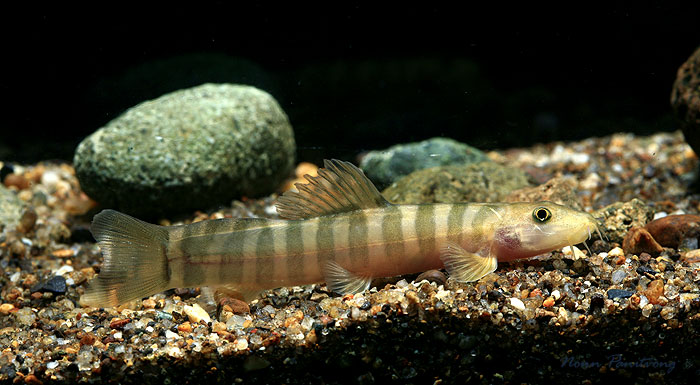
Schistura alticrista
Kottelat, 1990
Max length75mm SL3.0in SLTank90 × 30cm36 × 12inTemp21–26°C70–79°FpH6.0–7.5This species is very rare in the aquarium trade but available on occasion. It has 8-9 darkish body bars which usually split vertically as the fish mature, and like some conspecifics possesses a prominent dorsal adipose crest on the caudal peduncle. Schistura is the most species-rich genus among...
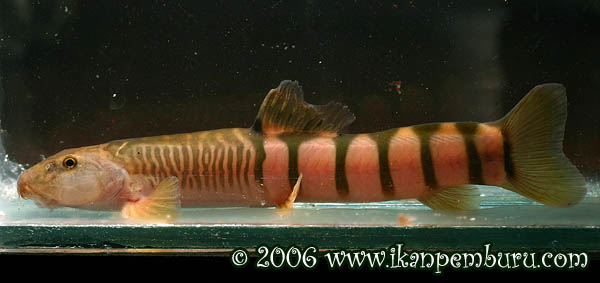
Schistura disparizona
Zhou & Kottelat, 2005
Max length96mm SL3.8in SLTank120 × 30cm48 × 12inTemp18–25°C64–77°FpH6.0–8.0Can be told apart from congeners by its colour pattern which consists of 8-11 closely-set, narrow dark bars in the anterior part of the body and 5 wider bars in the posterior part. It also possesses prominent dorsal and ventral adipose crests on the caudal peduncle and 9½ branched dorsal-fin rays.
Serrasalmus marginatus
authority not recorded
Max length221mm SL9in SLTank120 × 38cm48 × 15inTemp22–25°C72–77°FpHnot recordedThere are currently 24 described species of Serrasalmus, many of which look superficially similar. S. marginatus has at various times been considered a synonym of S. rhombeus and S. humeralis, but is currently considered to be distinct. It's main distinguishing feature is usually given as the thick, black, v-shaped marking in the anterior portion of the caudal fin. Juveniles are said to differ from similar-looking species such as S. compressus and S. altuvei because the dark body "spot...
Synodontis ocelliferOcellated Synodontis
authority not recorded
Max length200mm SL8in SLTank90 × 30cm36 × 12inTemp23–28°C73–82°FpH6.2–8.0S. ocellifer is often confused with other similar species of Synodontis but can be distinguished by the length of thewhich in this species is very long and runs from just past the base of the to just before the caudal fin. In recent years many alarming hybrids of this species have been appearing on the market and these should be avoided in our opinion. Besides being attractively marked this is one of the hardiest Synos available and is a good choice for the beginner....