Papyrocranus afer
Arowana Knifefish · Reticulate Knifefish · Marbled Knifefish
Last revised 2026Edit this page
On this page11 sections
Quick factsEdit
Difficulty4 of 8 measures
Rated difficult because it needs a tank at least 2 m long.
- Space
- very large tank
- Water
- needs a steady pH
- Temp
- needs a steady temperature
- Diet
- unknown
- Temperament
- territorial
- Social
- unknown
- Compatibility
- unknown
Other demands
Each of these can raise the rating on its own, whatever the measures above say.
- Hardiness
- unknown
- Needs a tank at least 2 m long
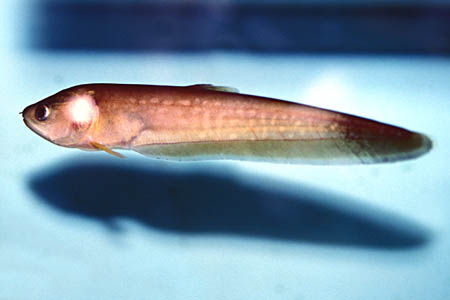
The arowana knifefish, Papyrocranus afer, is a notopterid knifefish widespread over much of western and central Africa, from Senegal to Sudan. Its anal and caudal fins are fused into one long, undulating fin. Infrequently imported, it grows to 80 cm and becomes increasingly territorial as it matures, so it is recommended only to the experienced fishkeeper and best kept as a single specimen.
Distribution
EditWidespread over much of western and central Africa. It's been recorded from Sudan, Democratic Republic of Congo, Cameroon, Nigeria, Niger, Benin, Ghana, Ivory Coast, Mali, Liberia, Sierra Leone, Guinea, GuineaBissau, Gambia and Senegal. It occurs in a number of river systems over this range, including the Niger, Cross, Sanaga, Tano and Prah.
Habitat
Write a noteEditIt's usually found in heavily vegetated, slow moving parts of rivers and sluggish backwaters.
Aquarium size
Write a noteEdit210 ∗ 90 ∗ 90 cm84 ∗ 36 ∗ 36 in - ~1701 litres~449 US gal for a fully grown specimen. Juveniles can be grown on in smaller aquaria.
Maintenance
Write a noteEditA dimly lit tank with areas of dense planting, pieces of driftwood and twisted roots is ideal for this species. Water movement should be minimal.
Water conditions
EditTemperature: 24 – 28 °C75 – 82 °F
pH: 6.5-7.5
Hardness: 5-15 dH
These recommendations come from this profile’s own figures. They contain affiliate links, so we may earn a commission.
Diet
Write a noteEditThis species is primarily carnivorous and will accept most meaty live and frozen foods. Some specimens will also accept pelleted varieties. We suggest a varied diet including lance fish, prawns, chopped mussel, earthworms, carnivore pellets etc.
Behaviour and compatibility
Write a noteEditAn aggressive species that should only be kept with very robust species. It can be kept in a group when young, but as it matures it becomes increasingly territorial, particularly towards other knifefish but also towards any fish it takes a disliking to. While there are reports of it coexisting peacefully with other large fish such as arowana there are at least as many of it attacking the same species in other aquaria. We recommend that it is kept as a single specimen in its own tank or perhaps with a large loricariid such as Acanthicus adonis for company.
Sexual dimorphism
Write a noteEditUnknown.
Reproduction
Write a noteEditNot reported in captivity.
Notes
EditLike other members of the family Notopteridae this species differs from Gymnotiform knifefish in that its anal and caudal fins are fused together into one long, undulating fin running along the underside of the fish. There is only one other species in the genus. P. congoensis is a smaller, plain brown coloured fish found only in the Democratic Republic of Congo and is very rare in the hobby.
P. afer is also infrequently imported and is one of the rarer knifefish species in the hobby. It can develop into a stunningly patterned fish when adult, but due to its potential size and aggressive nature is recommended only to the experienced fishkeeper.
Species images · 1
These photographs are used with each photographer's permission.
Send a photographDistribution
Profile completeness19 of 24
79% complete
Also missing: taxonomic authority, etymology.
Community
Questions about Papyrocranus afer?
Ask on Discord