Results for “gene”
Type a name: scientific, common, or one a species used to go by. Or narrow the catalogue with the filters.
Filters
Squaliforma cf. emarginataRed Fin Thresher Plec
authority not recorded
Max length400mm SL16in SLTanknot recordedTemp25–28°C77–82°FpH6.4–7.2This attractive species is often seen for sale at around 3-4" in length (often as Hypostomus cf. emarginata or H. emarginatus), but given its adult size, its not a terribly good choice for the general community tank. Due to its very wide natural distribution, there are a number of known geographical variants, and this has resulted in four L numbers currently being assigned to it. In reality, there are many more variants than this, and all share the characteristic elongated which gives rise...
Steatocranus tinanti
authority not recorded
Max length130mm SL5in SLTanknot recordedTemp25–28°C77–82°FpH6.0–7.5S. tinanti has a confused taxonomic history, having been previously classified in the genera Gobiochromis and then Leptotilapia, before being assigned to Steatocranus. Further taxonomic revision is likely, as it exhibits both behavioural and morphological differences to other species in the genus. It is a reophilic fish, meaning it inhabits fast waters. Its swimbladder is relatively small to reduce buoyancy and thus prevent it from being swept away by the strong currents in its natural habita...
Synodontis albolineataMustard Synodontis
authority not recorded
Max length100mm SL3.9in SLTank75 × 30cm30 × 12inTemp24–28°C75–82°FpH6.5–7.5Also known as the Mustard Squeaker, this species is imported infrequently, though it sometimes shows up in mixed boxes of Synodontis from exporters. An ideal Syno for the general community due to its small adult size.
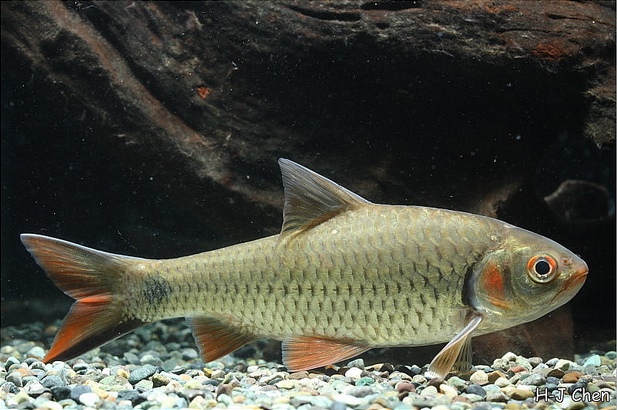
Systomus orphoides
Valenciennes, 1842
Max length250mm SL10in SLTank200 × 60cm79 × 24inTemp18–26°C64–79°FpH6.0–8.0The genus Puntius is currently viewed as something of a catch-all for well over 100 species of small to mid-sized cyprinid. Most experts agree that a full revision is required with the likely outcome that many species will be placed into new or different genera since it is clearly polyphyletic. When describing the grouping in 1822 Hamilton identified the defining characteristics as: presence or absence o...
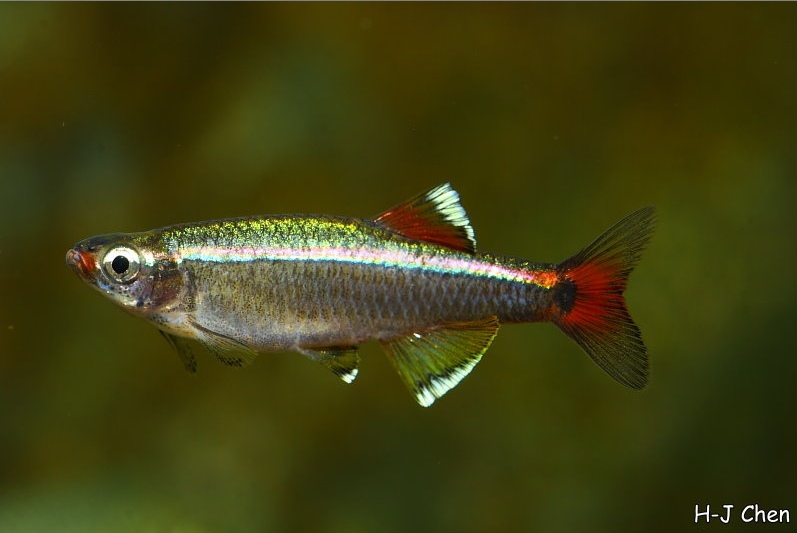
Tanichthys albonubesWhite Cloud Mountain Minnow
Lin, 1932
Max length40mm SL1.6in SLTank60 × 30cm24 × 12inTemp14–22°C57–72°FpH6.0–8.5One of the most ubiquitous species in the hobby and several ornamental strains are available including 'long-finned', 'golden', 'albino', and 'super red', for which care is identical to that of the 'standard' fish. Unfortunately the degree of inbreeding amongst farm-bred stock has resulted in a situation whereby many of the fish available today are genetically weak and prone to disease or develop physical deformities.
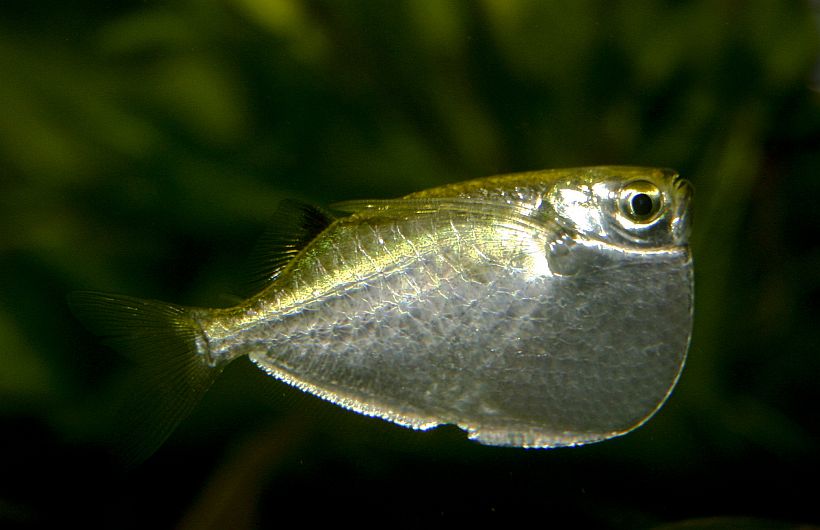
Thoracocharax stellatusSpotfin Hatchetfish
Kner, 1858
Max length70mm SL2.8in SLTank120 × 45cm48 × 18inTemp20–28°C68–82°FpH5.0–7.5T. stellatus is superficially similar to its only congener T. securis, but can immediately be identified by the presence (vs. absence) of a prominent dark spot in the dorsal-fin. It is sometimes traded as 'platinum hatchetfish'. The genus Thoracocharax was originally erected by Fowler in 1906 as a subgenus of Gasteropelecus, but was elevated to generic status by Weitzman (1960).
Trichogaster laliusDwarf Gourami
authority not recorded
Max length88mm SL3.5in SLTanknot recordedTemp22–27°C72–81°FpH6.0–7.5The Dwarf Gourami is one of the most ubiquitous freshwater species in the aquarium hobby, and is unarguably a beautiful fish. Several colour forms have been line-bred for the trade and have also proved popular. These include "Sunset" (also sold as "Red" or "Robin") and "Neon" varieties, although it's highly debatable whether these come close to matching the brilliance of the natural form. Unfortunately the general quality of dwarf gouramis availab...
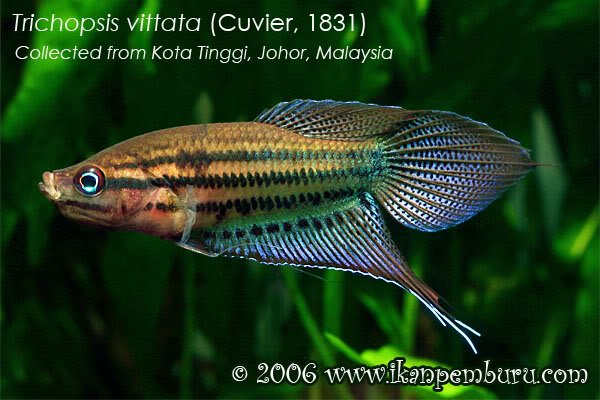
Trichopsis vittataCroaking gourami
Cuvier, in Cuvier & Valenciennes, 1831
Max length70mm SL2.8in SLTank60 × 30cm24 × 12inTemp22–28°C72–82°FpH5.0–7.5The common name is derived from the ability of genus members to produce audible sounds via a specialised pectoral mechanism which is unique within the family Osphronemidae. The structure comprises modified pectoral-fin tendons and muscles which are stretched and plucked by basal elevations of two fin rays in a similar way to guitar strings via rapid beating of the fins. The pectoral-fins beat alternately, each able to generate short or long bursts of sound. These sounds are produced by both sexes, predom...
Tropheus brichardi
authority not recorded
Max length115mm SL5in SLTanknot recordedTemp23–27°C73–81°FpH8.0–9.5Like others in the genus, Tropheus brichardi is something of an enigma in the aquarium hobby, and is not a good species for the beginner. There has been much arguement and discussion about how best to maintain it in the aquarium, and some of these debates still rage on. We have provided the generally accepted method of keeping the fish, but in reality what works for one aquarist may not for another. One aspect which is always true is that water quality is of the utmost importance in a Tropheus t...
Tropheus duboisiWhite-Spotted Cichlid
authority not recorded
Max length120mm SL5in SLTanknot recordedTemp23–27°C73–81°FpH8.0–9.5Like others in the genus, Tropheus duboisi is something of an enigma in the aquarium hobby and despite it's popularity, is not a good species for the beginner. There has been much arguement and discussion about how best to maintain it in the aquarium, and some of these debates still rage on. We have provided the generally accepted method of keeping the fish, but in reality what works for one aquarist may not for another. One aspect which is always true, is that water quality is of the utmos...
Tropheus moorii
authority not recorded
Max length145mm SL6in SLTanknot recordedTemp23–27°C73–81°FpH8.0–9.5Like others in the genus, Tropheus moorii is something of an enigma in the aquarium hobby, and despite it's popularity is not a good species for the beginner. There has been much arguement and discussion about how best to maintain it in the aquarium, and some of these debates still rage on. We have provided the generally accepted method of keeping the fish, but in reality what works for one aquarist may not for another. One aspect which is always true, is that water quality is of the utmost...
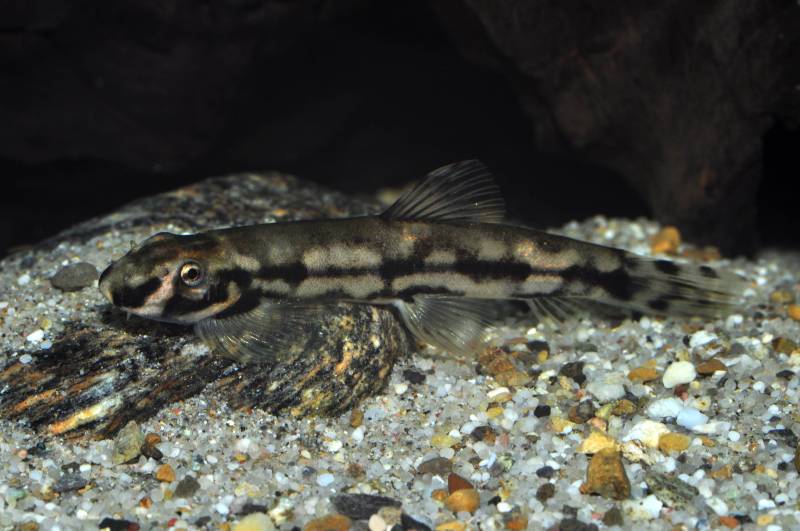
Yaoshania pachychilusPanda Loach
Chen, 1980
Max length60mm SL2.4in SLTank60 × 30cm24 × 12inTemp15.5–24°C60–75°FpH6.5–7.5Juvenile specimens were first exported for the aquarium hobby during 2009 and have since been available on a sporadic basis with prices generally reflecting its rarity and, hopefully, number of specimens being collected. The striking black-and-white-striped juvenile colour pattern inspired the vernacular name although it's sometimes labelled as 'panda goby' rather than 'panda loach'.