Results for “species”
Type a name: scientific, common, or one a species used to go by. Or narrow the catalogue with the filters.
Filters
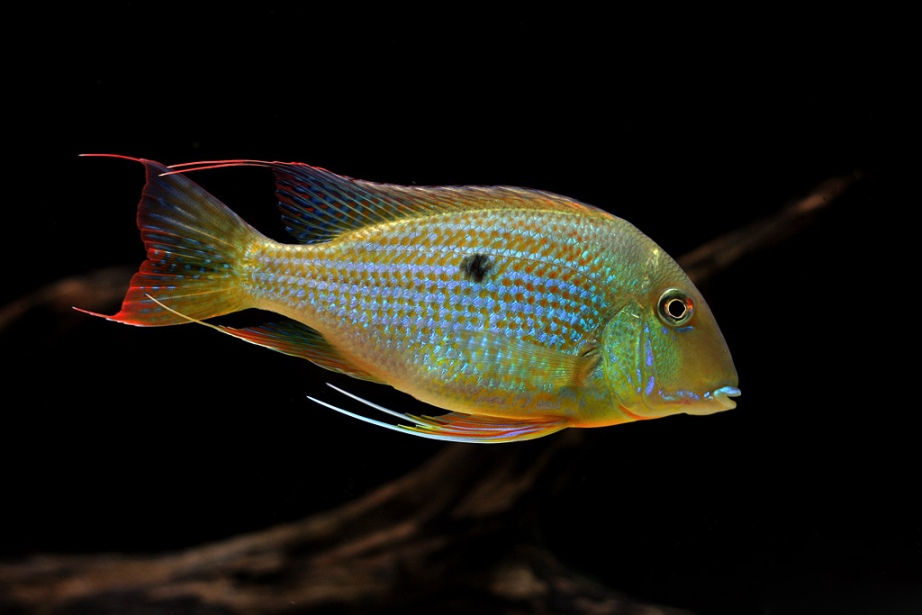
Geophagus neambi
Lucinda, Lucena & Assis, 2010
Max length200mm SL8in SLTank180 × 60cm72 × 24inTemp24–32°C75–90°FpH5.5–7.5This species was available in the hobby several years prior to being described, invariably traded as G. sp. aff. altifrons 'Tocantins', G. sp. 'Tocantins' or G. sp. 'rio Areoes'. The latter of these names refers to an Indian reserve named 'Areões' in the rio Das Mortes drainage, a tributary of the Araguaia which itself drains into the Tocantins, and the aquarium specimens in our images have been identified as G. neambi by Dr. Paulo Lucinda, co-describer of the species.
Hassar orestisBlack-top Mouse Catfish
authority not recorded
Max length180mm SL7in SLTank120 × 38cm48 × 15inTemp22–27°C72–81°FpH6.0–7.5This species can be quite delicate when first imported, but once settled is usually quite hardy. When buying the fish, check that it has a rounded belly and that its eyes aren't sunken. These are classic signs of emaciation in newly imported specimens, and fish in this condition do not often survive for long. If you can find healthy specimens for sale, it is a charming addition to the larger community tank. It is superficially similar to the closely related Nemadoras leporhinus. The two ...
Hoplerythrinus unitaeniatusGold Wolf Fish
authority not recorded
Max length400mm SL16in SLTanknot recordedTemp23–27°C73–81°FpH5.5–7.5Also known as the golden trahira, H. unitaeniatus is the only one of the three recognised species currently in the genus to appear in the trade with any regularity. It's really a fish suitable only for the specialist, and as with any predatory species, care must be taken when performing tank maintenance. It's a representative of an ancient group of fishes, and possesses a modified, highly vascularised swim bladder that acts as an accessory breathing organ, allowing the fish to survi...
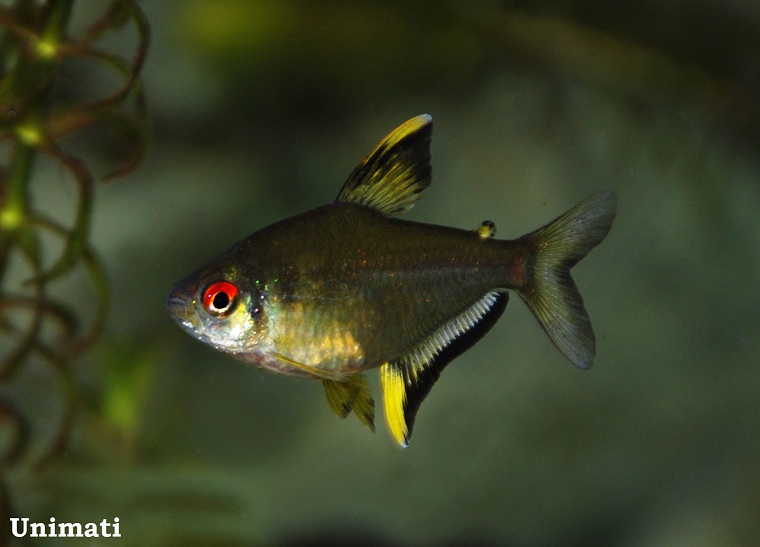
Hyphessobrycon pulchripinnisLemon Tetra
Ahl, 1937
Max length40mm SL1.6in SLTank80 × 30cm31 × 12inTemp20–28°C68–82°FpH5.0–7.5This species is a popular aquarium fish and is bred on a commercial basis in several countries, with a selectively-bred albino form also available. Wild specimens are rarely collected due to the low price of the farmed fish, but the origin of the commercial strain is questionable. The species was considered endemic to the rio Tapajós basin, but in the early 1990s fish appearing identical to the aquarium form were photographed in the...
Julidochromis ornatusGolden Julie
authority not recorded
Max length80mm SL3.1in SLTanknot recordedTemp23–27°C73–81°FpH7.5–9.0Julidochromis are commonly known as "Julies" in the hobby. This is one of the most common Julie species encountered in aquaria and may also be sold as the Yellow or Ornate Julie. The majority of specimens available are tank bred and do not exhibit as bright colouration as wild fish. As with other Julies, large water changes should be avoided as this can cause mated pairs to turn on one another. Several geographical morphs of this species are available, as is an aquarium sport albino...
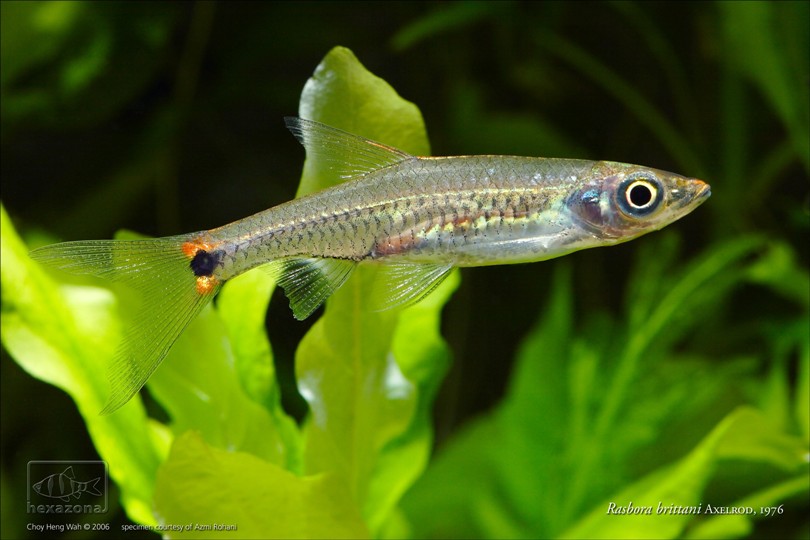
Kottelatia brittani
Axelrod, 1976
Max length60mm SL2.4in SLTank75 × 30cm30 × 12inTemp20–26°C68–79°FpH6.0–7.5This species was described from 'Johore River, Segamat, Malaysia', which corresponds to Segamat District within the the Johor River watershed, Johor state, southern Peninsular Malaysia, but the type specimens were obtained via a Singapore wholesaler so it's possible that a mistake was made as there exist no other records of the species in Peninsular Malaysia. It's also been recorded from the Kapuas drainage...
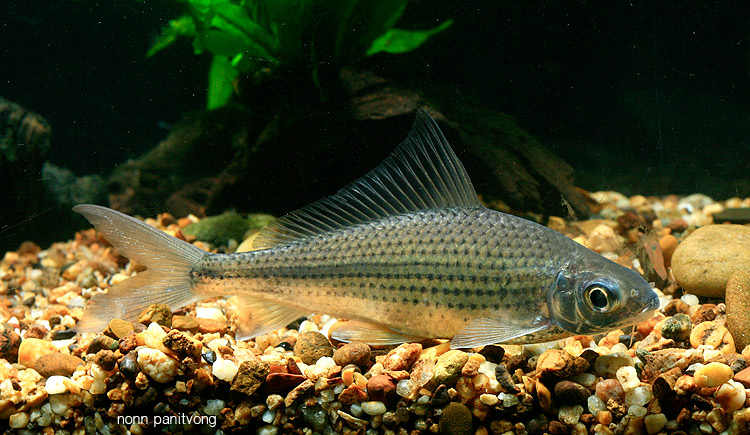
Labiobarbus leptocheilus
Valenciennes, 1842
Max length260mm SL10in SLTank240 × 60cm96 × 24inTemp20–26°C68–79°FpH6.0–8.0Different populations vary in appearance somewhat (see image of Salween specimen for example), and L. leptocheilus may turn out to represent a group of closely-related species rather than a single taxon. The population from the Cambodian Mekong has been considered to represent a distinct species, Labiobarbus lineatus, although that name is currently a synonym of L. leptocheilus following Kottelat (2013). It is widely used in the ornamental trade, however.
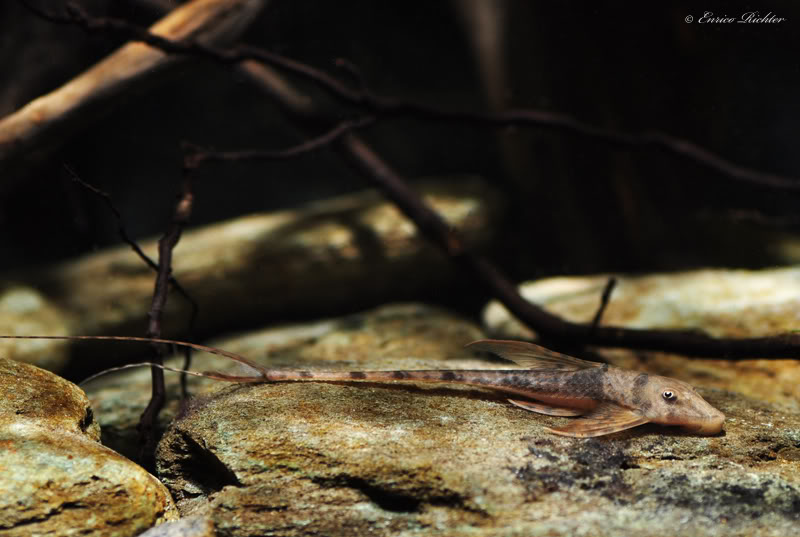
Lamontichthys filamentosusSturgeon Catfish
La Monte, 1935
Max length167mm SL7in SLTank120 × 45cm48 × 18inTemp22–30°C72–86°FpH5.5–7.5This species is relatively common in the aquarium hobby but is not easy to maintain and recommended only for experienced aquarists. It can be told apart from all congeners by specimens larger than 60 mm SL possessing an extended pectoral-fin spine forming an extremely long filament that may be more than four times the length of the first branched pectoral-fin ray (vs. not possessing such a filament in other species of Lamontichthys).
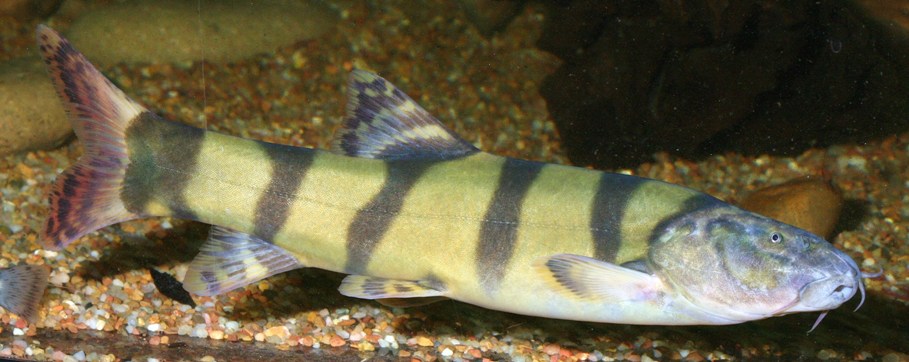
Leptobotia elongataImperial Flower Loach
Bleeker, 1870
Max length500mm SL20in SLTank360 × 90cm142 × 36inTemp15.5–21°C60–70°FpH6.5–7.5This species is rare in the aquarium trade, increasingly so in nature and as a result prohibitively expensive when available. Given its adult size and probable longevity this is therefore a species for the specialist possessing the necessary time, money and dedication to house it long term.
Loricaria simillimaMarbled Whiptail
authority not recorded
Max length180mm SL7in SLTanknot recordedTemp24–27°C75–81°FpH5.6–7.8The pictures here show the fish that is most commonly referred to as L. simillima, but there is a great deal of uncertainty surrounding its true identity. As suggested above, it seems unlikely that its natural distribution is so wide, and we are probably dealing with several species or subspecies. This argument is strengthened by the fact that several differently coloured fish are imported as this species, with darker specimens being collected from acidic blackwaters and lighter fish hailing fro...
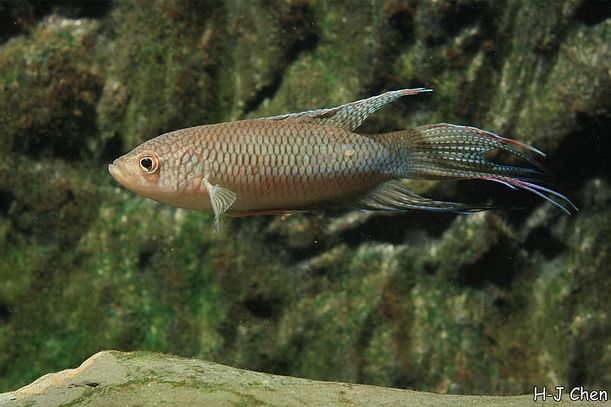
Macropodus erythropterus
Freyhof & Herder, 2002
Max length80mm SL3.1in SLTank80 × 30cm31 × 12inTemp20–30°C68–86°FpH6.0–8.0This species is frequently mistaken for the similar-looking congener M. spechti Schreitmüller 1936, which is easily-identified by the absence of reddish pigmentation in the dorsal, anal, and caudal fins. There has been some debate as to whether these two represent the same taxon, however, with Winstanley and Clements (2008) proposing that M. erythropterus be considered a synonym of M. spechti because they were unable to separate the two species by morphological characters, and specimens with red pigmentation on the unpaired fins were coll...
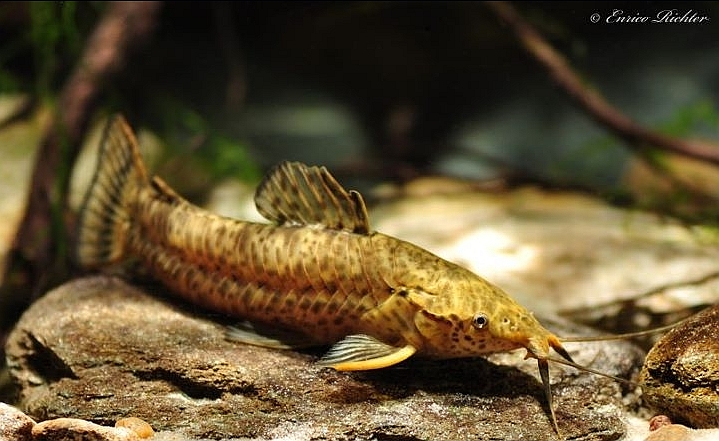
Megalechis pictaBar-tailed Hoplo
Müller & Troschel, 1849
Max length120mm SL5in SLTank120 × 45cm48 × 18inTemp18–28°C64–82°FpH5.0–7.5This species was previously referred to as M. thoracata, but that name is now applied to the species with a relatively short dorsal-fin spine which was formerly known as M. personata. M. picta can be told apart from M. thoracata by presence of a dark vertical bar in the caudal-fin, a comparatively longer dorsal-fin spine (52.0-64.0% vs. 32.0-48.0% of dorsal-fin base in specimens measur...
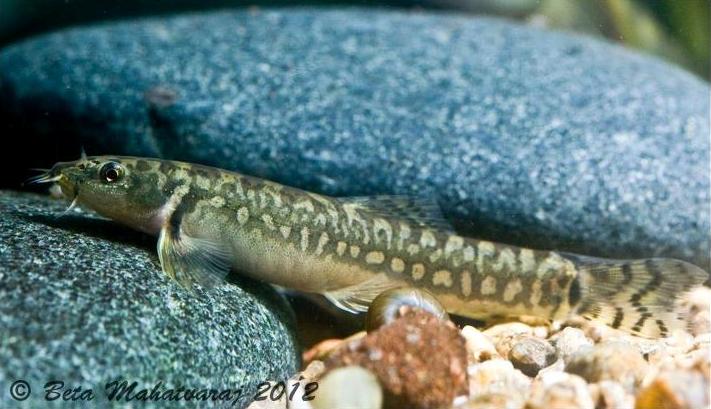
Mesonoemacheilus herrei
Nalbant & Bãnãrescu, 1982
Max length60mm SL2.4in SLTank60 × 30cm24 × 12inTemp18–25.5°C64–78°FpH6.0–7.5It's unclear if this species has ever been exported for the aquarium hobby outside of India but there may be a chance of finding the occasional specimen mixed in with shipments of M. guentheri or M. triangularis. It was earlier considered synonymous and may still be confused with M. guentheri since both species share similar body patterning consisting of rows of yellowish, dark-edged spots.
Mylochromis melanonotusHaplochromis Yellow-black Line
authority not recorded
Max length260mm SL10in SLTank150 × 60cm60 × 24inTemp24–28°C75–82°FpH7.6–8.8M. melanonotus is rarely imported and little information is available regarding its captive care. The shovel-like lower jaw possessed by some individuals of this species has been the cause of some confusion regarding the fishes' true identity. It was originally placed in the genus Platygnathochromis, in which it was the only species. However, Ad Konings observed that amongst wild breeding populations there existed individuals both with and without the modified lower jaw. The specimens witho...
Mystus leucophasisAsian Upside Down Catfish
authority not recorded
Max length300mm SL12in SLTank120 × 60cm48 × 24inTemp23–27°C73–81°FpH6.0–8.0Like some members of the African catfish genus Synodontis, this species spends the vast majority of it's time swimming in an inverted position. It is often seen for sale at only a couple of inches in length and may be confused with the popular (and much smaller) Synodontis nigriventris. It can easily be distinguished from this species by its patterning. It does not exhibit the or brown colours of the Synodontis and is a uniform black colour all over. Larger specimens may have some lighter c...
Nanochromis nudiceps
authority not recorded
Max length80mm SL3.1in SLTanknot recordedTemp24–27°C75–81°FpH5.0–7.0This species is rarely imported. It is easily confused with N. parilus but can be distinguished by the fact that male fish lack the barring seen in the upper part of the of parilus and have dark edges to the scales on the body. Females can be distinguished by the spotting in the lower part of the caudal, which is unpatterned in parilus. We do not recommend this species to the beginner due to its very specific water and care requirements....
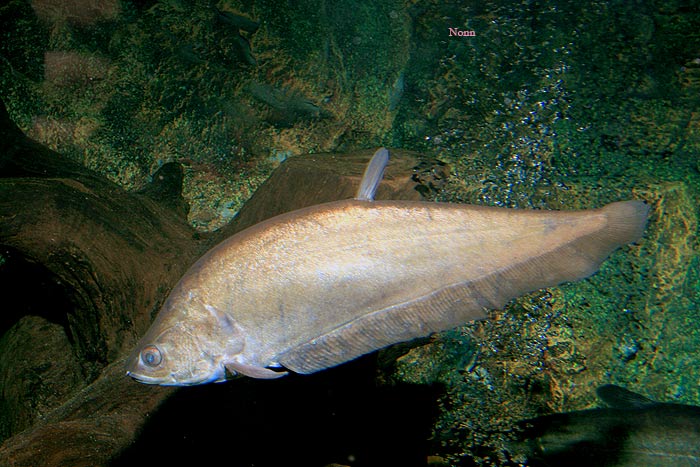
Notopterus notopterusBronze Featherback
Pallas, 1769
Max length600mm SL24in SLTanknot recordedTemp20–28°C68–82°FpH6.0–8.0This species is also referred to as 'Asian knifefish' or 'ghost knifefish' in the aquarium trade in the aquarium trade but arguably has no place in the ornamental hobby given its adult size and specialised requirements. It is sometimes confused with the African species Xenomystus nigri but is easily told apart by its larger adult size and presence (vs. absence) of a dorsal fin.
Parambassis pulcinellaHumphead Perchlet
authority not recorded
Max length100mm SL3.9in SLTank90 × 30cm36 × 12inTemp23–27°C73–81°FpH7.0–7.5A new species that was only described to science in 2003, little is known about the natural behaviour of P. pulcinella. It has started to be imported quite regularly over the last couple of years, although it is still quite expensive. Unfortunately this species has suffered the same fate as some of it's close relatives, and artificiallly dyed specimens have been making their way onto the market. These should be avoided at all costs, as the processes involved are cruel and unecessary, and us...
Petrochromis famula
authority not recorded
Max length150mm SL6in SLTank120 × 30cm48 × 12inTemp24–27°C75–81°FpH7.5–9.0The mouthparts of this species are highly specialised, reflecting its natural feeding habits of rasping algae and other organisms from rock surfaces. It feeds almost exclusively on unicellular algae and has very thick, extended lips and brush-like, mobile pads of teeth. The mouthparts thus form a rasping 'plate', used when the fish is feeding. It is somewhat rare in the hobby, perhaps due to its violent reputation or the fact that this is not a particularly gregarious species in nature...
Potamotrygon sp. "pearl"Pearl Ray
authority not recorded
Max length600mm SL24in SLTank240 × 90cm96 × 36inTemp23–29°C73–84°FpHnot recordedThis undescribed species must rank among the most jaw-dropping freshwater fish yet seen in the hobby. A good-sized adult makes a truly incredible sight. Unfortunately due to the current ban on ray exports from Brazil it is almost unobtainable and correspondingly expensive when it is. The handful of captive-bred specimens released each year can cost up to £1000 each, and we know of only a single breeder in the UK. The patterning of this "species" is highly variable, with...