Loricaria simillima
Marbled Whiptail
Last revised 2012Edit this page
On this page11 sections
Quick factsEdit
Difficulty3 of 8 measures
- Space
- large tank
- Water
- flexible
- Temp
- needs a steady temperature
- Diet
- unknown
- Temperament
- unknown
- Social
- unknown
- Compatibility
- unknown
Other demands
Each of these can raise the rating on its own, whatever the measures above say.
- Hardiness
- unknown
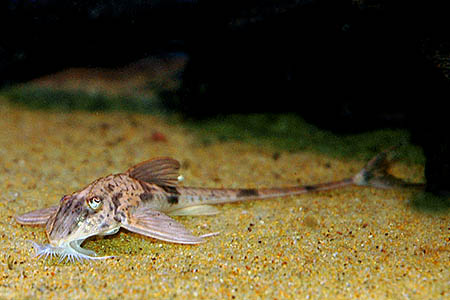
The marbled whiptail, Loricaria simillima, is a whiptail catfish recorded from Venezuela, Ecuador, Peru, Brazil, Paraguay and Argentina. There is a great deal of uncertainty about its identity, and several species or subspecies are probably involved, with darker fish collected from blackwaters and lighter ones from whitewater habitats. The fish in the trade is quite possibly not L. simillima at all. It has been bred in aquaria and shows parental care.
Distribution
EditHabitat
Write a noteEditInhabits a range of habitats, including whitewater and blackwater streams, rivers and tributaries. Water chemistry in these can vary from soft and acidic to medium hard and fairly alkaline.
Aquarium size
Write a noteEditNot terribly active, so a pair could be kept in a tank measuring around 30" x 12" x 12" (75cm x 30cm x 30cm) - 67.5 litres. Larger quarters would be needed for a group.
Maintenance
Write a noteEditThe actual choice of decor isn't really critical as long as there are plenty of shaded spots and hiding places. The fish seem to prefer a soft, sandy substrate, though, to which can be added bits of driftwood, smooth rocks, lengths of pvc pipe etc. as you wish. Live plants won't be harmed so these can also be used to add further cover.
Water conditions
EditTemperature: 24 – 27 °C75 – 81 °F
pH: 5.6-7.8
Hardness: 1-20°H
Diet
Write a noteEditOmnivorous but mainly feeds on aquatic invertebrates in nature, so offer plenty of live and frozen foods such as bloodworm, daphnia, chopped earthworm etc. This diet can be supplemented with dried sinking foods and the occasional slice of cucumber or courgette.
These recommendations come from this profile’s own figures. They contain affiliate links, so we may earn a commission.
Behaviour and compatibility
Write a noteEditA very quiet species, to the point that it will be out-competed for food by more vigorous tankmates. It's best kept with small characins, peaceful cichlids and catfish such as Corydoras or other Loricariids (avoiding the very territorial ones). It's quite amicable with conspecifics and usually does well when kept in a group.
Sexual dimorphism
Write a noteEditMales develop greatly enlarged mouthparts as they mature.
Reproduction
Write a noteEditHas been bred in aquaria, though not with any great regularity. It's well worth a shot if you can get hold some though, as the method of breeding is most intriguing. The best idea is to buy a small group to give yourself the best chance of obtaining a pair. Keep them in a tank set up as suggested above, with no tankmates except perhaps a shoal of a small characin species to act as dither fish. Feed the fish a good, varied diet and make weekly partial water changes of 40-50% to bring them into spawning condition.
Spawning occurs at night. The exact details of this are unknown, but it's obvious if a spawn has occured, as the male will be seen carrying a brood of eggs in his lower 'lip'. It's best to either remove the male to a separate tank, or remove the other fish at this point, in order to avoid predation of the fry.
The male retains the eggs for around 10-15 days. During this time he keeps them ventilated with movements of his mouthparts. Parental care can be variable and the eggs may be eaten or released early by some individuals, whereas others will hold onto them steadfastly. If the eggs are incubated for the full term, the resultant fry will need another 2-3 days to absorb their yolk sacs before they require feeding, at which point they're big enough to take brine shrimp nauplii, microworm and crushed dried foods. As well as being very sensitive to changes in water chemistry, the fry are particularly susceptible to starvation, but a combination of rigorous water maintenance, along with constant access to food will see them reach 1" in length quite quickly.
Notes
EditThe pictures here show the fish that is most commonly referred to as L. simillima, but there is a great deal of uncertainty surrounding its true identity. As suggested above, it seems unlikely that its natural distribution is so wide, and we are probably dealing with several species or subspecies. This argument is strengthened by the fact that several differently coloured fish are imported as this species, with darker specimens being collected from acidic blackwaters and lighter fish hailing from sediment-rich whitewater habitats. Furthermore, it is unclear as to what the original holotype of the species actually looks like, as the description is basic to say the least. Unfortunately the type specimens are now very old and have lost their patterning. These were collected from an isolated river in Ecuador that does not link to any other river system and where collection for the trade never occurs. All this means that the species shown here is quite possibly not L. simillima at all! Thankfully despite all the confusion the fish makes a great aquarium subject, and its fascinating parental care makes it an ideal choice for a breeding project.
Species images · 1
These photographs are used with each photographer’s permission.
Send a photographProfile completeness16 of 24
Community
Questions about Loricaria simillima?
Ask on Discord