Results for “pH”
Type a name: scientific, common, or one a species used to go by. Or narrow the catalogue with the filters.
Filters
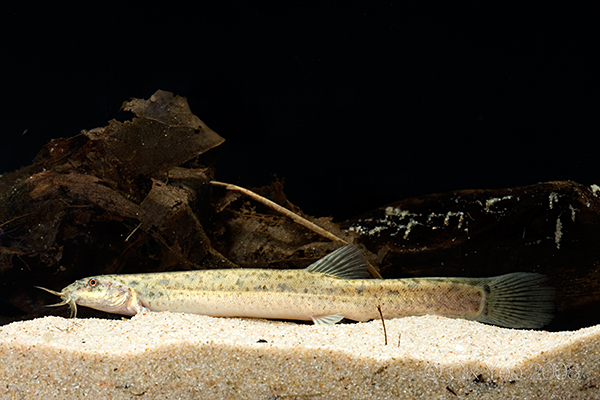
Misgurnus anguillicaudatusOriental Weather Loach
authority not recorded
Max length280mm SL11in SLTank120 × 45cm48 × 18inTempnot recordedpH6.0–8.0An exceptionally hardy and adaptable species tolerant of a wide range of physiological variables and flexible of diet, factors which have allowed it to become established as an alien species around the globe. Its high reproductive potential and low vulnerability to predation have made it a cause for concern to conservation scientists although as yet there remains no proof of it exerting a negative effect on native fishes in countries outside its natural range.
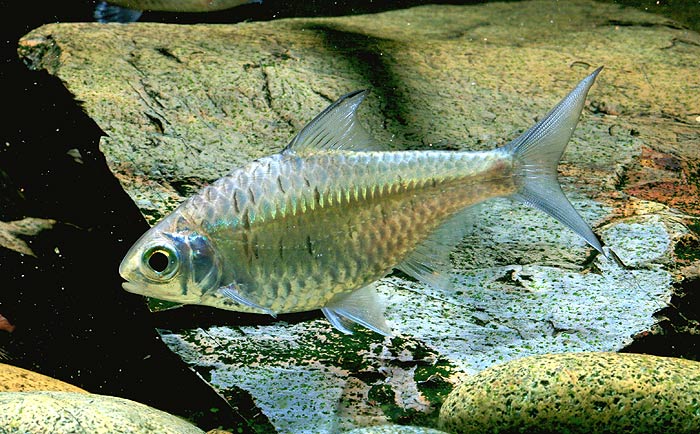
Mystacoleucus chilopterus
Fowler, 1935
Max length91mm SL3.6in SLTanknot recordedTempnot recordedpHnot recordedKnown from the middle Mekong basin in Laos and Thailand, including the Mun tributary drainage on the Khorat Plateau in northeastern Thailand, plus the Chao Phraya and Mae Klong watersheds in central and western Thailand, respectively. In the Mekong system it may also occur further upriver in Yunnan province, China, while the Khone Falls in Laos appear to represent its downstream limit.
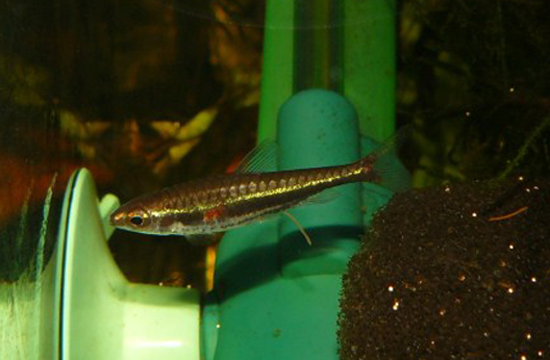
Nannostomus minimusLeast Pencilfish
Eigenmann, 1909
Max length23mm SL0.9in SLTank45 × 30cm18 × 12inTemp22–28°C72–82°FpH4.0–6.5Inhabits sluggish blackwater tributaries, small rivers and swampy areas, particularly in areas with dense growth of aquatic or overhanging riparian vegetation, submerged woody structures and leaf litter. The water is typically stained darkly with humic acids and other chemicals released by decaying organic material, the dissolved mineral content is generally negligible and pH can be as low as 4.0. N. minimus occurs sympat...
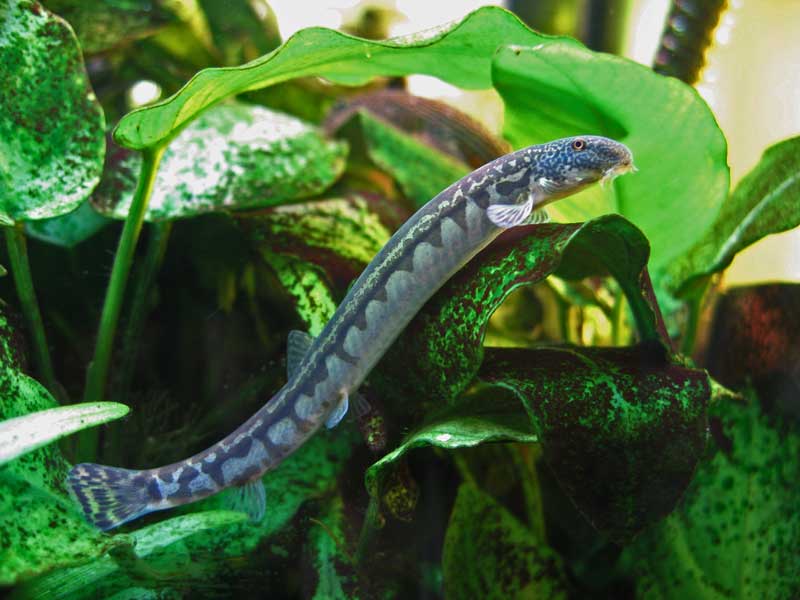
Niwaëlla delicataAjime Loach
Niwa, 1937
Max length110mm SL4in SLTank90 × 30cm36 × 12inTemp20–24°C68–75°FpH6.5–7.5During winter months N. delicata retreats to streams or underflows where it remains dormant between October and April (Kano, 2000) before emerging to spawn. Other species living alongside it in nature include Rhinogobius flumineus, Cottus pollux and Phoxinus spp. Niwaëlla is closely related to Cobitis and N. delicata, also the type species, was described as C. delicata (Niwa, 1937). The combination of characters used to tell it...
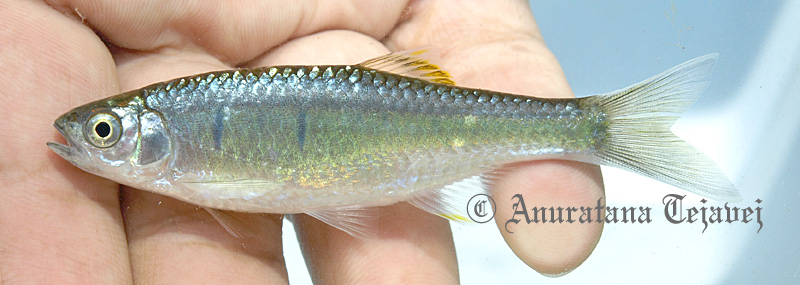
Opsarius koratensis
Smith, 1931
Max length100mm SL3.9in SLTank150 × 45cm60 × 18inTemp22–30°C72–86°FpH6.0–8.0Inhabits well-oxygenated, low-to-medium gradient, slow to moderate-flowing rivers and streams with substrates of gravel, cobbles, larger boulders and exposed bedrock. At the habitat in our image pH was 7.5, temperature 26°C and cond...
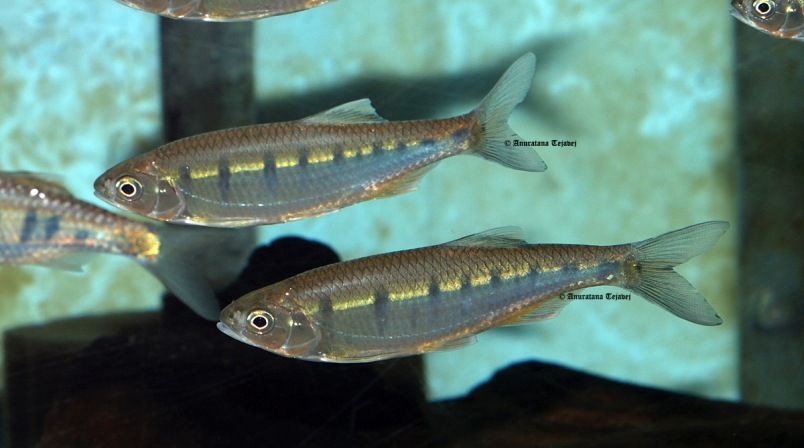
Opsarius ornatus
Sauvage, 1883
Max length110mm SL4in SLTank150 × 60cm60 × 24inTemp18–26°C64–79°FpH6.0–8.0Type locality is 'Mé-Nam River, Thailand', with 'Mé-Nam' having been considered an older name for the Chao Phraya river in central and western Thailand prior to this species' redescription by Tejavej (2012). In fact 'menam' is the Thai word for 'river' and thus could refer to any drainage, and B. ornatus is restricted to...
Oreochromis tanganicaeTanganyikan Tilapia
authority not recorded
Max length420mm SL17in SLTank210 × 60cm84 × 24inTemp24–28°C75–82°FpH7.5–9.0This large Tanganyikan species is not seen very often in the hobby. It is often seen in shoals in nature, where it appears to feed primarily on phytoplankton. An adult male would make a truly stunning specimen fish....
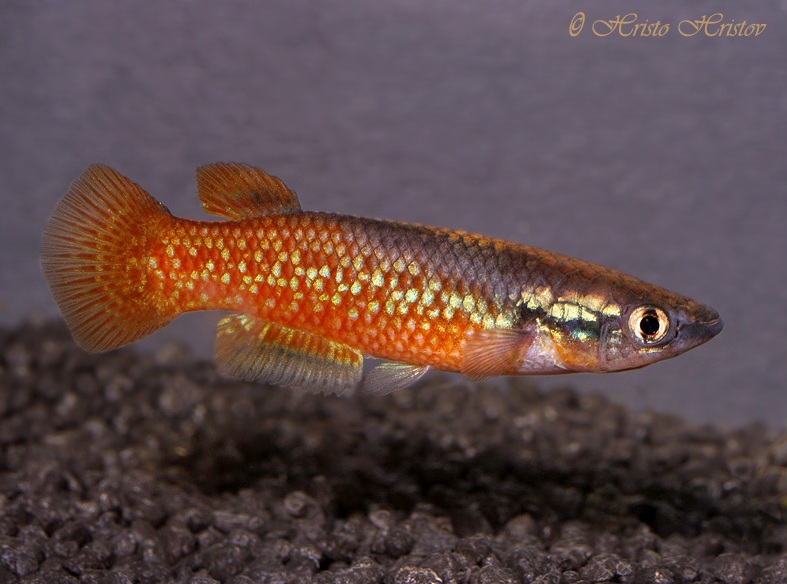
Pachypanchax sakaramyiMadagascar Panchax
Holly, 1928
Max length90mm SL3.5in SLTank90 × 30cm36 × 12inTemp20–24°C68–75°FpH6.5–7.5The majority of original populations have already been extirpated due to introduction of invasive species such as Gambusia holbrooki and Poecilia reticulata, ongoing deforestation of the Ambohitra Massif, and physical diversion of the source of the Sakaramy River for domestic use by locals. An additional population may exist in a stream on the southern slope of the Ambohitra Massif on the road between Bobasokoa and Anivorano, near the village of Andranotohiliny, but this requires verification.
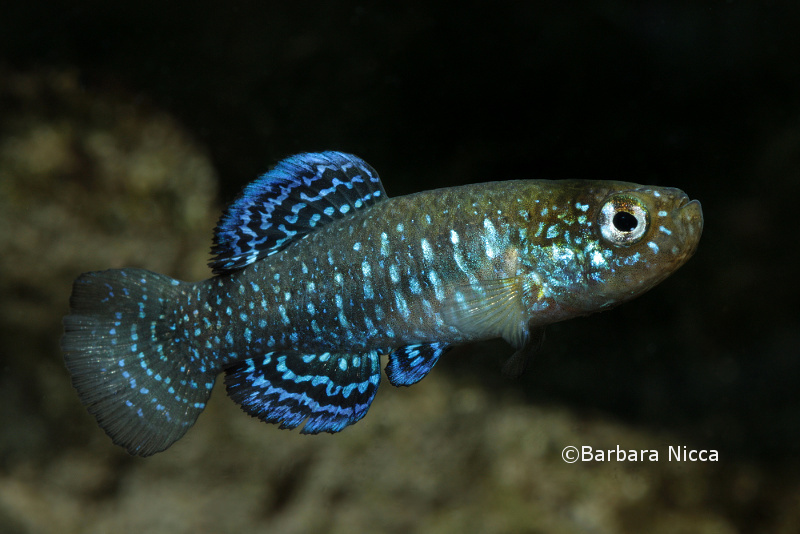
Paraphanius mentoIridescent Toothcarp
Heckel, 1843
Max length70mm SL2.8in SLTank120 × 30cm48 × 12inTemp2–30°C36–86°FpH7.5–9.0This species has something of a confused history having been previously been considered synonymous with both A. sophiae (a separate species native to Iraq and Iran) and A. cypris (currently considered a junior synonym of A. mento). Although some populations occur close to and even sympatric with other members of the genus in Turkey phylogenetic studies have shown it to be more closely-related to the Middle Eastern species A. dispar dispar, A. d. richardsoni, A. ginaonis and A. sirhani. It's...
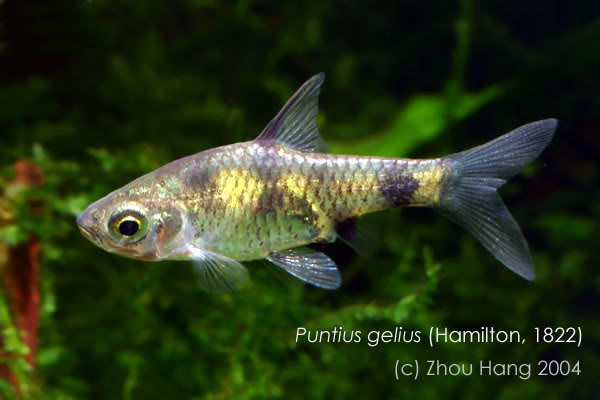
Pethia aurea
Knight, 2013
Max length25mm SL1.0in SLTank45 × 30cm18 × 12inTemp18–24°C64–75°FpH6.0–7.0This species was considered to be a phenotype of the similar-looking P. gelius prior to its description. Following Knight (2013) it is included a group of closely-related species alongside P. gelius and P. canius, the trio being distinguished from other members of the genus Pethia by the following combination of characters: lateral line incomplete with 3-4 por...
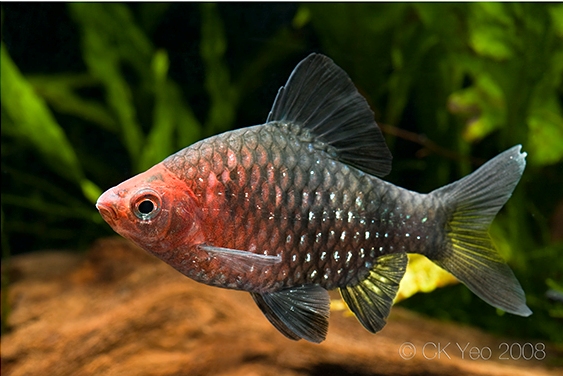
Pethia nigrofasciataBlack Ruby Barb
Günther, 1868
Max length55mm SL2.2in SLTank80 × 30cm31 × 12inTemp20–27°C68–81°FpH5.5–7.5Little sun is able to penetrate the forest floor so aquatic habitats are shaded and water temperature may be relatively cool, while conductivity and hardness are generally low and pH slightly acid. Macrophytes are uncommon though there may be dense, marginal vegetation, sometimes overhanging the full width of the stream, the roots of which may penetrate the banks underwater. Typical substrates are sandy but covered by a layer of leaf litter with fallen twigs and branches.
Pimelodus maculatusSpotted Pim
authority not recorded
Max length180mm SL7in SLTank120 × 60cm48 × 24inTemp20–24°C68–75°FpH6.4–7.4There are currently 32 genera and over 80 species included in the family Pimelodidae (including Pimelodus), making it the second largest and one of the most diverse amongst catfish. Most experts agree however, that a full systematic revision of the family is needed, as little information about the phylogenetic (evolutionary relatedness) relationships between the various genera exists. Taxonomy information at the species level is also basic at best. It's therefore likely that at least some o...
Pimelodus ornatusOrnate Pim
authority not recorded
Max length280mm SL11in SLTank150 × 60cm60 × 24inTemp24–25°C75–77°FpH6.0–7.2There are currently 32 genera included in the family Pimelodidae (including Pimelodus), making it the second largest and one of the most diverse amongst catfish. However most experts agree that a full systematic revision of the family is needed, as little information about the phylogenetic (evolutionary relatedness) relationships between the various genera exists. Taxonomy information at the species level is also basic at best. It's therefore likely that at least some of the Pimelodids will...
Pimelodus pictusPictus Cat
authority not recorded
Max length120mm SL5in SLTank120 × 45cm48 × 18inTemp22–25°C72–77°FpH5.8–6.8There are currently 32 genera and over 80 species included in the family Pimelodidae (including Pimelodus), making it the second largest and one of the most diverse amongst catfish. However most experts agree that a full systematic revision of the family is needed, as little information about the phylogenetic (evolutionary relatedness) relationships between the various genera exists. Taxonomy information at the species level is also basic at best. It's therefore likely that at least some of...
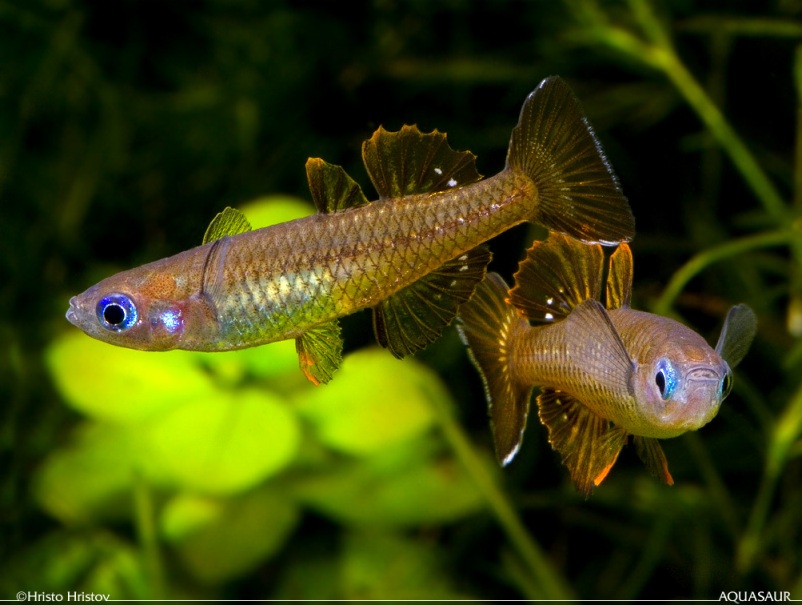
Pseudomugil tenellusDelicate Blue-eye
Taylor, 1964
Max length55mm SL2.2in SLTank75 × 30cm30 × 12inTemp25–32°C77–90°FpH5.5–7.5Euryhaline and mostly inhabits coastal floodplains where it's found in both fresh and brackish habitats, including tidal estuaries and salt marshes. It's particularly common in swamps, billabongs, and slow-moving streams where aquatic vegetation grows densely, but some populations have colonised upper sections of freshwater streams. Larger individuals may also move into main river channels. Tappin (2010) gives the following ranges of parameters based on those taken from various localities: temperature 27 - 38 °C, pH 5...
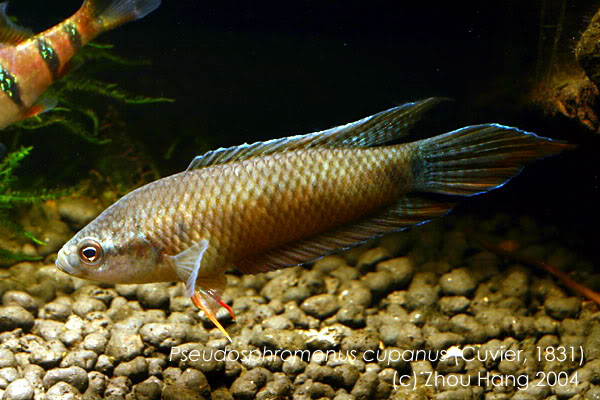
Pseudosphromenus cupanusSpiketail Paradisefish
Cuvier, 1831
Max length65mm SL2.6in SLTank60 × 30cm24 × 12inTemp20–28°C68–82°FpH6.0–7.5This species is most easily told apart from its only congener P. dayi by lacking (vs. possessing) two dark, irregular lateral stripes on the head and body, and a shorter caudal-fin in males. The results of phylogenetic analyses by Rüber et al. (2006) suggest that Pseudosphromenus is most closely-related to Malpulutta in an evolutionary sense.
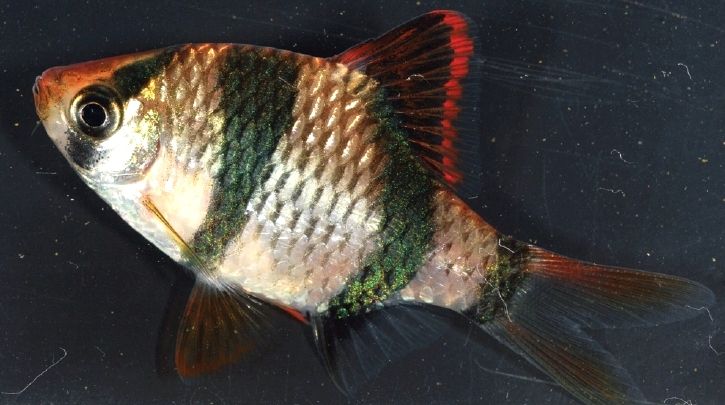
Puntigrus navjotsodhii
Tan, 2012
Max length48mm SL1.9in SLTanknot recordedTempnot recordedpHnot recordedThe type series was collected from a small clear-water stream with a pH of 6.0, forming a series of riffles and deeper pools, with a maximum width of 5 metres and depth ranging from 10 cm to 1 metre. The substrate was composed of sand gravel and rocks, with some leaf litter and overhanging marginal vegetation.
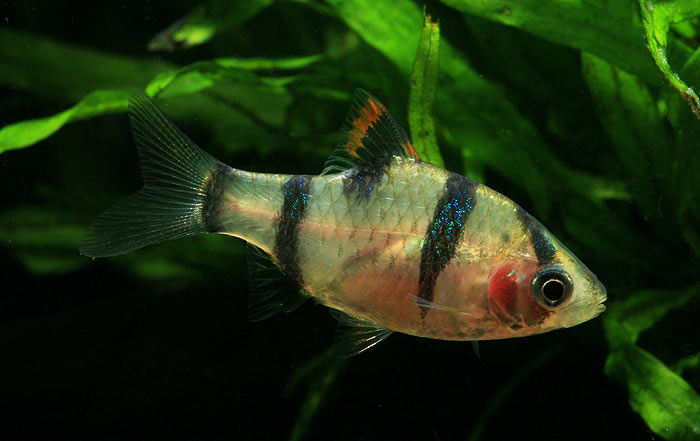
Puntigrus partipentazona
Fowler, 1934
Max length40mm SL1.6in SLTank80 × 30cm31 × 12inTemp20–26°C68–79°FpH5.0–7.0Recorded from numerous river basins in Vietnam, Cambodia, Laos, Thailand, and Peninsular Malaysia, including the Mekong, Chao Phraya, Mae Khlong, Chanthaburi, Tapi, Golok, Terengganu, Pahang, Endau, and Muar. Type locality is 'Kratt, southeastern Siam', which corresponds to modern-day Trat Province, Thailand.
Rasbora paucisqualis
authority not recorded
Max length40mm SL1.6in SLTank60 × 30cm24 × 12inTemp22.2–25.6°C72–78°FpHnot recordedRainboth's 'Fishes of the Cambodian Mekong' characterised members of Rasbora by possession of an unbranched, non-spiny firstray and seven soft dorsal rays, origin of thein the middle of the body, five branchedrays, a small mouth not extending below the eye and a lack of barbels. It's long been recognised as a polyphyletic lineage as noted by Kottelat (1999) amongst others, and in 2010 the results of a phylogenetic analysis by T. Y. Liao et al. suggested a number of changes in...
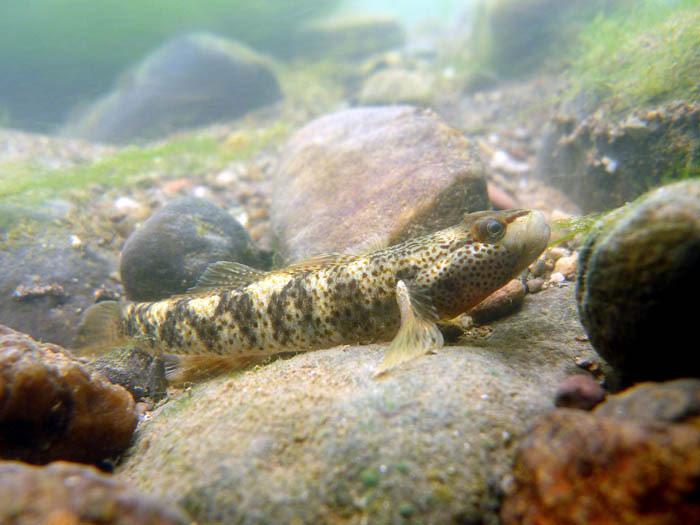
Rhinogobius mekongianus
Pellegrin & Fang, 1940
Max length50mm SL2.0in SLTank60 × 30cm24 × 12inTemp18–26°C64–79°FpH6.0–7.5Known from various parts of the middle and upper Mekong river basins with record existing from the Nam Tha, Nam Ou, Nam Khan, Nam Lik, Nam Ngum and Nam Mang tributary systems in Laos, the Nam Noeua (a tributary of Nam Ou) in Vietnam, and the Mae Nam Kok in Thailand. Occurrences in the Chao Phraya drainage in central Thailand most likely refer to the congener R. chiengmaiensis.