Search the catalogue
Type a name: scientific, common, or one a species used to go by. Or narrow the catalogue with the filters.
Filters
Melanotaenia maccullochiDwarf Rainbowfish
authority not recorded
Max length70mm SL2.8in SLTank60 × 30cm24 × 12inTemp20–30°C68–86°FpH5.5–8.0There are a few geographical variants of this species available, which differ in colour, patterning and less commonly, size. These should not be mixed in aquaria, as they may hybridise. The differences are so apparent between some of these forms that they may well turn out to be different species in the future....
Melanotaenia praecoxNeon Dwarf Rainbowfish
authority not recorded
Max length80mm SL3.1in SLTank60 × 30cm24 × 12inTemp23–28°C73–82°FpH6.8–7.5...
Melanotaenia splendida inornataCheckered Rainbowfish
authority not recorded
Max length150mm SL6in SLTank120 × 30cm48 × 12inTemp26–33°C79–91°FpH6.5–8.0There are currently 4 described subspecies of Melanotaenia splendida. The principle differences are generally in colour, pattern and fin counts, although even these vary depending on the locality of the fish. The different forms and subspecies should not be mixed in the aquarium, as they may hybridise. Adult specimens are rarely seen for sale, and it's the much drabber juvenile fish that are almost always offered in dealers tanks. However, exercise some patience (even on a good diet, full c...
Melanotaenia splendida rubrostriataRed-striped Rainbowfish
authority not recorded
Max length125mm SL5in SLTank120 × 30cm48 × 12inTemp24–30°C75–86°FpHnot recordedThere are currently 4 described subspecies of Melanotaenia splendida, of which this species is one of the most colourful. The principle differences are generally in colour, pattern and fin counts, although even these vary depending on the locality of the fish. The different forms and subspecies should not be mixed in the aquarium, as they may hybridise. Adult specimens are rarely seen for sale, and it's the much drabber juvenile fish that are almost always offered in dealers tanks. However,...
Melanotaenia splendida splendidaEastern Rainbowfish
authority not recorded
Max length150mm SL6in SLTank120 × 30cm48 × 12inTemp20–30°C68–86°FpH5.0–8.0There are currently 4 described subspecies of Melanotaenia splendida. The principle differences are generally in colour, pattern and fin counts, although even these vary depending on the locality of the fish. M s. splendida in particular also exhibits a wide variation in colour and patterning depending on locality within the subspecies, and the species name is often suffixed with a place name when the fish are seen for sale. The different forms and subspecies should not be mixed in the aquarium,...
Melanotaenia trifasciataBanded Rainbowfish
authority not recorded
Max length150mm SL6in SLTank120 × 30cm48 × 12inTemp24–33°C75–91°FpH6.5–8.0M. trifasciata exhibits a wide variation in colour and patterning depending on locality, and it's very important that the different morphs are not mixed in the aquarium, as they will hybridise freely. These different forms are often distinguished by the addition of the name of collection locality being added to the scientific name of the fish. It's thought that several species may in fact be in evidence here, and a reclassification will probably occur at some point As with many othe...
Mesonauta festivusFlag Cichlid
authority not recorded
Max length100mm SL3.9in SLTank120 × 38cm48 × 15inTempnot recordedpH6.0–8.0Flag Cichlids are enduringly popular in the hobby and can be found in most aquatic stores. Interestingly, this species is not the species most commonly sold as the Flag cichlid. It is usually m. insignis that makes it into dealers tanks....
Mesonauta insignis
authority not recorded
Max length100mm SL3.9in SLTank120 × 38cm48 × 15inTemp26–30°C79–86°FpHnot recordedThere is some debate that this species is actually the fish that finds its way into aquatic stores under the name of the Flag cichlid (normally attributed to m. festivus). The two fish look very similar and, in reality, it is likely that both species are sold under the same name - depending on the area where the fish were originally caught and exported from....
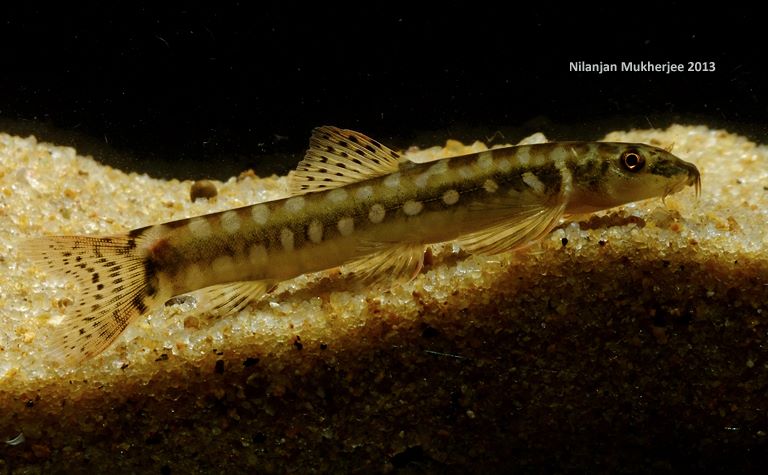
Mesonoemacheilus guentheri
Day, 1867
Max length60mm SL2.4in SLTank60 × 30cm24 × 12inTemp19–25.5°C66–78°FpH6.0–7.5However, according to the identification key of Rema Devi and Indra (2002), the two can be distinguished by a combination of factors as follows: body spots rounded in shape (vs. 'Y' or 'V' shaped in M. herrei); caudal peduncle relatively long (vs. relatively short); anal-fin not reaching base of caudal-fin (vs. anal-fin reaching base of caudal-fin); caudal peduncle with a dark band (vs. caudal peduncle with a dark spot); sub...
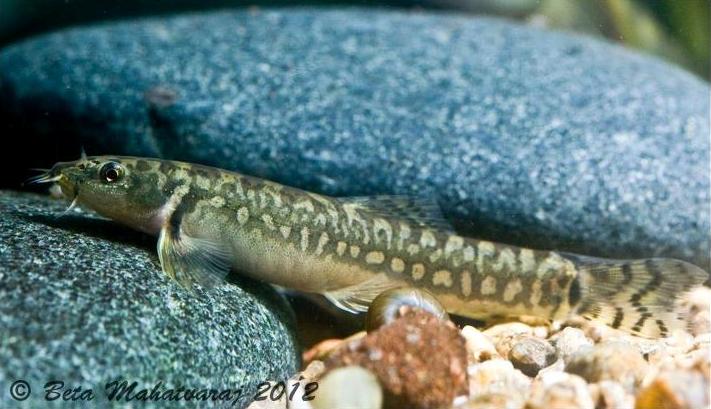
Mesonoemacheilus herrei
Nalbant & Bãnãrescu, 1982
Max length60mm SL2.4in SLTank60 × 30cm24 × 12inTemp18–25.5°C64–78°FpH6.0–7.5It's unclear if this species has ever been exported for the aquarium hobby outside of India but there may be a chance of finding the occasional specimen mixed in with shipments of M. guentheri or M. triangularis. It was earlier considered synonymous and may still be confused with M. guentheri since both species share similar body patterning consisting of rows of yellowish, dark-edged spots.
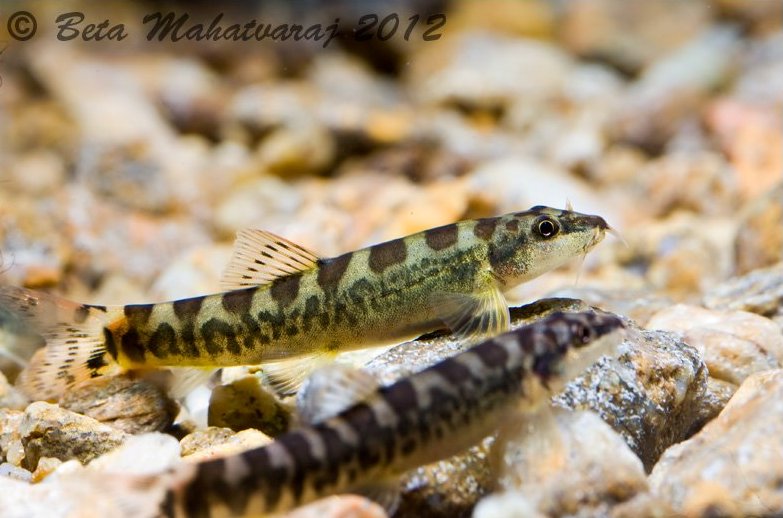
Mesonoemacheilus petrubanarescui
Menon, 1984
Max length50mm SL2.0in SLTank60 × 30cm24 × 12inTemp18–25.5°C64–78°FpH6.0–7.5Type locality is 'Netravati River, Dharmasthala, Karnataka State, India', with the species subsequently recorded from the Kabini (aka Kabani) River basin and it may be endemic to these two drainages. While the Netraviti flows through Karnataka in its entirety before emptying into the Arabian Sea just south of the city of Mangalore, th...
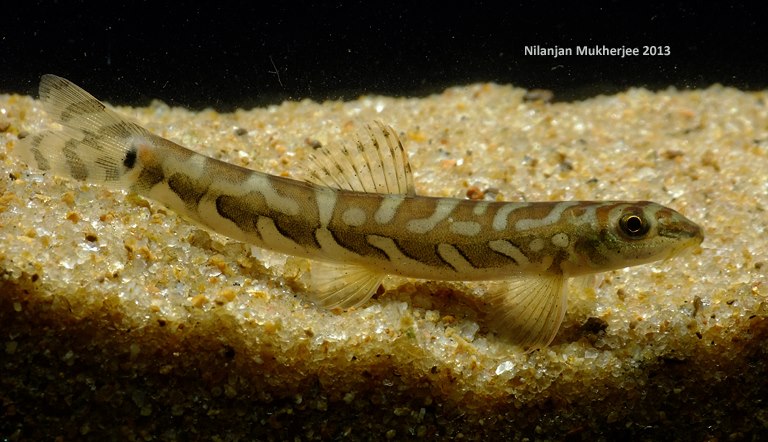
Mesonoemacheilus triangularisZodiac Loach
Day, 1865
Max length60mm SL2.4in SLTank75 × 30cm30 × 12inTemp18–25.5°C64–78°FpH6.0–7.5This species is also referred to by the alternative vernacular name 'Batik loach' and is the most-commonly traded member of the genus at present. It's easily-distinguished from congeners by body patterning which comprises a series of pale, oblique saddle-like markings edged in black and running along the dorsal surface, plus a similar set of bars originating from the otherwise plain ventral surface.
Metynnis argenteus
authority not recorded
Max length150mm SL6in SLTank180 × 38cm72 × 15inTemp24–28°C75–82°FpH6.0–7.0Metynnis argenteus is very similar to another member of the genus, Metynnis hypsauchen and both fish are sold in the hobby under the name "Silver Dollar". The latter species is sometimes referred to as the Plain Metynnis in an effort to distinguish it from its close relation. They are virtually indentical in terms of appearance and care requirements. The two species can be told apart as m. hypsauchen has a black blotch located slightly above and behind each eye. In addition to these tw...
Metynnis hypsauchenSilver Dollar
authority not recorded
Max length150mm SL6in SLTank180 × 38cm72 × 15inTemp24–28°C75–82°FpH6.0–7.0Metynnis hypsauchen is sometimes referred to as the Plain Metynnis in an effort to distinguish it from its close relation, Metynnis argenteus. Both fish are sold in the hobby under the name "Silver Dollar" and are virtually indentical in terms of appearance and care requirements. The two species can be told apart as m. hypsauchen has a black blotch located slightly above and behind each eye. This species also occurs in a striped colour form which is sometimes referred to as(m. hypsauch...
Metynnis lippincottianus
Cope, 1870
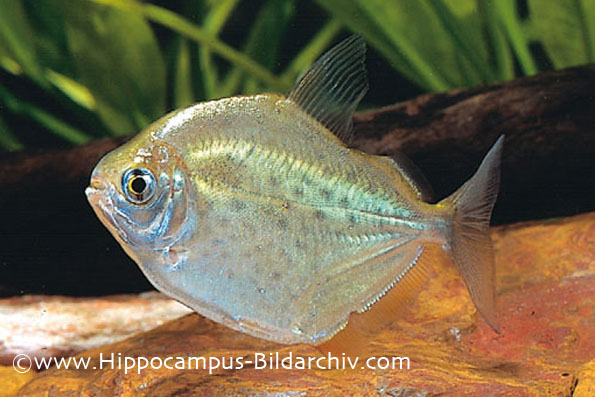
Max length130mm SL5in SLTank150 × 38cm60 × 15inTemp23–27°C73–81°FpH6.0–7.0Metynnis lippincottianus is occasionally seen for sale, sometimes under the name of "Silver Dollar". It is easily distinguishable from m. argenteus and m. hypsauchen (which are more commonly sold as Silver Dollars) by its spotted pattern, hence the common name. M. lippincottianus shares a common name with m. maculatus but the two can be distinguished as the spots on m. maculatus are more pronounced. Silver dollars are common and popular fish in the hobby. They are related to piranh...
Metynnis maculatusSpotted Metynnis
Kner, 1858
Max length148mm SL6in SLTank180 × 45cm72 × 18inTemp20–28°C68–82°FpH5.0–7.5Metynnis maculatus
Metzia bounthobi
Shibukawa, Phousavanh, Phongsa & Iwata, 2012
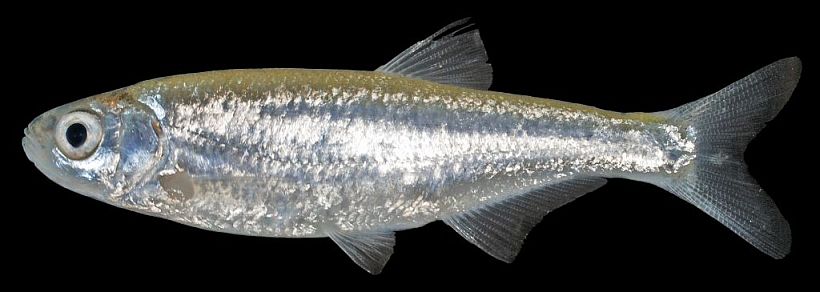
Max length61mm SL2.4in SLTanknot recordedTempnot recordedpHnot recordedThis species can be distinguished from congeners by the following combination of characters: 18–20 (vs. 10-18) branched anal-fin rays; 49–55 (vs. 35-48) lateral-line scale rows; 33–36 (vs. 15-20) predorsal sca...
Metzia formosae
Oshima, 1920
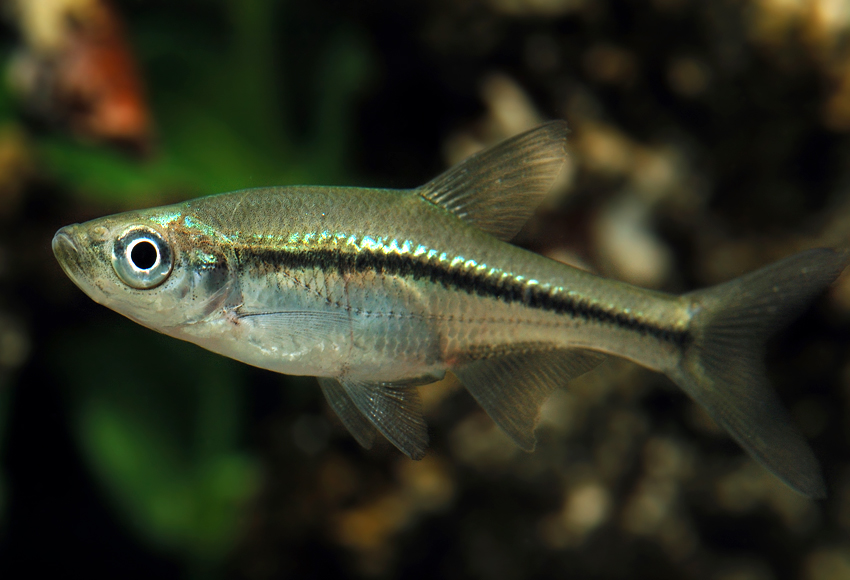
Max length75mm SL3.0in SLTanknot recordedTempnot recordedpHnot recordedAlthough it is included in the genus Metzia this grouping remains somewhat unresolved in terms of taxonomy and it may contain more than a single genetic lineage. For example, members share a number of characters with the genera Ischikauia Jordan and Snyder 1900, Hemiculterella Warpachowski 1887, and several species of Anabarilius Cockerell 1923, including a bipartite gas bladder, a non-spinous dorsal-fin ray, and a sharp ventral keel between the pelvic-fin insertion and anus.
Metzia lineata
Pellegrin, 1907
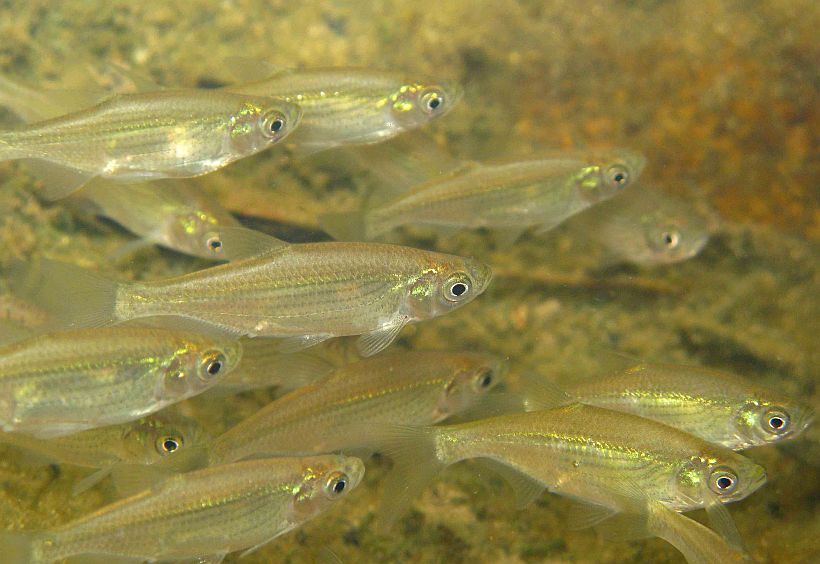
Max length100mm SL3.9in SLTanknot recordedTempnot recordedpHnot recordedPopulations from the upper Pearl River (Nanpan Jiang basin) differ in several morphological characters from those inhabiting Guangdong, Guangxi, and Guizhou Provinces, and Hainan Island. Those from Vietnam also seem to be different (Gan et al., 2009), the implication being that there may be several species currently included under the name M. lineata.
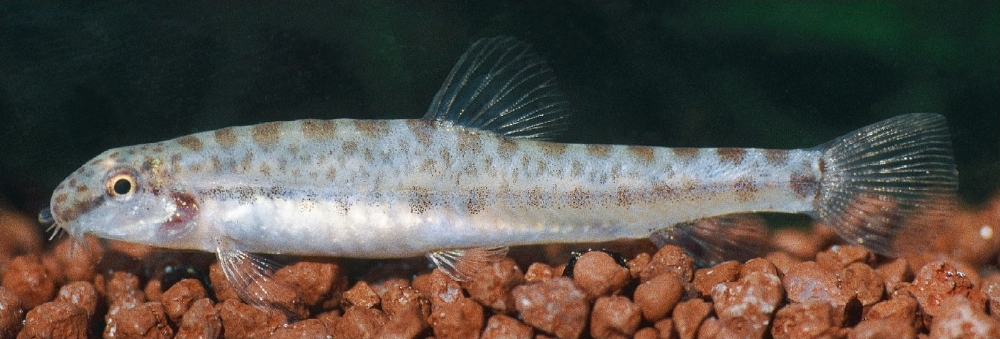
Microcobitis misgurnoides
Rendahl, 1944
Max length41mm SL1.6in SLTank45 × 30cm18 × 12inTemp20–24°C68–75°FpH5.5–7.0This species was initially described as a member of Cobitis and remained as such for over 60 years until being redescribed in the new genus Microcobitis by Bohlen and Harant (2011). It can be separated from Cobitis species by a number of char...