Mesonauta festivus
Flag Cichlid
Last revised 2026Edit this page
On this page11 sections
Quick factsEdit
Difficulty6 of 8 measures
Rated moderate because it needs a well-established tank and stable water.
- Space
- large tank
- Water
- needs soft water
- Temp
- needs a steady temperature
- Diet
- unknown
- Temperament
- peaceful
- Social
- unknown
- Compatibility
- fine with others
Other demands
Each of these can raise the rating on its own, whatever the measures above say.
- Hardiness
- needs a well-established tank
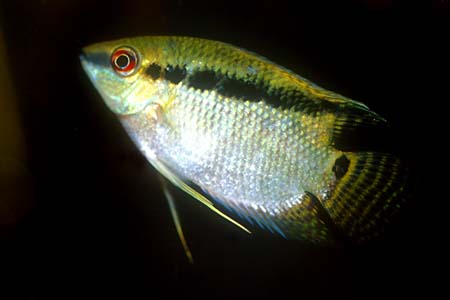
The flag cichlid, Mesonauta festivus, is a cichlid recorded from Venezuela, Peru, Brazil, Bolivia and Paraguay. It lives in well planted, slower-moving waters. Flag cichlids are found in most aquatic stores, but the fish usually sold under the name is M. insignis. It is peaceful, but becomes more aggressive when breeding.
Distribution
EditHabitat
Write a noteEditUsually foound in well planted habitats in slower moving waters.
Aquarium size
Write a noteEdit120 ∗ 38 ∗ 30 cm48 ∗ 15 ∗ 12 in - ~137 litres~36 US gal
Maintenance
Write a noteEditWell planted tank with moderate water flow. Bogwood and branches can be used for decor. Sandy subtrate is preferred. Lighting should not be too strong.
Water conditions
EditTemperature: Occurs in a wide rande of temperatures in the wild. 76 - 82°F (24 - 28°C) is suggested in the aquarium.
pH: 6.0 - 8.0 will be tolerated but a pH of around 6.5 is suggested.
Hardness: Up to 5°H
These recommendations come from this profile’s own figures. They contain affiliate links, so we may earn a commission.
Diet
Write a noteEditIt's a generalistic omnivore by nature. Wild fish feed on worms, crustaceans, plant matter (apparently including algae) and other zoobenthos. Accepts the majority of prepared foods. This should be supplemented with live foods such as bloodworm and brineshrimp and spme vegetable matter.
Behaviour and compatibility
Write a noteEditSexual dimorphism
Write a noteEditReproduction
Write a noteEditBreeding takes place a flat stone or similar area. Once the breeding area is prepared, eggs will be deposited by the female and then fertilised by the male. In excess of 200 eggs may be laid. Both fish guard the eggs and when the fry hatch two to three days later, they are transferred to a pit where the parents keep them until they become free-swimming. This is usually 3 - 4 days after hatching. Both fish assume parental duties but can be easily spooked often leading to them eating the fry. It is advisable that the breeding tank be placed in a quiet location and distrubed as little as possible.
Fry can be fed on newly-hatched brineshrimp and powdered fry foods until large enough to take bigger foods.
Notes
EditFlag Cichlids are enduringly popular in the hobby and can be found in most aquatic stores. Interestingly, this species is not the species most commonly sold as the Flag cichlid. It is usually m. insignis that makes it into dealers tanks.
Species images · 1
These photographs are used with each photographer's permission.
Send a photographDistribution
Profile completeness20 of 24
83% complete
Also missing: taxonomic authority, etymology.
Community
Questions about Mesonauta festivus?
Ask on Discord