Results for “species”
Type a name: scientific, common, or one a species used to go by. Or narrow the catalogue with the filters.
Filters
Potamotrygon hystrixPorcupine Stingray
authority not recorded
Max length375mm SL15in SLTanknot recordedTemp24–26°C75–79°FpH6.0–7.5P. hystrix is sometimes sold as P. sp. "C", and is much sought after in the hobby. The species is usually recommended as a good beginners' ray due to its relatively small adult size. However due to current Brazilian legislation regarding the export of rays it's almost never available at present, and tends to command a high price when it is. The fish sold as hystrix in the trade are almost always Peruvian in origin and erroneously labelled. We've seen P. humerosa, P. yep...
Potamotrygon leopoldiPolka Dot Stingray
authority not recorded
Max length600mm SL24in SLTank240 × 90cm96 × 36inTemp20–29°C68–84°FpH6.0–7.5P. leopoldi is aruably one of the most stunning freshwater species in the hobby and comes with a price tag to match. A fully grown one of these makes a jaw-dropping sight. Sadly exports from Brazil are now illegal under the IBAMA regulations, although captive bred fish are available occasionally. The price tends to be even more expensive as a result. A rare form in which the light spots appear as rings with black centres is known as P. leopoldi "eclipse" is more costly still. The stunn...
Potamotrygon motoroMotoro Stingray
authority not recorded
Max length900mm SL35in SLTank240 × 90cm96 × 36inTemp24–26°C75–79°FpH6.0–7.5P. motoro is one of the most popular members of the genus with aquarists. Whilst it is quite easily obtainable and hardy once settled in, it does grow very large so make sure you can house it adequately long term. It should also be noted that the males of this species are among the most violent when in the mood for spawning and females can end up on the wrong end of a serious beating. If you're keeping a pair or group of these keep a close eye on proceedings and be prepared to separate them...
Potamotrygon schroederiFlower Ray
authority not recorded
Max length600mm SL24in SLTank240 × 90cm96 × 36inTemp20–29°C68–84°FpH6.0–7.5P. schroederi is one of the most attractive and sought after members of the family. Due to current export restrictions in Brazil it has become very scarce in the hobby and commands a high price when it is available, usually from captive breeders. There is another fish sold under the name "flower ray", presumably to boost sales. This is a potentially undescribed species imported from Peru and is usually referred to as "Peru flower" or P40 by ray enthusiasts. Some believe this ...
Potamotrygon sp. "itaituba"P14
authority not recorded
Max length400mm SL16in SLTank210 × 90cm84 × 36inTemp23–29°C73–84°FpH6.0–7.5This stunning fish is one of the more sought after rays in the hobby. Taxonomically it remains unclear whether it is a geographical variant of P. leopoldi or a distinct species. It has a smaller adult size and both pups (see section above) and adults exhibit different patterning than it's relative. In P. leopoldi the light spotted markings tend to be quite large, spaced out and do not extend to the edge of the disc. In P14 they are typically much smaller, more randomly distributed and prese...
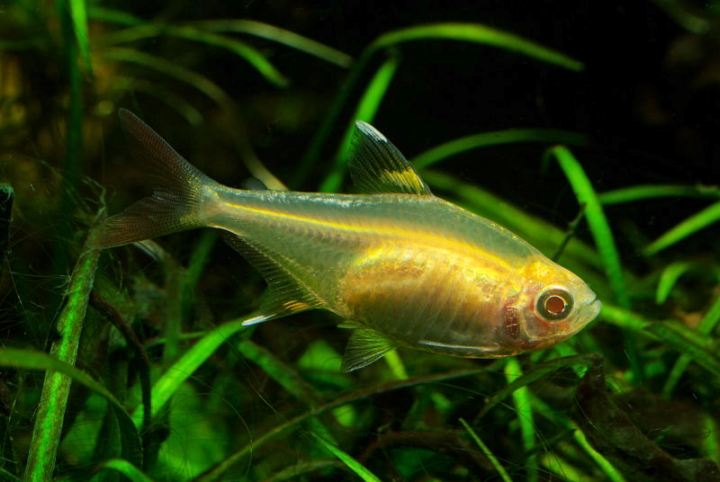
Pristella maxillarisX-ray Tetra
Ulrey, 1894
Max length45mm SL1.8in SLTank60 × 30cm24 × 12inTemp22–28°C72–82°FpH6.0–7.5P. maxillaris is one of the more popular tetras in the hobby, and is easily obtainable from most aquatic shops. It must rank among the very best choices for the newcomer to fishkeeping as it's peaceful, hardy and inexpensive. There's a selectively-bred "golden" strain available which is actually a semi-albino fish. Care is much the same as for the standard form. Currently the only species in the genus, in older literature it's often referred to by the now invalid name...
Pristolepis marginatusMalabar Leaffish
authority not recorded
Max length150mm SL6in SLTank120 × 30cm48 × 12inTemp23–28°C73–82°FpH6.5–7.5Also known as the common catopra, this is still quite a rare species in the hobby, although it's becoming more readily available due to captive breeding efforts. It makes an interesting addition to the larger community or oddball tank....
Protomelas pleurotaenia
authority not recorded
Max length140mm SL6in SLTank120 × 45cm48 × 18inTemp24–28°C75–82°FpH7.6–8.8This species has an interesting method of feeding in nature. It 'blows' at the top layer of the substrate (usually sand) and feeds on any invertebrates or other morsels that are uncovered. It is rare in the hobby and little information regarding it's care is available....
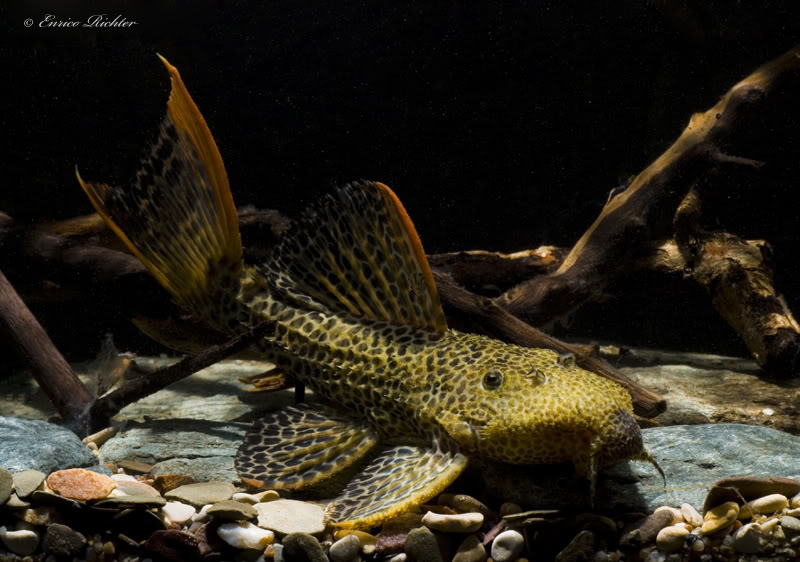
Pseudacanthicus cf. leopardusL114
authority not recorded
Max length250mm SL10in SLTank180 × 60cm72 × 24inTemp24–30°C75–86°FpH5.5–7.5Mostly collected in the in the rio Negro basin, Amazonas state, Brazil, and in particular the rio Demini, a northern tributary flowing into the central Negro in the municipality of Barcelos. P. leopardus was described from the Rupununi River in Guyana and the identity of this fish thus remains unconfirmed. This 'species' is also traded simply as 'leo...
Pseudocrenilabrus philanderSouthern Mouth-Brooder
authority not recorded
Max length75mm SL3.0in SLTank120 × 30cm48 × 12inTemp22–25°C72–77°FpH6.5–7.5This species is not often seen in the hobby, which is a pity as it is a stunning fish with interesting behaviour. If you do manage to get some, be sure to provide the best possible conditions from the start, as they appear to travel quite badly and losses are common. There are currently 3 subspecies, Pseudocrenilabrus philander philander, P. p. dispersus and P. p. luebberti. However, recent studies suggest as many as 11 distinct populations exist, differing in location, colour, patterning, be...
Pseudogastromyzon myersi
authority not recorded
Max length60mm SL2.4in SLTank75 × 30cm30 × 12inTempnot recordedpH6.0–7.5This species is traded under various vernacular names including 'Chinese hillstream loach', 'Chinese butterfly plec' and 'Hong Kong Otocinclus. It's the commonest member of the genus in the hobby but has been frequently misidentified as the congener P. cheni in the past with the two often said to be indistinguishable in terms of colour pattern. Some sources additionally suggest the sole defining external character to be that in P. cheni the distance between the resp...
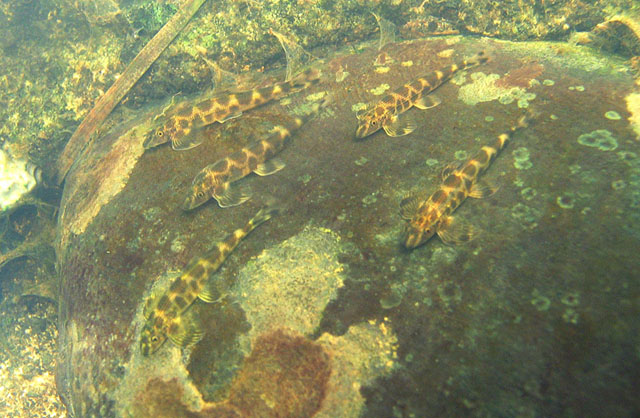
Pseudohomaloptera sexmaculata
Fowler, 1934
Max length70mm SL2.8in SLTank80 × 30cm31 × 12inTemp20–25.5°C68–78°FpH6.0–7.5H. sexmaculata is very similar to H. leonardi but can be told apart since it possesses 2 simple and 12-14 branched pectoral-fin rays (versus 6 simple and 11 branched rays). Both of these species are sometimes misidentified as H. yunnanensis which has 7 simple and 12 branched pectoral-fin rays.
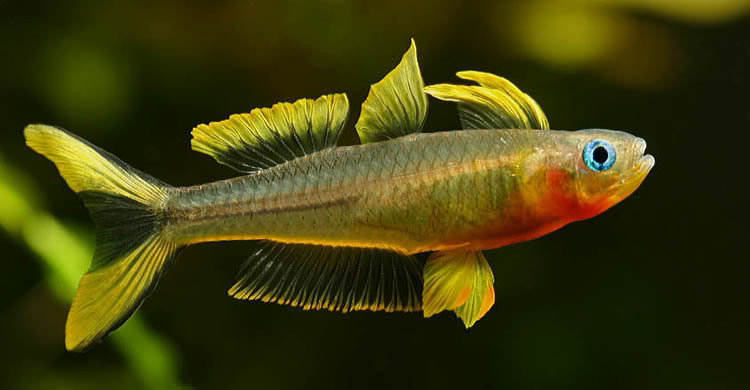
Pseudomugil furcatusForktail Blue-eye
Nichols, 1955
Max length60mm SL2.4in SLTank60 × 30cm24 × 12inTemp24–28°C75–82°FpH7.0–8.0This species is also traded as 'forktail rainbowfish' or 'yellow forktail', and it's also undergone several changes in scientific name since description. Pseudomugil furcatus is the original designation, but Allen (1980) created the genus Popondetta for it on the basis of morphological characters including number of anal-fin rays (16-20 in P. furcatus, 8-12 in other Pseudomugil spp.), absence of anterior...
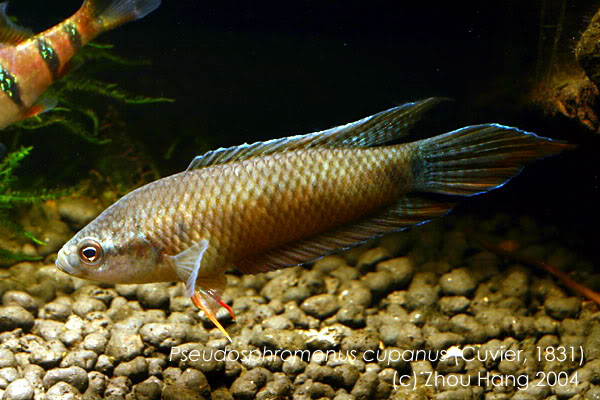
Pseudosphromenus cupanusSpiketail Paradisefish
Cuvier, 1831
Max length65mm SL2.6in SLTank60 × 30cm24 × 12inTemp20–28°C68–82°FpH6.0–7.5This species is most easily told apart from its only congener P. dayi by lacking (vs. possessing) two dark, irregular lateral stripes on the head and body, and a shorter caudal-fin in males. The results of phylogenetic analyses by Rüber et al. (2006) suggest that Pseudosphromenus is most closely-related to Malpulutta in an evolutionary sense.
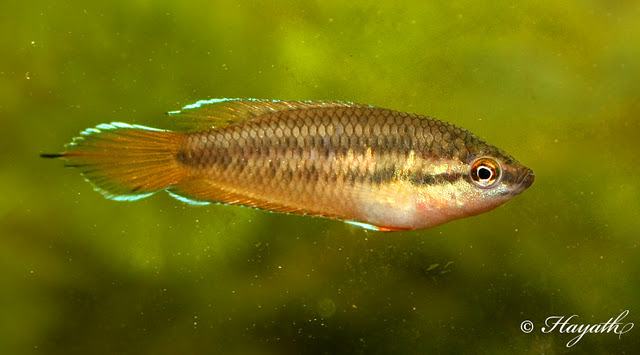
Pseudosphromenus dayiBrown Spike-tailed Paradise Fish
Engman, 1909
Max length65mm SL2.6in SLTank60 × 30cm24 × 12inTemp20–28°C68–82°FpH6.0–7.5Engmann (1909) mentions that the type series was collected from 'Malakka' but this is considered an error which probably should have read 'Kerala' since this species is known only from coastal drainages of the Western Ghats mountains in southern Kerala state, India.
Pseudotropheus fainzilberiGoldbreast Zebra
authority not recorded
Max length175mm SL7in SLTank120 × 45cm48 × 18inTemp24–28°C75–82°FpH7.6–8.8There is ongoing debate as to the true genus of this species, it having been variously grouped in both Maylandia and Metriaclima as well as the currently valid Pseudotropheus. It is unlikely it will remain in Pseudotropheus, however. One interesting feature is the presence of additional rows of teeth when compared to others in the genus. Also, the rows of bicuspid teeth, used for rasping algae from rock surfaces, extend further back into the mouth than in other Pseudotropheus. P. fainzilberi...
Pseudotropheus lombardoiKennyi
authority not recorded
Max length150mm SL6in SLTank120 × 45cm48 × 18inTemp24–28°C75–82°FpH7.6–8.8A popular mbuna that has been in the hobby for many years. There is ongoing debate as to the true genus of this species, it having been variously grouped in both Maylandia and Metriaclima, as well as the currently valid Pseudotropheus. It is unlikely it will remain in Pseudotropheus, however, and many sources already consider it a member of Metriaclima. As with other members of the genus, it possesses flat, bicuspid teeth which are designed for scraping algae and other organisms from the surface...
Pseudotropheus socolofiPowder Blue Cichlid
authority not recorded
Max length115mm SL5in SLTank90 × 45cm36 × 18inTemp24–28°C75–82°FpH7.6–8.8This common mbuna also goes by the names "Eduard's mbuna" and "Pindani". It is one of the most popular Rift Lake cichlids in the hobby due to its striking colouration and somewhat peaceful nature (for a mbuna). Wild fish can now be quite difficult to find, as the vast majority of specimens offered for sale are tank-bred. An albino form exists in aquaria and has achieved a fair degree of popularity. A highly recommended beginner's mbuna....
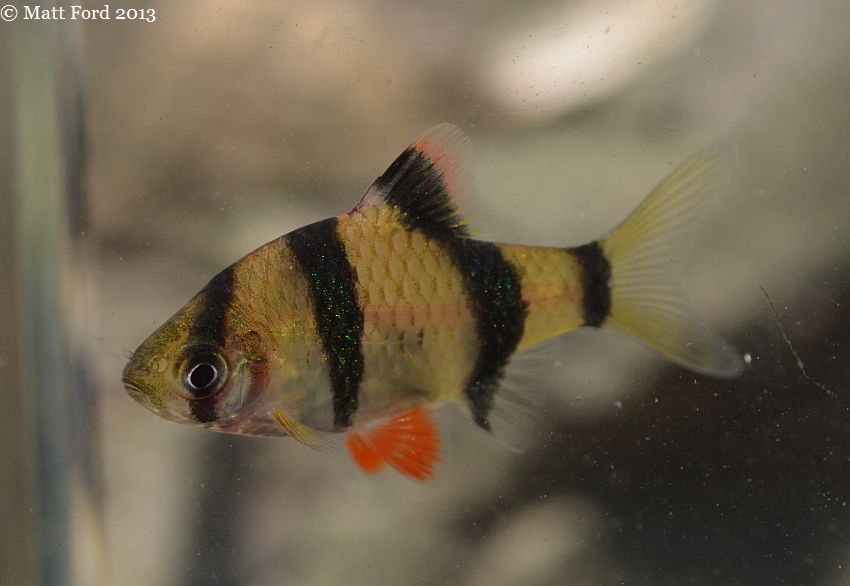
Puntigrus anchisporus
Vaillant, 1902
Max length60mm SL2.4in SLTank80 × 30cm31 × 12inTemp20–26°C68–79°FpH5.5–7.0This species occasionally appears in the aquarium hobby, but the trade is largely reliant on commercially-produced 'tiger barbs' of questionable origin. It is distinguished from congeners by the following combination of characters: lateral line complete; 14 circumpeduncular scales; 21-23+2 scales in the lateral row; dorsal-fin black with red outer band; pelvic fins red.
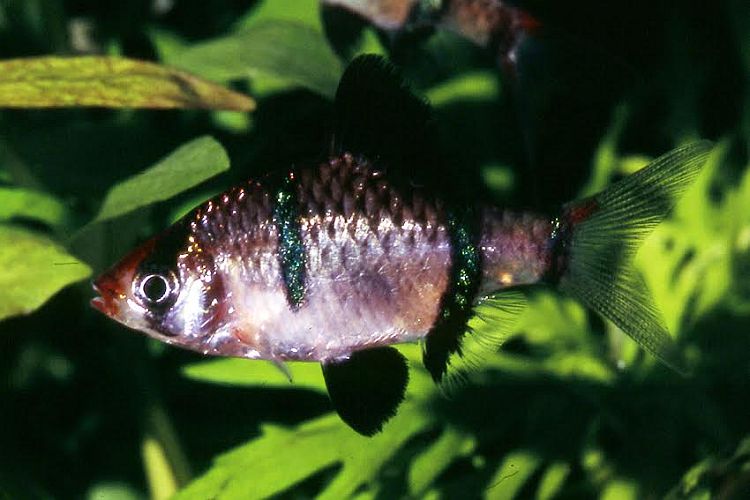
Puntigrus pulcher
Rendahl, 1922
Max length60mm SL2.4in SLTank80 × 30cm31 × 12inTemp20–26°C68–79°FpH5.0–7.5This species occasionally appears in the aquarium hobby, but the trade is largely reliant on commercially-produced 'tiger barbs' of questionable origin. It was considered a synonym of P. anchisporus for a number of decades following Alfred (1963), but revalidated by Kottelat and Tan (2011).