Results for “species”
Type a name: scientific, common, or one a species used to go by. Or narrow the catalogue with the filters.
Filters
Squaliforma cf. emarginataRed Fin Thresher Plec
authority not recorded
Max length400mm SL16in SLTanknot recordedTemp25–28°C77–82°FpH6.4–7.2This attractive species is often seen for sale at around 3-4" in length (often as Hypostomus cf. emarginata or H. emarginatus), but given its adult size, its not a terribly good choice for the general community tank. Due to its very wide natural distribution, there are a number of known geographical variants, and this has resulted in four L numbers currently being assigned to it. In reality, there are many more variants than this, and all share the characteristic elongated which gives rise...
Squaliforma villarsiBlue Fin Thresher Pleco
authority not recorded
Max length175mm SL7in SLTank120 × 30cm48 × 12inTemp21–23°C70–73°FpH6.0–7.2This species is sometimes referred to as Hypostomus villarsi, and is a rare find in the hobby. If you're lucky enough to see some for sale, check the fish have rounded bellies and that their eyes aren't sunken before you part with any cash, as these are classic signs of emaciation in newly imported Loricariids....
Steatocranus tinanti
authority not recorded
Max length130mm SL5in SLTanknot recordedTemp25–28°C77–82°FpH6.0–7.5S. tinanti has a confused taxonomic history, having been previously classified in the genera Gobiochromis and then Leptotilapia, before being assigned to Steatocranus. Further taxonomic revision is likely, as it exhibits both behavioural and morphological differences to other species in the genus. It is a reophilic fish, meaning it inhabits fast waters. Its swimbladder is relatively small to reduce buoyancy and thus prevent it from being swept away by the strong currents in its natural habita...
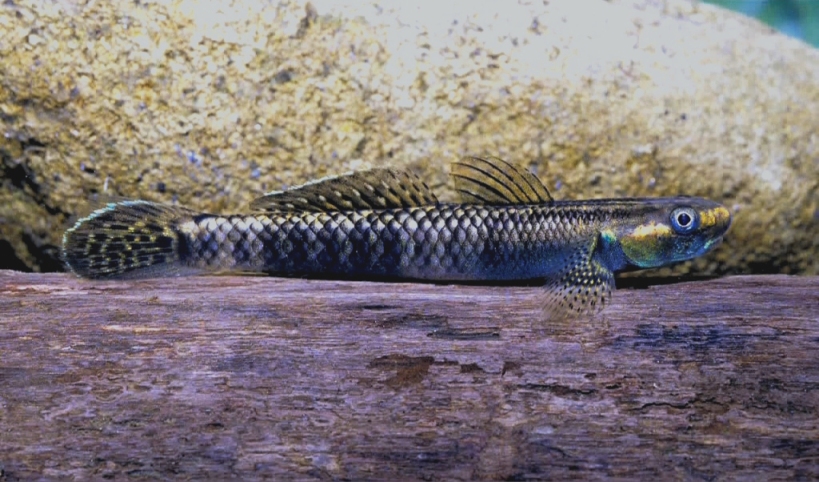
Stiphodon atratus
Watson, 1996
Max length60mm SL2.4in SLTank60 × 30cm24 × 12inTemp22–28°C72–82°FpH6.5–7.5Type locality is given as 'Stream at end of long narrow bay, Waigeo Island, Irian Jaya, Indonesia', with the species also known from rivers draining the northern slope of New Guinea as well as Halmahera Island (Indonesia), the Admiralty Islands (Papua New Guinea), the Bismarck Archipelago (Papua New Guinea), D'Entrecasteaux Islands (Papua New Guinea), Louisiade Archipelago (Papua New Guinea), Bougainville (Papua New Guinea), Vanuatu, and...
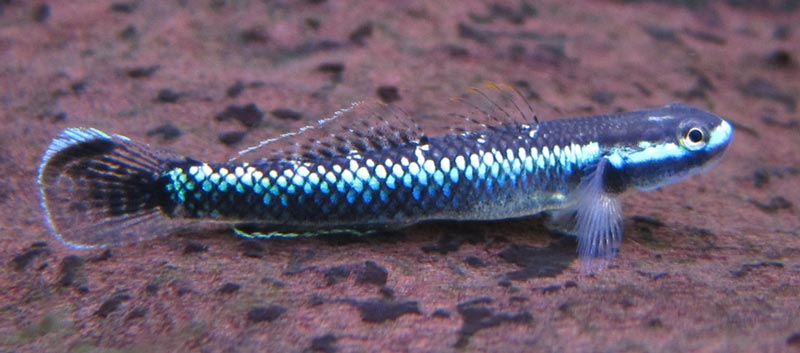
Stiphodon atropurpureusBlue Neon Goby
Herre, 1927
Max length50mm SL2.0in SLTank60 × 30cm24 × 12inTemp22–26°C72–79°FpH6.5–7.5This species is available occasionally, though not always under the correct name. We've seen it on sale as S. elegans on numerous occasions, for example, and other trade names include 'Sumatran blue neon goby' (it's not found on Sumatra), 'cobalt blue goby' and 'freshwater neon goby'. Further...
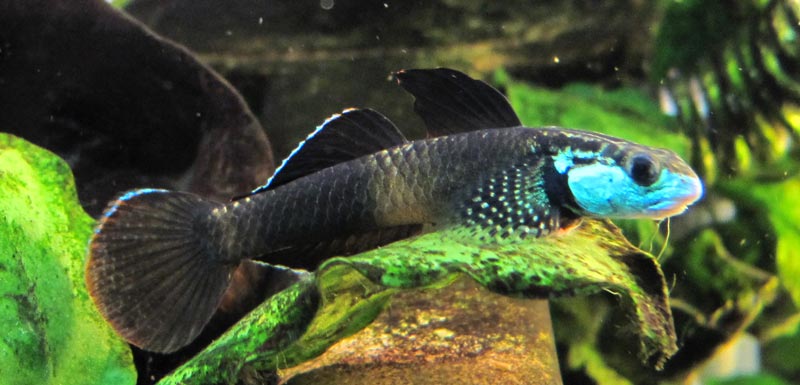
Stiphodon ornatusRainbow Stiphodon
Meinken, 1974
Max length70mm SL2.8in SLTank80 × 30cm31 × 12inTemp20–28°C68–82°FpH6.5–7.5This species is traded as S. sp. 'rainbow', S. sp. 'gold fin', or S. sp. 'gold cheek' and is among the more widely-available members of the genus although its identity was unclear prior to 2013. The most commonly-traded fish certainly appears to...
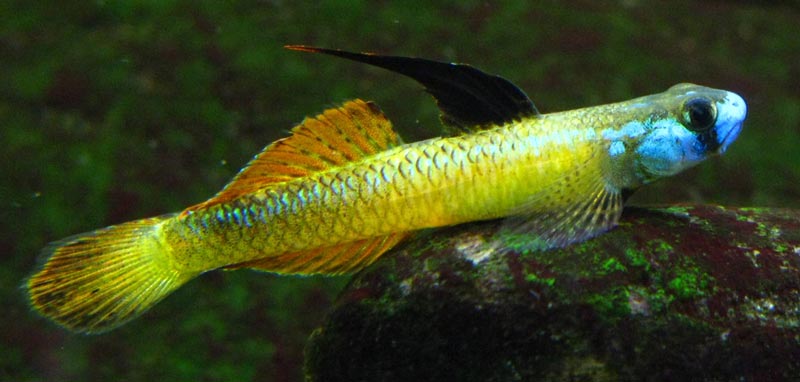
Stiphodon percnopterygionus
Watson & Chen, 1998
Max length35mm SL1.4in SLTank60 × 30cm24 × 12inTemp22–28°C72–82°FpH6.5–7.5This species is rare in the aquarium trade and normally expensive when available. It's one of the most easily-identifiable in the genus by the combination of usually 14 pectoral-fin rays, 10 segmented second dorsal-fin rays, relatively small adult size, unique colouration in males and the shape of the first dorsal-fin in males in which the fourth and fifth spines are...
Stomatepia pindu
authority not recorded
Max length90mm SL3.5in SLTank75 × 30cm30 × 12inTemp28–30°C82–86°FpH7.5–8.5Because of it's its tiny natural range, habitat destruction due to excess water removal (the nearby town of Kumba relies on the lake for it's water supply), deforestation, the introduction of non-native species and overfishing, it is considered to be critically endangered. All efforts at captive breeding are to be encouraged. However, it is correspondingly rare in the hobby. The area around Lake Barombi Mbo has been suggested to be designated a protected area, but as yet this has not o...
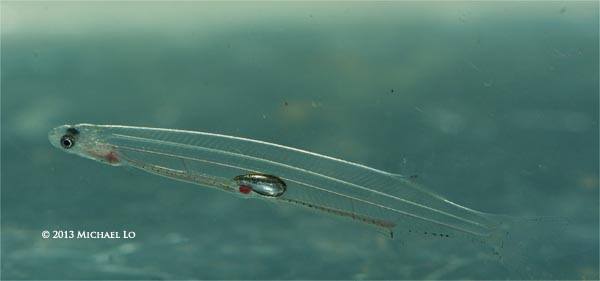
Sundasalanx microps
Roberts, 1981
Max length20mm SL0.8in SLTank45 × 30cm18 × 12inTemp22–26°C72–79°FpHnot recordedThe genus Sundasalanx is distributed throughout much of Southeast Asia and currently comprises seven species which have primarily been distinguished on the basis of oral and dental morphology, gill rakers and eye size. S. microps possesses 0-3 small conical teeth on ceratobranchial 5, 0-2 minute gill rakers on the first arch and a small eye measuring less...
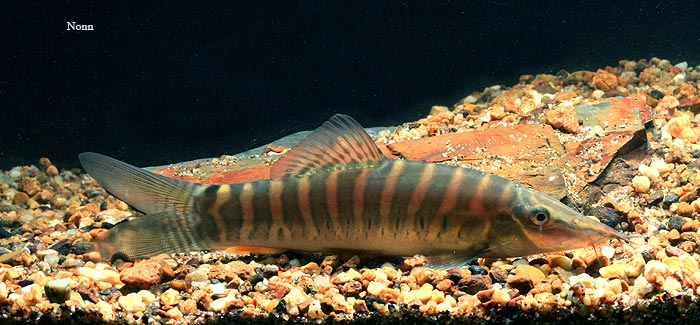
Syncrossus helodesBanded Tiger Loach
Sauvage, 1876
Max length300mm SL12in SLTank180 × 45cm72 × 18inTemp24–30°C75–86°FpH6.0–7.5This species is sometimes confused with S. hymenophysa, native to the Greater Sunda Islands and Peninsular Malaysia, but differs in several ways, the most immediately identifiable of which are possession of small, irregular, dark markings in the lower half of the body and lack of a dark spot in the dorsal-fin. It also has 10-12 vertical body bars...
Synodontis albolineataMustard Synodontis
authority not recorded
Max length100mm SL3.9in SLTank75 × 30cm30 × 12inTemp24–28°C75–82°FpH6.5–7.5Also known as the Mustard Squeaker, this species is imported infrequently, though it sometimes shows up in mixed boxes of Synodontis from exporters. An ideal Syno for the general community due to its small adult size.
Synodontis aterrima
authority not recorded
Max length115mm SL5in SLTank90 × 30cm36 × 12inTemp22–27°C72–81°FpH6.0–7.5This species is infrequently offered for sale but makes an attractive addition to the medium sized community aquarium.
Synodontis contractaBig-nosed Upside-down Catfish
authority not recorded
Max length75mm SL3.0in SLTank60 × 30cm24 × 12inTemp22–27°C72–81°FpH6.2–7.2Often confused with the similar S.nigriventris, this species is imported infrequently. It is easily distinguished from nigriventris by its larger eyes and broad mouth and head. These features give rise to the common name "Big-nosed upside-down catfish". S. contracta spends the majority of its time swimming in an inverted position and this, along with its exaggerated facial features,make it a characterful and interesting addition to the community aquarium. It is also known as the Bug-e...
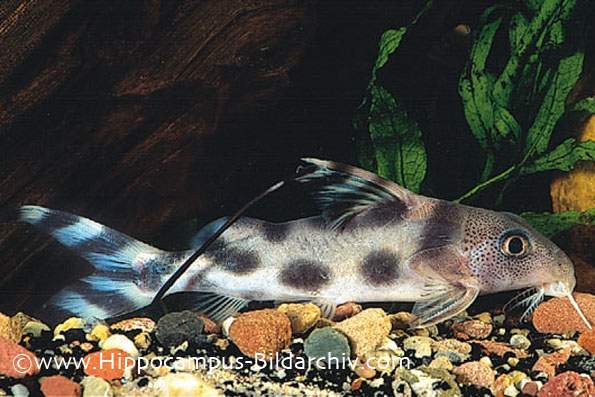
Synodontis decorusClown Synodontis
Boulenger, 1899
Max length300mm SL12in SLTank120 × 45cm48 × 18inTemp22–27°C72–81°FpH6.0–8.0Also known as both the Clown Squeaker and Decorated Synodontis, the first ray of theis greatly extended in this species. It is one of the more secretive, nocturnal Synos and if you wish to observe it regularly we recommend the addition of a 'moon' light or a red bulb timed to come on for a couple of hours after the main tank lights go off. If some food is added to the tank under these lighting conditions it should emerge to feed. This is one of only 3 members of the genus to exhibit...
Synodontis eupteraFeatherfin Synodontis
authority not recorded
Max length300mm SL12in SLTank120 × 30cm48 × 12inTemp22–27°C72–81°FpH6.0–7.5One of the most popular and commonly seen Synos in the hobby, S. eupterus is usually offered for sale as a small (1-3") juvenile with no information regarding its potential size. These young fish are often sold as Synodontis "Network" due to their attractive reticulated patterning. This patterning breaks up as the fish mature and adult specimens have a simple spotted colouration. The characteristic 'feathered' dorsal also develops with age, with the first few rays develo...
Synodontis flavitaeniataPyjama Synodontis
authority not recorded
Max length195mm SL8in SLTank90 × 30cm36 × 12inTemp23–28°C73–82°FpH6.5–8.0Also known as the Orange Striped Squeaker, in our opinion this fish is one of the most attractively patterned Synos. S. flavitaeniata can vary considerably in patterning and colouration but is difficult to misidentify. This fish is more sensitive to deteriorating water quality than many Syno species so aquarium maintenance must be rigorous. When it was first imported 25 or so years ago it commanded an extortionate price but thankfully is affordable today. Its flexibility with regards to w...
Synodontis nigriventrisUpside-down Catfish
authority not recorded
Max length100mm SL3.9in SLTanknot recordedTemp24–28°C75–82°FpH6.0–7.5One of the commonest Synos seen for sale, S. nigriventris is occasionally confused with S. contractus. However, on close inspection the species are easy to tell apart as S. nigriventris lacks the large head and mouth and larger eye of S. contractus. The scientific name nigriventris refers to the fact that the belly of this fish is darker than the dorsal area. This is a form of camouflage, making the fish harder to spot by predators above, such as predatory fish, birds etc. It is a basic re...
Synodontis njassaeLake Malawi Synodontis
authority not recorded
Max length190mm SL7in SLTank120 × 30cm48 × 12inTemp23–28°C73–82°FpH7.5–8.5This is the only species of Synodontis found in Lake Malawi. There exists both large and small-spotted morphs, both of which are available in the trade.
Synodontis polliPoll's Synodontis
authority not recorded
Max length100mm SL3.9in SLTank90 × 30cm36 × 12inTemp24–28°C75–82°FpH7.5–8.5This species is superficially similar to S. petricola but the spots on its body are larger than in petricola and it has a longer head. It is rarely seen in the trade, though can occasionally be found mis-identified as S. angelicus, S. petricola or Synodontis sp.....
Synodontis schoutedeniVermiculated Synodontis
authority not recorded
Max length138mm SL5in SLTank90 × 30cm36 × 12inTemp22–27°C72–81°FpH6.0–7.5In our opinion, this is one of the most attractively marked Synos commonly available in the hobby. The colour and patterning can vary considerably and the vermiculated pattern seems to intensify with age in well kept fish. When taken into consideration with its moderate adult size, this is an ideal beginners's Syno. One point worth noting is that this species seems very susceptible to bloating. While the cause of this is unknown, we suggest that feeding of dried foods be kept to a minimum. ...